In a nutshell: OTC (over-the-counter) crypto trading means buying or selling crypto directly with a trading desk instead of placing orders on a public exchange order book. You ask for a price (a “request for quote”), the desk gives you one all-in price, and if you accept, the whole trade fills at that price and then settles. OTC desks mainly serve institutions and wealthy individuals making large trades, often with minimums like $50,000, so most small buyers simply use a regular exchange. Educational only; not financial advice.
Last updated: October 21, 2026.
OTC crypto trading is how a lot of large crypto deals happen away from public exchanges. When a fund, company or wealthy investor wants to buy or sell a big block of Bitcoin or another coin, dumping the whole order onto an exchange can push the price against them. An OTC crypto exchange service, usually called an OTC desk, quotes them one price for the whole amount instead.
This guide explains what OTC desks are, who uses them, how a trade works step by step, the difference between principal and agency desks, well-known desk examples, costs, and the risks, including scammers who pretend to be OTC brokers.
Table of contents
- What is OTC crypto trading?
- Who uses OTC desks and why
- How an OTC crypto trade works step by step
- Principal vs agency OTC desks
- Examples of crypto OTC desks
- OTC desk vs exchange order book
- Fees and spreads on OTC trades
- Risks of OTC crypto trading
- Scams posing as OTC brokers
- Do small buyers need an OTC desk?
- FAQ
What Is OTC Crypto Trading?
“Over the counter” is an old finance term for trading that happens directly between two parties rather than on a formal exchange. Investopedia’s guide to OTC markets notes that many bonds, currencies and derivatives trade this way, and that Bitcoin and Ethereum can also be traded OTC so the buyer and seller can negotiate directly and keep the deal’s terms private.
Galaxy, a crypto financial services firm with its own trading desk, describes OTC trading in its overview of OTC benefits and risks as buying and selling crypto assets directly between two parties without the supervision of a formal exchange, often for larger blocks or customized derivatives.
In practice, a crypto OTC desk is a team (and usually a software platform) at an exchange, broker or trading firm that:
- takes your request to buy or sell a specific amount of a coin,
- gives you a firm price for the full amount,
- executes the trade off the public order book once you accept, and
- handles settlement: moving the crypto and the cash (or stablecoins) between the two sides.
You won’t see these trades as orders on an exchange screen. That privacy is one of the main reasons people use OTC desks.
Who Uses OTC Desks and Why
Kraken’s support article introducing the Kraken OTC Desk says its desk serves institutional clients and high-net-worth individuals who need to fill large orders, offering deeper liquidity and tighter spreads. Typical OTC users include:
- hedge funds, asset managers and trading firms,
- companies buying crypto for their treasury or paying in it,
- miners and early holders selling large amounts,
- wealthy individuals moving big sums at once.
The core reason is price impact. An exchange order book only has so many coins on offer at each price. A big market order “walks the book,” eating through the cheapest offers and then paying more and more for the rest. Investopedia’s slippage explainer defines slippage as the difference between the price you expect and the price at which the trade actually executes, and notes it can happen when a large order is executed without enough volume at the chosen price, and is most common in volatile or low-liquidity markets.
Galaxy lists the other main draws: executing large volumes while limiting market impact, reduced slippage through negotiated prices, privacy (trades aren’t visible on public order books), custom terms such as settling in stablecoins or fiat, and personal service from a trading team.
A simple made-up example
Numbers here are invented for easy math, not real prices. Say a coin’s order book shows only 10 coins for sale at $100, the next 10 at $101 and the next 10 at $103. A buyer who wants 30 coins at market pays $1,000 + $1,010 + $1,030 = $3,040, about $101.33 per coin, and everyone watching sees the price jump. An OTC desk might instead quote, say, $101 per coin for all 30 ($3,030), then source the coins itself over time and across venues. The buyer knows the full cost before trading, and the public book isn’t hit all at once.
How an OTC Crypto Trade Works Step by Step
Every desk has its own process, but the broad flow is similar.
- Onboarding and KYC. You open an account and pass identity checks (know-your-customer and anti-money-laundering reviews). Kraken says OTC trading is subject to applicable anti-money-laundering laws, that clients must be verified, and that the name on your bank account must match the name on your Kraken account. Institutions usually sign a trading agreement too.
- Meet the minimum. Many desks set a floor. Kraken’s OTC minimum order is $50,000 USD equivalent, with exceptions considered case by case (Kraken support page, checked October 21, 2026). Kraken’s blog post on lowering the OTC minimum to $50K shows it made that change in March 2025.
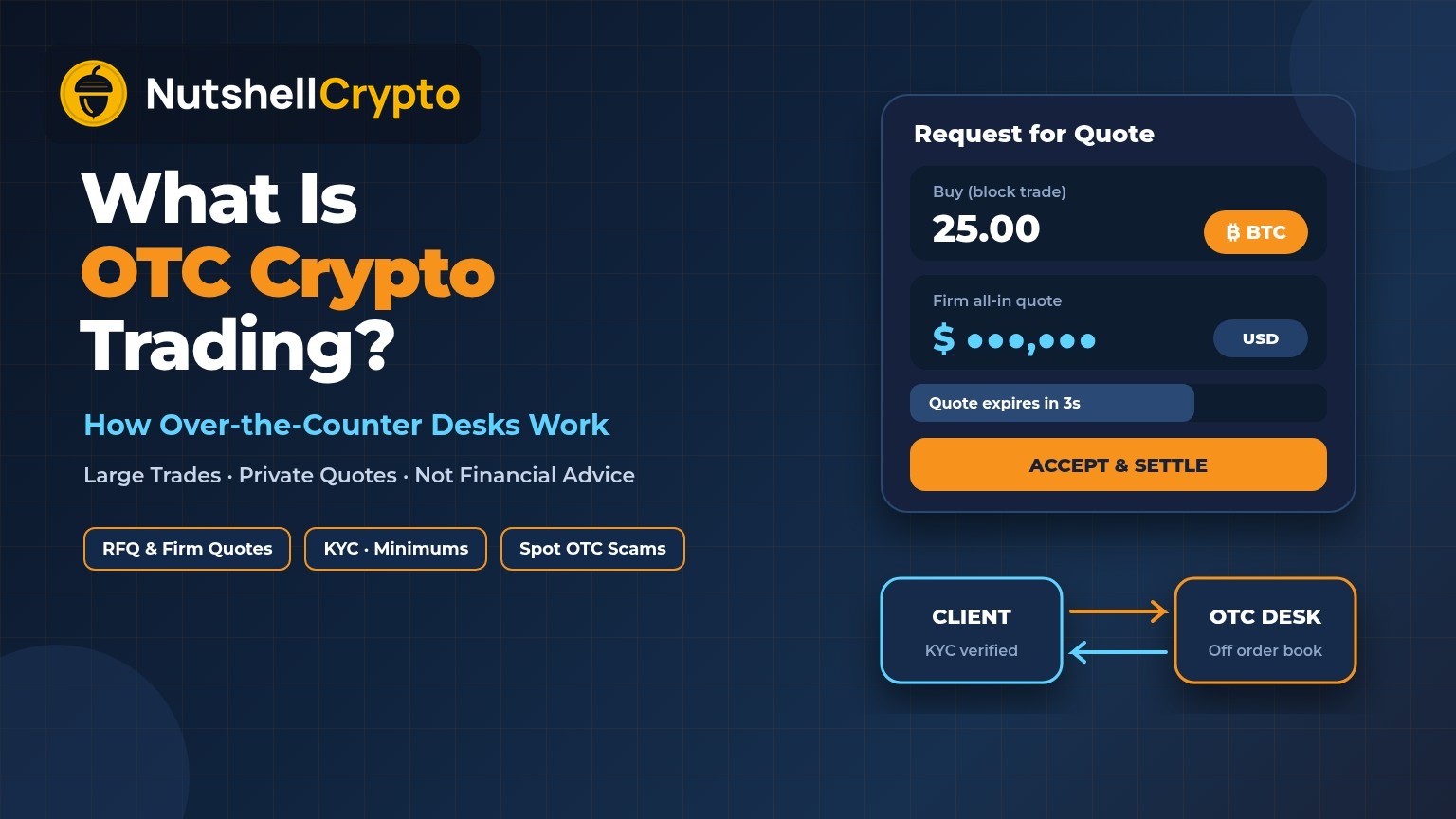
- Request a quote (RFQ). You say what you want, for example “buy 20 BTC with USD.” This happens over chat with a trader or through an RFQ screen or API.
- Get a firm price. The desk replies with one all-in price for the full size. On Coinbase Prime, the RFQ help page explains that liquidity providers compete in a brief auction and the winning quote is returned inclusive of all fees and commissions.
- Accept fast, or let it expire. Quotes are short-lived. Coinbase Prime holds an RFQ price for 3 seconds in its interface (refreshable up to 20 times) and 1 second via API; if you don’t accept, the quote expires. Its RFQ orders are fill-or-kill: they execute in full or not at all.
- Settlement. The coins and money change hands. Some desks settle instantly from a balance you hold with them; Kraken describes automated settlement from your account balance, and flexible “trade now, settle later (within 24 hours)” settlement for eligible clients. Others settle by bank wire and blockchain transfer after the trade is agreed.
Principal vs Agency OTC Desks
OTC desks generally work in one of two ways, as the explainer on what crypto OTC desks are from Learn Crypto describes:
- Principal desk. The desk trades with you using its own money and inventory. It quotes you a firm price, sells you the coins (or buys yours) and takes on the market risk of sourcing or offloading them afterward. Its profit is built into the spread.
- Agency desk. The desk acts as a middleman. It works your order across markets or finds a counterparty on your behalf and charges a fee or commission. Because it isn’t taking the other side, the final price can move while the order is being worked, so more of the price risk stays with you.
A real example of the principal model: in a 2025 letter to the SEC’s Crypto Task Force, Cumberland DRW wrote that it trades OTC with institutional and high-net-worth counterparties and transacts solely on a principal basis, not as a broker for third parties. Some platforms mix models; Coinbase Prime’s RFQ, for instance, routes your request to outside liquidity providers who compete to quote.
Examples of Crypto OTC Desks
These are well-known examples to illustrate how the industry works, listed alphabetically. This is not a ranking or a recommendation, and availability depends on where you live and what kind of client you are. Details were checked on official pages on October 21, 2026.
| Desk | What it is (per its own or official sources) |
|---|---|
| Coinbase Prime | Coinbase’s institutional platform. Its RFQ sends quote requests to liquidity providers and returns an all-inclusive, fill-or-kill price executed off the central limit order book (Coinbase Help). |
| Cumberland (DRW) | Trading firm DRW says Cumberland was launched in 2014 and specializes in institutional-sized liquidity (DRW). Cumberland’s site lists institutional OTC liquidity in dozens of cryptocurrencies, including stablecoins. |
| Galaxy | Runs an institutional trading business and publishes guidance on OTC benefits and counterparty risk (Galaxy). Investopedia reported that Goldman Sachs made its first OTC crypto trade with Galaxy in March 2022. |
| Kraken OTC | Kraken’s desk for large orders via chat or RFQ, with a $50,000 minimum, no separate fee (the quoted price is all-inclusive), and support around the clock (Kraken Support). |
A cautionary history: Genesis
Size and reputation don’t remove risk. Genesis, owned by Digital Currency Group, was a major provider of trading services to institutional clients. After the 2022 collapses of Three Arrows Capital and FTX, its lending unit froze customer redemptions on November 16, 2022 and filed for US bankruptcy owing creditors at least $3.4 billion, Reuters reported in January 2023. The SEC later said Genesis agreed to pay a $21 million penalty to settle charges over the Gemini Earn lending program. The trading business was kept out of the bankruptcy at first, but by September 2023 CoinDesk reported that Genesis had stopped offering trading services through any of its entities. The lesson: who you trade with matters as much as the price.
OTC Desk vs Exchange Order Book
On a regular exchange you trade against a public order book: buyers and sellers post bids and asks, and your order matches against them. Our guide to spot trading crypto with market and limit orders walks through how that works. Here’s how OTC compares:
| Exchange order book | OTC desk | |
|---|---|---|
| Price | Whatever the book offers; large orders may slip | One firm quote for the full size |
| Visibility | Orders and trades are public | Private between you and the desk |
| Size | Any size, even a few dollars | Often a minimum, such as $50,000 at Kraken |
| Fees | Maker/taker fees, plus spread | Usually built into the quoted price |
| Who it suits | Most everyday buyers | Institutions and very large individual trades |
A decentralized exchange is a third option, where you swap from your own wallet against liquidity pools; our explainer on how a crypto DEX works covers that. For how regular trading platforms hold your funds and run their order books, see our guide to what a centralized exchange is.
Fees and Spreads on OTC Trades
Most OTC desks don’t show a separate commission. Their earnings sit inside the spread: the gap between the price they buy at and the price they sell at. Investopedia’s bid-ask spread explainer describes the spread as the difference between the highest price a buyer will pay and the lowest price a seller will accept.
- Kraken: says it charges no fees for OTC; the bid or offer it shows is the all-inclusive price.
- Coinbase Prime RFQ: the quoted price includes trading fees, and fee details appear on the post-trade report.
- Agency desks: may charge an explicit commission on top of the execution price.
Galaxy notes OTC trades typically involve lower fees than the cumulative fees of executing a large trade on exchanges, but it also warns that unusually cheap spreads can mask weak risk management. To compare, check the all-in cost: quoted price × amount, plus any bank wire, network or withdrawal fees. Our breakdown of crypto exchange fees and spreads explains the exchange side.
Risks of OTC Crypto Trading
Counterparty risk
When you trade OTC, you rely on one company to deliver. Investopedia’s counterparty risk definition explains it as the chance that one party in a deal defaults on its obligation. Galaxy’s article lists what can go wrong if a counterparty fails, including a complete loss of assets, hidden liabilities, contagion through connected crypto firms and frozen operations after regulatory action. The Genesis story above is a real example.
Settlement risk
If one side sends first (say, you wire $200,000 before receiving the coins), you’re exposed until the other side delivers. Desks reduce this with pre-funded accounts, instant settlement from balances, or post-trade settlement windows. Galaxy describes post-trade settlement as a way to confirm a price first and settle afterward instead of posting assets to an exchange before trading. Know exactly who sends what, when, and to which verified account or wallet.
Custody and where the coins end up
Kraken notes that its OTC desk does not hold custody of assets on behalf of trading counterparties. Plan where the coins go after the trade: an exchange account, a qualified custodian or your own wallet.
Market risk on agency orders
With an agency desk working your order over time, the price can move before it’s filled.
Taxes
An OTC trade is taxed like any other crypto trade. The IRS’s digital assets page says you may have to report digital asset transactions on your tax return, including when you sell or exchange digital assets, and that you should keep records of each sale or exchange and its fair market value in US dollars. Our beginner’s guide to crypto taxes covers the details. This is not tax advice.
Scams Posing as OTC Brokers
“OTC” sounds exclusive, which makes it a favorite word for fraudsters. Fake “OTC brokers” show up in Telegram groups, on social media and through unsolicited messages, offering discounted coins, guaranteed returns or “private allocations.”
The scale of crypto fraud is large. The FBI said its 2025 Internet Crime Report (released April 6, 2026) received 181,565 complaints involving cryptocurrency, with reported losses of more than $11 billion.
The SEC and CFTC’s joint alert to watch out for fraudulent crypto trading websites lists red flags that fit fake OTC offers well:
- “guaranteed” high returns or “risk-free” deals,
- unlicensed sellers or unregistered firms,
- unsolicited offers from people you don’t know,
- pressure to act right now,
- demands for extra “fees” or “taxes” before you can withdraw, a form of advance-fee fraud.
Practical habits: reach a desk only through the official website of a firm you can verify, never through a link or phone number someone sends you. Be very suspicious of prices below the market, since real desks quote near market prices. Confirm wallet addresses and bank details through a second official channel before sending anything. And never share a wallet’s recovery phrase; no legitimate desk needs it.
Do Small Buyers Need an OTC Desk?
Usually not. If you’re buying a few hundred or a few thousand dollars of crypto, a regular exchange’s order book is deep enough for popular coins, and you’re well below typical OTC minimums like Kraken’s $50,000. Some exchanges show an “OTC” or RFQ-style quote on their simple buy screen, but for most beginners the normal route is enough. Our step-by-step guide on how to buy Bitcoin safely shows that process.
OTC starts to make sense when a single trade is big enough to move the market for that coin, or when privacy, custom settlement or a dedicated trader matter to you.
FAQ
What does OTC mean in crypto?
OTC means “over the counter”: trading crypto directly with a desk or another party at a negotiated price, instead of on a public exchange order book.
Is an OTC crypto exchange the same as a regular exchange?
No. A regular exchange matches many buyers and sellers on a public order book. An OTC desk, often run by an exchange or trading firm, quotes you a private price for a large trade and executes it off the public book.
What is the minimum for OTC crypto trading?
It varies by desk. Kraken’s OTC minimum is $50,000 USD equivalent as of October 21, 2026, with exceptions considered case by case.
Do I need KYC for OTC trading?
With legitimate desks, yes. Expect identity checks and anti-money-laundering reviews, and for businesses, documents about the company and its owners. A “broker” who skips all checks is a red flag.
Is OTC crypto trading legal?
OTC trading itself is a normal part of financial markets. What matters is that the desk is a real, properly registered business in your country and that you report the trade for taxes.
Sources
- Investopedia: Over-the-counter (OTC) markets
- Investopedia: Slippage
- Investopedia: Bid-ask spread
- Investopedia: Counterparty risk
- Investopedia: Goldman Sachs makes the first OTC Bitcoin trade
- Kraken Support: Introducing the Kraken OTC Desk (checked October 21, 2026)
- Kraken Blog: Kraken OTC lowers trade minimum to $50K
- Coinbase Help: Request for Quote (RFQ) on Coinbase Prime (checked October 21, 2026)
- Galaxy: Benefits and risk considerations of OTC trading
- DRW: Who we are and Cumberland
- Cumberland DRW letter to the SEC Crypto Task Force (April 2025)
- Learn Crypto: What are crypto OTC desks?
- Reuters: Crypto lending unit of Genesis files for U.S. bankruptcy
- SEC: Genesis agrees to pay $21 million penalty to settle SEC charges
- CoinDesk: Genesis has ceased all crypto trading services
- FBI: Cryptocurrency and AI scams bilk Americans of billions (2025 IC3 report)
- SEC and CFTC: Watch out for fraudulent digital asset and crypto trading websites
- IRS: Digital assets
This article is for educational purposes only and is not financial, investment or tax advice.