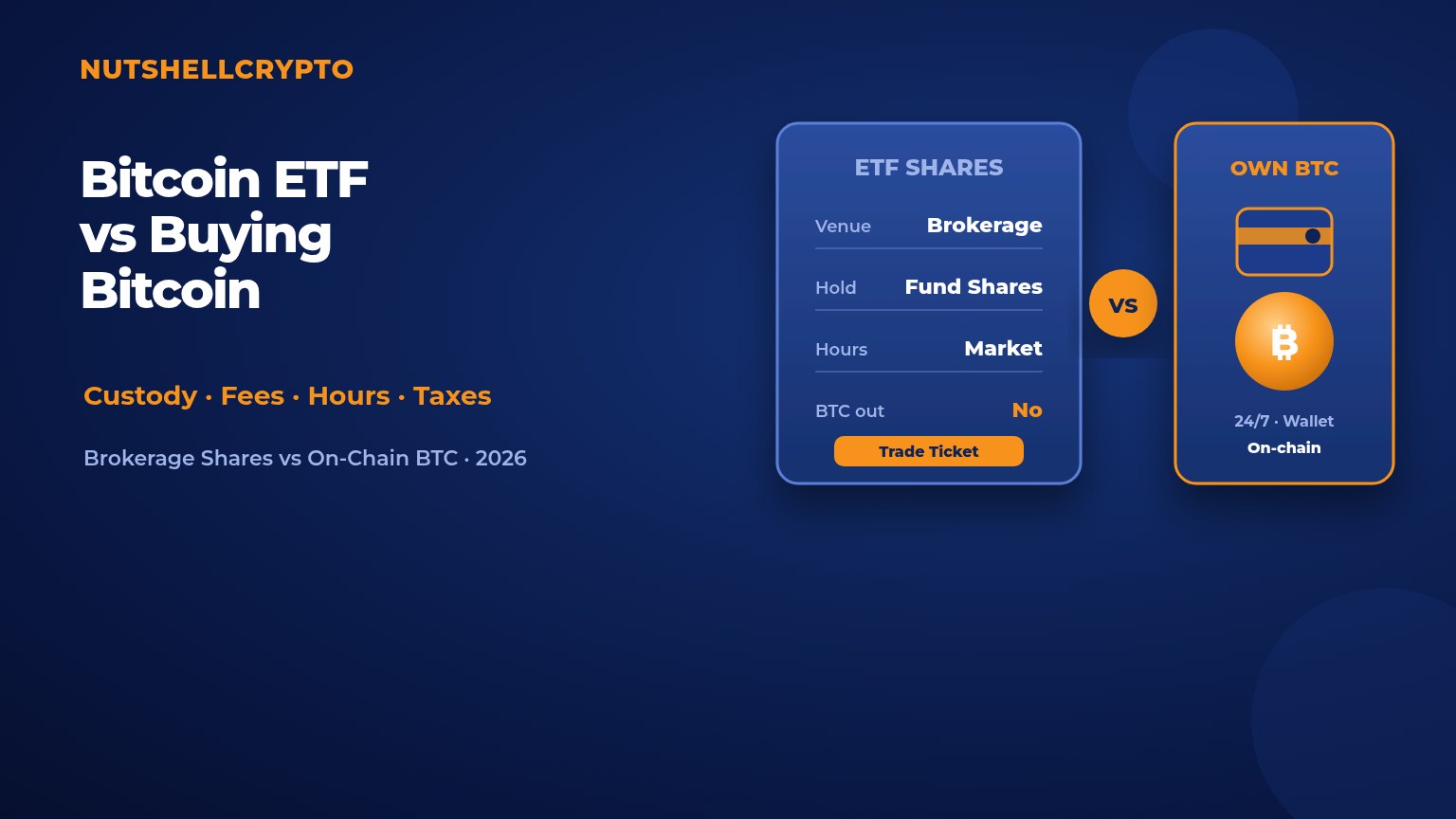
In a nutshell: Bitcoin ETF vs buying Bitcoin is brokerage fund shares versus owning BTC itself. An ETF gives price exposure through a regulated securities wrapper during market hours; buying bitcoin means you (or an exchange) hold the asset, often 24/7, with wallet and tax rules that differ. This guide compares custody, fees, hours, retirement accounts, and taxes at a high level — educational only, not advice.
Brokers, fund fees, tax rules, and product terms change; confirm details on official issuer, broker, SEC, and IRS materials before you act.
People searching bitcoin etf vs buying bitcoin usually want a clear side-by-side: shares in a brokerage account versus bitcoin on an exchange or in a personal wallet. Spot Bitcoin ETFs (bitcoin ETPs in SEC language) became widely available to US investors after the Commission’s January 10, 2024 approvals. Direct bitcoin has been buyable for years. Neither path is “best” for everyone — they solve different problems. For product mechanics see Bitcoin ETF explained; for the US buy flow see how to buy a Bitcoin ETF; for on-chain steps see how to buy Bitcoin.
Table of contents
What Each Option Is
Spot Bitcoin ETF (brokerage shares)
A spot Bitcoin ETF is a fund whose shares trade on a stock exchange while the trust holds bitcoin with a qualified custodian. When you buy shares, you get economic exposure to bitcoin’s price through a regulated securities wrapper — not an on-chain balance or a seed phrase. You typically sell shares for cash; you generally cannot withdraw BTC to a personal wallet. On January 10, 2024, SEC Chair Gary Gensler issued a statement on approving spot bitcoin exchange-traded products. The Commission approved listing and trading of several spot bitcoin ETP shares; trading for the first wave began around January 11, 2024. Official framing: the action was not an endorsement of bitcoin.
Buying Bitcoin directly
Buying bitcoin means acquiring BTC on a crypto platform or peer-to-peer and holding it either on the platform (custodial) or in a wallet you control. You can usually send BTC on-chain (subject to network fees and platform withdrawal rules). That flexibility comes with operational responsibility: keys, phishing, and exchange security. See our crypto wallet guide if you plan to self-custody.
Quick Comparison Table
| Topic | Spot Bitcoin ETF | Buying Bitcoin (direct) |
|---|---|---|
| What you hold | Fund shares in a brokerage | Bitcoin (exchange custody or your keys) |
| Custody | Fund custodian / trust | Exchange or self-custody wallet |
| Trading hours | US stock market hours (+ any extended hours) | Typically 24/7 on crypto venues |
| Withdraw BTC on-chain | No — sell shares for cash | Yes, if withdrawals are allowed |
| Main ongoing cost | Sponsor / expense ratio (+ broker spread) | Spreads, trading fees, withdraw fees, sometimes custody |
| Typical account | Taxable brokerage; some IRAs | Exchange or wallet; IRA options are limited/specialized |
| Tax framing (US, high level) | Securities disposition when you sell shares | Virtual currency / property rules per IRS FAQs |
Custody and Control
ETF path: The trust’s custodian holds the bitcoin. You hold brokerage shares. You do not manage private keys. That is simpler for many investors who already use a brokerage — and it means you cannot move the underlying BTC yourself.
Direct bitcoin: On an exchange, the platform holds BTC for you until you withdraw. In self-custody, you control keys (and bear loss-of-key risk). Custody choice is the core practical difference in any bitcoin etf vs buying bitcoin decision.
Trading Hours and Liquidity
ETF shares trade during US equity sessions (plus any extended hours your broker offers). Bitcoin itself trades around the clock, so ETF share prices can gap when markets reopen after weekends or holidays. Direct BTC on major exchanges is typically available 24/7, which matters if you need to react outside stock-market hours — and also means more temptation to trade constantly.
Liquidity for large ETF trades depends on authorized participants and market makers; for direct BTC it depends on the venue’s order book and withdrawals. Neither is risk-free in stress periods.
Fees (Always Verify Live)
Costs look different on each path.
Spot Bitcoin ETFs typically charge an annualized sponsor fee accrued against fund assets. Issuer materials commonly discussed for educational examples include figures around 0.25% for products such as IBIT (iShares / BlackRock) and FBTC (Fidelity Wise Origin), and around 0.20% for BITB (Bitwise) after promotional periods — always re-check the latest fact sheet or prospectus. Fees and waivers change. Over time, sponsor fees are often paid by selling small amounts of bitcoin from the trust, which can reduce bitcoin per share even if bitcoin’s spot price is flat. Broker commissions and bid-ask spreads add to all-in cost. Our Bitcoin ETF fees guide lists each spot fund’s expense ratio and what it costs per year.
Direct bitcoin costs are usually spreads and trading fees when you buy/sell, plus network fees and possible withdrawal fees when you move coins. Long-term “holding” may have no explicit annual fee if you self-custody — but security tools, hardware wallets, and operational mistakes are real costs.
This site does not recommend a ticker or exchange. Treat every fee number here as a snapshot to verify, not a permanent quote.
Retirement Accounts and IRAs
Many US investors care about whether bitcoin exposure can sit inside a retirement wrapper.
- ETF shares: Some brokerage custodians allow spot Bitcoin ETF tickers in traditional or Roth IRAs. Contribution limits, early-withdrawal rules, and prohibited-transaction rules still apply. Confirm ticker support with your plan — availability is not universal.
- Direct bitcoin: Holding raw BTC inside a standard IRA is less common and often requires specialized custodians or structures. Do not assume your ordinary brokerage IRA can hold on-chain bitcoin.
An IRA changes tax timing; it does not remove bitcoin price risk. Canada readers comparing TFSA/RRSP access to listed crypto ETFs should see our Canada Bitcoin ETF guide separately — this article is primarily US/global framing.
Taxes at a High Level (Not Tax Advice)
ETF shares (US): Selling shares in a taxable account is generally treated like disposing of other securities (capital gain or loss concepts apply based on facts). Your broker’s 1099 and cost-basis records matter. Holding shares alone is not a taxable sale.
Direct bitcoin (US): The IRS treats virtual currency as property for federal tax purposes in its published guidance. Disposing of BTC (selling, trading for another crypto, or using it to buy goods/services) can be a taxable event. See the IRS Frequently Asked Questions on Virtual Currency Transactions. For a beginner overview on this site, read crypto taxes in the US.
Rules are fact-specific. Nothing here is tax advice — talk to a qualified professional for your situation.
When Each Approach Often Fits
These are educational patterns, not recommendations:
- ETF often appeals when you already use a brokerage, want statements alongside stocks and bonds, prefer not to manage wallets, or need IRA-style access your custodian supports.
- Direct bitcoin often appeals when you want on-chain transfers, 24/7 trading venues, self-custody, or use-cases that require actual BTC (payments, Lightning, DeFi, etc.).
- Some people use both — for example ETF exposure in a retirement account and a smaller self-custodied BTC balance for learning. That is a personal design choice, not a rule.
Shared and Path-Specific Risks
- Volatility (both): Bitcoin’s price — and ETF shares tied to it — can fall sharply.
- ETF-specific: Tracking differences, premium/discount to indicative value, sponsor fee drag, and reliance on custodians and authorized participants (details in each prospectus).
- Direct-specific: Exchange hacks or freezes, phishing, lost seed phrases, irreversible mistaken sends, and withdrawal delays.
- No FDIC on underlying BTC: Trust-held or exchange-held bitcoin is not a bank deposit. Brokerage SIPC (when it applies to securities) is not a guarantee against price declines.
- No advice: SEC approval of spot bitcoin ETPs was not an endorsement of bitcoin as an investment.
Frequently Asked Questions
What is the main difference in bitcoin ETF vs buying Bitcoin?
With an ETF you own fund shares in a brokerage; the trust holds bitcoin. With direct purchase you own BTC (custodial or self-custody) and can usually move it on-chain. Custody and withdrawal rights are the clearest split.
Can I withdraw bitcoin from a Bitcoin ETF?
Generally no for retail shareholders. You sell shares for cash. Creation/redemption in-kind mechanics, if any, apply to authorized participants — not typical retail accounts. Read the specific prospectus.
Is a Bitcoin ETF safer than holding bitcoin?
“Safer” depends on which risks you mean. ETFs remove seed-phrase risk and fit brokerage workflows; they add fund, market-hours, and securities-market risks. Direct holdings can be self-custodied but expose you to key and exchange risks. Neither removes price risk.
Which has lower fees?
It depends on holding period, trade frequency, and venue. ETF sponsor fees are ongoing percentages of assets; direct costs concentrate at trade and withdrawal time. Compare all-in cost for your pattern, and verify live fee schedules.
Can I hold either in an IRA?
Some custodians allow spot Bitcoin ETF shares in IRAs. Direct BTC in an IRA usually needs specialized arrangements. Confirm with your custodian — do not assume.
Is this financial advice?
No. This article is educational only. Consider licensed advice before investing or changing tax positions.
Sources
- U.S. Securities and Exchange Commission — Gary Gensler: Statement on the Approval of Spot Bitcoin Exchange-Traded Products (Jan 10, 2024)
- SEC — example approval order materials such as NYSE Arca Order 34-99306
- IRS: Frequently Asked Questions on Virtual Currency Transactions
- Issuer fact sheets / prospectuses for illustrative fee examples (IBIT, FBTC, BITB) — re-check live documents; this site does not endorse any ticker
Disclaimer: This article is for educational purposes only and is not financial, investment, tax, or legal advice. Bitcoin and Bitcoin ETFs are volatile; you can lose money. Nothing here is a recommendation to buy or sell any security or crypto-asset, or an endorsement of any broker, exchange, or ticker. Do your own research, verify fees and account eligibility on official sites, and consider speaking with licensed professionals before making decisions.