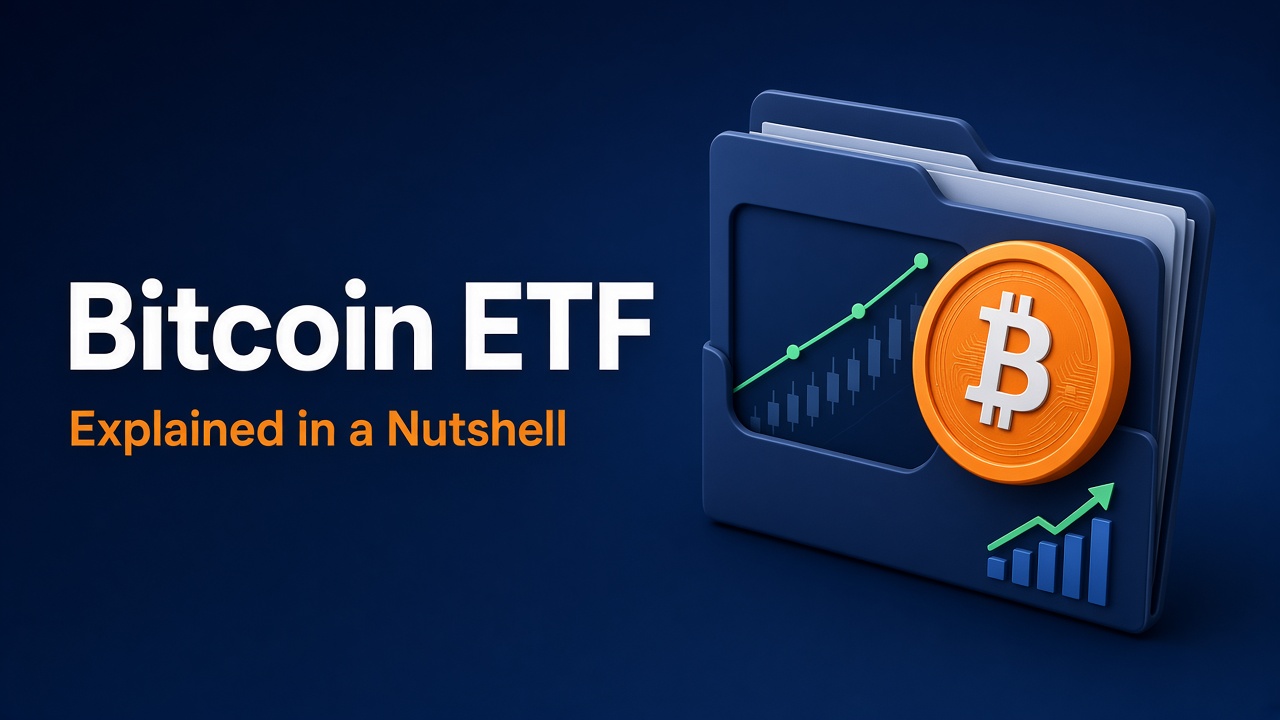

In a nutshell: A Bitcoin ETF is an exchange-traded fund (technically, in the US, an exchange-traded product) that gives you exposure to bitcoin’s price through shares you buy and sell in an ordinary brokerage account. A spot Bitcoin ETF holds real bitcoin with a professional custodian, so you skip wallets and private keys, but you pay a yearly fee, can’t withdraw coins, and still take on bitcoin’s full price swings.
Last updated: October 6, 2026. Fees, fund assets and other figures that change are dated where they appear. Educational content only, not financial advice.
If you’ve seen tickers like IBIT, FBTC or BITB and wondered what you would actually own, this guide explains how Bitcoin ETFs work, how to buy one in the US or Canada, what they cost, how to read NAV and a fact sheet, and the risks to weigh first. If you’re new to bitcoin itself, start with what Bitcoin is and how it works. Facts below are checked against primary sources such as SEC releases, issuer pages and tax agencies, listed at the end. For every major fund ranked by assets, see our Bitcoin ETFs list.
Table of contents
- What is a Bitcoin ETF?
- How Bitcoin ETFs work
- What a spot Bitcoin ETF is
- Spot vs futures Bitcoin ETFs
- How to buy a Bitcoin ETF
- How to invest in Bitcoin through an ETF
- Bitcoin ETF fees and expenses
- Bitcoin ETF NAV explained
- How to read a Bitcoin ETF fact sheet
- Benefits of Bitcoin ETFs
- Risks and disadvantages
- Are Bitcoin ETFs safe?
- Bitcoin ETF vs buying Bitcoin directly
- Who might consider each option
- Tax considerations (US and Canada)
- Pros and cons summary
- Bitcoin ETF FAQ
- Sources
What Is a Bitcoin ETF?
An ETF (exchange-traded fund) is a fund whose shares trade on a stock exchange throughout the day, like shares of a company. A Bitcoin ETF is a fund designed to track the price of bitcoin, so you can get bitcoin exposure by buying a ticker in your brokerage account instead of buying coins on a crypto exchange.
When people say “Bitcoin ETF” today, they usually mean a spot Bitcoin ETF: a fund that buys and holds actual bitcoin, stored with a custodian. Each share represents a small, fixed slice of the fund’s bitcoin, minus fees. When bitcoin’s price rises or falls, the value of the shares moves with it.
A note on terms: US spot Bitcoin funds are structured as trusts. The SEC calls them exchange-traded products (ETPs), and its investor bulletin points out that they are not registered under the Investment Company Act of 1940, so they lack some protections of traditional mutual funds and ETFs, even when “ETF” appears in the name. In everyday use, “Bitcoin ETF” and “Bitcoin ETP” mean the same thing.
A short history
- February 2021: Canada got the first spot Bitcoin ETFs, led by the Purpose Bitcoin ETF on the Toronto Stock Exchange.
- October 2021: The first US Bitcoin futures ETF, ProShares’ BITO, launched (inception date October 18, 2021, per ProShares).
- 2018 to 2023: The SEC disapproved more than 20 filings for US spot Bitcoin funds, until a 2023 appeals court ruling in Grayscale’s favor.
- January 10, 2024: The SEC approved US spot bitcoin ETPs (details below).
How Do Bitcoin ETFs Work?
Three groups make a spot Bitcoin ETF work: the sponsor (the issuer, such as BlackRock or Fidelity), the custodian that stores the bitcoin, and authorized participants (APs) that create and redeem shares. Here’s the simplified flow:
- The fund holds bitcoin with a custodian. For example, BlackRock’s iShares Bitcoin Trust (IBIT) uses Coinbase Custody Trust Company as its primary bitcoin custodian, and Fidelity’s FBTC uses its affiliate Fidelity Digital Assets, N.A. Custodians typically keep most coins in offline “cold storage” with layered key controls (similar in spirit to a multisig wallet).
- Authorized participants create and redeem shares in large blocks. APs are large broker-dealers. When demand for the ETF rises, an AP delivers cash or bitcoin to the fund and receives a big block of new shares (a “creation basket”), which it can sell on the exchange. When demand falls, an AP returns shares and receives cash or bitcoin back (a redemption). This is why you’ll see daily Bitcoin ETF inflows and outflows reported in the news: they measure net creations and redemptions.
- Arbitrage keeps the price close to the bitcoin value. If shares trade above the value of the bitcoin behind them, APs can create shares and sell them; if shares trade below, APs can buy shares and redeem them. That incentive tends to pull the market price back toward net asset value (NAV).
- You trade shares on the exchange. As a regular investor, you never deal with the fund directly. You buy and sell shares through your broker during market hours, like any stock.
- The fee comes out of the bitcoin. The sponsor fee accrues daily, and the fund sells (or transfers) small amounts of bitcoin to pay it. The SEC’s bulletin notes this means the amount of bitcoin represented by each share declines over time.
In-cash vs in-kind: When US spot funds launched, creations and redemptions had to be done in cash, so the fund itself bought and sold bitcoin. On July 29, 2025, the SEC approved in-kind creations and redemptions for bitcoin and ether ETPs, letting APs swap bitcoin directly for shares. The SEC said this should make the products less costly and more efficient.
What Is a Spot Bitcoin ETF?
“Spot” means the fund holds the asset itself, bought at the current (spot) price, rather than contracts betting on a future price. A spot Bitcoin ETF owns bitcoin; its NAV is calculated each day from a bitcoin price benchmark.
On January 10, 2024, the SEC approved the listing and trading of a group of spot bitcoin ETP shares; the Congressional Research Service counts 11 applications approved that day, including the conversion of the Grayscale Bitcoin Trust (GBTC). In his official statement, then-Chair Gary Gensler stressed: “we did not approve or endorse bitcoin.” Funds from BlackRock, Fidelity, Grayscale, Bitwise, ARK 21Shares, VanEck, Franklin Templeton and others began trading on January 11, 2024. Since then:
- November 2024: Options on IBIT began trading on Nasdaq, and options on other spot Bitcoin ETFs followed.
- July 2025: In-kind creations and redemptions were approved (see above).
- September 17, 2025: The SEC approved generic listing standards for commodity-based trust shares, shortening the path to market for qualifying crypto funds.
- April 8, 2026: Morgan Stanley launched the Morgan Stanley Bitcoin Trust (MSBT), the first spot bitcoin ETP from a US bank-affiliated asset manager.
Spot Bitcoin ETFs are now among the largest bitcoin holders. IBIT alone reported net assets of about $69.0 billion as of October 5, 2026, per the iShares IBIT page. See our list of the biggest Bitcoin investors for how ETFs compare with companies and other holders.
Spot vs Futures Bitcoin ETFs
Not every fund with “Bitcoin” in its name holds bitcoin. Before spot funds existed, US investors could only buy Bitcoin futures ETFs, which hold regulated bitcoin futures contracts instead of coins.
| Spot Bitcoin ETF | Bitcoin futures ETF | |
|---|---|---|
| What it holds | Actual bitcoin with a custodian | Bitcoin futures contracts (mostly CME) plus cash/Treasuries |
| Example | IBIT, FBTC, BITB | ProShares Bitcoin Strategy ETF (BITO) |
| Legal structure (US) | Commodity trust (not a 1940 Act fund) | Usually a 1940 Act ETF |
| Tracking | Should track bitcoin closely, minus fees | Can drift from bitcoin because of futures “roll” costs |
| Typical fee (as of Oct 6, 2026) | 0.14% to 0.25% for most; GBTC 1.50% | BITO: 0.95% expense ratio (ProShares) |
Why futures funds can lag: futures contracts expire, so the fund must keep selling the expiring contract and buying a later one (“rolling”). When later-dated contracts cost more than near-dated ones, a situation called contango, the fund repeatedly sells low and buys high, which can create a drag versus bitcoin’s spot price over time. In backwardation (later contracts cheaper), the effect reverses. Leveraged, inverse and covered-call “Bitcoin” funds add further complications and are generally designed for traders, not long-term holders.
For most people who simply want bitcoin price exposure, a spot fund is the more direct structure. Always check which type you’re buying before you compare fees or performance.
How to Buy a Bitcoin ETF
Buying a Bitcoin ETF works like buying any other ETF. Here are the core steps for US investors:
- Open or use a brokerage account with a SIPC-member broker that offers spot Bitcoin ETFs. Most major US online brokers do, though access policies have varied by firm.
- Choose the account type: a regular taxable account, or a retirement account such as an IRA if your broker allows these funds there.
- Fund the account by bank transfer and wait for the cash to settle if your broker requires it.
- Search the ticker and confirm the product type. Common US spot tickers include IBIT (iShares), FBTC (Fidelity), BITB (Bitwise), ARKB (ARK 21Shares), HODL (VanEck), EZBC (Franklin), BTC and GBTC (Grayscale) and MSBT (Morgan Stanley). Confirm it is a spot fund, not a futures, leveraged or options-income product. These are examples, not recommendations.
- Place your order during market hours. A limit order lets you set the maximum price you’ll pay, which can help when prices move quickly near the open.
- Confirm the fill and keep your records. Your shares appear in your positions; no crypto wallet is needed.
For screenshots-level detail, account choices and broker considerations, see our step-by-step guide on how to buy a Bitcoin ETF in the US.
Buying a Bitcoin ETF in Canada
Canadians usually buy TSX-listed funds through a Canadian brokerage, often inside a TFSA or RRSP. Examples include the Purpose Bitcoin ETF (BTCC, BTCC.B, BTCC.U) and the Fidelity Advantage Bitcoin ETF (FBTC and FBTC.U on the TSX). Watch the ticker: Fidelity Canada’s TSX-listed FBTC is a different fund from Fidelity’s US-listed FBTC. Many Canadian funds also offer CAD-hedged, CAD-unhedged and USD units. Our dedicated guide covers how to buy a Bitcoin ETF in Canada, including registered-account eligibility.
Elsewhere: availability depends on local rules. Some countries list their own bitcoin ETPs; others restrict retail access to US-listed funds. Check with a locally regulated broker.
How to Invest in Bitcoin Through an ETF
Buying the ticker is the easy part. Investing through a Bitcoin ETF also means deciding how much, in which account, and how often. These are considerations, not recommendations.
Position sizing
Bitcoin can fall by half or more, and an ETF falls with it. Many investors decide in advance what share of their total portfolio they’re willing to hold in a single, highly volatile asset and how much of a drop they could tolerate without selling in a panic. There’s no universal “right” percentage; it depends on your goals, timeline and other savings. The SEC’s bulletin specifically urges investors to consider their risk tolerance and the possibility of loss.
Account types
- US taxable brokerage account: simplest to open; sales can create taxable gains or losses.
- US IRAs (traditional or Roth): many brokers allow spot Bitcoin ETFs in IRAs, where gains aren’t taxed each year. Availability in employer 401(k) plans varies by plan.
- Canada TFSA and RRSP: listed Bitcoin ETFs can be eligible where they meet the qualified-investment rules; holding bitcoin directly in these accounts generally isn’t possible. Confirm eligibility with your broker.
Lump sum vs dollar-cost averaging (DCA)
Dollar-cost averaging means investing a fixed amount on a regular schedule (for example, $100 every month) regardless of price. You buy more shares when prices are low and fewer when they’re high, and you avoid trying to time the market. A lump sum puts the money to work at once. Neither approach guarantees a profit or protects against losses in a falling market; DCA mainly changes the timing risk and can make volatility easier to live with. Check whether your broker supports recurring purchases or fractional ETF shares. For worked examples of the math, see our guide to what DCA means in crypto and how to do it.
Bitcoin ETF Fees and Expenses
Bitcoin ETF costs come in three layers:
- Expense ratio (sponsor fee): the ongoing annual percentage charged against fund assets. You don’t see a bill; it’s deducted inside the fund, reducing the bitcoin per share over time.
- Bid-ask spread: the gap between the buying and selling price on the exchange, a trading cost each time you buy or sell. Large funds often show very tight spreads; IBIT and BITB each listed a 30-day median spread of 0.02% in early October 2026.
- Broker commissions: many US online brokers charge $0 for US-listed ETFs, but check your own account (and any currency conversion fees in Canada).
Spot Bitcoin ETF fees compared (US)
The table below shows sponsor fees, custodians and pricing benchmarks for well-known US spot funds, checked on issuer pages and filings on October 6, 2026. Fees and waivers can change, so confirm on the issuer’s site before investing. This is not a ranking or recommendation.
| Fund (Ticker) | Sponsor fee | Bitcoin custodian(s) | NAV benchmark |
|---|---|---|---|
| Morgan Stanley Bitcoin Trust (MSBT) | 0.14%* | Coinbase and BNY | CoinDesk Bitcoin Benchmark 4PM NY Settlement Rate |
| Grayscale Bitcoin Mini Trust (BTC) | 0.15% | Coinbase Custody (Anchorage as additional custodian) | CoinDesk Bitcoin Benchmark Rate |
| Franklin Bitcoin ETF (EZBC) | 0.19% | Coinbase Custody | CME CF Bitcoin Reference Rate – New York Variant |
| Bitwise Bitcoin ETF (BITB) | 0.20% | Coinbase Custody | CME CF Bitcoin Reference Rate – New York Variant |
| VanEck Bitcoin ETF (HODL) | 0.20% | Gemini Trust and Coinbase Custody | MarketVector Bitcoin Benchmark Rate |
| ARK 21Shares Bitcoin ETF (ARKB) | 0.21% | Anchorage Digital, BitGo, Coinbase Custody International | FTSE Bitcoin Index (since Aug. 27, 2026) |
| iShares Bitcoin Trust (IBIT) | 0.25% | Coinbase Custody (Anchorage as additional custodian) | CME CF Bitcoin Reference Rate – New York Variant |
| Fidelity Wise Origin Bitcoin Fund (FBTC) | 0.25% | Fidelity Digital Assets, N.A. | Fidelity Bitcoin Reference Rate |
| Grayscale Bitcoin Trust (GBTC) | 1.50% | Coinbase Custody | See fund documents |
*MSBT fee per Morgan Stanley’s April 8, 2026 launch announcement. Other figures from issuer pages, fact sheets and SEC filings linked in Sources. As of October 6, 2026.
Putting fees in dollars: on a $10,000 position, a 0.25% fee costs about $25 a year, a 0.15% fee about $15, and a 1.50% fee about $150. The gap compounds over many years. GBTC’s higher fee is a holdover from its years as a closed-end trust before its 2024 conversion.
Canada: Canadian funds quote a management fee and a broader MER. As of early October 2026, Purpose’s page listed a 1.00% management fee and a 1.29% MER (as of June 30, 2026) for BTCC/BTCC.B, with the MER capped at 1.50%; Fidelity Canada lists a 0.32% management fee and 0.35% MER (as of March 31, 2026) for its FBTC.
For the full fee table, waiver history and how “lowest fee” comparisons can mislead, see our deep dive on Bitcoin ETF fees and expense ratios.
Bitcoin ETF NAV Explained
Net asset value (NAV) is what one share of the fund is worth based on its holdings: the value of the fund’s bitcoin (plus any cash), minus liabilities such as accrued fees, divided by shares outstanding. Spot Bitcoin ETFs calculate NAV once per trading day, typically as of 4:00 p.m. ET.
NAV vs market price
You don’t buy at NAV; you buy at the market price on the exchange, set by supply and demand during the day. If the market price is above NAV, the fund trades at a premium; below NAV, at a discount. Thanks to the creation/redemption arbitrage described earlier, large spot funds usually stay very close to NAV.
Real example (issuer data): on October 5, 2026, iShares reported IBIT’s NAV at $48.51 and its closing price at $48.56, a premium of about 0.10%. Bitwise reported BITB’s NAV at $46.49 and market price at $46.53, a 0.08% premium, as of its latest data date.
Benchmarks: where the bitcoin price comes from
Bitcoin trades on many exchanges at slightly different prices, so each fund names a pricing benchmark in its prospectus. Many use the CME CF Bitcoin Reference Rate – New York Variant (BRRNY) from CF Benchmarks, which takes trades on qualifying exchanges between 3:00 and 4:00 p.m. New York time, splits that hour into twelve 5-minute windows, finds the volume-weighted median price in each, and averages them. It’s the New York-close version of the CME CF Bitcoin Reference Rate (BRR), which uses 4:00 p.m. London time and is used to settle CME bitcoin futures. Other funds use CoinDesk, Fidelity, MarketVector or FTSE benchmarks (see the table above).
Because the benchmark averages the last hour while the ETF’s market price is taken at the 4:00 p.m. close, small premiums or discounts can appear even when nothing is wrong, a point Bitwise notes on its own premium/discount disclosure.
What is iNAV?
The intraday NAV (iNAV), also called the indicative value or IOPV, is an estimate of the fund’s per-share value published repeatedly during the trading day under a separate ticker. Examples include BTC.IV for Grayscale’s Bitcoin Mini Trust and BITO.IV for ProShares’ futures fund. It’s a useful reference for judging whether the price you’re about to pay is near fair value, but it is an estimate, not the official NAV.
How to Read a Bitcoin ETF Fact Sheet
Every issuer publishes a fund page and a downloadable fact sheet. Here’s what the key fields mean, using real data points from issuer pages:
| Fact sheet field | What it tells you | Example (issuer data) |
|---|---|---|
| Sponsor fee / expense ratio | Annual cost charged against assets | IBIT 0.25%; BITB 0.20% |
| Holdings / bitcoin in trust | Total bitcoin the fund holds; spot funds show one holding | BITB: 37,838.72 BTC (data as of Oct. 4, 2026) |
| Bitcoin per share | How much bitcoin backs one share; it shrinks slowly as fees are paid | BITB: 0.000543 BTC per share |
| NAV and market price | Value of holdings per share vs exchange price | IBIT NAV $48.51; close $48.56 (Oct. 5, 2026) |
| Premium/discount | How far the price strayed from NAV, including day counts | IBIT +0.10% (Oct. 5, 2026) |
| Net assets (AUM) | Fund size; larger funds often trade with tighter spreads | IBIT ~$69.0 billion (Oct. 5, 2026) |
| 30-day median bid/ask spread | Typical trading cost per round trip | IBIT and BITB 0.02% |
| Custodian | Who holds the private keys for the fund’s bitcoin | BITB: Coinbase Custody Trust Co. |
| Benchmark | The bitcoin price used to strike NAV | IBIT: CME CF BRRNY |
| Performance (NAV vs market vs benchmark) | Tracking quality; the gap should roughly equal fees | Compare the three rows on the fund page |
Some issuers add extras. Bitwise, for instance, publishes daily third-party examinations of its bitcoin reserves on the BITB page. For anything that matters to your decision, read the prospectus and the latest 10-Q or 10-K on SEC EDGAR; the fact sheet is a summary.
Benefits of Bitcoin ETFs
- Simplicity: no crypto exchange account, wallet, seed phrase or private keys to manage.
- Familiar account and paperwork: holdings sit next to your stocks and funds, with standard statements and, in the US, standard brokerage tax forms.
- Retirement and registered accounts: often available in IRAs (US) and TFSAs/RRSPs (Canada), where direct bitcoin usually isn’t.
- Professional custody: removes the personal risk of losing keys or sending coins to the wrong address.
- Liquidity and low trading costs: the biggest funds trade millions of shares a day with tight spreads.
- Disclosure and oversight: SEC-registered offerings with prospectuses and periodic reports, listed on regulated exchanges.
Risks and Disadvantages of Bitcoin ETFs
- Volatility: the wrapper doesn’t calm bitcoin down. IBIT’s own page showed a 52-week NAV range of $33.19 to $71.32 as of October 5, 2026, so the high was more than double the low. See our coverage of a recent Bitcoin price drop for how fast moves happen.
- No keys, no coins: you can’t withdraw bitcoin to a wallet, spend it or move it on-chain. You own fund shares.
- Trading hours and gaps: US funds trade during exchange hours (regular session 9:30 a.m. to 4:00 p.m. ET), while bitcoin trades 24/7. A big weekend move shows up as a price gap at Monday’s open.
- Custodian concentration: many US spot funds, including IBIT, BITB, EZBC, BTC and GBTC, name Coinbase Custody as their primary or sole bitcoin custodian. A problem at one major custodian could affect several funds at once.
- Fees over time: small annual fees steadily reduce the bitcoin per share. Over a decade, the difference between 0.15% and 1.50% is large.
- Tracking differences: fees, benchmark timing and premiums/discounts mean your return won’t exactly match bitcoin’s price.
- Not a 1940 Act fund: spot bitcoin ETPs don’t carry the Investment Company Act protections that apply to traditional ETFs and mutual funds.
- Underlying market and regulatory risk: the SEC warns that spot crypto trading platforms may lack the oversight of registered intermediaries, raising fraud and manipulation risk in the underlying market. Rules can also change.
- Bitcoin-specific factors: network events and supply changes such as the Bitcoin halving can move sentiment and price; no fund can shield you from that.
Are Bitcoin ETFs Safe?
It depends on what you mean by “safe.” A Bitcoin ETF is a regulated wrapper around a volatile asset. The wrapper removes some risks; it doesn’t remove price risk.
Risks an ETF reduces: losing your own private keys, a hacked personal wallet, or coins stuck on an unregulated exchange that fails. The fund’s bitcoin sits with institutional custodians named in SEC filings.
Risks an ETF doesn’t remove: a crash in bitcoin’s price, custodian or operational failures at the fund level (the SEC notes the ETP “itself is subject to these risks”), and tracking differences.
What SIPC does and doesn’t cover
The Securities Investor Protection Corporation (SIPC) protects customers if a SIPC-member brokerage firm fails and cash or securities are missing from their accounts, up to $500,000 per customer, including a $250,000 limit for cash. Spot Bitcoin ETF shares are SEC-registered securities, so shares held at a SIPC-member broker generally fall within that custody protection. However:
- SIPC does not protect against a decline in value; if bitcoin falls, SIPC doesn’t help.
- SIPC covers the broker’s custody of your shares, not the bitcoin held inside the fund by its custodian. Fidelity’s FBTC materials, for example, state that digital assets are not FDIC-insured or SIPC-protected.
- SIPC states it does not protect digital or crypto assets that don’t qualify as securities, which is one reason bitcoin bought directly on a crypto platform generally isn’t SIPC-protected.
Bottom line: a Bitcoin ETF can be a more convenient and operationally simpler way to hold bitcoin exposure, but it is still a high-risk investment.
Bitcoin ETF vs Buying Bitcoin Directly
Neither option is automatically better; they fit different goals. Here’s the core comparison:
| Spot Bitcoin ETF | Owning bitcoin directly | |
|---|---|---|
| Where you buy | Any brokerage that offers the fund | Crypto exchange or app |
| What you own | Fund shares backed by bitcoin | Actual bitcoin |
| Custody | Fund’s institutional custodian | You (self-custody wallet) or the platform |
| Ongoing fees | Annual sponsor fee (about 0.14%–0.25% for most US funds; GBTC 1.50%, as of Oct. 6, 2026) | No annual fee if self-custodied; trading spreads and withdrawal fees vary |
| Trading hours | Stock market hours (some brokers offer extended hours) | 24/7, every day |
| Send or spend it? | No | Yes |
| Retirement accounts | Often allowed in IRAs; eligible funds in TFSAs/RRSPs | Specialized crypto IRA providers (US); generally not in TFSAs/RRSPs |
| US tax paperwork | Form 1099-B from your broker, plus the trust’s annual tax information | Platform forms (Form 1099-DA is being phased in) plus your own cost-basis records |
| SIPC | Shares at a member broker generally covered if the broker fails (not market losses) | Generally not covered |
| Main risks | Price drops; fund, custodian and broker risk | Price drops; hacks, lost keys, platform failure |
If you decide to own coins, our guides on how to buy Bitcoin, crypto wallets and hot vs cold wallets walk through the setup and security basics. For a deeper side-by-side, read Bitcoin ETF vs buying Bitcoin.
Who Might Consider a Bitcoin ETF vs Holding Bitcoin Directly?
These are common considerations people weigh, not advice for your situation:
An ETF may fit people who:
- Want bitcoin price exposure inside an existing brokerage, IRA, TFSA or RRSP
- Don’t want to manage wallets, seed phrases or crypto exchange accounts
- Prefer standard brokerage statements and tax forms
- Are comfortable paying an annual fee for convenience and institutional custody
Direct ownership may fit people who:
- Want to hold their own keys and avoid relying on a fund, custodian and broker
- Want 24/7 access or plan to send, spend or use bitcoin on-chain
- Expect to hold for many years and want to avoid an ongoing sponsor fee
- Are willing to learn, and take responsibility for, wallet security
Some people use both. Whatever the mix, the bigger question is usually how much bitcoin risk to take, not which wrapper to use.
Bitcoin ETF Tax Considerations
High-level overview, not tax advice. Rules change and depend on your situation; consider a qualified tax professional.
United States
- Taxable accounts: selling Bitcoin ETF shares creates a capital gain or loss, like other capital assets. Shares held more than one year generally qualify for long-term capital gains rates; shorter holds are taxed at ordinary income rates (IRS Topic 409).
- Form 1099-B: your broker reports share sales and, for covered shares, cost basis on Form 1099-B.
- Grantor trust structure: most spot Bitcoin ETPs are treated as grantor trusts, so for federal tax purposes you’re treated as owning your pro rata share of the fund’s bitcoin. When the trust sells bitcoin to pay the sponsor fee, that can create small taxable gains or losses for shareholders even if you didn’t sell, as described in fund prospectuses such as Fidelity’s FBTC prospectus. Issuers publish annual tax information to help with this.
- IRAs: inside a traditional or Roth IRA, gains and the fee-related sales aren’t taxed each year. Traditional IRA withdrawals are generally taxed as ordinary income; qualified Roth withdrawals are generally tax-free.
- Wash sales: whether the wash-sale rule applies to spot Bitcoin ETF shares isn’t spelled out in specific IRS guidance, and many brokers and tax professionals take the conservative view that it does. See our guide to crypto tax-loss harvesting.
For bitcoin held directly, see crypto taxes in the US and crypto capital gains tax, and the IRS digital assets page.
Canada
- Taxable accounts: selling Bitcoin ETF units at a gain is generally a capital gain, and one-half of a capital gain is included in income. The government cancelled the proposed increase to a two-thirds inclusion rate in March 2025 (CRA update). Frequent trading can, depending on the facts, be treated as business income instead.
- TFSA: gains on qualified investments held in a TFSA aren’t taxed, and withdrawals are tax-free. Securities listed on a designated stock exchange are generally qualified investments (CRA Folio S3-F10-C1).
- RRSP: growth is tax-deferred; withdrawals are taxed as income.
For bitcoin held directly and CRA’s rules on crypto, see cryptocurrency tax in Canada.
Bitcoin ETF Pros and Cons Summary
| Pros | Cons |
|---|---|
| Buy in a normal brokerage account | Annual sponsor fee, forever |
| No wallets or private keys | Can’t withdraw or spend bitcoin |
| Often eligible for IRAs, TFSAs, RRSPs | Trades only during market hours; weekend gaps |
| Institutional custody and SEC disclosure | Reliance on sponsor, custodian and broker; custodian concentration |
| Tight spreads on large funds | Small tracking differences vs bitcoin’s price |
| Standard tax forms (US 1099-B) | Same bitcoin volatility; not a 1940 Act fund |
Bitcoin ETF FAQ
What is a Bitcoin ETF, explained simply?
It’s a fund that trades on a stock exchange and tracks bitcoin’s price. A spot Bitcoin ETF holds real bitcoin with a custodian, and each share represents a small amount of it, so you get bitcoin exposure by buying a ticker in your brokerage account.
How does a Bitcoin ETF work?
The sponsor holds bitcoin with a custodian. Authorized participants create new shares when demand rises and redeem shares when it falls, which keeps the price close to the value of the bitcoin. You buy and sell shares on the exchange, and the annual fee is paid by gradually selling a small amount of the fund’s bitcoin.
How do I buy a spot Bitcoin ETF (or any BTC ETF)?
Open a brokerage account that offers spot Bitcoin ETFs, fund it, search a spot ticker such as IBIT, FBTC or BITB, confirm it’s a spot fund, and place a buy order (a limit order gives you price control). In Canada, use a Canadian broker and TSX tickers such as BTCC or FBTC. See our US and Canada buying guides.
How do I invest in a Bitcoin ETF?
Decide your position size first, pick the account (taxable, IRA, TFSA or RRSP), compare fees and liquidity, then choose a lump sum or regular purchases (dollar-cost averaging). See how to invest through an ETF.
Why buy a Bitcoin ETF instead of bitcoin?
Common reasons are convenience, institutional custody, retirement-account access and simpler paperwork. The trade-offs are an annual fee, market-hours trading and no way to withdraw the bitcoin.
What are Bitcoin ETF fees?
Mainly the annual sponsor fee (expense ratio), plus the bid-ask spread and any broker commission when you trade. As of October 6, 2026, most major US spot funds charged about 0.14% to 0.25% a year, while GBTC charged 1.50%. Details in our Bitcoin ETF fees guide.
What is Bitcoin ETF NAV?
NAV is the per-share value of the fund’s bitcoin and cash minus liabilities, struck once a day using a benchmark such as the CME CF Bitcoin Reference Rate – New York Variant. The market price can sit slightly above (premium) or below (discount) NAV.
How do I read a Bitcoin ETF fact sheet?
Focus on the sponsor fee, bitcoin per share, total bitcoin held, NAV vs market price, premium/discount history, net assets, median spread, custodian and benchmark. Then check the prospectus for risks.
Is a Bitcoin ETF safe?
It reduces personal security risks (no keys to lose) but not price risk: if bitcoin falls 40%, a spot Bitcoin ETF falls roughly 40% too. SIPC covers missing shares if your broker fails, not losses in value. More in Are Bitcoin ETFs safe?
What are the pros and cons of Bitcoin ETFs?
Pros: easy access, no keys, retirement-account eligibility. Cons: annual fees, no withdrawals, market-hours trading and full bitcoin volatility. See the summary table.
Do Bitcoin ETFs pay dividends?
No. Bitcoin produces no income, so spot Bitcoin ETFs don’t pay dividends; returns come only from price changes.
Which Bitcoin ETF is the best?
There’s no single best fund. Spot funds hold the same asset, so the differences are mainly fees, liquidity, spreads, custodian and benchmark. Compare current issuer data against your own priorities.
Are there ETFs for other cryptocurrencies?
Yes. US spot ether ETFs began trading on July 23, 2024 (track their flows in our Ethereum ETF inflows coverage and learn the basics in What is Ethereum?), and funds tracking coins such as Solana and XRP followed in late 2025. Smaller coins are typically more volatile than bitcoin, whose share of the crypto market is tracked as Bitcoin dominance.
Related Guides
Sources
- SEC: Statement on the Approval of Spot Bitcoin Exchange-Traded Products (Jan. 10, 2024)
- SEC / Investor.gov: ETPs Providing Exposure to Bitcoin and Ether – Investor Bulletin (Sept. 9, 2024)
- SEC: SEC Permits In-Kind Creations and Redemptions for Crypto ETPs (July 29, 2025)
- SEC: Generic Listing Standards for Commodity-Based Trust Shares (Sept. 17, 2025)
- Congressional Research Service: SEC Approves Bitcoin Exchange-Traded Products (ETPs)
- FINRA: Bitcoin Basics
- SIPC: What SIPC Protects
- iShares: iShares Bitcoin Trust ETF (IBIT) (fee, NAV, net assets, spread; data as of Oct. 5, 2026)
- Fidelity: Fidelity Wise Origin Bitcoin Fund (FBTC) prospectus
- Bitwise: Bitwise Bitcoin ETF (BITB) (holdings, BTC per share, premium/discount)
- 21Shares: ARK 21Shares Bitcoin ETF (ARKB)
- VanEck: VanEck Bitcoin ETF (HODL)
- Franklin Templeton: Franklin Bitcoin ETF (EZBC)
- Grayscale: Grayscale Bitcoin Trust ETF (GBTC) and Bitcoin Mini Trust (BTC) fact sheet on EDGAR
- Morgan Stanley: Launch of Morgan Stanley Bitcoin Trust (MSBT) (Apr. 8, 2026)
- ProShares: ProShares Bitcoin Strategy ETF (BITO)
- CF Benchmarks: CME CF Bitcoin Reference Rate – New York Variant
- Purpose Investments: Purpose Bitcoin ETF (BTCC)
- Fidelity Canada: Fidelity Advantage Bitcoin ETF (FBTC)
- IRS: Topic 409, Capital Gains and Losses; About Form 1099-B; Digital Assets
- Canada Revenue Agency: Capital gains inclusion rate update; Folio S3-F10-C1, Qualified Investments
- Nasdaq: IBIT options first day of trading (Nov. 2024)
- CNBC: Ether ETFs officially begin trading in U.S. (July 23, 2024)
Disclaimer: This article is for educational purposes only and is not financial, investment, legal or tax advice. Bitcoin and Bitcoin ETFs are highly volatile and you can lose money. Mentions of specific funds are examples, not recommendations. Fees, assets and rules change; verify current information with the issuer and official sources, and consider speaking with a licensed professional before investing.