In a nutshell: Stablecoins are safer than most crypto when it comes to price swings, but they are not risk-free. A “depeg” is when a stablecoin trades away from its $1 target. It usually happens for one of four reasons: people doubt the reserves, the reserves get stuck (for example at a failed bank), the crypto collateral crashes, or a single market runs out of buyers. Big fiat-backed coins have recovered from short depegs; algorithmic and high-yield designs have collapsed. Stablecoins are not bank deposits and are not covered by FDIC or CDIC insurance.
Last updated: October 22, 2026.
A stablecoin is built to be boring: one token, one dollar. That is why people park money in USDT or USDC between trades, send them across borders, and use them in DeFi. So it is fair to ask: are stablecoins safe, and what actually happens when one stops being worth $1?
This guide explains how the $1 peg is held up, the main ways it breaks, real examples from 2021 to 2025, and a simple checklist you can use before you hold any stablecoin. If you are new to the topic, start with our beginner guide to what stablecoins are and how the main types work. This article is educational only and is not financial advice.
Table of contents
The Short Answer: How Safe Are Stablecoins?
It depends on what backs the coin and who can redeem it. Safety is not one thing, so it helps to split it into three questions:
- Will it hold $1 in the market? The biggest coins usually trade within a fraction of a cent of $1. On October 22, 2026, at 9:27 PM PKT, DefiLlama showed USDT at about $0.9993 and USDC at about $0.9997, out of roughly $306 billion in dollar-pegged stablecoins tracked on DefiLlama.
- Is the backing really there? A coin is only as good as its reserves or collateral, and how honestly they are reported.
- Can you get out? Can you sell or redeem at $1 quickly, on the platform where you hold it, during a panic?
A coin backed by cash and short-term US Treasuries, with frequent public reports, scores well on all three. A coin that holds its peg with an algorithm, or pays a very high yield from complex strategies, can fail all three at once.
How a Stablecoin Holds Its $1 Peg
For fiat-backed coins like USDT and USDC there are two markets:
- The primary market. Approved customers, usually large firms, send dollars to the issuer to create (mint) new tokens, or send tokens back to get dollars (redeem). Retail users rarely use this route.
- The secondary market. Everyone else buys and sells existing tokens on exchanges and DeFi apps, where the price moves with supply and demand.
Arbitrage links the two. If a coin trades at $0.99, a trader can buy it cheap and redeem it with the issuer for $1. If it trades at $1.01, a trader can mint at $1 and sell higher. That buying and selling pulls the price back toward $1, as the Federal Reserve explains in its note The stable in stablecoins.
The same note points out the weak spot: this only works while people believe the issuer can pay. If that belief cracks, holders rush to redeem before others do, much like a bank run.
What Is a Depeg?
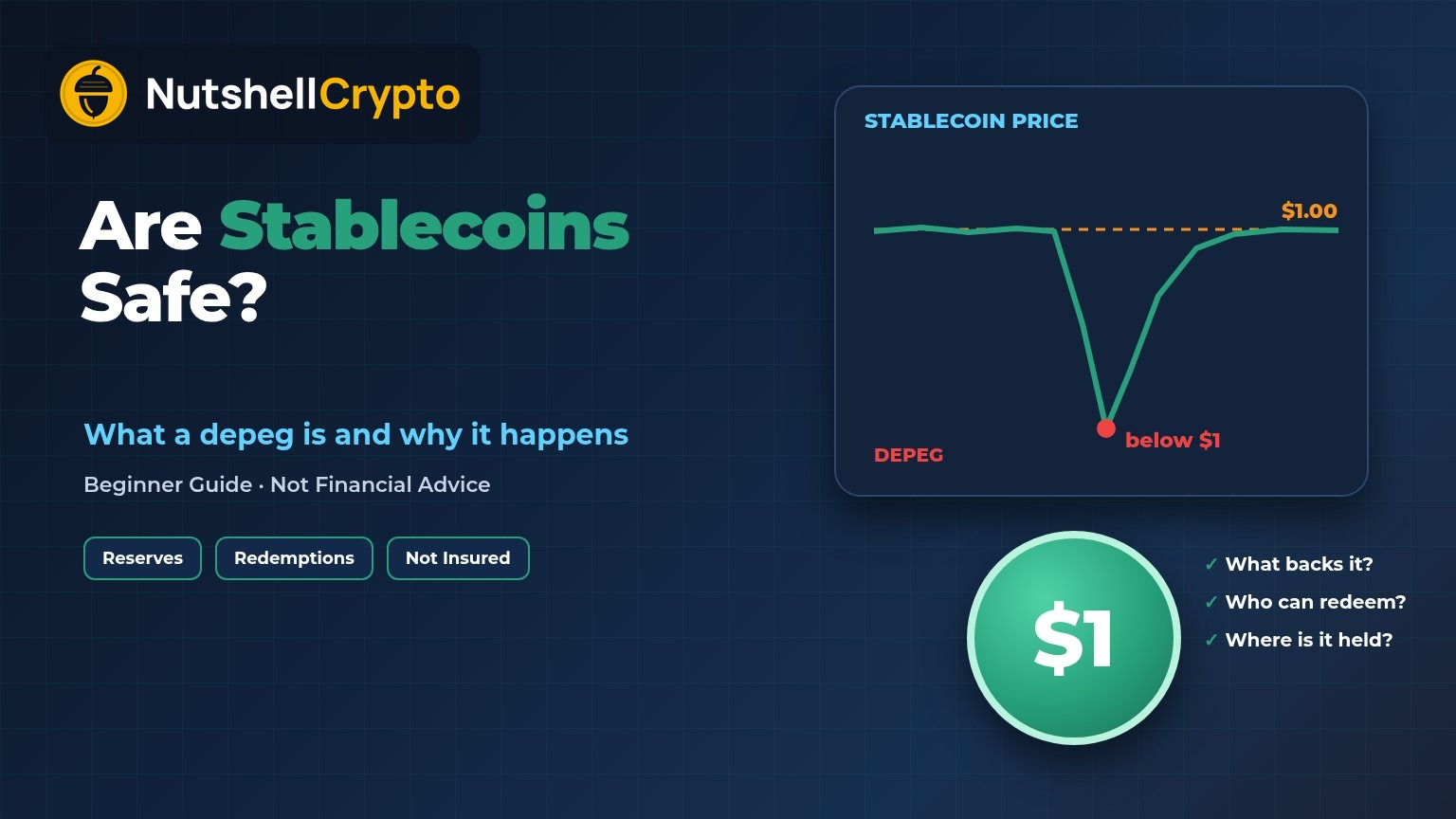
A depeg is when a stablecoin’s market price moves meaningfully away from its target, usually below $1. Tiny moves, such as $0.998 or $1.002, happen all the time and are normal. A real depeg is a bigger or longer break, for example a coin trading at $0.95 or lower for hours.
Depegs come in two kinds, and the difference matters:
- Venue depeg: the coin falls on one exchange because that market runs out of buyers, while it stays near $1 elsewhere and redemptions keep working.
- Backing depeg: the coin falls everywhere because people believe the reserves or collateral are worth less than $1. This kind can last, and in the worst cases it never recovers.
4 Reasons Stablecoins Depeg
1. Doubts about the reserves
If people suspect the issuer does not hold enough safe assets, they sell first and ask questions later. Unclear reports, risky reserve assets and legal trouble all feed these doubts. Tether’s early depegs came from this kind of worry, which our USDT vs USDC comparison covers alongside each coin’s reserves, ratings and rules.
2. Reserves that are stuck or lost
Even good reserves can be a problem if holders cannot reach them. A bank failure, a frozen account or a fund manager that loses money can leave a coin short of dollars, at least for a while.
3. Crypto collateral that crashes
Crypto-backed coins lock up more crypto than the dollars they issue, so they have a cushion. But if collateral prices fall fast, automatic sales kick in, and a thin market can turn those sales into a spiral. This is the same mechanism behind liquidation in crypto lending and leveraged trading.
4. Design flaws and no real backing
Algorithmic stablecoins try to hold $1 with code and a companion token instead of full cash reserves. When confidence falls, the companion token drops, which weakens the peg, which pushes the token down further. TerraUSD and Iron Finance both failed this way.
Real Depegs, From Small Wobbles to Collapses
| Stablecoin | When | Low point | Main cause | Outcome |
|---|---|---|---|---|
| IRON (Iron Finance) | June 2021 | Below $0.75 | Partly backed by its own token, TITAN, which crashed | Collapsed |
| TerraUSD (UST) | May 2022 | Near zero | Algorithmic design, run on LUNA | Collapsed |
| USDC | March 2023 | About $0.88 | $3.3 billion of reserves at failed Silicon Valley Bank | Recovered within days |
| USDe (on Binance only) | October 2025 | About $0.65 | Thin order book on one exchange during a market crash | Recovered the same day |
| xUSD (Stream Finance) | November 2025 | About $0.30 | $93 million loss reported by an outside fund manager | Did not recover |
Iron Finance (2021): a bank run on a half-backed coin
IRON was backed about 75% by USDC and 25% by TITAN, a token issued by the project itself. When TITAN fell from about $60 to near zero in hours on June 16, 2021, IRON broke its peg and dropped below $0.75. A Federal Reserve study of the IRON run found design flaws in its arbitrage mechanism, and that the largest accounts ran first. Iron Finance itself called it crypto’s first large-scale bank run, CoinDesk reported.
TerraUSD (2022): the biggest collapse
UST was an algorithmic stablecoin tied to the LUNA token. In May 2022 a run broke the link and both tokens collapsed. We cover the full story and the losses in our list of the largest stablecoins by market cap. The short lesson: a promise to hold $1 is not the same as holding $1.
USDC (2023): good reserves, wrong bank
On March 10, 2023, Silicon Valley Bank failed. Circle then said $3.3 billion of USDC’s cash reserves were held there, and USDC fell to about $0.88 over the weekend, CNBC reported. It went back to $1 once US authorities said all SVB depositors would be protected. The Fed’s later study of the SVB episode found the price fell hardest when redemptions with Circle largely stopped, and recovered unevenly over the weekend. The lesson: even well-backed coins depend on banks and on being able to redeem.
USDe on Binance (2025): one market, one bad price
On October 10, 2025, during a crash with more than $19 billion of liquidations, Ethena’s USDe dropped to about $0.65 on Binance, CoinDesk reported. Ethena said minting and redemption kept working and the coin stayed overcollateralized. Ethena’s founder said Binance valued USDe using its own thin order book and had deposit and withdrawal problems, so traders could not close the gap, Cointelegraph reported. Binance later paid about $283 million to affected users, The Block reported. The lesson: where you hold a stablecoin matters, especially if you use it as collateral on a centralized exchange.
Stream Finance xUSD (2025): yield with hidden risk
On November 4, 2025, DeFi platform Stream Finance paused deposits and withdrawals after saying an outside fund manager had lost about $93 million of its assets, The Block reported. Its yield-bearing dollar token, xUSD, fell to about $0.50 and later about $0.33, per Cointelegraph. The lesson: a token that pays a high yield is taking risk somewhere to earn it, even if it is called a stablecoin.
Are Stablecoins Insured?
No. A stablecoin is not a bank deposit. In the US, the FDIC has proposed that dollars held as stablecoin reserves are insured only to the issuer as a company, not passed through to people who hold the tokens, per the FDIC’s April 2026 proposal. FDIC Chairman Travis Hill said stablecoin users will not get any government guarantee, CoinDesk reported.
What the US GENIUS Act, signed in July 2025, does give holders of permitted payment stablecoins:
- Full reserves in dollars, short-term Treasuries or similar liquid assets, with monthly public reports, per the Senate Banking Committee’s fact sheet.
- First claim on the reserves if the issuer goes bankrupt, ahead of the issuer’s other creditors, under 12 U.S.C. § 5910.
- A ban on claiming government backing. Issuers may not say their coins are FDIC-insured or backed by the US government.
Having first claim is helpful, but it is not insurance: if the reserves are short, holders can still lose money or wait a long time. In Canada, regulators treat stablecoins as “value-referenced crypto assets” with their own listing rules, and CDIC deposit insurance does not cover cryptocurrencies, including stablecoins. Our USDT vs USDC guide explains the US, EU and Canadian rules in more detail.
How to Judge a Stablecoin’s Safety: A Checklist
Before you hold a meaningful amount of any stablecoin, run through these questions:
- What backs it? Cash and short-term Treasuries are the simplest. Crypto collateral adds price risk. “Algorithmic” or “synthetic” means you should read the design carefully.
- How often are reserves reported, and by whom? Monthly reports from an accounting firm beat quarterly or none. A full audit is stronger than a point-in-time attestation.
- Who is the issuer, and who regulates it? A known company under a clear license is easier to hold to account than an anonymous team.
- How big and how liquid is it? Larger coins with deep markets on many venues are harder to knock off $1.
- Where does the yield come from? Plain fiat-backed coins pay holders nothing. If a “stable” token pays a high yield, find out what risk earns it.
- How has it behaved under stress? Look at its price history on CoinGecko during past crashes.
- Where are you holding it? On an exchange you also take that platform’s risk. In your own wallet you control the keys, though issuers like Tether and Circle can still freeze tokens; our guide to self-custody in crypto covers the trade-offs.
Spreading larger balances across more than one well-backed coin and more than one platform also reduces the damage if one fails.
What to Do If Your Stablecoin Depegs
- Check more than one source. Compare the price on CoinGecko, other exchanges and big DeFi pools. If it is only one venue, it may be a venue depeg like USDe on Binance.
- Read the issuer’s official channels. Look for news about reserves, redemptions and bank exposure. Ignore rumors and “rescue” links in DMs; scammers move fast during panics.
- Avoid forced selling. If you used the stablecoin as collateral for a loan or leveraged trade, a depeg can trigger liquidation. Lowering your borrowing reduces that risk.
- Do not assume it will bounce back. USDC recovered; UST and xUSD did not. Decide based on the backing, not on hope.
- Keep records. Save transaction IDs and prices. A sale below $1 may have tax effects.
FAQ
Are stablecoins safe to hold long term?
Large fiat-backed stablecoins have held close to $1 for years, but they earn holders nothing, are not insured, and depend on the issuer and its banks. They work well as a short-term parking spot; for long-term savings, think about what you give up compared with an insured account.
Which stablecoin is the safest?
No coin is risk-free. Coins backed by cash and short-term Treasuries, with monthly reports and a regulated issuer, are generally seen as the lowest risk. Algorithmic and high-yield designs carry the most.
Can a stablecoin go to zero?
Yes. TerraUSD fell to near zero in 2022, and IRON collapsed in 2021. Fully backed coins can still depeg for a while, as USDC did in 2023.
What does depeg mean in crypto?
It means a stablecoin’s market price has moved away from its target value, usually $1. A brief move of a fraction of a cent is normal; a larger or longer break is a depeg.
Are stablecoins safer than Bitcoin?
For day-to-day price swings, yes, because stablecoins aim to stay at $1 while Bitcoin’s price moves a lot. But stablecoins carry issuer, reserve and freeze risks that Bitcoin does not. They are different risks, not zero risk.
Are stablecoins safe in DeFi?
Using stablecoins in DeFi apps adds smart contract, hack and liquidation risk on top of the coin’s own risk. Start small and learn how a protocol works before you deposit.
Sources
- DefiLlama: Stablecoins (prices and total supply, checked October 22, 2026, 9:27 PM PKT)
- Federal Reserve: The stable in stablecoins (2022)
- Federal Reserve: Runs on algorithmic stablecoins: Iron, Titan and Steel (2022)
- Federal Reserve: Lessons from the SVB failure and its impact on stablecoins (2025)
- CoinDesk: Iron Finance postmortem (2021)
- CNBC: USDC breaks its peg after SVB exposure (2023)
- CoinDesk: USDe briefly loses peg (2025)
- Cointelegraph: Ethena founder on the Binance oracle issue (2025)
- The Block: Binance pays $283 million in compensation (2025)
- The Block: Stream Finance halts withdrawals after $93 million loss (2025)
- Cointelegraph: Stream Finance exposure and xUSD price (2025)
- FDIC: GENIUS Act proposed rule (April 2026)
- CoinDesk: No deposit insurance for stablecoins, says FDIC chief (2026)
- US Senate Banking Committee: GENIUS Act consumer protections
- CDIC: What’s covered
- Cornell LII: 12 U.S.C. § 5910, stablecoin issuer insolvency
Not financial advice: this article is for general education. Stablecoins can lose value, can be frozen by their issuers, and are not covered by deposit insurance. Do your own research before holding any crypto asset.