In a nutshell: A crypto option gives the buyer the right, but not the duty, to buy (call) or sell (put) a coin at a set price before or on a set date. The buyer pays an upfront fee called the premium, which is the most they can lose. Option sellers take on much bigger risk. In the US, regulated access is mainly through CME options and options on spot Bitcoin ETFs. Educational only; not financial advice.
Last updated: October 21, 2026.
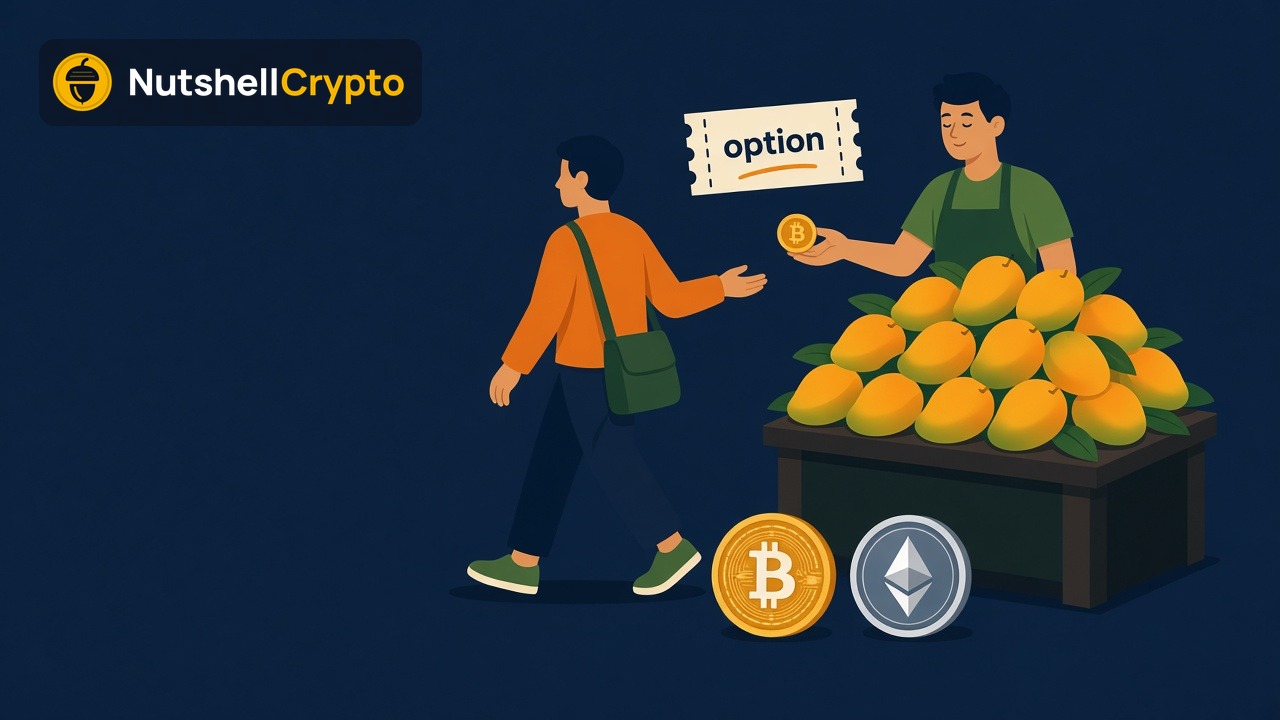
Quick note: the mango example in this guide is just a fruit market story. It has nothing to do with Mango Markets, the Solana crypto exchange that the SEC says was drained of about $116 million in October 2022.
Crypto options let you pay a small fee for a choice instead of a promise. This guide explains calls, puts and premiums with a mango market story first, then connects it to Bitcoin and Ether, plus US and Canadian access and the risks.
Table of contents
The Mango Market Story
Ben the juice seller likes the idea of locking in mangoes at $10 a box next month, but he doesn’t want to be stuck paying $10 if prices crash. So he offers Asha the farmer a deal: “I’ll pay you $1 a box today for the right to buy at $10 next month. If I don’t want to, I can walk away.”
- If next month’s price is $14, Ben uses his right and buys at $10. After his $1 fee, he is $3 a box better off.
- If the price falls to $7, Ben walks away and buys at the market. He loses only the $1 fee.
Asha keeps the $1 either way. But if prices soar, she must sell at $10 no matter how high the market goes. That is the seller’s big risk.
What Are Crypto Options?
An option is a contract that gives the buyer the right, but not the obligation, to buy or sell an asset at a set price (the strike price) by or on a set date (the expiry), as Investopedia defines it. The fee paid for that right is the premium. With crypto options, the asset is usually Bitcoin, Ether, a Bitcoin futures contract or a Bitcoin ETF.
Calls and Puts
| Option | Buyer gets the right to… | Buyer benefits if… |
|---|---|---|
| Call | Buy at the strike price | The price rises above the strike plus premium |
| Put | Sell at the strike price | The price falls below the strike minus premium |
CME Group’s FAQ on options on Bitcoin futures describes calls as a way to express a bullish view and puts as a bearish view or a form of downside protection. A buyer pays the premium; the seller receives it and may be assigned the opposite position.
A Bitcoin example
Suppose Bitcoin is $100,000. You buy a call with a $105,000 strike expiring in a month, paying a $2,000 premium per BTC (simplified numbers). If Bitcoin ends at $112,000, the call is worth $7,000, so you are up about $5,000 after the premium. If Bitcoin ends at $100,000 or below, the call expires worthless and you lose the $2,000 premium, and no more.
What Sets the Premium?
Premiums rise and fall with the underlying price, how volatile the market is, interest rates and how much time is left before expiry, per CME Group. Crypto is volatile, so crypto options are often expensive compared with options on calmer assets.
Options vs Futures
| Futures | Options (buyer) | |
|---|---|---|
| Obligation | Both sides must follow through | Buyer may walk away |
| Upfront cost | Margin deposit | Premium |
| Max loss | Can exceed the deposit | The premium paid |
For the obligation side of the story, see our crypto futures guide and its mango deal example. Selling (writing) options is a different matter: the seller collects the premium but can face large losses, and positions may be subject to liquidation if margin runs out. Option buyers also never pay perpetual futures funding rates, and unlike margin trading, buying an option involves no borrowing.
US and Canada Access
United States: CME lists options on Bitcoin and Ether futures, and launched options on its Micro Bitcoin and Micro Ether futures on March 28, 2022. Options on BlackRock’s iShares Bitcoin Trust (IBIT) began trading on Nasdaq on November 19, 2024, after SEC approval, as CNBC reported. Those ETF options trade through ordinary brokerage accounts that are approved for options. Crypto-native options exchanges based offshore generally do not serve US residents.
Canada: Canadians who want crypto options usually go through a regulated investment dealer rather than a crypto app, because Canadian crypto trading platforms can’t offer leveraged products and offshore options exchanges typically restrict residents. See our full US and Canada rules in crypto futures explained.
Global: options availability, leverage and protection vary a lot by country.
Risks of Crypto Options
- Premiums can go to zero: most of an option’s value can disappear quickly as expiry nears.
- Sellers can lose far more than they collect: like Asha, a call seller is exposed if prices soar.
- Complexity: volatility, time decay and strike choice make options hard to price for beginners.
Risk warning: Options are complex products; buying them can lose the full premium, and selling them can create large losses. The CFTC warns that virtual currency prices can swing sharply and that leveraged trading can multiply losses. Only use money you can afford to lose, and consider simply buying coins on the spot market without leverage if you just want exposure.
FAQ
What is the most a crypto option buyer can lose?
The premium paid, plus fees. Sellers can lose much more.
Are crypto options the same as perpetual futures?
No. Perps have no expiry and use funding payments; see how perpetual futures work.
Do I need options to invest in crypto?
No. Many people simply buy coins on the spot market and hold them.
Sources
- Investopedia: Option
- Investopedia: Premium
- CME Group: FAQ on options on Bitcoin futures
- CME Group: Launch of Micro Bitcoin and Micro Ether options (March 28, 2022)
- SEC: Order approving options on the iShares Bitcoin Trust (2024)
- CNBC: Bitcoin ETF options begin trading (November 19, 2024)
- CFTC: Understand the Risks of Virtual Currency Trading
- CSA Staff Notice 21-332 (Ontario Securities Commission)
- CIRO: Crypto asset trading platforms becoming a Dealer Member
- CIRO: Margin requirements for cryptocurrency futures contracts
- SEC: SEC Charges Avraham Eisenberg with Manipulating Mango Markets (January 20, 2023)