In a nutshell: A crypto futures contract is a deal made today to buy or sell a coin like Bitcoin at a set price on a future date. Both sides must follow through, so gains and losses can be large, especially with leverage. In the US you can access them mainly through CFTC-regulated venues like CME and Coinbase Derivatives; in Canada retail access is tightly limited. Educational only; not financial advice.
Last updated: October 21, 2026.
Quick note: the mango example in this guide is just a fruit market story. It has nothing to do with Mango Markets, the Solana crypto exchange that the SEC says was drained of about $116 million in October 2022.
Crypto futures sound complicated, but the idea is older than money markets: two people agree on a price now for something that will change hands later. This guide explains futures with a simple fruit market story, then shows how the same idea works for Bitcoin, Ether and other coins, what it costs, and where the risks are.
Table of contents
The Mango Market Story
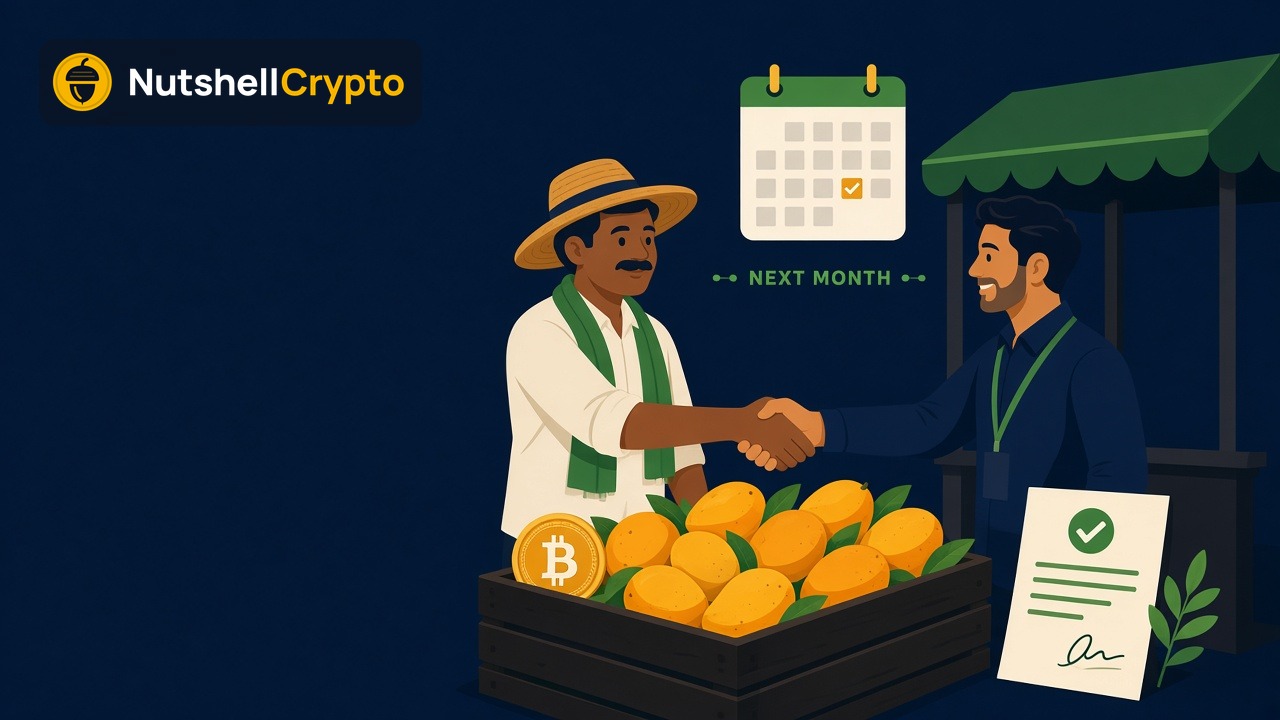
Meet Asha, a mango farmer, and Ben, who runs a juice stand. Today mangoes sell for $10 a box. Ben worries prices will jump before summer. Asha worries they will crash at harvest. So they sign a deal today: next month, Asha will deliver 100 boxes and Ben will pay $10 a box, no matter what the market price is then.
- If next month’s market price is $14, Ben is happy. He pays $10 for something worth $14. Asha misses out on $4 a box.
- If the price drops to $7, Asha is happy. She still gets $10. Ben pays $3 a box more than the market.
The key point: both of them must follow through. Neither can walk away just because the price moved against them. To make sure nobody vanishes, the market organizer asks each of them to leave a deposit up front.
What Are Crypto Futures?
A futures contract is a standardized, exchange-traded agreement to buy or sell an asset at a set price on a future date, as Investopedia explains. A private, custom version of the same deal is called a forward contract. With crypto futures, the “mangoes” are a coin such as Bitcoin or Ether.
Most regulated crypto futures are cash-settled: instead of handing over actual coins, the two sides simply swap the difference in dollars. CME’s Bitcoin futures, for example, settle in cash against the CME CF Bitcoin Reference Rate, according to CME Group. So a futures trader is betting on the price, not taking delivery of a coin.
How Crypto Futures Work
Long and short
Ben’s side is called long: he profits if the price rises. Asha’s side is short: she profits if the price falls. In crypto, you can go long or short on a Bitcoin futures contract without owning any Bitcoin.
Contract size
Futures come in fixed sizes. CME’s standard Bitcoin contract is 5 BTC, while its Micro Bitcoin contract is one-tenth of a bitcoin, or 1/50 the size of the standard contract, per CME Group. At an example price of $100,000 per BTC, one Micro contract would control about $10,000 of Bitcoin.
Margin: the deposit
Just like the mango deposit, you don’t pay the full contract value. You post initial margin, a good-faith deposit, and must keep at least the maintenance margin in your account while the trade is open, as Coinbase’s help center describes. Gains and losses are usually settled daily (“marked to market”). If losses eat your deposit, the position can be closed for you. Our guide to what liquidation in crypto means covers that step in detail.
A Bitcoin example
Say Bitcoin is $100,000 and you buy (go long) one Micro Bitcoin future expiring next month, controlling 0.1 BTC (about $10,000). If Bitcoin rises to $105,000 by expiry, the contract gains about $500. If it falls to $95,000, it loses about $500. These are simplified numbers that ignore fees; the point is that your profit or loss is based on the whole $10,000, not just your deposit.
Dated vs Perpetual Futures
| Type | End date? | How price stays near the market |
|---|---|---|
| Dated (traditional) futures | Yes, a fixed expiry | The contract settles at the reference price on expiry |
| Perpetual futures | No fixed expiry (or a very long one) | Periodic funding payments between longs and shorts |
The CFTC describes perpetual contracts as having no fixed expiration date and using a funding rate to stay close to the spot price. Read our explainer on what perpetual futures are and how they differ from dated contracts for the full picture, and our guide to how the funding rate works for the payments that keep perps in line.
Why People Use Futures
- Hedging: like Asha locking in a price, a crypto miner or long-term holder can use futures to reduce the impact of a price drop.
- Price exposure without holding coins: cash-settled contracts let traders follow the price without a wallet.
- Speculation: some traders try to profit from price moves, often with leverage. This is where most beginners get hurt.
Futures are different from simply buying a coin. If you just want to own Bitcoin, our guide to spot trading crypto explains the simpler route, and our margin trading guide explains borrowing to trade, which shares many of the same risks.
Can You Trade Crypto Futures in the US and Canada?
United States: In the US, crypto futures and perpetual-style futures for everyday traders run through CFTC-regulated venues. CME Group has listed Bitcoin futures since December 18, 2017, and Coinbase Financial Markets, a CFTC-registered futures commission merchant, began offering US perpetual-style futures on July 21, 2025. The CFTC’s perpetuals explainer advises traders to stick to CFTC-registered exchanges and avoid offshore venues outside its reach.
Canada: Canada is stricter. Under CSA Staff Notice 21-332, crypto trading platforms operating while they seek registration must not offer margin, credit or other leverage to any client. Platforms that offer crypto derivatives are expected to register as investment dealers and become CIRO dealer members, and CIRO requires dealers to margin exchange-traded crypto futures at no less than 50% of market value. Big offshore exchanges generally block Canadian and US residents from their derivatives products, so always check eligibility for your state or province.
Elsewhere: rules vary widely. Many global exchanges offer futures, but regulation, investor protection and leverage limits differ by country.
Risks of Crypto Futures
- Leverage cuts both ways: Coinbase warns that losses from futures can exceed the value of your margin, and you can be liable for any deficit, per its futures cash balance page.
- Forced closing: a quick move can trigger liquidation before you have time to react.
- 24/7 volatility: crypto trades around the clock, including weekends and holidays.
- Platform risk: offshore or unregulated venues may offer little protection if something goes wrong.
Risk warning: Futures are complex, leveraged products and most beginners do not need them. The CFTC warns that virtual currency prices can swing sharply and that leveraged trading can multiply losses. Only use money you can afford to lose, and consider simply buying coins on the spot market without leverage if you just want exposure.
FAQ
Are crypto futures the same as owning crypto?
No. Most regulated crypto futures are cash-settled contracts on the price. You don’t hold coins in a wallet.
Can I lose more than I put in?
Yes, on some platforms. Coinbase states that futures losses can exceed your margin and that you may be responsible for the deficit.
What is the difference between futures and options?
Futures oblige both sides to follow through. An option gives the buyer a right without the duty. See our guide to how crypto options work.
Sources
- Investopedia: Futures
- Investopedia: Forward Contract
- CME Group: Bitcoin futures to launch December 18, 2017
- CME Group: Micro Bitcoin futures product overview
- CFTC: Crypto Asset Perpetual Contracts (one-pager)
- CFTC: Understand the Risks of Virtual Currency Trading
- Coinbase: Perpetual futures have arrived in the U.S. (July 21, 2025)
- Coinbase Help: Margin ratio and liquidation risk management (US Derivatives)
- Coinbase Help: Cash balances (Futures)
- CSA Staff Notice 21-332 (Ontario Securities Commission)
- CIRO: Crypto asset trading platforms becoming a Dealer Member
- CIRO: Margin requirements for cryptocurrency futures contracts
- SEC: SEC Charges Avraham Eisenberg with Manipulating Mango Markets (January 20, 2023)