In a nutshell: Perpetual futures (“perps”) are futures contracts with no fixed end date. Instead of expiring, they use a funding rate: periodic payments between buyers and sellers that pull the contract price back toward the coin’s market price. Perps are popular and often leveraged, which makes them risky for beginners. Educational only; not financial advice.
Last updated: October 21, 2026.
Quick note: the mango example in this guide is just a fruit market story. It has nothing to do with Mango Markets, the Solana crypto exchange that the SEC says was drained of about $116 million in October 2022.
Perpetual futures are the most traded crypto derivative. Coinbase says perps make up about 90% of global crypto derivatives trading volume in its US launch announcement. Here is what they are, using a mango deal that never ends.
Table of contents
The Mango Market Story
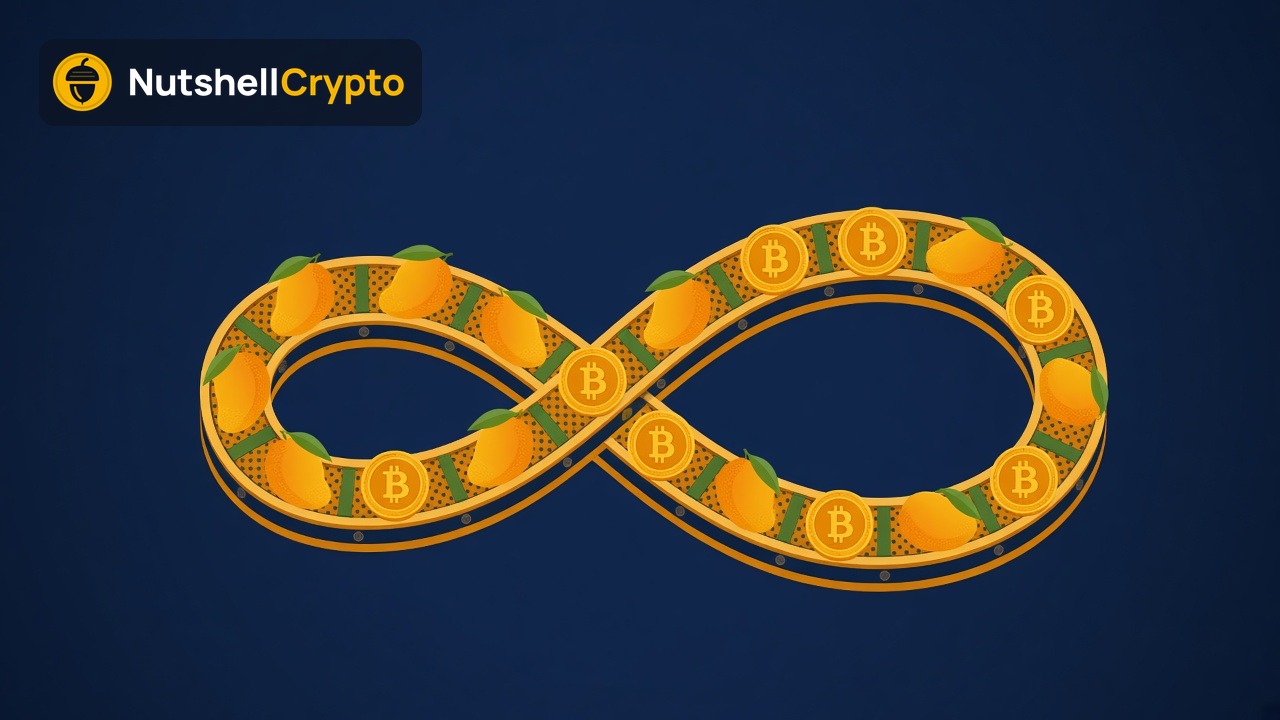
Asha and Ben like their mango deal so much that they drop the end date. Ben is “long” mangoes and Asha is “short,” and the deal simply keeps running until one of them chooses to close it.
There is a problem: with no delivery day, what keeps the deal price honest? Their fix is a small regular fee. Every day, if the deal price is above the market price of mangoes, Ben (the buyer) pays Asha a small fee. If it is below, Asha pays Ben. That nudge keeps people from piling onto one side, so the deal price stays close to the real market price.
What Are Perpetual Futures?
The CFTC describes crypto perpetual contracts as derivatives with no fixed expiration date that use a funding rate, a periodic payment between longs and shorts, to stay close to the spot price. It also notes that leverage is not inherent to perps, but platforms usually offer it.
Like other futures, most perps are cash-settled and margined: you post a deposit, and gains and losses flow in and out of your account. For the basics of how futures contracts work, see our crypto futures guide.
Funding: How Perps Track the Price
Funding is the “small fee” from the mango story. Coinbase explains that when the funding rate is positive, longs pay shorts, and when it is negative, shorts pay longs, per its perpetual-style futures overview. Coinbase’s US product calculates funding hourly, while Binance commonly settles funding every eight hours on many contracts. Our separate guide on what a funding rate is and how it is calculated goes deeper.
A Bitcoin Perp Example
Say Bitcoin trades at $100,000 and you go long a perp worth 0.01 BTC (about $1,000). That is the size of Coinbase’s nano Bitcoin perp-style contract, according to its CFTC filing. If Bitcoin rises 5%, your position gains about $50; if it falls 5%, it loses about $50, before fees. If the market is crowded with buyers and funding is positive, you also pay small funding amounts while the trade stays open.
Perps vs Dated Futures vs Spot
| Spot | Dated futures | Perpetual futures | |
|---|---|---|---|
| You own the coin? | Yes | No (usually cash-settled) | No |
| End date | None | Fixed expiry | None or very long |
| Extra cost | Trading fees | Fees, roll costs | Fees plus funding |
| Liquidation risk | No (without borrowing) | Yes | Yes |
To compare with borrowing to buy actual coins, read our guide to margin trading crypto. For the simplest approach, see spot trading crypto.
US and Canada Access
United States: Coinbase Financial Markets launched CFTC-regulated perpetual-style futures for US customers on July 21, 2025, starting with nano Bitcoin and nano Ether contracts, with five-year expirations and up to 10x intraday leverage, per its announcement. The current contracts expire on December 20, 2030, per Coinbase Help. The CFTC urges traders to use registered exchanges rather than offshore venues.
Canada: Perps are hard to reach from Canada, because locally registered platforms generally can’t offer leveraged crypto products to retail clients and most offshore perp exchanges turn away Canadian accounts. Coinbase’s help page says its regulated derivatives offering is also available to some Canadian residents under foreign dealer and futures commission merchant exemptions, so check current eligibility in your province. See our full US and Canada rules in crypto futures explained.
Risks of Perpetual Futures
- Leverage and liquidation: perps are usually traded with leverage, and a small move can wipe out your deposit. See how crypto liquidation works.
- Funding costs add up: holding a crowded side for weeks can cost more than you expect.
- Cascades: forced selling can feed on itself in fast markets, as seen in recent sell-offs like the NEAR price drop driven by long liquidations.
Risk warning: Perpetual futures are leveraged, complex products that can lose more than your deposit on some platforms. The CFTC warns that virtual currency prices can swing sharply and that leveraged trading can multiply losses. Only use money you can afford to lose, and consider simply buying coins on the spot market without leverage if you just want exposure.
FAQ
Why are they called perpetual?
Because they have no fixed expiry date (or, in the US, a very long one of about five years).
Do I pay funding if I’m short?
Only when funding is negative. When it is positive, shorts receive funding from longs.
Are perps the same as options?
No. Options give a right without obligation; see crypto options explained.
Sources
- CFTC: Crypto Asset Perpetual Contracts (one-pager)
- Coinbase: Perpetual futures have arrived in the U.S. (July 21, 2025)
- Coinbase Help: US perpetual-style futures overview
- Coinbase Derivatives filing to the CFTC: nano Bitcoin Perp Style Futures (June 26, 2025)
- Binance: Introduction to Binance Futures Funding Rates
- CFTC: Understand the Risks of Virtual Currency Trading
- CSA Staff Notice 21-332 (Ontario Securities Commission)
- CIRO: Crypto asset trading platforms becoming a Dealer Member
- CIRO: Margin requirements for cryptocurrency futures contracts
- SEC: SEC Charges Avraham Eisenberg with Manipulating Mango Markets (January 20, 2023)