In a nutshell: A funding rate is a small, regular payment between traders holding perpetual futures. When it is positive, buyers (longs) pay sellers (shorts); when it is negative, shorts pay longs. It exists to keep the perpetual contract price close to the coin’s real market price. Funding can quietly add up over time. Educational only; not financial advice.
Last updated: October 21, 2026.
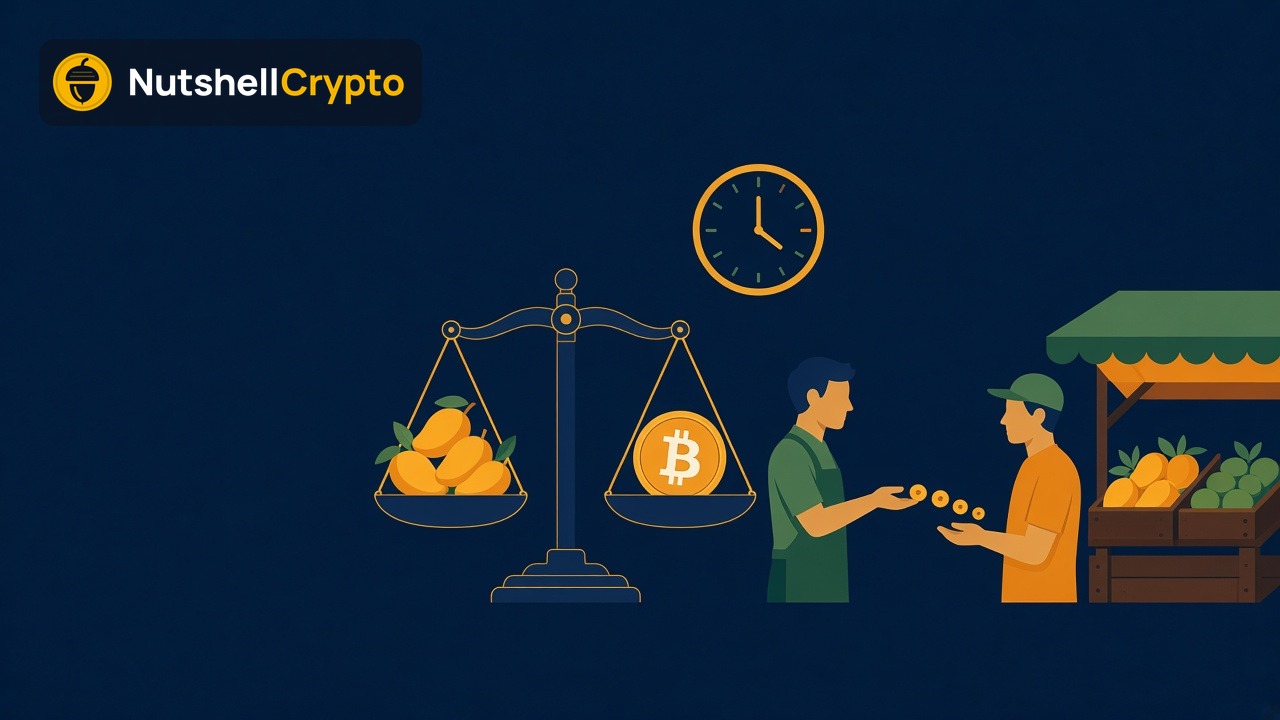
Quick note: the mango example in this guide is just a fruit market story. It has nothing to do with Mango Markets, the Solana crypto exchange that the SEC says was drained of about $116 million in October 2022.
If you have looked at a perpetual futures screen, you’ve seen a funding rate and a countdown timer. This guide explains what that number means with a simple mango story, how exchanges calculate it, and how it affects what you pay.
Table of contents
The Mango Market Story
Asha and Ben have a never-ending mango deal. Lots of other buyers join in on Ben’s side, and the deal price drifts to $11 a box while real mangoes sell for $10. To pull it back, the market sets a rule: every few hours, whoever is on the crowded side pays a small fee to the other side. Since buyers are crowded, they pay sellers. Some buyers decide the fee isn’t worth it and close their deals, and the price drifts back toward $10.
That small fee is the funding rate. It is paid between traders, not to the market itself.
What Is a Funding Rate?
Binance describes funding rates as periodic cash flows exchanged between long and short position holders, based on the difference between the perpetual contract price and the index (spot) price, and notes that Binance only facilitates the exchange, per its funding rate FAQ. The CFTC likewise describes funding as the mechanism that keeps perpetual contracts close to spot.
- Positive funding: longs pay shorts. Usually happens when the perp trades above spot.
- Negative funding: shorts pay longs. Usually happens when the perp trades below spot.
New to perps? Start with our guide to perpetual futures.
How Funding Is Calculated
Coinbase (US)
Coinbase’s perpetual-style futures overview says funding is calculated and paid every hour, on the hour. It measures the gap between futures and spot prices every three minutes, averages 20 readings over the hour, scales the result down by 24, and smooths it by weighting the current hour 75% and the previous hour 25%. The payment equals the funding rate times your position size times the futures mark price (with the sign set so the right side pays).
Binance (global)
Binance commonly settles funding every eight hours, at 00:00, 08:00 and 16:00 UTC, with some contracts on four-hour intervals, per its FAQ. Its rate combines an interest component (by default 0.01% per eight-hour interval) and a premium index, and since September 18, 2025 the formula is scaled to the funding interval, per a Binance announcement. The funding amount equals your position’s nominal value times the funding rate.
A Bitcoin Funding Example
Say you hold a long Bitcoin perp worth $10,000 and funding is +0.01% per eight hours. Each interval you pay $10,000 x 0.0001 = $1, or about $3 a day. That looks tiny, but over 30 days it is about $90, and funding can climb much higher in crowded markets. If funding turns negative, the same long would receive payments instead. (Simplified numbers that ignore fees.)
What Funding Can and Can’t Tell You
Very high positive funding shows many traders are leaning long with leverage; deeply negative funding shows the opposite. That crowding can make the market fragile, because a sharp move can force many traders out at once (see what liquidation in crypto means). But funding is not a prediction tool, and crowded trades can stay crowded for a long time.
US and Canada Note
United States: regulated perps with hourly funding are available through Coinbase Financial Markets, a CFTC-registered futures commission merchant, per Coinbase Help. Dated contracts like traditional crypto futures don’t have funding at all.
Canada: Most Canadians never pay or receive funding, since the perpetual contracts that use it are largely off-limits: Canadian-registered crypto platforms can’t extend leverage to retail clients, and the big offshore perp venues usually exclude Canadian residents. See our full US and Canada rules in crypto futures explained.
Risks and Costs
- Hidden holding cost: funding is charged on the full position size, not your deposit, so leverage magnifies it.
- Rates change: funding can flip from small to large quickly in volatile markets.
- It adds to other costs: trading fees and spreads still apply. Compare with borrowing costs in our margin trading guide.
Risk warning: Funding payments can turn a flat trade into a losing one over time. The CFTC warns that virtual currency prices can swing sharply and that leveraged trading can multiply losses. Only use money you can afford to lose, and consider simply buying coins on the spot market without leverage if you just want exposure.
FAQ
Does the exchange keep the funding fee?
Generally no. Funding is exchanged between traders; trading fees are separate.
Do spot buyers pay funding?
No. Funding only applies to perpetual contracts, not to spot trading.
Do options have a funding rate?
No. Option buyers pay a one-time premium; see crypto options explained.
Sources
- Binance: Introduction to Binance Futures Funding Rates
- Binance: Updates on funding rate formula (September 18, 2025)
- Coinbase Help: US perpetual-style futures overview
- CFTC: Crypto Asset Perpetual Contracts (one-pager)
- CFTC: Understand the Risks of Virtual Currency Trading
- CSA Staff Notice 21-332 (Ontario Securities Commission)
- CIRO: Crypto asset trading platforms becoming a Dealer Member
- CIRO: Margin requirements for cryptocurrency futures contracts
- SEC: SEC Charges Avraham Eisenberg with Manipulating Mango Markets (January 20, 2023)