In a nutshell: In the US, crypto capital gains tax applies when you sell, swap, or spend crypto for more than your cost basis. Coins held one year or less are taxed as short-term gains at ordinary income rates (10% to 37%). Coins held more than one year get long-term rates of 0%, 15%, or 20%, based on your taxable income. You report each disposal on Form 8949 and Schedule D. Educational only; not tax or financial advice.
Last updated: October 5, 2026. Tax rules change. Check current IRS guidance or a tax professional before you act.
This guide explains how crypto capital gains tax works for US taxpayers: what counts as a taxable event, how cost basis and holding periods work, the 2026 rates, how to report, and how Canada differs. For the full picture, including staking and mining income, see our US crypto taxes guide.
Table of contents
- What is crypto capital gains tax?
- Which crypto transactions are taxable?
- How cost basis works
- Short-term vs long-term crypto gains
- 2026 long-term capital gains rates
- Worked example (hypothetical)
- Capital losses and the wash-sale question
- How to report: Form 8949, Schedule D, 1099-DA
- How Canada taxes crypto capital gains
- FAQ
- Sources

What Is Crypto Capital Gains Tax?
The IRS treats digital assets such as bitcoin, ether, stablecoins, and NFTs as property, not currency. That means the same capital gains rules that apply to stocks also apply to most crypto you hold as an investment.
When you dispose of crypto, your gain or loss is simple in concept:
Amount realized (what you got, in US dollars) − cost basis (what you paid, including fees) = capital gain or loss
You owe tax only on realized gains. If your coins went up but you haven’t sold, swapped, or spent them, there is no capital gain to report yet.
Which Crypto Transactions Are Taxable?
According to the IRS digital assets page, these generally trigger a capital gain or loss:
| Transaction | Capital gain or loss? |
|---|---|
| Selling crypto for US dollars or another currency | Yes |
| Trading one crypto for another (for example, BTC for ETH) | Yes. Each swap is a disposal |
| Spending crypto on goods or services | Yes |
| Paying a network fee with crypto | Can be a disposal of the coins used for the fee |
| Buying crypto with dollars and holding it | No |
| Moving crypto between your own wallets | No (but keep records so your basis follows the coins) |
Some crypto is taxed as ordinary income when you receive it, not as a capital gain. That includes staking rewards, mining, and being paid in crypto. Once you’ve counted that income, its dollar value becomes your cost basis for a later sale. Our guide on what staking in crypto is covers how rewards work.
How Cost Basis Works
The IRS says the basis of a digital asset is generally its cost in US dollars. Transaction fees you paid to buy usually increase your basis, and fees on a sale reduce your proceeds.
To calculate gain or loss, the IRS lists the information you need for each disposal: the type of asset, the date and time, the number of units, the fair market value in US dollars at the time, and your basis.
Which units did you sell?
If you bought the same coin at different prices, the units you sell decide the size of your gain. The IRS digital asset FAQs allow you to specifically identify units. Otherwise, a first-in, first-out (FIFO) default generally applies. Basis is tracked wallet by wallet, so check your exchange’s cost-basis settings before you sell.
Short-Term vs Long-Term Crypto Gains
Your holding period is the biggest lever in crypto capital gains tax. Per IRS Topic No. 409:
- Short-term: held one year or less. Net short-term gains are taxed as ordinary income at graduated rates, from 10% to 37%.
- Long-term: held more than one year. Net long-term gains qualify for the lower 0%, 15%, or 20% rates.
You generally count from the day after you acquired the asset up to and including the day you dispose of it. Selling even one day too early can turn a long-term gain into a short-term one.
2026 Long-Term Capital Gains Rates
For tax year 2026, the IRS set these taxable-income thresholds in Rev. Proc. 2025-32:
| Filing status (2026) | 0% rate up to | 15% rate up to | 20% rate above |
|---|---|---|---|
| Single | $49,450 | $545,500 | $545,500 |
| Married filing jointly | $98,900 | $613,700 | $613,700 |
| Married filing separately | $49,450 | $306,850 | $306,850 |
| Head of household | $66,200 | $579,600 | $579,600 |
These thresholds apply to your total taxable income, not just your crypto gain. For 2025 returns (filed in 2026), the 0% limit was lower: $48,350 for single filers and $96,700 for joint filers, per Topic No. 409.
Two extras to know:
- Net Investment Income Tax (NIIT). Higher earners may owe an extra 3.8% on investment income, including crypto gains. See IRS Topic No. 559.
- Collectibles. Net gains from collectibles can be taxed at up to 28%. The IRS has said some NFTs may be treated as collectibles.
Worked Example (Hypothetical Numbers)
All numbers below are made up for illustration. They aren’t price predictions or advice, and they ignore state tax and the NIIT.
Alex is a single US filer with about $77,000 of taxable income from wages in 2026. Alex bought a coin for $5,000, including fees, and later sells it for $8,000, a $3,000 gain.
| Scenario | Holding period | Rate on the gain | Federal tax on $3,000 |
|---|---|---|---|
| Sold after 8 months | Short-term | 22% (Alex’s ordinary bracket) | About $660 |
| Sold after 14 months | Long-term | 15% (income above $49,450) | About $450 |
Same coin, same profit, but waiting past the one-year mark saves Alex about $210 in this simple example. If Alex had swapped the coin for ether instead of selling for dollars, the result would be the same: the swap is a taxable disposal.
Capital Losses and the Wash-Sale Question
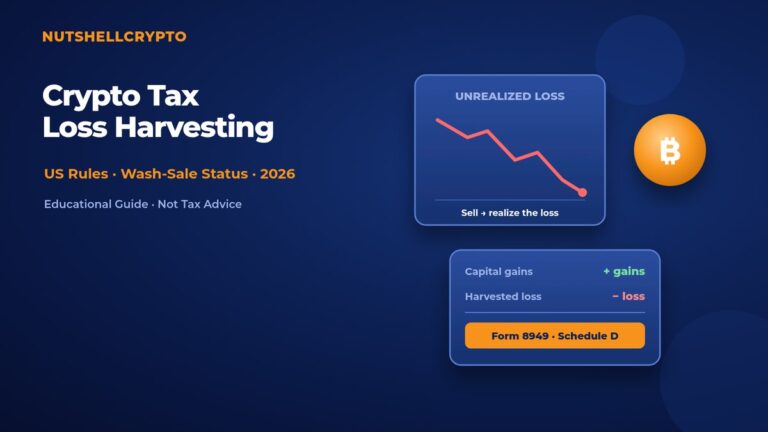
Losses help. Capital losses first offset capital gains. If losses are bigger, you can deduct up to $3,000 a year ($1,500 if married filing separately) against other income and carry the rest forward (Topic No. 409). Our guide to crypto tax loss harvesting walks through how investors use this.
The wash-sale rule (as of October 5, 2026): Internal Revenue Code §1091 applies to stock or securities. The IRS Schedule D instructions say it generally applies to digital assets that are also stock or securities for tax purposes (tokenized securities). We found no IRS guidance applying it to ordinary crypto like bitcoin or ether held directly.
That could change. The Digital Asset Tax Certainty Act (H.R. 10357), introduced September 14, 2026, would extend wash-sale rules to traded digital assets. Congress.gov shows the House Ways and Means Committee approved it 38–5 on September 16, 2026. It is not law. Spot bitcoin ETF shares are securities, so treat them as covered by the wash-sale rule.
How to Report: Form 8949, Schedule D, and 1099-DA
- Answer the digital asset question. Form 1040 asks whether you received, sold, exchanged, or otherwise disposed of a digital asset. If you sold, swapped, or spent crypto, check “Yes.”
- List each disposal on Form 8949, split into short-term and long-term.
- Carry the totals to Schedule D (Form 1040), where net gain or loss is calculated.
- Check your Form 1099-DA. Under final IRS regulations, brokers such as custodial exchanges report gross proceeds for transactions on or after January 1, 2025, and cost basis on certain transactions on or after January 1, 2026. Per the Form 1099-DA instructions, basis reporting mainly covers assets bought after 2025 and held in the same custodial account.
A 1099-DA covers only that broker. Coins you moved in from a self-custody wallet may show no basis, and DeFi activity may not appear at all. You are still responsible for reporting the correct basis and every disposal. If you have a large taxable gain, you may also need to make estimated tax payments during the year.
How Canada Taxes Crypto Capital Gains
Canada doesn’t split gains into short-term and long-term. Instead, if your crypto dealings are on capital account, only half of a capital gain is included in income (the 50% inclusion rate) and taxed at your marginal rate. If your activity looks like a business, such as frequent trading, the Canada Revenue Agency (CRA) may treat profits as fully taxable business income. Crypto-to-crypto trades are dispositions in Canada too.
Canadians also use adjusted cost base (ACB) averaging rather than US-style lot picking, and a “superficial loss” rule can deny a loss if you buy back within 30 days. A proposed two-thirds inclusion rate was cancelled, so don’t rely on old headlines. For the details, read our cryptocurrency tax in Canada guide.
FAQ
Do I pay crypto capital gains tax if I don’t sell?
No. Price gains on coins you still hold are unrealized. Tax comes when you sell, swap, or spend them. Income such as staking rewards is a separate matter.
Is trading one crypto for another taxable?
Yes. The IRS treats a crypto-to-crypto swap as a disposal, so you calculate gain or loss using the dollar value of what you received.
What is the capital gains tax rate on crypto?
For coins held more than a year, 0%, 15%, or 20% at the federal level, depending on taxable income. For coins held a year or less, your ordinary income rate, from 10% to 37%.
Is there a minimum amount before crypto gains are taxable?
No. There is no small-transaction exemption for crypto in current US law, so even a small purchase paid in crypto can create a reportable gain or loss.
What if I didn’t get a Form 1099-DA?
You still have to report your crypto gains and losses. Use your own records or exchange history to complete Form 8949.
Just getting started? Our how to buy bitcoin guide covers the basics, including keeping records from day one.
Sources
- IRS: Digital assets (property treatment, taxable events, basis, Form 1099-DA timeline)
- IRS Topic No. 409: Capital gains and losses
- IRS Rev. Proc. 2025-32: 2026 inflation adjustments (capital gains thresholds)
- IRS Topic No. 559: Net investment income tax
- IRS: FAQs on digital asset transactions
- IRS: About Form 8949
- IRS: About Schedule D (Form 1040)
- IRS: Instructions for Schedule D (wash sales and tokenized securities)
- IRS: Instructions for Form 1099-DA
- Congress.gov: H.R. 10357, Digital Asset Tax Certainty Act
- CRA: Reporting income from crypto-asset transactions
Educational content only. This is not tax, legal, or financial advice. Tax outcomes depend on your situation, and rules or pending legislation may change. Consult a qualified tax professional before acting.