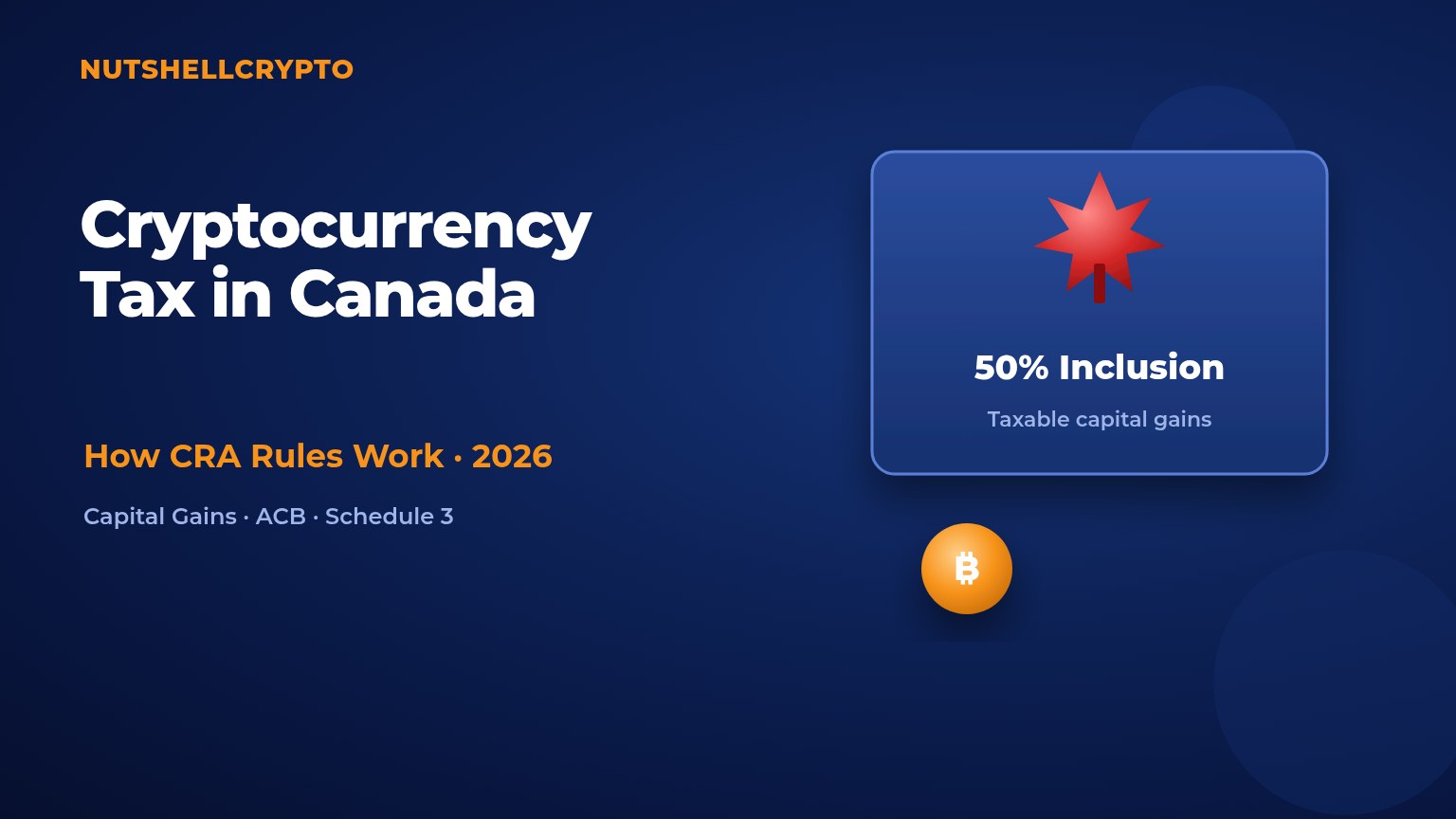
In a nutshell: Cryptocurrency tax in Canada is administered by the Canada Revenue Agency (CRA). Crypto-assets are generally treated like commodities/property — not like Canadian dollars — so selling, trading, or spending them can trigger capital gains (or losses) or business income. For capital dispositions, you typically include half of the gain in income (the 50% inclusion rate). This guide explains dispositions, capital vs business income, adjusted cost base (ACB), mining/staking at a high level, Schedule 3 reporting, records, and common mistakes — for educational readers, not as personalized tax advice.
Last updated: October 3, 2026. Tax rules and CRA guidance can change; confirm details on canada.ca and with a qualified Canadian tax professional before you file.
If you search for cryptocurrency tax with Canada in mind, you are usually asking how the CRA treats Bitcoin, Ether, stablecoins, and other crypto-assets when you buy, sell, trade, mine, stake, or spend them. This article focuses on Canadian rules. For the U.S. IRS beginner overview, see our separate guide on crypto taxes in the US. It is educational only — not financial, legal, or tax advice for your situation.
Table of contents
How CRA Treats Crypto-Assets
The CRA publishes a dedicated crypto-asset tax guide for users and tax professionals. In plain language:
- Not government-issued currency: Using crypto to buy goods or services is generally treated as a barter transaction for income tax purposes.
- Property / commodity-style treatment: Dispositions can create capital gains (or losses) or business income (or losses), depending on your facts.
- Fair market value in Canadian dollars: For tax reporting, the CRA generally accepts a crypto-asset’s fair market value (FMV) in CAD at the time of the trade or other event.
So cryptocurrency tax in Canada is mostly existing income-tax ideas — dispositions, ACB, capital vs income account, and records — applied to digital assets.
What Counts as a Disposition
According to the CRA’s page on reporting income from crypto-asset transactions, a disposition of a crypto-asset may occur when you:
- Trade or exchange it for government-issued currency (for example, CAD) or another crypto-asset
- Use it to buy goods or services
- Transfer ownership by gift or donation
The list is not exhaustive. Importantly, moving crypto between wallets you own generally does not create a taxable disposition. On capital account, compare proceeds of disposition to your adjusted cost base (plus disposal costs) to compute a gain or loss.
Capital Gains vs Business Income
This is the fork that changes how much of a profit is taxable.
Capital account (many long-term holders)
If a transaction is not on account of business income, the CRA generally treats it as capital in nature. You realize a capital gain when proceeds exceed ACB and disposal costs; a capital loss when proceeds are lower.
Business income (or an adventure in the nature of trade)
Income may be business income when your activities look like a business — frequent trading, short holds, substantial market study, debt-financed buys, or advertising that you buy crypto. The CRA points to factors in Interpretation Bulletin IT-479R as helpful analogies (while noting crypto is not necessarily a “security”).
Even an isolated deal can be business income if it is an adventure or concern in the nature of trade. Facts control. Business profits are generally included in full; capital gains use the inclusion rate below. Misclassifying active trading as “just capital gains” is a common audit risk.
The 50% Capital Gains Inclusion Rate
For capital dispositions, CRA guidance and tax tips say you include half of capital gains (taxable capital gains) in income. Allowable capital losses use the same half-rate logic and only offset taxable capital gains — not employment income. CRA examples match this: a $500 capital gain → $250 taxable; a $5,600 gain from a crypto-to-crypto swap → $2,800 taxable.
Cancelled hike: A proposed move toward a two-thirds inclusion rate for larger gains was deferred and then cancelled. Do not treat 66.67% as current law from old headlines. Confirm the rate for your taxation year on official sources. Net capital losses can generally be carried back three years or forward indefinitely against taxable capital gains.
Adjusted Cost Base (ACB)
Your adjusted cost base is usually what you paid in CAD, plus acquisition expenses. For identical properties, Canadian practice typically uses a weighted-average cost — not cherry-picking lots. Convert every buy, trade, and reward to CAD at a reasonable FMV; track fees consistently; treat crypto-to-crypto swaps as disposing of what you give up and setting ACB for what you receive. Weak ACB records make both under- and over-reporting hard to fix later.
Mining and Staking (High Level)
CRA guidance on mining and staking (from the crypto-asset hub) is the primary reference:
- Mining: Often treated as a business at scale; report business income/loss. Equipment may qualify for CCA (CRA discusses ASIC/GPU miners); exact class treatment is fact-specific.
- Staking rewards: Rewards credited on a centralized exchange are generally income when credited. Later sales can create further gains/losses; ACB usually starts at the amount included as income.
Patterns vary (pools, liquid staking, DeFi). Use CRA pages and a Canadian tax pro — not generic blog shortcuts. For custody basics before ACB math, see our crypto wallet beginner’s guide.
Reporting on Schedule 3
The CRA tax tip on reporting capital gains as a crypto-asset user points individuals to T1 Schedule 3, including the section for bonds, debentures, promissory notes, crypto-assets, and similar properties. Business income belongs on business schedules (for example Guide T4002) — not folded into Schedule 3. Past errors may be fixable by amending a return or, in some cases, the Voluntary Disclosures Program; get professional help.
Records You Should Keep
Cryptocurrency tax compliance is mostly recordkeeping. The CRA’s capital-gains tax tip lists examples of information to retain for crypto-asset transactions:
- Number of units and type of crypto-asset for each transaction
- Date and time of each transaction
- Value in Canadian dollars at the time of each transaction
- Description of the nature of the transaction and the other party (even if only a crypto address)
- Addresses associated with each digital wallet used
- Beginning wallet balance (and its cost) and ending wallet balance for each crypto-asset for each year
Export exchange CSVs regularly — platforms shut down or restrict history. Tools help, but you own the source records. Keep books at least six years from the end of the related taxation year (standard CRA expectation for many taxpayers). See also CRA’s books and records page.
Common Mistakes
- Ignoring crypto-to-crypto trades. Swapping BTC for ETH is usually a disposition of BTC.
- Treating spending as “not a sale.” Paying a merchant in crypto is generally a barter disposition.
- Mixing business trading with capital reporting. Frequency, intent, and conduct matter.
- No CAD valuations. Guessing year-end prices for every mid-year trade will not hold up.
- Assuming transfers between your wallets are taxable — or the opposite extreme of never tracking internal moves that explain exchange gaps.
- Relying on cancelled inclusion-rate headlines instead of current CRA guidance.
- Not exporting exchange history until an audit letter arrives.
Canada vs US (Quick Contrast)
| Topic | Canada (CRA) | United States (IRS overview) |
|---|---|---|
| Asset character | Crypto generally treated like property/commodity; spending is barter | Crypto generally treated as property for federal income tax |
| Capital gains | Typically 50% inclusion of capital gains in income | Gains taxed under short- vs long-term capital gains rules (rates differ) |
| Business / trader | Business income or adventure in the nature of trade; facts matter | Ordinary income / trader facts; different forms and tests |
| Reporting form (individuals) | Schedule 3 (capital); business schedules if on income account | Form 8949 / Schedule D (capital); other forms as applicable |
| Primary guidance hub | CRA crypto-asset guide on canada.ca | IRS digital asset pages and publications |
Compare with our US crypto taxes beginner’s guide. Cross-border facts need specialized advice. For product mechanics of regulated spot exposure, see Bitcoin ETF explained (not tax advice on registered-account units).
FAQ
Is cryptocurrency tax free in Canada if I only hold?
Simply buying and holding without disposing generally does not create a capital gain by itself. Dispositions (sales, trades, spending, certain transfers of ownership) and income events (such as many staking rewards) are what usually create reporting obligations.
Do I pay cryptocurrency tax when I move coins to my own wallet?
Transfers between wallets you own generally are not taxable dispositions. Keep records so you can show the coins are still yours and preserve ACB.
What is the capital gains inclusion rate for crypto in 2026?
CRA materials and examples continue to use the long-standing approach of including half of capital gains as taxable capital gains. Proposed increases floated in earlier budget coverage were cancelled before becoming the rate you should assume from old news articles. Verify against official sources for your taxation year.
Are crypto trading profits always capital gains?
No. Frequent trading or an adventure in the nature of trade can be business income, which is typically included in full.
Where do I report crypto capital gains in Canada?
Individuals generally use Schedule 3 (capital gains or losses), including the crypto-assets section referenced in CRA tax tips. Business income uses the business reporting guides/schedules.
Does this article replace an accountant?
No. It is a plain-language explainer of public CRA concepts. Your residency, province, business facts, and history can change the answer.
Related Guides
- Crypto Taxes in the US: The Easy Beginner’s Guide (2026)
- Bitcoin ETF Explained: The Best Beginner’s Guide (2026)
- What Is a Crypto Wallet? The Best Beginner’s Guide (2026)
- What Is Bitcoin? The Best Beginner’s Guide (2026)
Sources
- CRA — Information for crypto-asset users and tax professionals
- CRA — Reporting income from crypto-asset transactions
- CRA Tax Tip — Reporting your capital gains as a crypto-asset user
- CRA — Reporting income from crypto-asset mining and staking activities
- CRA — Keeping books and records of crypto-assets for tax filing
Educational content only. NutshellCrypto does not provide tax, legal, or investment advice. Rules differ by residency and facts; confirm with the CRA and a qualified professional.