In a nutshell: Crypto wash trading is when the same person or group buys and sells a coin to themselves, over and over, so it looks like lots of people are trading it. No real ownership changes hands. The goal is fake volume: to make a token look popular, climb rankings, or set up a pump-and-dump. It is illegal in US and Canadian markets, and it can leave ordinary buyers holding a coin that nobody really wants. Educational only; not financial advice.
Last updated: October 23, 2026.
A small token shows $40 million in daily trading volume and sits on a “trending” list. It looks busy and in demand. But if most of those trades are one group trading with itself, the busy market is an illusion. That is crypto wash trading.
This guide explains what wash trading is, how it works on centralized and decentralized exchanges, why people do it, what US and Canadian law says, real cases, and the simple checks you can run before you trust a coin’s volume number.
Table of contents
- What is wash trading in crypto?
- A simple example
- Why people wash trade crypto
- How wash trading works on exchanges and DEXs
- How common is crypto wash trading?
- Real cases: Operation Token Mirrors
- Is wash trading illegal?
- Wash trading vs the wash sale rule
- How to spot fake crypto volume
- How to protect yourself
- FAQ
What Is Wash Trading in Crypto?
The US Commodity Futures Trading Commission (CFTC) defines wash trading as entering into, or pretending to enter into, trades “to give the appearance that purchases and sales have been made, without incurring market risk or changing the trader’s market position.” In plain English: you are on both sides of the trade, so you never really buy or sell anything.
Investopedia describes it as a form of market manipulation that creates artificial activity and misleading market information. In crypto, the same idea is usually done with bots and many wallets or exchange accounts, so it does not look like one trader.
The key point: trading volume is supposed to show real demand. Wash trading fakes that signal.
A Simple Example
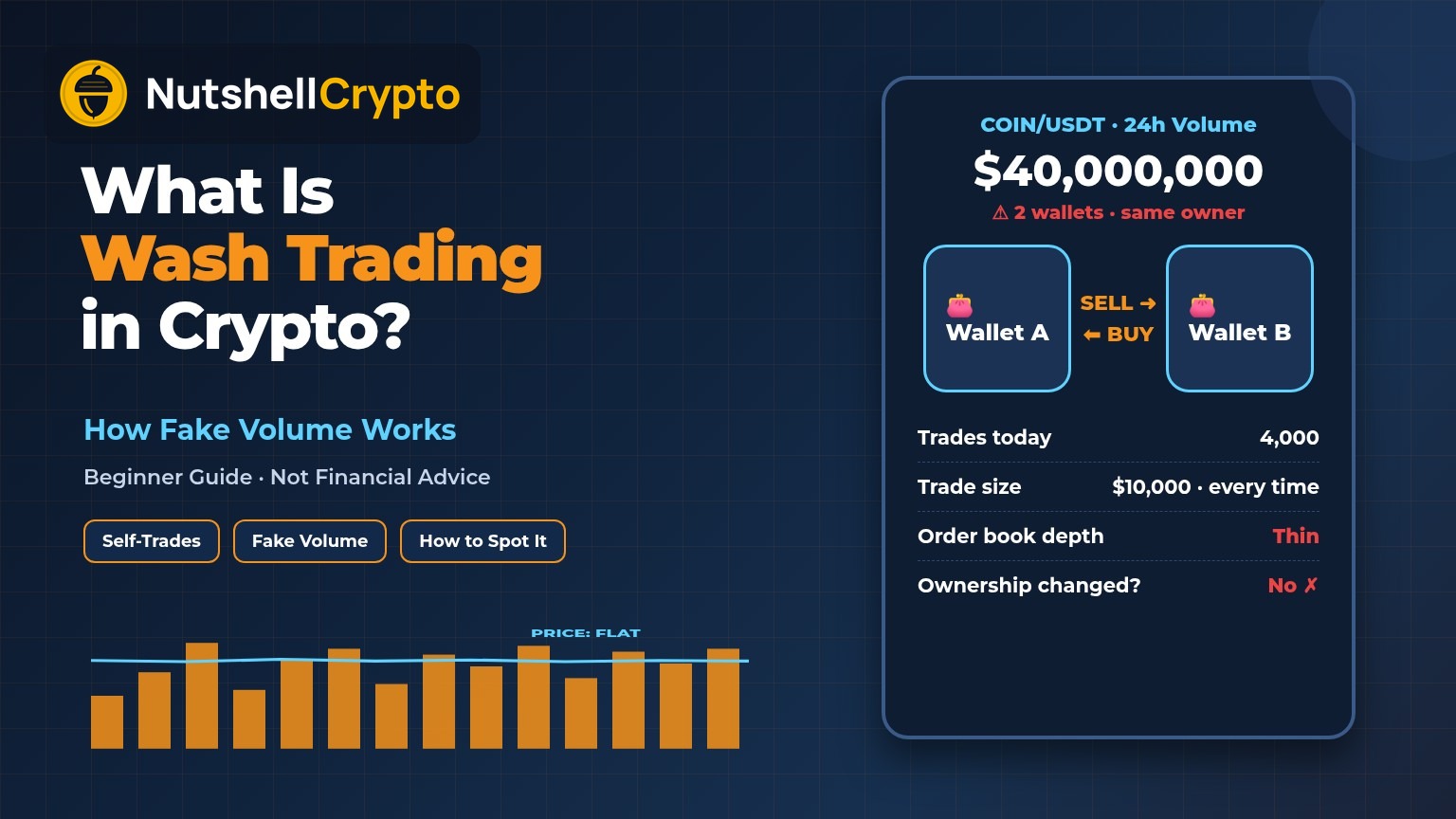
Imagine a token called COIN with almost no real buyers. Its team controls Wallet A and Wallet B.
- Wallet A sells 100,000 COIN to Wallet B for $10,000.
- A few seconds later, Wallet B sells the same 100,000 COIN back to Wallet A for about $10,000.
- A bot repeats this 2,000 times a day.
The exchange now reports about $40 million of daily volume. The team still owns the same coins and has paid only trading fees. But to an outsider scanning a price site, COIN looks like a busy, liquid market.
Why People Wash Trade Crypto
- To look popular. High volume pushes a token up “top volume” and “trending” lists, which brings real buyers.
- To get listed. US prosecutors say Gotbit’s founder described writing code to wash trade so tokens could get listed on CoinMarketCap and trade on bigger exchanges (US Department of Justice). In a related 2024 case, prosecutors say another market maker’s founder described wash volume as a way to get exchanges to waive listing fees (DOJ).
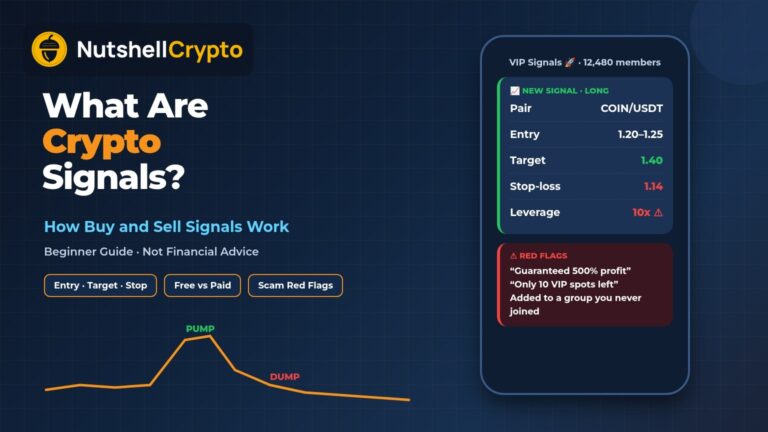
- To set up a pump-and-dump. Fake activity attracts buyers, the price rises, and insiders sell into it. Our guide to crypto signals and pump-and-dump groups covers how that hype side works.
- To inflate an exchange. Some exchanges have reported fake volume to climb exchange rankings. A peer-reviewed study found that fabricated volume helped unregulated exchanges improve their ranking (Cong, Li, Tang and Yang, NBER / Management Science).
- To farm rewards. Some platforms pay rewards or airdrop points based on trading volume, which tempts users to trade with themselves. Chainalysis notes that on centralized exchanges, motives include attracting users and climbing leaderboards.
How Wash Trading Works on Exchanges and DEXs
On centralized exchanges
On a centralized crypto exchange, the manipulator uses several accounts (or a market-making firm’s bot) to place matching buy and sell orders at about the same price and size. Prosecutors say one firm described trading “maybe ten times per minute or twenty times a minute” to “increase the trading volume” and “pump the price,” using many wallets so the activity would not look “fake” (DOJ, October 9, 2024).
On decentralized exchanges
On a decentralized exchange (DEX), trades are public on the blockchain, and each one costs network fees, which makes wash trading more expensive. It still happens. Chainalysis describes bad actors using “multi-sender” tools to fund many fresh wallets from one controller wallet, then having those wallets buy and sell in the same pool so the volume looks spread out. It found the average suspicious controller address managed about 183 wallets in 2024 (Chainalysis).
Not all fast back-and-forth trading is wash trading. Arbitrage bots and MEV bots also buy and sell the same pairs within seconds, but to capture price gaps, not to fake volume. That is one reason wash trading is hard to prove from the outside.
How Common Is Crypto Wash Trading?
Estimates vary a lot because they measure different markets:
- Unregulated centralized exchanges: A study of 29 exchanges estimated that wash trading averaged over 70% of reported volume on the unregulated ones, while regulated exchanges showed normal trading patterns (NBER Working Paper 30783; published in Management Science in 2023). The data in that study is from earlier years, so treat it as a sign of how bad it got, not today’s exact level.
- DEXs on Ethereum, BNB Smart Chain and Base: Chainalysis estimated suspected wash trading of up to $2.57 billion in 2024, using two detection methods ($704 million and $1.87 billion). That is a small share of total DEX volume, and Chainalysis says it was concentrated in a small number of pools and actors (Chainalysis, January 29, 2025, updated February 13, 2025).
The takeaway: big, regulated venues are much cleaner, while small tokens on small or unregulated platforms are where fake volume clusters.
Real Cases: Operation Token Mirrors
In October 2024, US prosecutors in Boston charged 18 people and companies in what they called the first criminal charges against financial services firms for crypto wash trading. The FBI even created its own token, NexFundAI, and hired market makers to see whether they would fake its volume (DOJ). Key points from the DOJ release:
- More than $25 million in crypto was seized, and trading bots that had made wash trades in about 60 different cryptocurrencies were switched off.
- One employee of a charged firm allegedly said: “We have an algorithm that… basically does self-trades, buying and selling,” and “I know that it’s wash trading.”
- One token in the case, Saitama, allegedly reached a market value of $7.5 billion at its peak while its leaders secretly sold.
In June 2025, market maker Gotbit was ordered to forfeit about $23 million in crypto and to stop operating, and its founder was sentenced to eight months in prison after pleading guilty to wire fraud and conspiracy to commit market manipulation (DOJ, June 13, 2025).
Is Wash Trading Illegal?
- United States: The CFTC notes that the Commodity Exchange Act prohibits wash trading (CFTC glossary). Investopedia notes the ban dates back to 1936. Securities laws also ban it, and prosecutors have used wire fraud and market manipulation charges in crypto cases, as in Operation Token Mirrors above.
- Canada: Section 382 of the Criminal Code makes it an offence, punishable by up to 10 years in prison, to trade a security with no change in beneficial ownership in order to create a false appearance of active trading or price. Whether that section applies depends on whether a given crypto asset counts as a security, but provincial securities laws and fraud laws can also apply.
As a regular investor, the bigger risk is not breaking the law yourself. It is buying a coin because its volume looked real.
Wash Trading vs the Wash Sale Rule
These names sound alike but are different things. Wash trading is market manipulation. A wash sale is a tax rule: in the US it blocks you from claiming a loss on a stock or security if you buy it back within 30 days (Investopedia). How that rule applies to crypto is explained in our guide to crypto tax-loss harvesting and the wash-sale question.
How to Spot Fake Crypto Volume
No single check proves wash trading, but several red flags together should make you cautious:
- Volume is huge compared with market cap. A small token trading several times its entire market value every day, with few holders, is suspicious.
- Volume is high but the order book is thin. Real markets with big volume usually have lots of buy and sell orders near the price. CoinGecko’s Trust Score for trading pairs looks at order book spread and ±2% depth, volume, trade frequency and outlier checks for this reason. A red or missing Trust Score on a pair is worth noticing.
- Almost all volume is on one or two small exchanges. If big, regulated exchanges show little activity, the “volume” may not be real demand.
- Volume moves but the price does not. Massive volume with an almost flat price can mean trades are matching each other at the same level. Our guide on how to read crypto trading charts and volume bars explains what normal volume looks like.
- Trades come in odd, repeating sizes. Researchers found unnatural trade-size rounding and patterns on unregulated exchanges (NBER). The same sizes, again and again, every few seconds, is a classic bot pattern.
- On-chain, many fresh wallets funded by one wallet. On a block explorer, dozens of new wallets that all got their first funds from the same address and then trade the same pool is the pattern Chainalysis flags.
- Hype plus “volume” screenshots. If a Telegram or X promoter is pointing at volume as proof that a coin is about to explode, be extra careful.
How to Protect Yourself
- Check where the volume is coming from before you buy a small token, not just the headline number.
- Prefer established, regulated exchanges with deep order books. Thin markets also mean bigger slippage when you try to sell.
- Use limit orders on small coins so a sudden price jump or drop does not fill you at a bad price.
- Never buy because a coin is “trending” alone. Trending lists are partly driven by volume, and volume can be faked.
- If you think you have seen manipulation, you can report it to the CFTC in the US, or to your provincial securities regulator in Canada.
FAQ
What is wash trading in simple terms?
It is trading with yourself, buying and selling the same asset so it looks like there is real demand. Nobody new actually owns the coins afterward.
Is wash trading illegal in crypto?
In the US and Canada, wash trading and market manipulation are illegal in regulated markets, and US prosecutors have brought criminal cases against crypto market makers for it. Some offshore platforms are poorly policed, which is part of why it still happens.
How can I tell if a coin’s volume is fake?
Compare volume with market cap and order book depth, see which exchanges the volume comes from, look for repeating trade sizes, and check data sites’ trust or liquidity scores. Several red flags together are a warning.
Does wash trading happen on Bitcoin?
Yes, at least in reported numbers. Investopedia cites a 2022 Forbes study of 157 exchanges that found more than half of reported Bitcoin trading volume was likely fake or non-economic (Investopedia). Bitcoin’s real market is large and deep, though, so wash trading mostly distorts the reported volume figures rather than Bitcoin’s price. Small tokens are much easier to manipulate.
Is wash trading the same as a wash sale?
No. Wash trading is faking market activity. A wash sale is a US tax rule about claiming losses when you buy back the same security within 30 days.
This article is for education only and is not financial, legal or investment advice. Crypto is highly volatile, and you can lose some or all of what you invest. Small, thinly traded tokens carry extra risk of manipulation.
Sources
- CFTC Glossary: Wash Trading
- Investopedia: Wash Trading Explained
- Investopedia: Wash Sale
- US Department of Justice: Eighteen Individuals and Entities Charged (October 9, 2024)
- US Department of Justice: Gotbit and Founder Sentenced (June 13, 2025)
- Chainalysis: Suspected Wash Trading May Account for Up To $2.57 Billion (2025 Crypto Crime Report)
- NBER Working Paper 30783: Crypto Wash Trading (Cong, Li, Tang, Yang)
- CoinGecko: Methodology and Trust Score
- Justice Laws Website (Canada): Criminal Code, Section 382