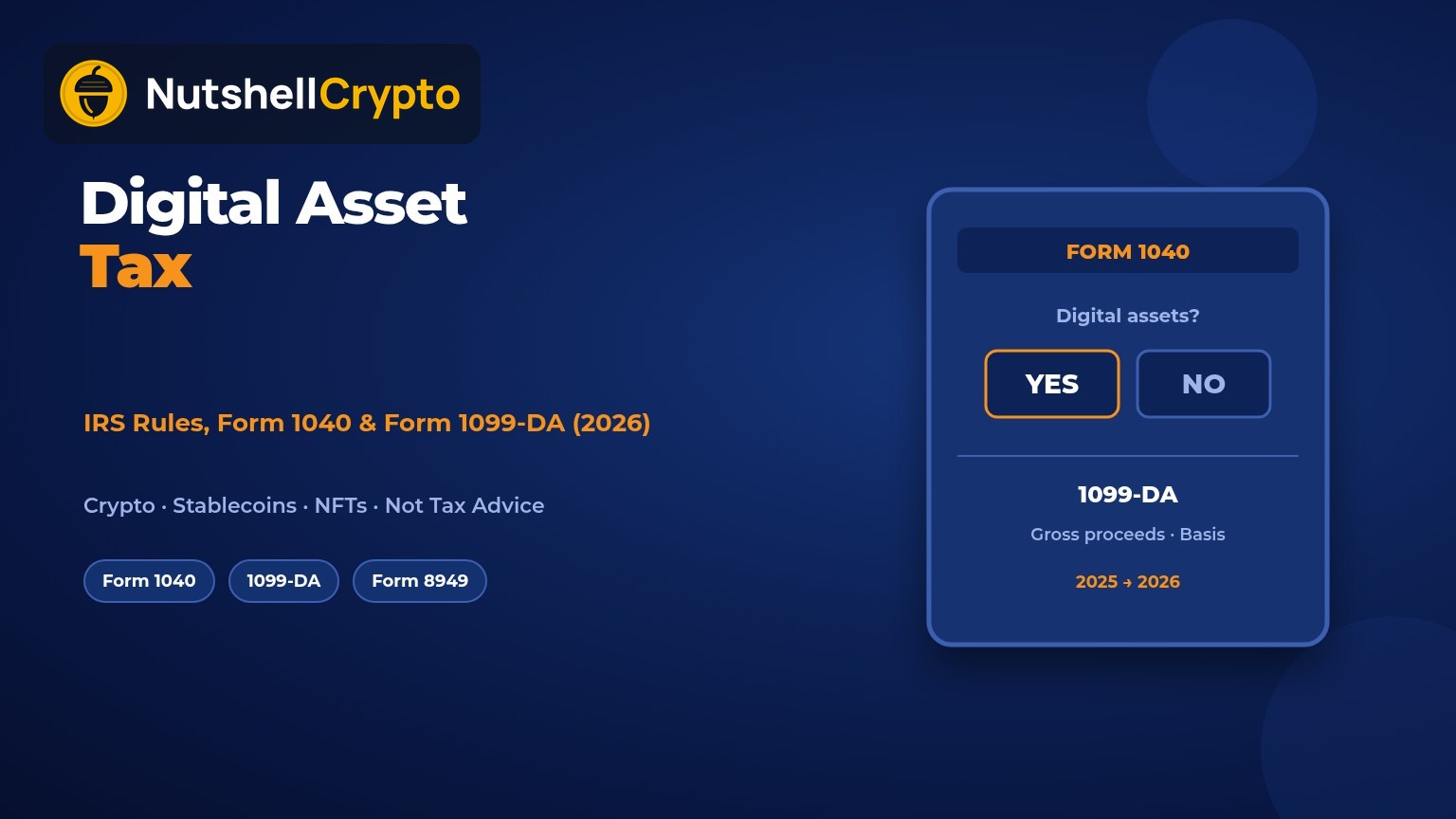
In a nutshell: Digital asset tax paperwork comes down to two things: the Yes/No digital asset question on Form 1040, and Form 1099-DA from crypto brokers. Answer Yes if you received or disposed of a digital asset during the year; answer No if you only held or bought with dollars. Form 1099-DA reports gross proceeds for 2025 sales and adds cost basis for covered securities sold from 2026. Both feed into Form 8949 and Schedule D. Educational only; not tax advice.
Last updated: October 12, 2026.
The IRS uses the official term digital assets for cryptocurrencies, stablecoins and NFTs. That language shows up on Form 1040, in broker reporting rules, and on the new Form 1099-DA. This guide focuses on just two things: how to answer the Form 1040 digital asset Yes/No question, and what Form 1099-DA reports and how to use it. For how crypto is taxed in general (taxable events, rates, income), see our beginner guide to crypto taxes in the US.
Table of contents
What Counts as a Digital Asset?
Per the IRS digital assets page, a digital asset is any digital representation of value recorded on a cryptographically secured distributed ledger (or similar technology). For U.S. tax purposes, digital assets are property, not currency.
Examples the IRS lists include:
- Convertible virtual currencies and cryptocurrencies such as Bitcoin
- Stablecoins
- Non-fungible tokens (NFTs)
If an asset has those characteristics, the IRS treats it as a digital asset for federal income tax purposes. That is why forms and notices say “digital assets” instead of only “crypto.”
The Form 1040 Digital Asset Yes/No Question
On Form 1040 (and several other returns), you must answer this question:
At any time during the tax year, did you: (a) receive (as a reward, award or payment for property or services); or (b) sell, exchange, or otherwise dispose of a digital asset (or a financial interest in a digital asset)?
You must check Yes or No. Do not leave it blank, even if you did not get a Form 1099-DA. The IRS publishes a questionnaire to help you decide.
When to answer No
According to the IRS, you generally answer No if you:
- Did not own any digital assets
- Only held digital assets in a wallet or account and had no other digital asset transactions during the year
- Bought digital assets with U.S. dollars or other real currency (including through apps like PayPal or Venmo) but did not sell or dispose of them
- Transferred digital assets between wallets or accounts you own or control (unless you paid a network fee in digital assets, which the IRS treats as a disposition of the fee amount)
Simply holding crypto is not enough to force a Yes. See also if I hold crypto, do I pay taxes? and if I transfer crypto, do I pay taxes?.
When to answer Yes
Answer Yes if during the year you received digital assets as payment, a reward or award, from mining or staking, or from an airdrop related to a hard fork — or if you sold, exchanged, or otherwise disposed of a digital asset (including trading one coin for another, paying for goods or services with crypto, or paying a transfer fee with digital assets).
Who must answer the question
The question appears on Forms 1040, 1040-SR and 1040-NR, and also on Forms 1041 (estates and trusts), 1065 (partnerships), 1120 and 1120-S (corporations). Per the IRS digital assets page, all taxpayers filing those returns must check Yes or No, not only people who traded crypto.
Examples: Yes or No?
| What you did in the tax year | Answer |
|---|---|
| Bought $500 of bitcoin on an exchange with dollars and held it | No |
| Moved ETH from an exchange to your own hardware wallet (fee paid in USD) | No |
| Sold bitcoin for dollars, even at a loss | Yes |
| Swapped ETH for a stablecoin | Yes |
| Received staking rewards or an airdrop | Yes |
| Got paid in USDC for freelance work | Yes |
| Paid a network fee in crypto when moving coins between your own wallets | Yes (the fee is a disposition) |
These examples follow the IRS questionnaire and the Form 1040 instructions. Answering Yes does not by itself mean you owe tax; it tells the IRS to expect digital asset activity on your return.
Which Events Are Taxable?
This page covers only the paperwork. For which crypto activities are taxable and which are not, see our beginner guide to crypto taxes.
Capital Gains vs Ordinary Income
Selling or swapping digital assets usually creates a capital gain or loss, while crypto you receive as pay or rewards is usually ordinary income. Rates and holding periods are explained in our crypto capital gains tax guide.
Form 1099-DA Broker Reporting
Form 1099-DA (Digital Asset Proceeds From Broker Transactions) is how brokers report digital asset sales and other dispositions to you and the IRS. It works much like the Form 1099-B you get for stock sales.
What Form 1099-DA reports
Final broker reporting regulations (Treasury Decision 10000, July 2024) phase in requirements:
- Sales on or after January 1, 2025: Brokers must report gross proceeds. Per IRS Tax Tip 2026-07 (Jan. 28, 2026), brokers had to send you a copy by February 17, 2026 for 2025 transactions, and most 2025 statements will not include basis. You calculate basis from your records.
- Sales on or after January 1, 2026: Brokers must also report basis for covered securities, generally digital assets acquired on or after January 1, 2026 and held in the same broker account. Basis reporting for noncovered securities remains optional (with box 9 checked when not reporting). See the 2026 Instructions for Form 1099-DA.
You get a 1099-DA when a broker effects a disposition of your digital assets for another digital asset, for dollars or other currency, for property, goods or services, or to pay broker transaction costs (IRS).
Who issues Form 1099-DA
Brokers issue it: custodial platforms that take possession of your digital assets, such as centralized exchanges and certain hosted wallet providers, plus some digital asset kiosks and payment processors. The issuer’s name and contact details appear in the “Filer” box at the top left of the form. For 2025, the requirements generally apply to U.S. brokers, so a foreign exchange may not send you one (IRS).
What to do if the numbers are wrong
The IRS says (source):
- Request a corrected form from the issuer (the broker in the “Filer” box). Do not contact the IRS; it cannot correct your 1099-DA.
- If you got a 1099-DA you should not have, contact the issuer immediately.
- Keep the original, any corrected form, and all correspondence with your records.
- Don’t wait to file. Report income from the corrected form as you normally would.
Important caveats from the IRS:
- You must report all income, gains and losses whether or not you receive a 1099-DA.
- For 2025, requirements generally apply to U.S. brokers; foreign exchanges may not issue the form.
- Decentralized/non-custodial brokers that do not take possession were not included in the final custodial broker reporting rules.
- Notice 2024-57 temporarily excepts certain transaction types (for example wrapping, liquidity providing, staking, lending, short sales and notional principal contracts) from broker 1099-DA filing until further guidance — but rewards from those activities can still be taxable to you.
If you use Coinbase, our Coinbase tax report guide covers how to download and use that platform’s tax documents alongside 1099-DA.
How Form 1099-DA Ties to Form 8949 and Schedule D
If you disposed of digital assets held as capital assets, the IRS says to report each sale or exchange on Form 8949, then carry the totals to Schedule D (Form 1040). You still report even if a sale produced a loss, and even if you never received a Form 1099-DA.
Form 8949 needs the description of the asset, dates acquired and sold, proceeds, cost or other basis, and the gain or loss. In practice:
- Proceeds come from your 1099-DA (or your own records if you got no form).
- Basis comes from the 1099-DA only when the broker reported it (covered securities sold from 2026). Otherwise, you enter basis from your own records. The Instructions for Form 8949 explain which checkbox (Part I or Part II, short- or long-term) matches whether basis was reported to the IRS.
- If the broker’s numbers are wrong and you cannot get a corrected form in time, the Form 8949 instructions explain how to report the correct figure and enter an adjustment code.
The IRS gets a copy of every 1099-DA, so your Form 8949 proceeds should reconcile with what brokers reported.
Record Keeping
The IRS expects you to keep records that show purchases, receipts, sales, exchanges and other dispositions, plus fair market value in U.S. dollars when you receive digital assets as income. At a minimum, track for each lot:
- Asset type and number of units
- Date and time acquired and disposed
- Cost basis and fair market value at each event
- Wallet or account, and which broker (if any) effected the sale
Good records matter even more for 2025, when many 1099-DA forms show proceeds without basis. They also help if you use tax-loss harvesting; see crypto tax loss harvesting.
Canada: CRA Rules in Brief
Canada uses different vocabulary. The CRA talks about crypto-assets, not the IRS “digital asset” Form 1040 checkbox. Per CRA guidance:
- Crypto-assets are generally treated like a commodity for tax purposes (property), not as Canadian currency.
- Dispositions (selling, trading, using crypto to buy goods/services, or gifting) can create business income or a capital gain, depending on your facts (frequency, intent, time spent, and similar factors).
- When a disposition is on account of capital, you include half (50%) of the capital gain as a taxable capital gain on Schedule 3 / line 12700. CRA’s crypto examples use that one-half inclusion.
- Wallet-to-wallet transfers you control are generally not a taxable disposition.
For the full Canadian walkthrough, see cryptocurrency tax in Canada.
This article is for education only and is not financial, investment or tax advice. Tax rules change and your facts matter. Confirm current IRS and CRA guidance or talk to a qualified tax professional before filing.
FAQ
What is digital asset tax?
Digital asset tax means U.S. federal income tax on cryptocurrencies, stablecoins, NFTs and similar ledger-based assets. The IRS treats them as property. You answer the Form 1040 digital asset question, report dispositions on Form 8949/Schedule D, and may receive Form 1099-DA from brokers.
Do I owe tax just for answering Yes on Form 1040?
No. The Yes/No question flags that you had certain digital asset activity. Your tax (if any) still comes from reporting income, gains and losses on the correct forms.
Will every crypto sale show up on Form 1099-DA?
No. Foreign brokers, non-custodial venues, and some excepted transaction types may not generate a 1099-DA. You still must report taxable activity from your own records.
When does Form 1099-DA include cost basis?
IRS final rules require gross proceeds reporting for broker sales on or after January 1, 2025, and basis reporting for covered securities on sales on or after January 1, 2026. Most 2025 payee statements will not include basis.
Is Canada’s digital asset tax the same?
No. Canada has no Form 1040-style digital asset checkbox. CRA rules focus on business income versus capital gains, with a 50% capital gains inclusion in current CRA crypto examples. Read our Canada guide for details.
Sources
- IRS: Digital assets
- IRS: Determine how to answer the digital asset question
- IRS Tax Tip 2026-07: Reminders for taxpayers about digital assets
- IRS: Understanding your Form 1099-DA
- IRS: Instructions for Form 1099-DA (2026)
- IRS: About Form 8949
- IRS: Instructions for Form 8949
- IRS: About Schedule D (Form 1040)
- IRS: Instructions for Form 1040
- IRS Publication 544: Sales and Other Dispositions of Assets
- CRA: Reporting income from crypto-asset transactions
- CRA: Line 12700 – Taxable capital gains