In a nutshell: Why is Monero dropping today? XMR is down about 10.6% in 24 hours to roughly $511, mostly because the whole crypto market sold off as Bitcoin fell below $70,000 and more than $1.2 billion in leveraged bets were liquidated. On top of that, MEXC is delisting all XMR spot and futures pairs on November 13, which adds Monero-specific selling pressure. Prices were checked on CoinGecko at 9:50 a.m. PKT (4:50 a.m. UTC) on November 13, 2026. No hack or network problem has been reported.
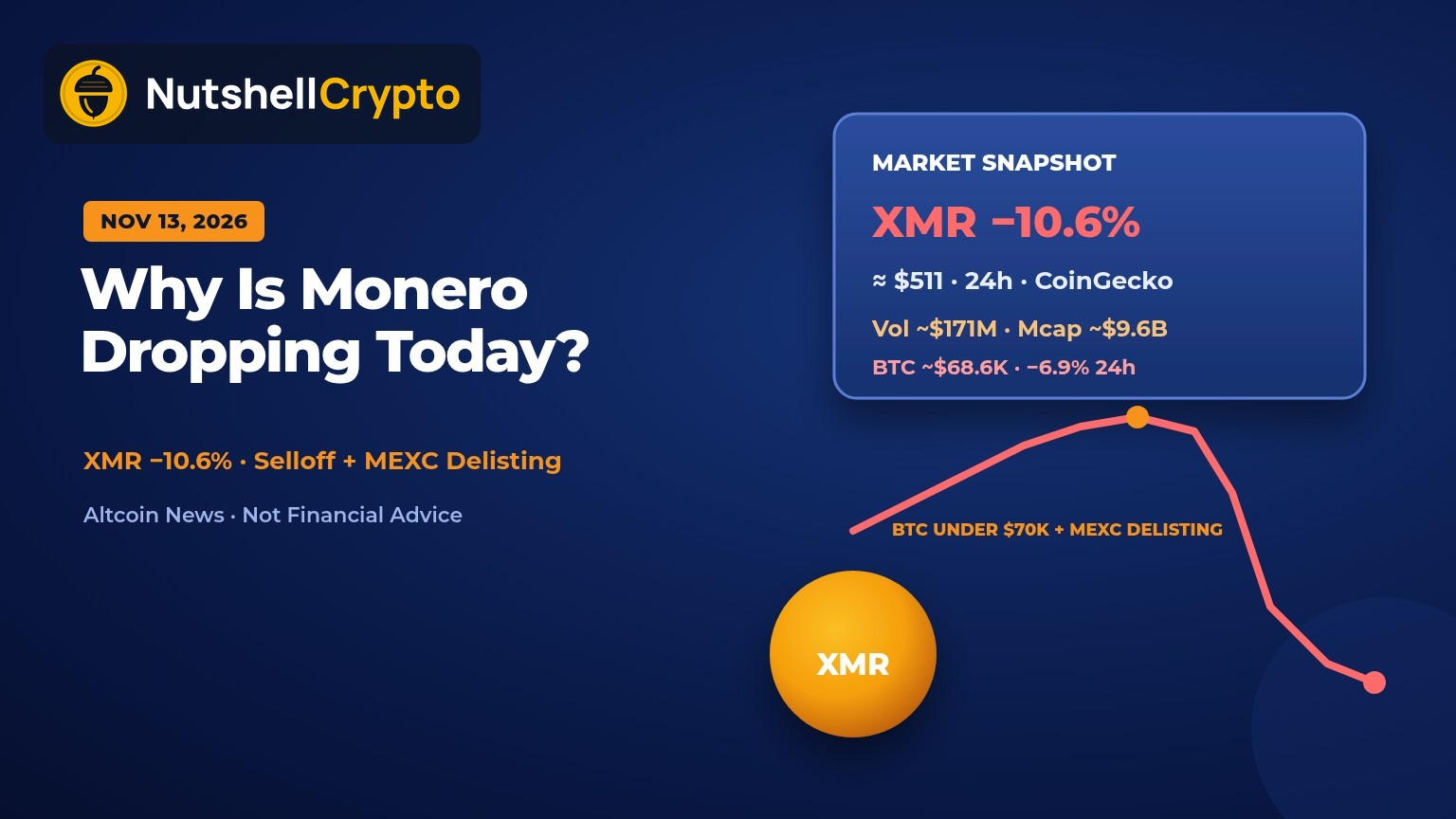
Monero (XMR) fell about 10.6% in a day because a broad crypto sell-off hit a coin that trades on fewer exchanges than most top coins, and one of those exchanges, MEXC, is removing it today. Bitcoin and Ether fell about 7% and 6%, so XMR dropped harder than the market, and the MEXC delisting is the clearest coin-specific reason for that gap.
Why Is Monero Dropping Today?
At our November 13 check, Monero ranked #13 by market value (about $9.6 billion), with a 24-hour high near $570, trading volume around $171 million and a seven-day loss of about 17.9%, per CoinGecko. In local money that is about C$728 and A$750 per coin. XMR is now roughly 36% below its all-time high of $797.73, set on January 14, 2026.
Over the same 24 hours, Bitcoin was down about 6.9% to near $68,590, Ether about 6.1% to near $1,922, and the total crypto market about 8.2% (CoinGecko). Dash, the other coin in MEXC’s delisting notice, was down about 7.6%. So XMR fell roughly 1.5 times as hard as Bitcoin.
CoinMarketCap’s AI price analysis from early November 13 said the move “looks primarily market driven” and found no confirmed Monero-only catalyst, naming liquidations as a possible amplifier. That is a fair reading: most of today’s drop is the market, and the delisting explains part of the extra weakness.
Main Reason: Bitcoin Breaks Below $70,000
Bitcoin fell below $70,000 early Friday for the first time since August 19, and Ether dropped below $2,000, CoinDesk reported. CoinDesk named XMR, along with GT and Stacks, among the smaller tokens down 7% or more, and tied the sell-off to a US Dollar Index above 103, its highest since April 2025, plus rising odds of a Federal Reserve rate hike in December after a hotter-than-expected October CPI report.
Investing.com said markets were pricing a 25 to 50 basis point hike in December, according to CME FedWatch. It also pointed to MSCI’s plan to drop Strategy and similar Bitcoin treasury companies from its indexes from November 30, and to a tougher US regulatory outlook after Democrats won majorities in both chambers of Congress.
Liquidations made it worse. Exchanges closed about $1.23 billion of leveraged positions in 24 hours, hitting more than 151,000 traders, with long (bullish) bets making up over 96% of Bitcoin’s $677.5 million share, crypto.news reported, citing CoinGlass. The same report said US spot Bitcoin ETFs had about $1.44 billion of outflows over five trading days through November 11. If you are new to forced selling, our guide on how crypto liquidation works explains why these waves push prices down fast.
MEXC Delisting: The Monero-Specific Factor
MEXC said it will suspend XMR and DASH spot trading on November 13, 2026, at 09:00 UTC (2:00 p.m. PKT) and automatically cancel all open orders, according to its spot delisting notice. Deposits are already closed, and withdrawals stay open for 30 days after the delisting.
A separate futures notice says MEXC will delist the XMR and DASH USDT-M perpetual futures at 10:00 UTC the same day and close all remaining positions at the fair price. Traders closing positions before that deadline, and holders moving coins off the exchange, can add short-term selling.
Keep the size in perspective. Monero Observer noted that MEXC’s XMR spot pairs were less than 1% of Monero’s total 24-hour trading volume. MEXC did not give a reason for the delisting in its notice. So the delisting is a sentiment hit and an access problem for MEXC users, not the main driver of an 11% fall.
Monero Observer also reported that MEXC’s XMR withdrawals were temporarily unavailable for maintenance, with MEXC estimating a return around November 22. If you hold XMR there, check the exchange’s notices and move your coins to a wallet you control once withdrawals reopen. Our self-custody guide covers how to do that safely.
Other Factors Behind the XMR Drop
- Thinner liquidity. With daily volume around $150 million, Monero is one of the less liquid coins in the top 25, so selling waves can move it more than Bitcoin, CryptoTicker noted on November 12, when XMR hit its lowest daily level since October 13.
- Giving back a rally. XMR had climbed to a monthly high of $640.02 on November 4 after gaining more than a fifth from mid-October, so some holders were sitting on gains they could lock in (CryptoTicker).
- Delayed THORChain swaps. The announced THORChain integration for XMR swaps has still not been switched on, CryptoTicker reported.
- EU privacy-coin rules. The EU’s anti-money-laundering regulation, Regulation (EU) 2024/1624, bars crypto service providers from keeping accounts that use anonymity-enhancing coins, and it applies from July 10, 2027. Self-hosted wallets are not covered by that ban.
What It Means in the US, Canada and Australia
Exchange access differs by country, so check your own platform. In Canada, Kraken already delisted XMR for Canadian clients, disabling trading on September 2, 2025, citing local compliance requirements. A social post claiming a fresh Kraken Canada delisting circulated this week, but CoinMarketCap’s analysis called it unverified, and Kraken’s notice refers to the 2025 change. For readers in Australia, XMR was near A$750 at our check.
Today’s move is about markets and exchange access, not the Monero network. The project’s official site still describes XMR as a private, decentralized cryptocurrency, and no outage or security issue has been reported. For how privacy affects exchange rules, see our explainer on KYC in crypto.
What to Watch Next
- Bitcoin around $70,000. XMR has tracked the wider market closely this week; a Bitcoin recovery or a deeper slide will likely set the tone (CoinMarketCap, CoinDesk).
- MEXC deadlines. Spot trading ends at 09:00 UTC and futures at 10:00 UTC on November 13, with a 30-day withdrawal window after that (MEXC).
- Fed expectations. Markets are weighing a December rate hike after the hot October CPI report (Investing.com).
- Other privacy coins. Zcash is also down about 8.7% today; see our Zcash drop explainer for its recent moves.
If you buy dips in volatile coins, spreading purchases over time can lower timing risk; you can model that with our crypto DCA calculator. For how exchanges list and remove coins, read what a centralized exchange is.
FAQ
Is Monero being delisted?
MEXC is delisting XMR spot and perpetual futures pairs on November 13, 2026, according to its official notices. Delistings happen exchange by exchange and country by country; Kraken, for example, stopped XMR trading for Canadian clients on September 2, 2025. Monero still trades on other exchanges and can be held in self-custody wallets.
Can I still withdraw Monero from MEXC?
MEXC says XMR withdrawals stay open for 30 days after the November 13 delisting. Monero Observer reported that withdrawals were temporarily paused for maintenance, with MEXC estimating a restart around November 22, so check MEXC’s announcements before the window closes.
Why is Monero price disconnected from the rest of the market?
XMR often moves differently because it trades on fewer exchanges and has thinner volume than most top-20 coins, and privacy-coin news affects it directly. Today it moved with the market but fell harder: about 10.6% versus roughly 6.9% for Bitcoin on CoinGecko.
Is Monero banned in the EU?
Not yet. The EU anti-money-laundering regulation will bar crypto service providers from keeping accounts that use anonymity-enhancing coins from July 10, 2027, but it does not cover self-hosted wallets that the provider does not control.
Is Monero dead?
No. The Monero network is running normally, and today’s drop came from a market-wide sell-off plus one exchange delisting, not a network failure. Price drops and delistings can hurt access and sentiment, but they do not stop the blockchain.
Sources
- CoinGecko, Monero (XMR) price and market data (checked 9:50 a.m. PKT, November 13, 2026)
- CoinGecko, cryptocurrency prices by market cap
- CoinMarketCap, CMC AI Monero price analysis (November 13, 2026)
- MEXC, Delisting of XMR and DASH Spot Pairs on Nov 13, 2026
- MEXC, Delisting of XMR and DASH USDT-M Perpetual Futures Pairs
- Monero Observer, MEXC to delist XMR and DASH spot trading pairs
- CoinDesk, Bitcoin dips below $70,000 as Dollar Index hits 19-month high (November 13, 2026)
- Investing.com, Bitcoin drops below $70k as crypto appetite sours (November 13, 2026)
- crypto.news, Bitcoin price crashes below $70K as crypto liquidations hit $1.2B (November 13, 2026)
- CryptoTicker, Monero price falls 8.6 percent (November 12, 2026)
- Kraken, Notice of delisting for Monero (XMR) in Canada
- EUR-Lex, Regulation (EU) 2024/1624 (anti-money-laundering regulation)
- Monero, official website
Disclaimer: This article is for informational purposes only and is not financial advice. Crypto prices are volatile; do your own research.