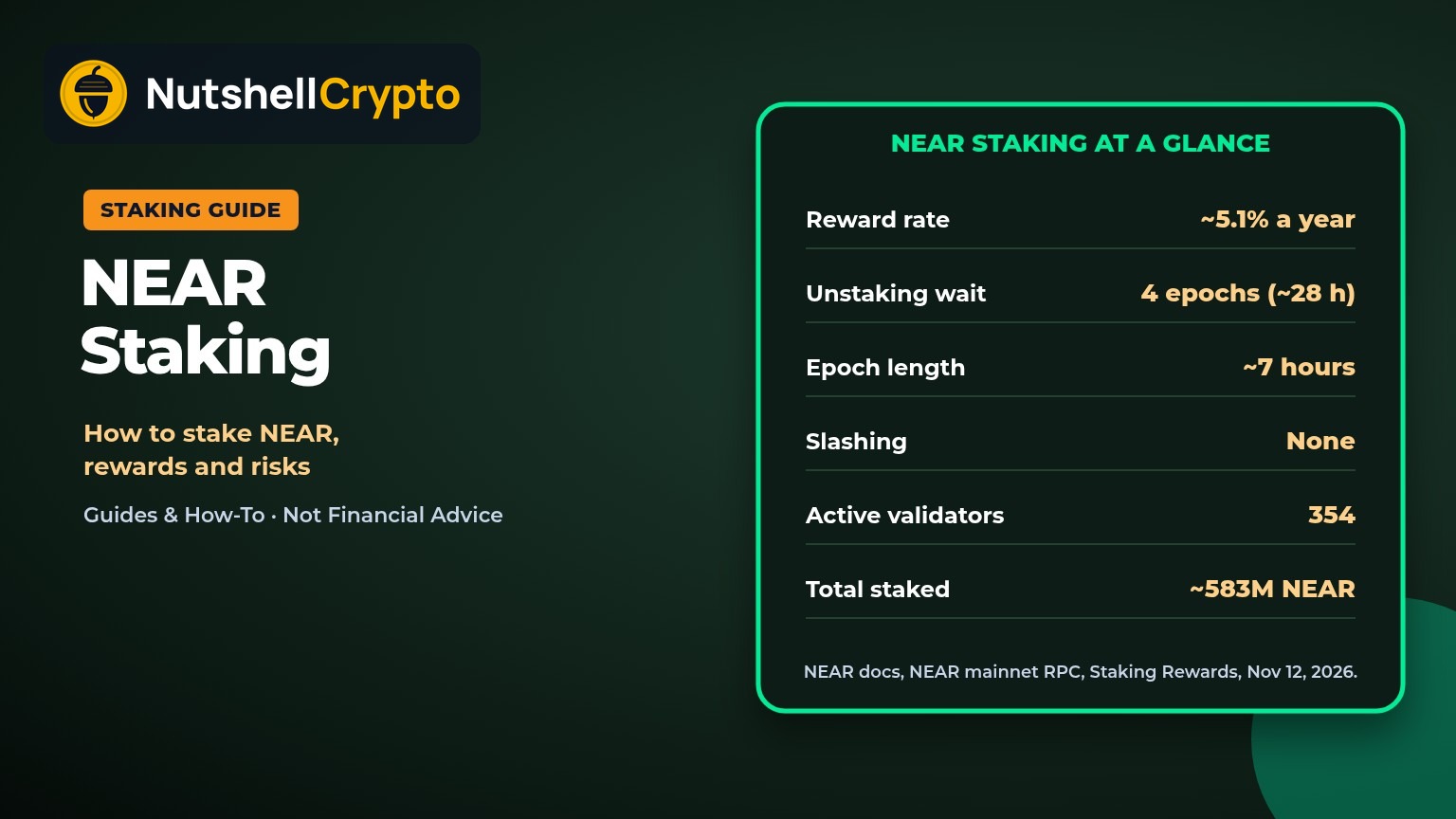
In a nutshell: You stake NEAR by delegating it from your own wallet to a validator’s staking pool, and you earn a share of the network’s rewards minus the pool’s fee. On November 12, 2026, the network-wide reward rate was about 5.1% a year before fees, rewards were added every epoch (about 7 hours), and unstaked NEAR took 4 epochs, roughly 28 hours, before you could withdraw it. Educational only; not financial advice.
NEAR staking means delegating your NEAR to a validator’s staking pool so it helps secure the network and earns rewards, without giving up ownership of your coins. On November 12, 2026, that paid about 5.1% a year before the pool’s fee, and getting your NEAR back after unstaking took about 28 hours.
This guide covers how NEAR staking works, the live numbers we pulled from the NEAR mainnet RPC on November 12, 2026 (checked at about 4:51 to 4:55 PM PKT), how to stake with a wallet, a Ledger or an exchange, liquid staking with Meta Pool, RHEA and LiNEAR, the unstaking wait, risks, and short tax notes for the US, Canada and Australia.
Table of contents
What Is NEAR Staking?
NEAR is a proof-of-stake blockchain. Validators run the nodes that produce and check blocks, and holders support them by delegating NEAR. The NEAR validators docs say validators are paid in NEAR every epoch, that the yearly reward budget is 2.5% of the total supply, and that NEAR does not slash (burn) staked tokens: a validator that is offline or underperforms just loses its rewards and can be removed from the set. If you are new to the idea, start with our guide to what staking in crypto is.
Most people never run a validator. Instead they use delegation: you send NEAR to a validator’s staking pool contract, the pool stakes everyone’s coins together, and the pool’s rewards are shared out by stake.
How NEAR Staking Pools Work
Each NEAR validator usually runs a staking pool smart contract, and you can read the reference version in NEAR’s core-contracts repository on GitHub. A few points matter for you as a delegator:
- Your coins stay in the pool, not with the operator. The contract’s listed guarantees say it can’t lose or lock users’ tokens and that the owner can’t withdraw other delegators’ funds.
- Rewards are added to your stake. When a new epoch starts, the pool works out the new rewards, takes the owner’s fee, and adds the rest to the total staked balance. That raises the value of every share, so your staked balance grows without you claiming anything.
- The fee is set by the pool owner. The contract calls it the
reward_fee_fraction. It can be anything from 0% to 100%, and the owner can change it. - Rewards start after the next epoch. The NEAR staking tutorial says you start earning after the next epoch, and it uses 100 NEAR as its example without listing a minimum.
- Unstaking is a two-step process. You unstake, wait 4 epochs, then withdraw. More on that below.
Validator selection is competitive. The validators docs say mainnet has 500 validator seats and no fixed minimum stake: if fewer than 500 proposals qualify, a validator needs more than 1/62,500 of the total stake to get in. The top 100 validators produce blocks and chunks, and the rest act as chunk validators, all paid from the same reward pool in proportion to stake.
NEAR Staking Numbers on November 12, 2026
We read these values from the public NEAR mainnet RPC (EXPERIMENTAL_protocol_config, validators and block) at about 4:51 to 4:55 PM PKT on November 12, 2026, and queried each active pool’s get_reward_fee_fraction on-chain.
| Setting | Live value |
|---|---|
| Epoch length | 43,200 blocks (the last two epochs took about 6.8 and 7.1 hours) |
| Unstaking wait | 4 epochs (about 28 hours at current speed) |
| Yearly reward budget (max inflation) | 1/40 of total supply (2.5%) |
| Active validators | 354 (epoch 4,962) |
| Total stake of active validators | about 582.7 million NEAR |
| Total supply | about 1,311.5 million NEAR (about 44.4% staked) |
| Smallest active validator | about 9,400 NEAR |
| Largest active validator | about 33.2 million NEAR |
Pool fees varied a lot. Of the 354 active pools, 7% was the most common fee (115 pools), followed by 5% (75 pools) and 10% (34 pools). Eight pools charged 0%, and 25 charged 100%, which means delegators there get no rewards. You can compare pools, fees and delegator counts on NearBlocks or Near Staking, both of which the NEAR docs point to.
Staking Rewards showed a 5.06% reward rate, a 44.5% staking ratio, about 583.7 million NEAR staked and 2.49% inflation on November 12. CoinGecko priced NEAR at $3.44 (C$4.91, A$5.04) at about 4:52 PM PKT, down about 6.4% in 24 hours. If you are wondering about the recent price swings, see why NEAR has been dropping.
NEAR Staking Rewards and APY
The validators docs give the math. The yearly reward budget is 2.5% of supply, 10% of that goes to the protocol treasury, and validators share the rest by stake, so the yearly yield is about 2.25% times total supply divided by total stake. With the November 12 figures that is 2.25% × 1,311.5 million ÷ 582.7 million, or about 5.06% a year before pool fees, which matches the 5.06% on Staking Rewards. The docs add that validators below 90% uptime in an epoch get no reward for it, and rewards are cut between 90% and 99% uptime.
Two things move the rate over time. If more NEAR gets staked, the same budget is split across more coins and the rate falls. If stake leaves, the rate rises. Coinbase’s NEAR page (powered by Staking Rewards data) showed 5.07% on November 12, down from 5.29% thirty days earlier. Some wallet pages, such as MyNearWallet’s homepage and Meteor’s staking guide, still mention about 10%, so check the date on anything you read.
As a rough example, 1,000 NEAR in a pool charging a 7% fee would earn about 5.06% × 0.93 = 4.71% a year, or about 47 NEAR if nothing changed, worth roughly $162 at the November 12 price. To try your own figures, enter the NEAR rate into our Chainlink staking calculator, which works for any yearly rate, and see our guide to staking APR vs APY for why the headline numbers differ.
How to Stake NEAR Step by Step
Option 1: A NEAR wallet
The official NEAR ecosystem wallets page lists wallets such as NEAR Mobile, Meteor Wallet, HOT Wallet and Intear Wallet. NEAR Mobile lists staking among its features, and MyNearWallet also offers staking and Ledger support. The Meteor Wallet staking guide shows the usual flow:
- Fund your wallet with NEAR, leaving a little unstaked for transaction fees.
- Click Stake, choose Standard Staking, then Create New Staking.
- Enter the amount and pick a validator from the list. Check its fee and stake on NearBlocks first; in Stakin’s walkthrough, the default choice was Meteor’s own pool.
- Click Stake and confirm the transaction.
- Your stake starts earning from the next epoch, and rewards are added to your staked balance each epoch after that.
Validators publish the same steps with their own pool names. For example, Stakin’s Meteor guide searches for its pool in the validator list. Providers such as Figment run some of the largest NEAR pools, including figment.poolv1.near and ledgerbyfigment.poolv1.near.
Option 2: A Ledger
Ledger’s NEAR page says you can stake NEAR through Ledger Live in a few clicks and track rewards in its Earn section, with staking provided by third parties and availability varying by country. Our Ledger staking guide explains how staking from a hardware wallet works in general.
Option 3: An exchange
Exchange support varies by country and changes often. When we checked on November 12, 2026, Kraken’s NEAR staking page showed up to 5.1% APY on bonded NEAR with a 1-day bonded time, 2.52% on flexible NEAR, and weekly payouts. Its small print says flexible staking earns rewards on up to 50% of the assets you stake and that geographic restrictions apply. Coinbase’s NEAR page said NEAR “is not available to stake on Coinbase”, although it is available to trade. An exchange holds your coins, picks the validator and takes its own cut, and our flexible vs locked staking guide explains the trade-off.
Unstaking NEAR: the 4-Epoch Wait
The NEAR staking tutorial says unstaked tokens enter a 4-epoch unbonding period before they can be withdrawn. In practice:
- You send an unstake (or unstake-all) transaction to the pool.
- The pool sets the earliest withdrawal at the current epoch plus 4.
- Once that has passed, you send a separate withdraw transaction to move the NEAR back to your spendable balance.
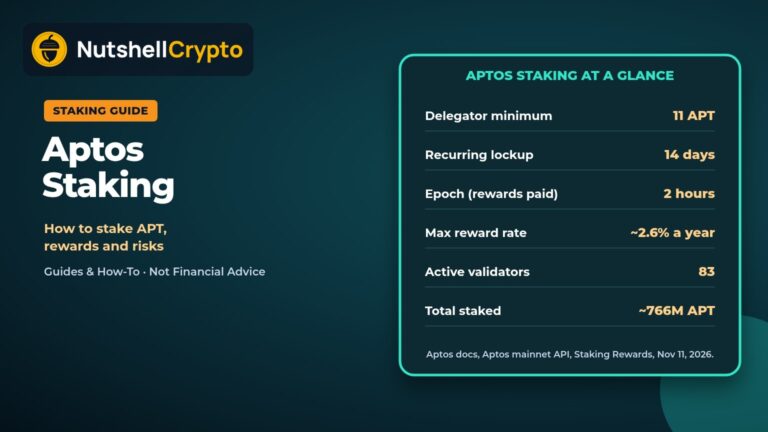
NEAR’s liquid staking docs put 4 epochs at roughly 24 to 28 hours, which fits the roughly 7-hour epochs we measured on November 12. Some pages, such as the Staking Rewards description, still say about 2 days, so trust the epoch count rather than a fixed number of hours. Our explainer on what an unbonding period is compares this with other chains, such as the 14-day cycle in our Aptos staking guide.
Liquid Staking on NEAR: stNEAR, rNEAR and LiNEAR
Liquid staking gives you a token that stands for your staked NEAR, so you can sell it or use it in DeFi instead of waiting through the unstaking delay. The NEAR liquid staking docs note that these contracts spread stake across many validators, so the rate is usually slightly lower than the best single pool. Our liquid staking guide explains the general idea and risks. The largest NEAR options by value locked on DefiLlama at about 4:52 PM PKT on November 12, 2026, were:
- Meta Pool (stNEAR). The Meta Pool FAQ says stNEAR’s price in NEAR rises each epoch as rewards are added. Meta Pool’s site showed 4.13% APY for NEAR, and DefiLlama showed about $75.8 million locked on NEAR.
- RHEA LST (rNEAR). The RHEA guide describes rNEAR as a token that gains value against NEAR, with an instant unstake through the RHEA exchange for a small fee or a standard unstake of 4 epochs. DefiLlama showed about $65.7 million locked.
- LiNEAR. LiNEAR’s site says it delegates to up to 200 active nodes and that LiNEAR rises in value against NEAR after each epoch. DefiLlama showed about $44.6 million locked.
Swapping a liquid staking token back to NEAR instantly means paying a swap fee and possibly accepting a price a little below its NEAR value.
Risks of NEAR Staking
- Price risk. A yield of about 5% does little if the NEAR price falls, and you wait about a day to withdraw after unstaking.
- Validator performance. A validator below 90% uptime earns nothing for that epoch, and one that drops out of the active set stops earning until it gets back in.
- Fees. On November 12, 25 active pools charged a 100% fee, and owners can change fees, so check yours before and after you stake.
- Changing rates. The rate depends on how much NEAR is staked and on the protocol’s reward settings, which governance and upgrades can change.
- Smart-contract and depeg risk. Liquid staking adds protocol risk and the chance that the token trades below its NEAR value.
- Wallet risk. Anyone with your recovery phrase can unstake and withdraw your NEAR. Never share it, and ignore anyone offering to “speed up” a withdrawal.
The NEAR docs say staked tokens are not slashed, but rewards are never guaranteed.
US, Canada and Australia Tax Notes
This section is general information, not tax advice. We found no IRS, CRA or ATO page that deals with NEAR specifically, so please confirm with a qualified tax professional. For the full picture, see our crypto staking taxes guide.
United States: the IRS says to answer “Yes” to the digital asset question on your return if you received digital assets from staking, and that staking income is reported on Schedule 1 (IRS digital assets). Revenue Ruling 2023-14 says validation rewards are included in gross income in the year you gain dominion and control over them, meaning the ability to sell, exchange or otherwise dispose of them (Rev. Rul. 2023-14). NEAR rewards are added to your staked balance each epoch but need an unstake and a 4-epoch wait before you can move them, so when you gain control is a question for your tax professional.
Canada: the CRA says rewards from staking on a centralized exchange are generally income when they are credited to your wallet on the platform, and that business income from staking has its own rules (CRA: mining and staking income). That page does not address delegating from your own wallet. More in our Canada crypto tax guide.
Australia: the ATO’s crypto asset guidance, in its section on acquiring and disposing of crypto assets, treats the value of tokens you receive as staking rewards as ordinary income when you receive them, and that value becomes their cost base for capital gains when you later dispose of them. Values are recorded in Australian dollars; at about 4:52 PM PKT on November 12, 2026, CoinGecko priced NEAR at about A$5.04.
FAQ
Can I stake my NEAR tokens?
Yes. You can delegate NEAR from your own wallet, such as NEAR Mobile, Meteor or MyNearWallet, or from a Ledger, to a validator’s staking pool, and the NEAR staking tutorial says you start earning after the next epoch. Some exchanges, such as Kraken, also offer NEAR staking where available, while Coinbase said NEAR was not available to stake when we checked on November 12, 2026.
Can I lose my crypto when staking?
Not through slashing on NEAR: the NEAR validators docs say the network does not slash staked tokens, and a validator that is offline or underperforms just loses its rewards. You can still lose value if the NEAR price falls, if you pick a pool with a 100% fee, if a liquid staking token trades below its NEAR value, or if someone gets your recovery phrase.
How risky is staking?
On NEAR the main risks are price swings while your coins are staked and during the 4-epoch (about 28-hour) unstaking wait, plus pool fees and validator performance. The validators docs say a validator below 90% uptime in an epoch earns nothing for it, and on November 12, 2026, 25 active pools charged a 100% fee, so check your pool on NearBlocks first. Our risks section covers each one.
Is staking really worth it?
It depends on whether you plan to hold NEAR anyway. On November 12, 2026, the network rate was about 5.06% a year before pool fees, matching Staking Rewards, so 1,000 NEAR in a 7% fee pool would earn about 47 NEAR a year if nothing changed. Staking does not protect you from a price drop, and the rate changes as more or less NEAR is staked.
Is near coin an AI coin?
NEAR is a proof-of-stake blockchain, but the project itself positions it as AI infrastructure: near.org calls NEAR “the currency of agents” and “the open infrastructure powering the agent economy”, and notes that co-founder Illia Polosukhin co-authored the Transformer paper “Attention Is All You Need”. Its NEAR AI arm offers private AI inference that runs open-weight models inside hardware-secured enclaves (TEEs). Staking NEAR works the same way whatever label you give the coin.
Sources: NEAR docs, NEAR mainnet RPC, NEAR core-contracts, NEAR ecosystem wallets, Meteor Wallet, Ledger, Kraken, Coinbase, Staking Rewards, NearBlocks, DefiLlama, Meta Pool, RHEA, LiNEAR, CoinGecko, IRS, CRA and ATO, all checked on November 12, 2026. Rates, fees and rules change. This article is for education only and is not financial or tax advice.