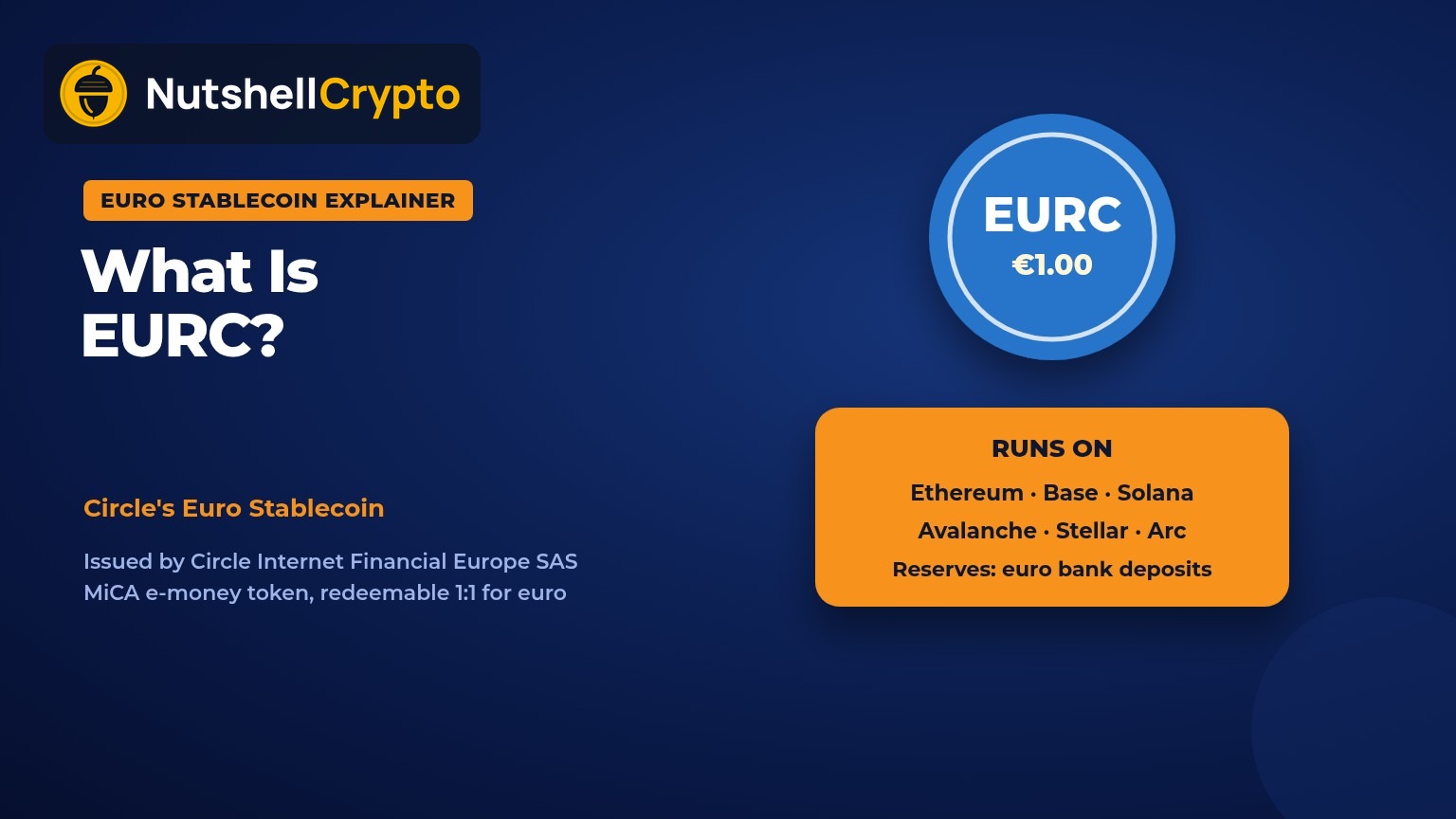
In a nutshell: EURC is a euro stablecoin issued by Circle, the company behind USDC. Each token is meant to be worth one euro and can be redeemed 1:1 for euro, with reserves held in euro at regulated banks in Europe. It is issued in France as a MiCA-regulated e-money token, it pays holders no interest, and it trades on Coinbase, Kraken and decentralized exchanges. As of November 12, 2026 (12:44 PM PKT), about 471 million EURC were in circulation, according to CoinGecko.
EURC is Circle’s euro-backed stablecoin: a crypto token worth €1 that you can hold, send and trade on several blockchains, and redeem for euros through Circle. This guide covers who issues it, what backs it, how big it is, fees, where you can buy it from the US, Canada and Australia, the main risks, and how it is taxed.
New to the topic? Start with our explainer on what stablecoins are and how they work.
Table of contents
What Is EURC?
Circle calls EURC “a fully backed euro stablecoin” that is “MiCA-compliant and redeemable 1:1 for euro” (Circle: EURC). Think of it as USDC’s euro sibling: the smart contract is modeled after USDC, but the token tracks the euro instead of the US dollar.
EURC launched on Ethereum in June 2022, according to Circle’s August 2026 blog post. It used to be called “Euro Coin” with the ticker EUROC. Circle renamed it EURC, kept the same token addresses, and says some apps and block explorers may still show the old name for a while (Circle FAQ).
One point trips up US, Canadian and Australian readers: EURC is pegged to the euro, not your home currency. One EURC traded at about €0.999, or about US$1.11, C$1.58 and A$1.62, on CoinGecko on November 12, 2026. So its value in dollars rises and falls with the EUR/USD, EUR/CAD and EUR/AUD exchange rates.
Who Issues EURC, and Is It Regulated?
EURC is issued by Circle Internet Financial Europe SAS, Circle’s French subsidiary. Circle says this entity is an electronic money institution authorized by the ACPR, France’s banking regulator, and that EURC “qualifies as an e-money token under MiCA” (Circle). Circle’s MiCA redemption policy gives the ACPR register number as 17788 and adds that the French entity also got a crypto-asset service provider (CASP) license from France’s AMF on April 24, 2026 (Circle MiCA Redemption Policy).
Circle announced on July 1, 2024 that it was the first global stablecoin issuer to comply with MiCA, the EU’s Markets in Crypto-Assets law, with both USDC and EURC issued in the EU under its French license (Circle press release). Unlike USDC, which is also issued by Circle’s US company, the policy says “EURC is issued solely by Circle France.”
The parent, Circle Internet Group, is listed on the New York Stock Exchange under the ticker CRCL. Our USDT vs USDC comparison explains how Circle’s dollar coin differs from Tether.
What Backs EURC: Reserves and Attestations
Circle says EURC is “backed 100% by euro,” with the reserves “held at regulated financial institutions in the EEA” and monthly attestation reports by a Big Four accounting firm. It also says the reserves are bankruptcy remote, meaning they are kept separate from Circle’s own money (Circle: EURC).
Circle’s transparency page splits EURC reserves into bank deposits at systemically important institutions and other bank deposits. Unlike USDC, EURC reserves are not shown in Treasury bills or a money market fund. Circle also says it “assumes the interest rate risk on EURC reserves,” so changes in eurozone rates are Circle’s problem, not the holder’s.
That is a different model from yield-focused tokens like Ethena’s USDe, which earns from derivatives rather than cash reserves.
How EURC Minting and Redemption Work
There are two ways in and out of EURC:
- Circle Mint (businesses). Qualified businesses and wholesale distributors open a Circle Mint account, wire euros, and receive EURC, or send EURC back and get euros. Circle says this 1:1 on/off-ramp is offered “at no additional cost” (Circle).
- Exchanges (everyone else). Most people buy and sell EURC on exchanges such as Coinbase or Kraken, or swap it on decentralized exchanges.
Under Article 49 of MiCA, every EURC holder has a right to redeem “at any time and at par value.” Circle’s policy lets individual (retail) holders who were refused at an exchange, or who prefer to go direct, apply to Circle France through a form. They must pass identity and transaction checks and give an IBAN for an EEA bank account that can receive SEPA payments. Circle says payment “should not take more than 5 business days” once checks are done (Circle MiCA Redemption Policy). In practice, that means direct redemption is built for people with a European bank account; most readers outside Europe will sell EURC on an exchange instead.
How Big Is EURC, and Which Chains Is It On?
Circle reported €461.5 million of EURC in circulation as of November 9, 2026 (Circle). CoinGecko showed about 471 million EURC, a market cap of about $522 million, rank #100, and about $34 million of 24-hour trading volume on November 12, 2026 at 12:44 PM PKT (CoinGecko).
That makes EURC the largest euro stablecoin. On DefiLlama on November 12, 2026, EURC had about $520 million in circulation, ahead of Societe Generale-Forge’s EUR CoinVertible (EURCV, about $188 million) and Eurite (EURI, about $36 million). It is still tiny next to dollar coins: see our list of the largest stablecoins by market cap.
Growth has been fast. Circle says EURC had about €80 million in circulation at the end of 2024, more than doubled in the first half of 2025, and passed €400 million in August 2026. Circle also says the whole euro stablecoin market grew from about €400 million in June 2025 to roughly €650 million in June 2026 (Circle blog).
Circle lists EURC on nine blockchains: Arc, Avalanche, Base, Cronos, Ethereum, Plasma, Solana, Stellar and World Chain. The official contract addresses are on Circle’s developer docs. Always check the address there before you send or accept EURC, because fake tokens can use the same name.
| EURC fact | Detail | Source (checked Nov 12, 2026) |
|---|---|---|
| Issuer | Circle Internet Financial Europe SAS (France) | Circle |
| Regulation | E-money token under MiCA; EMI licensed by ACPR | Circle |
| Peg | 1 EURC = €1, redeemable 1:1 | Circle |
| Circulation | €461.5M (Nov 9, 2026); ~471M on CoinGecko | Circle, CoinGecko |
| Price in other currencies | ~US$1.11 / C$1.58 / A$1.62 | CoinGecko |
| Interest to holders | None | EURC Terms |
| Chains | Arc, Avalanche, Base, Cronos, Ethereum, Plasma, Solana, Stellar, World Chain | Circle |
EURC Fees
Circle does not charge businesses extra to mint or redeem EURC through Circle Mint, per the EURC page. The EURC Terms (last updated October 15, 2026) still say Circle buys back EURC for €1 “less fees where applicable,” and the retail redemption policy warns that your own bank may charge incoming or currency conversion fees.
For most people, the real costs are elsewhere:
- Exchange trading fees and spreads when you buy or sell EURC on Coinbase or Kraken. Our guide to crypto exchange fees explains how these work.
- Currency conversion. If you pay in USD, CAD or AUD, you are really buying euros, so the exchange’s FX rate matters.
- Network (gas) fees when you move EURC on-chain. These are usually far lower on Base, Solana or Stellar than on Ethereum.
Where to Buy EURC in the US, Canada and Australia
United States. Coinbase’s US price page says “EURC is currently available on Coinbase’s centralized exchange” (Coinbase). Kraken also supports EURC, though Kraken’s support page lists Ethereum as its only EURC deposit and withdrawal network (Kraken Support, updated November 5, 2026). Check the network before you send.
Canada. Coinbase Canada’s EURC page says “EURC is not tradable on Coinbase” (Coinbase Canada). Kraken has a Canadian EURC buying page with CAD pricing and a C$10 minimum (Kraken Canada). Canadian platforms can only offer stablecoins under the conditions set by the Canadian Securities Administrators in CSA Staff Notice 21-333, so availability can change.
Australia. Kraken has an Australian EURC page with AUD pricing and an A$10 minimum (Kraken Australia). If you use an Australian exchange, check that it is registered with AUSTRAC as a digital currency exchange provider.
DeFi. A large share of EURC trading happens on decentralized exchanges. On November 12, 2026, CoinGecko’s busiest EURC markets included Aerodrome Slipstream on Base, Coinbase Exchange, Uniswap on Ethereum, Kraken and Orca on Solana. Our guide to how decentralized exchanges work covers the basics.
What People Use EURC For
- Euro exposure without a European bank account. Circle says EURC is “available globally — no bank account required.”
- FX trading. Swapping EURC and USDC on-chain is a 24/7 euro-dollar trade. Circle Mint customers in the EEA can also swap EURC to USDC directly.
- DeFi. Circle says EURC is commonly used for borrowing, lending and FX in DeFi. Lending EURC carries smart contract risk; see our stablecoin staking guide for how those yields work.
- Payments and settlement. Circle says Visa and Mastercard added EURC to their stablecoin settlement options in 2024 and 2025. In November 2026, Crypto Briefing reported that Visa’s stablecoin settlement now runs on weekends and holidays and supports five stablecoins, including EURC.
EURC Risks
- Currency risk. If you think in US, Canadian or Australian dollars, EURC is not “stable” for you. CoinGecko showed EURC near US$1.11 on November 12, 2026, and Coinbase’s price page showed it down about 4.8% against the dollar over one year. A weaker euro means a smaller balance in your home currency.
- Price on exchanges. The Terms say Circle “does not guarantee that the value of one (1) EURC will always equal 1 euro” on other platforms. In the 30 days to November 12, 2026, CoinGecko’s daily EUR price ranged from about €0.995 to €1.000.
- Freezes. Circle can block addresses and freeze EURC it links to illegal activity or a legal order, and you may lose the right to redeem frozen tokens (EURC Terms).
- No interest and no deposit insurance. Holders are “not entitled to any interest” on the reserves, and EURC in a Circle Mint account is not covered by FDIC or SIPC protection.
- Bank and issuer risk. Reserves sit in bank deposits, so a bank failure could matter. Dollar stablecoins have depegged in the past for this reason; read our guide on whether stablecoins are safe.
- Wrong network or fake tokens. Sending EURC on a network your exchange doesn’t support, or buying a fake “EURC” token, can mean lost funds.
Is EURC Taxable?
EURC is taxed like other crypto in the US, Canada and Australia. Because it is pegged to the euro, not your local currency, gains and losses are more likely than with a USD stablecoin. This is general information, not tax advice.
United States. The IRS treats digital assets as property (IRS: Digital assets). Selling EURC for dollars, swapping it for another coin, or spending it is a taxable disposal. If the euro rose against the dollar while you held EURC, you have a capital gain in USD terms; if it fell, a loss.
Canada. The CRA treats crypto dispositions, including trading one crypto for another, as taxable events, and you report the result in Canadian dollars (CRA: Income from crypto-asset transactions). Movements in the EUR/CAD rate can create a gain or loss when you sell or swap EURC.
Australia. The ATO generally treats crypto as a CGT asset, so disposing of EURC can trigger capital gains tax, worked out in Australian dollars (ATO: Crypto asset investments).
For a deeper look at how stablecoin trades are taxed in each country, see our stablecoin taxes guide.
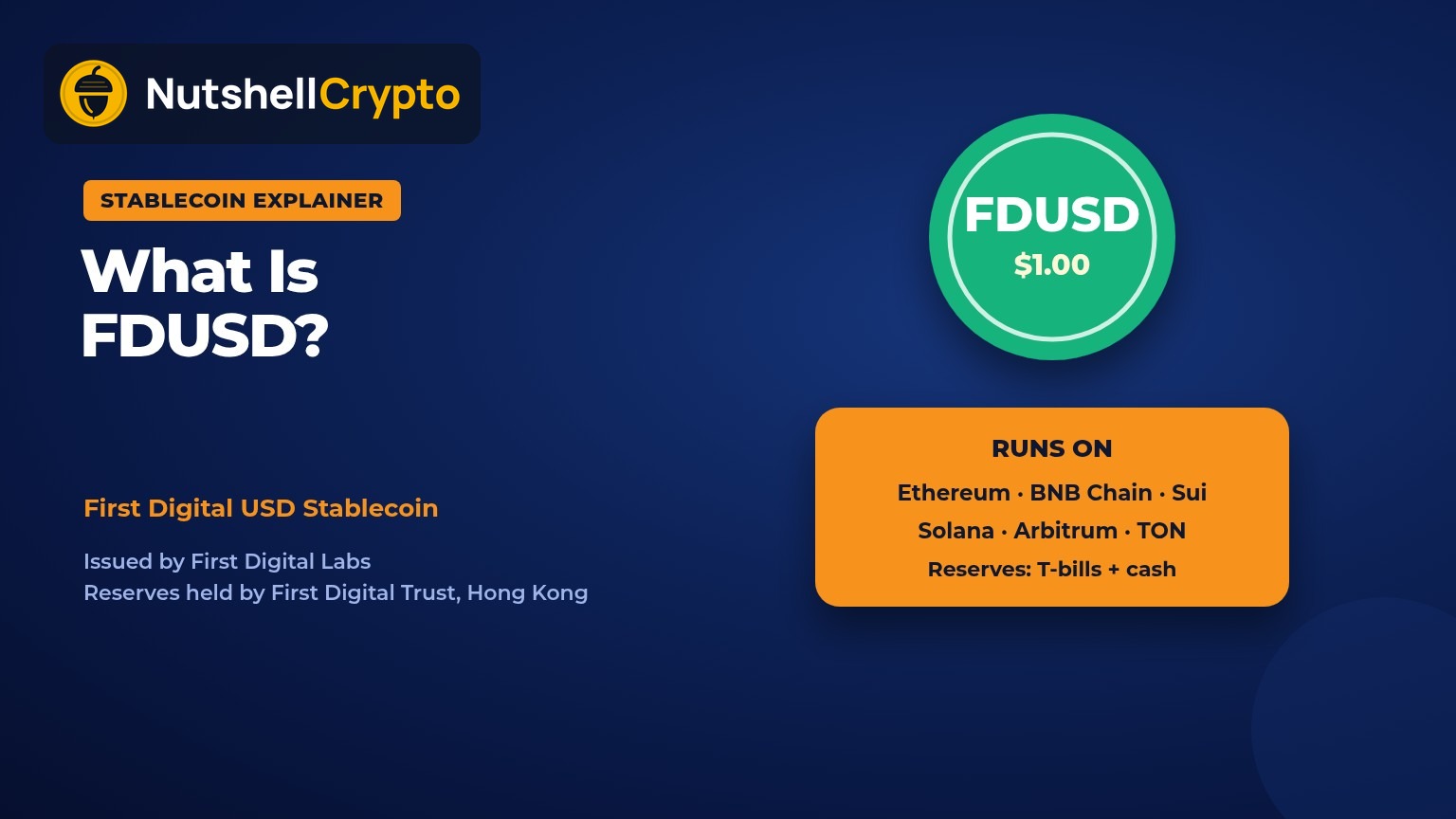
Looking at other named stablecoins? Compare EURC with Paxos’s Global Dollar (USDG), PayPal USD (PYUSD) and First Digital USD (FDUSD).
FAQ
Who owns EURC?
EURC is issued by Circle Internet Financial Europe SAS, the French subsidiary of Circle Internet Group, which trades on the NYSE as CRCL. Holders own the tokens, and each one is a claim that Circle France will redeem 1:1 for euro under MiCA (Circle).
Is EURC a good investment?
EURC is not built to grow in value: it aims to stay at €1 and pays holders no interest, per the EURC Terms. For someone outside the eurozone, its value in local currency moves only with the euro exchange rate, so it works as a way to hold and move euros on-chain, not as a growth asset.
What is the best euro stablecoin?
No stablecoin is risk-free, but EURC is the largest euro stablecoin by circulation. On November 12, 2026, DefiLlama showed about $520 million of EURC, against about $188 million for EURCV and about $36 million for EURI (DefiLlama). Size, MiCA status and monthly attestations are good things to compare.
What is 1 euro coin in US dollars?
One EURC is worth about one euro, so its dollar price follows the EUR/USD exchange rate. On November 12, 2026, CoinGecko priced 1 EURC at about US$1.11, C$1.58 and A$1.62 (CoinGecko).
Can I make money on stablecoins?
Not from EURC itself, because Circle keeps the reserve income and holders get no interest. Some exchanges and DeFi lending apps pay rewards on stablecoins, but those come from the platform or borrowers and add platform and smart contract risk. Our stablecoin staking guide explains how those yields work.
Sources
- Circle: EURC
- Circle: Transparency and reserves
- Circle: EURC Terms
- Circle: MiCA Redemption Policy
- Circle: MiCA compliance announcement (July 1, 2024)
- Circle: EURC surpasses €400 million (August 17, 2026)
- Circle developer docs: EURC contract addresses
- CoinGecko: EURC
- DefiLlama: EURC
- Coinbase: EURC and Coinbase Canada: EURC
- Kraken: Stablecoins supported on Kraken
- Kraken Canada: Buy EURC and Kraken Australia: Buy EURC
- Crypto Briefing: Visa weekend stablecoin settlement (November 10, 2026)
- CSA Staff Notice 21-333 (OSC)
- IRS: Digital assets
- CRA: Income from crypto-asset transactions
- ATO: Crypto asset investments