In a nutshell: A multisig wallet is a crypto wallet that needs more than one private key to approve a transaction, such as any 2 of 3 keys. That way, one lost or stolen key cannot drain your funds. It is popular for long-term cold storage, inheritance planning, and business or DAO treasuries, but it is more complex than a normal wallet. Educational only; not financial advice.
Last updated: October 6, 2026.
A normal crypto wallet has one key, which makes it a single point of failure. A multisig wallet spreads control across several keys so no single mistake or theft is fatal. If you are new to wallets, start with our crypto wallet guide.
Table of contents
What Is a Multisig Wallet?
“Multisig” is short for multi-signature. The Bitcoin Wiki defines it as requiring multiple keys to authorize a transaction, rather than a single signature from one key. Investopedia describes a multi-signature wallet the same way: a crypto wallet that needs multiple keys to unlock funds or approve transactions.
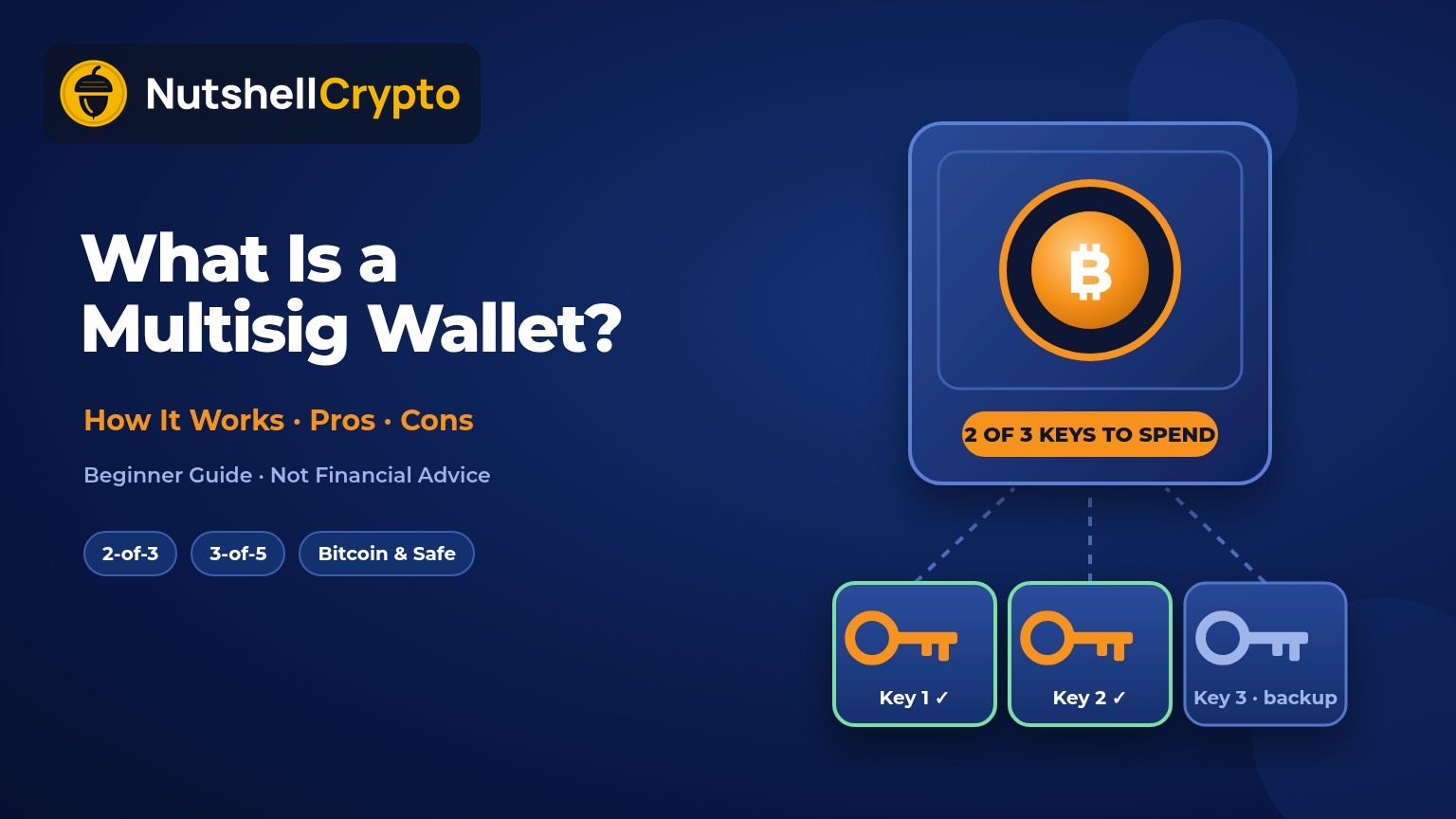
Multisig setups are written as m-of-n:
- n is the total number of keys in the wallet.
- m is how many of those keys must sign before funds can move. This is often called the quorum or threshold.
So a 2-of-3 wallet has three keys and needs any two to sign. Unchained, a Bitcoin custody firm, says 2-of-3 and 3-of-5 are by far the most widely used arrangements for Bitcoin cold storage.
How a Multisig Wallet Works
Keys
Each of the n keys is a separate private key, ideally created on a separate device such as a hardware wallet and stored in a separate place. The wallet combines the matching public keys into one shared receiving address. Anyone can send crypto to that address, just like a normal one.
Signing
To spend, one participant creates a transaction. It stays pending until enough keys have signed it. Coinbase Learn explains that any party can start a transaction with their key, but it shows as pending until the other required parties sign.
On Bitcoin, the half-signed transaction is usually passed between devices as a PSBT (Partially Signed Bitcoin Transaction). BIP 174 defines this format so a signer, even an offline one, has all the information it needs and so signatures can be collected before the set is complete.
Quorum
Once m valid signatures are attached, the network accepts the transaction. Fewer than m, and it is simply invalid. The choice of m and n is a balance:
- 1-of-n (like 1-of-2) is convenient, but any single stolen key can spend.
- n-of-n (like 2-of-2) stops theft from one key, but losing any one key locks the funds.
- 2-of-3 sits in between. Unchained calls it the least complex setup that protects against both a single lost key and a single stolen key.
The Bitcoin Wiki puts it simply: the backup redundancy is n minus m. A 3-of-5 wallet can survive the loss of any two keys.
Common Use Cases
Personal cold storage
Individuals use multisig to protect long-term savings. The Bitcoin Wiki gives the example of a 2-of-3 “decentralized cold storage vault” with one key at home, one in a bank safe deposit box, and one with a trusted person. A burglar at home finds only one key. Sparrow Wallet’s best-practice guide recommends at least 2-of-3 for true cold storage, with hardware wallets from different vendors kept in different locations. For background on offline storage, see our hot wallet vs cold wallet guide.
Inheritance
Bitcoin.org warns that coins can be lost forever if your family has no backup plan. Multisig helps because an heir can be given some keys without being able to spend alone. For example, Casa’s documentation describes an inheritance process where a recipient’s access only unlocks after a 6-month verification period passes without objection from the vault owner.
Businesses, DAOs, and treasuries
Bitcoin.org notes that an organization can let its members access a treasury while only allowing a withdrawal if, say, 3 of 5 members sign. Coinbase Learn says multisig is a tool for businesses, institutions, and DAOs (decentralized autonomous organizations) because it prevents any one person from abusing power.
Pros and Cons of Multisig
Pros
- No single point of failure. One stolen key cannot move funds, and one lost key does not lock them (in setups like 2-of-3).
- Protection against device flaws. The Bitcoin Wiki notes that using hardware wallets from different companies makes it far harder for any one vendor’s flaw or bad actor to steal funds.
- Shared control. Teams and families can require agreement before money moves.
Cons and risks
- Complexity. More keys means more devices, backups, and locations to manage. Kraken Learn notes setup and recovery can be more complex and some platforms do not support multisig, so it best suits advanced users or teams.
- Losing too many keys. If you lose more keys than your redundancy allows, the funds are locked for good. Safe’s help center warns that if you cannot reach enough signers to meet the threshold, you will not be able to recover your assets.
- The wallet configuration matters too. On Bitcoin you must back up the wallet setup (often called the descriptor or configuration file), not just the seeds. Nunchuk’s guide says recovery needs either that backup file plus enough keys, or all keys and a reconstruction that can fail for custom wallets.
- Coordinator software. You rely on wallet software (a “coordinator”) to build addresses and collect signatures. Pick well-known, open-source tools that let you export your setup and move to another app.
- Higher fees on some chains. Unchained says spending from a Bitcoin multisig typically costs more than single-sig, and more complex quorums cost more. On Ethereum, deploying a Safe costs a transaction fee.
Bitcoin Multisig vs Ethereum Smart-Contract Multisig
Bitcoin: built into the script
Bitcoin supports multisig natively in its scripting language. BIP 11 made m-of-n transactions standard, and BIP 16 (Pay to Script Hash) moved the spending conditions to the person redeeming the funds, giving multisig its own short addresses. According to the Bitcoin Wiki, legacy P2SH multisig addresses start with “3” and were limited to 3 co-signers as standard, while newer SegWit (P2WSH) multisig addresses start with “bc1q” and allow up to 20.
The Taproot upgrade added a new opcode, OP_CHECKSIGADD, for multisig policies in Taproot scripts (BIP 342). Standards like BIP 48 (key paths for multisig wallets) and BIP 383 (multisig descriptors) help different wallet apps work together.
Ethereum: a smart contract account
A regular Ethereum account (an externally owned account, or EOA) is controlled by one private key. Ethereum.org explains that a contract account is instead controlled by code, and creating one has a cost because it uses network storage. Ethereum multisig works this way. The best-known example is Safe, a smart account with multi-signature logic at its core: you define a list of owners and a threshold that must confirm a transaction before it runs.
Because the rules live in a contract, Safe supports features like changing owners, spending allowances, and recovery modules. The trade-off: the contract code becomes part of what you trust.
How to Set Up a Multisig Wallet (High Level)
Exact steps depend on the app, but the flow is similar. For Bitcoin, Unchained lists free, open-source coordinators such as Caravan, Sparrow, Electrum, and Specter.
- Pick a quorum. For most individuals, 2-of-3 is the common starting point.
- Get separate signing devices. Ideally hardware wallets from different makers. Back up each seed phrase separately.
- Create the wallet in a coordinator. Import each device’s public key (xpub) and set the threshold. On Ethereum, the Safe web app asks you to add signer addresses, choose a confirmation threshold, and pay a deployment fee.
- Back up the configuration. Save the wallet descriptor or configuration file in several places.
- Test with a small amount. Receive a little, then spend it by signing with two different keys.
- Store keys in separate locations and write down simple instructions for your heirs.
If self-managing feels like too much, “collaborative custody” services hold one key of a 2-of-3 while you hold two. Unchained says this means the provider cannot move your funds alone.
Multisig vs Single-Sig vs MPC
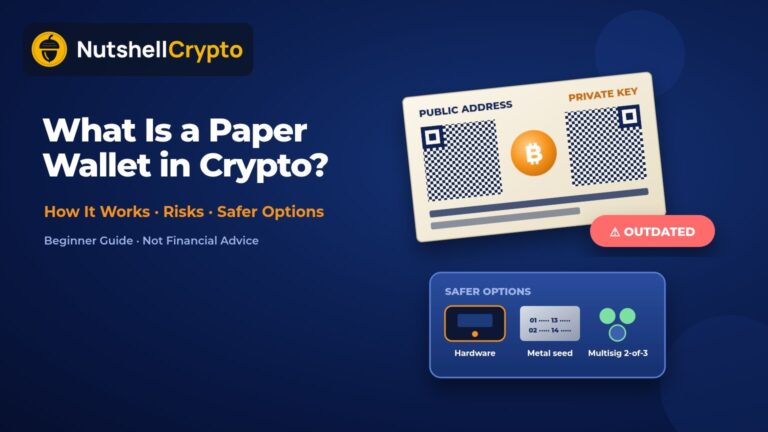
Single-sig wallets use one key. Unchained notes they are simpler and their fees can be lower, but they always have a single point of failure. A paper wallet is an extreme example.
MPC (multi-party computation) wallets also spread control, but differently. Safe’s comparison explains that MPC splits a single private key into cryptographic shares and signs off-chain, submitting one signature, while multisig uses multiple independent keys with approvals verified on-chain. Kraken lists both as popular shared-custody options.
| Feature | Single-sig | Multisig | MPC |
|---|---|---|---|
| Keys | One key | Several independent keys | One key split into shares |
| Where rules are enforced | N/A | On-chain | Off-chain by the MPC software |
| Single point of failure | Yes | No (if m is less than n) | No, by design |
| Complexity | Low | Medium to high | Usually hidden by a provider |
| Typical users | Everyday users | Long-term holders, DAOs, businesses | Institutions, some consumer apps |
FAQ
Is a multisig wallet safer than a hardware wallet?
They work together. A multisig wallet usually uses several hardware wallets as its keys, removing the single point of failure of one device and one seed phrase.
What happens if I lose one key in a 2-of-3 multisig?
You can still sign with the other two. Unchained suggests using them to move the funds into a new wallet.
Do I need multisig for small amounts?
Usually not. Investopedia notes most individual account holders probably don’t need one. Sparrow’s guide places multisig at the expert stage, after singlesig with a hardware wallet.
Does multisig cost more in fees?
Often, yes. On Bitcoin, spending from multisig typically costs more than single-sig. On Ethereum, creating the contract costs gas.
Sources
- Bitcoin Wiki: Multi-signature
- Bitcoin.org: Securing your wallet
- BIP 11: M-of-N Standard Transactions
- BIP 16: Pay to Script Hash
- BIP 174: Partially Signed Bitcoin Transaction Format
- BIP 342: Validation of Taproot Scripts
- Ethereum.org: Ethereum accounts
- Safe Docs: How Safe Smart Accounts work
- Investopedia: Multi-signature wallets
- Coinbase Learn: What is multi-signature?
- Unchained: What is multisig?
Educational content only. This is not financial or investment advice. Crypto is volatile and you can lose money. Do your own research before you act.