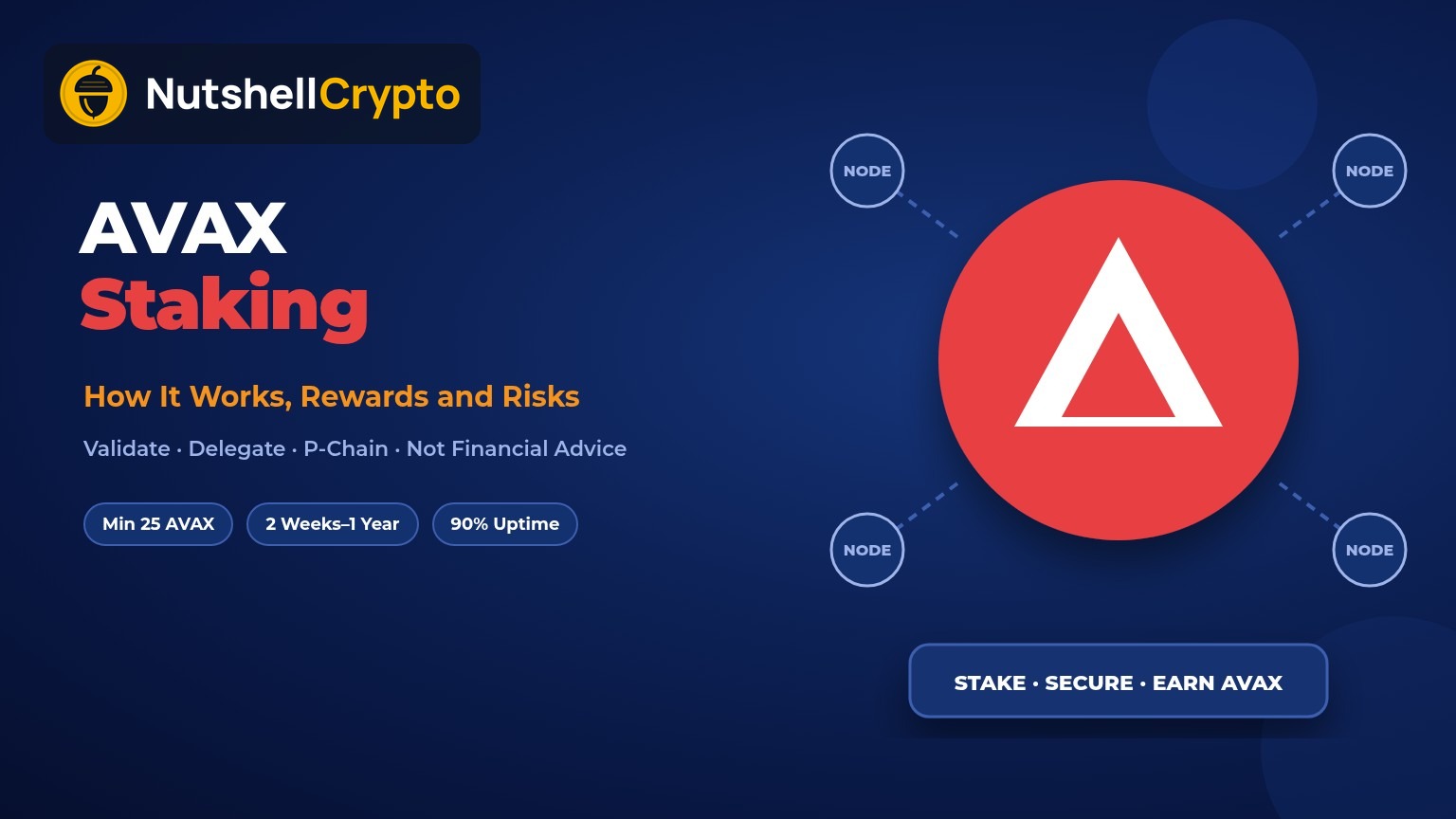
In a nutshell: AVAX staking means locking AVAX on Avalanche’s P-Chain to help secure the network and earn AVAX rewards. You can run your own validator (minimum 2,000 AVAX) or delegate to an existing validator (minimum 25 AVAX, for 2 weeks to 1 year). Rewards are paid automatically at the end of the term if the validator meets the uptime rule (90% for validations started after the September 22, 2026 Helicon upgrade). Avalanche has no slashing, but you cannot unstake early. Educational only; not financial advice.
Last updated: October 14, 2026.
AVAX staking is how holders of Avalanche’s native token, AVAX, help secure the Avalanche Primary Network and earn more AVAX in return. Staking happens on the P-Chain (Platform Chain), and the simplest official way to do it is through Ava Labs’ Core wallet at core.app/stake.
This guide covers how AVAX staking works, validating vs delegating, the official staking parameters, how rewards and uptime work after the Helicon upgrade, step-by-step delegation in Core, how to pick a validator, liquid and exchange options, risks, taxes and an FAQ. If you are new to the idea, first read our explainer on what staking in crypto means.
Table of contents
What Is AVAX Staking?
Avalanche is a proof-of-stake blockchain. Validators secure the network, create new blocks and process transactions, and the chance that a validator is sampled during consensus is proportional to its stake, according to Avalanche’s official How to Stake documentation. Staking AVAX puts your tokens behind that security process.
A few things make AVAX staking different from staking on many other chains:
- It happens on the P-Chain. Most people hold AVAX on the C-Chain (the EVM chain used by MetaMask-style wallets) or on an exchange. To stake natively, AVAX must sit on the P-Chain. Core web lets you move it there with a cross-chain transfer from the C-Chain or X-Chain, per the Core web FAQ.
- Stake is time-locked. You pick an end date when you stake. Once the transaction is issued you cannot remove your stake early or change the amount, node ID or reward address.
- There is no slashing. Avalanche’s staking guide for finance professionals states that the protocol does not slash stake. The worst case is earning zero rewards, not losing principal.
- Rewards arrive at the end. There is nothing to claim. Rewards are sent automatically to your reward address when the staking period ends, per the Avalanche Support Staking FAQ.
How much AVAX is already staked? When we queried Avalanche’s public P-Chain API on October 14, 2026 at about 2:50 PM PKT, total Primary Network stake was about 186.5 million AVAX against a reported current supply of about 475.1 million AVAX, or roughly 39%.
Validate vs Delegate: Two Ways to Stake AVAX
Avalanche gives you two native paths. Avalanche Support’s How do I stake AVAX on Avalanche? article sums them up: delegate with at least 25 AVAX, or validate with at least 2,000 AVAX.
1. Run a validator
You run an AvalancheGo node and stake at least 2,000 AVAX to it. When you register it you set your node ID, BLS key and signature, end time, stake amount, reward address and delegation fee. You are responsible for keeping the node online, upgraded and well connected. Core web supports validating; Core mobile supports only delegating, per the Core web FAQ.
Validators can accept delegations and earn a fee on delegators’ rewards. Back up the node’s staker.key, staker.crt and signer.key: losing the staking key gives your node a new ID, which can put your validation reward at risk, according to the official docs.
2. Delegate to an existing validator
Most beginners delegate. You choose a validator node, an end date, an amount (25 AVAX or more) and a reward address. Your AVAX never goes to the validator operator. It is locked on the P-Chain and returned to you when the delegation ends. The validator keeps a share of your reward equal to its delegation fee.
Avalanche Support gives a simple example: if you earn 10 AVAX and the validator charges a 2% fee, 0.2 AVAX goes to the validator and you net 9.8 AVAX.
AVAX Staking Parameters (Mainnet)
These figures come from Avalanche’s official staking parameters page, checked October 14, 2026:
| Parameter | Validator | Delegator |
|---|---|---|
| Minimum stake | 2,000 AVAX | 25 AVAX |
| Minimum staking period | 48 hours (was 2 weeks before Helicon) | 2 weeks (unchanged) |
| Maximum staking period | 1 year | 1 year |
| Fee | Sets its delegation fee (minimum 2%) | Pays the validator’s fee from rewards |
| Uptime needed for rewards | 90% (80% for validations started before Helicon) | Depends on the validator’s uptime |
| Maximum weight | Lower of 3 million AVAX or 5× own stake | Must fit under the validator’s cap |
| Early exit | Not possible | Not possible |
Two rules trip people up:
- Delegations must fit inside the validator’s period. Your end date must be at or before the validator’s end date. Because the delegation minimum is still 2 weeks, a validator staking for less than 2 weeks cannot receive delegations at all.
- Validators have a delegation cap. A validator that stakes 2,000 AVAX can reach a total weight of 10,000 AVAX (5 × 2,000), so it can accept up to 8,000 AVAX of delegations in total. If a node is full, Core will not let you delegate to it.
The 25 AVAX delegation minimum is a network parameter set in the genesis block. Avalanche Support says it works as an anti-Sybil measure and changing it would need a network upgrade.
AVAX Staking Rewards, Uptime and the Helicon Upgrade
How rewards are calculated
Rewards come from new AVAX minted under a formula published in the official docs. It depends on your stake, the current supply versus the maximum supply, and how long you stake. The longer the staking period, the closer your effective rate gets to the maximum rate, so a 1-year stake earns a higher rate than a 2-week stake. Uptime decides only whether you are rewarded; the amount depends on the length of the staking period.
What APY to expect
There is no fixed APY, and we will not quote a live rate as a promise. Here is what official and major sources showed:
- The Avalanche Support Staking FAQ says Core’s staking reward was roughly 6.41% when Avalanche Support last noted it in that FAQ.
- Core’s staking page advertised “up to 5.8% APY” when we checked on October 14, 2026.
- Coinbase’s AVAX staking page showed an estimated 3.41% APY for its own service on October 14, 2026, subject to location.
Check the estimate Core shows for your chosen validator and duration before you confirm. Your net rate after the validator’s fee will be lower than the gross number.
Uptime: all or nothing
When a validator’s period ends, other validators vote, weighted by stake, on whether it was responsive enough to be rewarded. There is no partial payout. Avalanche’s Helicon upgrade page explains the new rules:
- Helicon activated on Mainnet on September 22, 2026 at 15:00 UTC (8:00 PM PKT).
- Validations that start at or after activation need 90% uptime. Validations that started before still need 80%.
- The minimum validator staking period dropped from 2 weeks to 48 hours. The delegation minimum stayed at 2 weeks.
- Missing the threshold means no rewards, but the validator keeps its principal. There is still no slashing.
The uptime increase came from ACP-267. If you delegate, your reward depends on your validator meeting this threshold, so validator choice matters.
How to Delegate AVAX in Core (Step by Step)
These steps follow Core’s own guide, How do I delegate in Core Stake?. You need at least 25 AVAX plus a little for fees.
- Set up a wallet. Install the Core extension or Core mobile, or connect a Ledger to Core web. Save your recovery phrase offline. Our beginner guide to crypto wallets explains the basics.
- Get AVAX onto the P-Chain. Buy or send AVAX to your wallet, then use Core web’s cross-chain transfer to move it from the C-Chain or X-Chain to the P-Chain.
- Open Stake. On Core web, select Stake in the left menu, then choose Delegate (or Fast Stake, below).
- Pick a validator. Use Advanced filters for uptime range, maximum delegation fee, minimum available delegation and minimum time remaining. Open a node to see its APY, fee, time responsive and available amount, then click Select this node.
- Set duration and amount. Choose a stake duration of at least 14 days that ends on or before the node’s end date. Enter your amount (25%, 50% or Max shortcuts are available).
- Set the reward address. Keep your current address or enter a custom one. It cannot be changed later.
- Review and approve. Check the APY, validator fee and estimated rewards, select Review, then Submit and approve the transaction in Core.
Fast Stake vs Delegate: Fast Stake picks a validator for you. Avalanche Support says Core charges Fast Stake users a fee equal to 10% of gross estimated delegation rewards, on top of the staked amount; normal delegations do not carry that Core fee.
Want to validate instead? Run an up-to-date AvalancheGo node (v1.15.0 or later after Helicon), make sure it accepts incoming TCP traffic on port 9651, then add it as a validator in Core web with at least 2,000 AVAX. Monitor it with Avalanche’s validator health dashboard.
How to Choose an AVAX Validator
- Uptime history: Pick nodes with uptime close to 100%. After Helicon, new validations need 90%, so a node that barely cleared 80% in the past is a risk.
- Delegation fee: The minimum is 2%. A lower fee leaves more reward for you, but uptime matters more than a small fee difference.
- Time remaining: The node’s end date caps your delegation. If you want a 1-year term, pick a node validating for at least that long.
- Available capacity: Full nodes cannot take your delegation.
- Health check: Paste the node ID into the validator health dashboard before you commit.
Liquid Staking and Exchange Staking
Native staking locks AVAX for at least 2 weeks with no early exit. Two alternatives trade that lock-up for other risks.
Liquid staking (sAVAX)
BENQI Liquid Staking lets you stake AVAX from the C-Chain and receive sAVAX, a token whose AVAX value grows as rewards accrue. Per BENQI’s docs, unstaking takes a 15-day unlock period followed by a 2-day redemption window, you can swap sAVAX for AVAX on secondary markets instead, and the protocol keeps 10% of validator rewards. Liquid staking adds smart contract and depeg risk; learn how it works in our liquid staking explainer.
Exchange staking
Some exchanges stake AVAX for you. Coinbase, for example, says AVAX staking is available only in locations where staking is allowed and that rates change. It is simpler, but the exchange holds your coins (custody risk), takes a cut, and terms can change. Compare this with self-custody staking before you choose.
If you are comparing chains, our guides to staking POL on Polygon and Chainlink staking use the same format.
Risks of AVAX Staking
- Lock-up risk: You cannot unstake early. If AVAX’s price falls during your term, you cannot sell the staked coins until it ends.
- Price risk: Rewards are paid in AVAX. A few percent in AVAX does not protect you from a large drop in AVAX’s price.
- Zero-reward risk: If your validator misses the uptime threshold, you get no reward for the whole period (principal is still returned).
- Mistake risk: Amount, end date and reward address are final once you submit. A wrong address cannot be fixed.
- Wallet security: Phishing sites and fake “Core” apps exist. Use only core.app and official app stores.
- Third-party risk: Liquid staking and exchanges add smart contract, depeg, custody and regulatory risks that native staking does not have.
- Validator operator risk: Running a node means hardware, upgrades and key backups. A missed upgrade can cost you the reward.
Taxes on AVAX Staking Rewards (US and Canada)
In the US, the IRS’s Revenue Ruling 2023-14 says a cash-method taxpayer includes staking rewards in gross income, at fair market value, in the year they gain dominion and control over them. In Canada, the CRA explains on its crypto mining and staking income page that staking income can be business income or other income depending on your situation. Selling the AVAX later can create a capital gain or loss. For record-keeping tips and examples, see our full guide to crypto staking taxes. This is not tax advice.
FAQ
What is the minimum for AVAX staking?
25 AVAX to delegate and 2,000 AVAX to run a validator on Mainnet, per Avalanche’s docs.
How long is AVAX locked when staking?
Delegations last 2 weeks to 1 year. Validators can stake for 48 hours to 1 year since the Helicon upgrade. You cannot unstake early in either case.
Can you lose AVAX by staking?
Not through slashing: Avalanche does not slash stake, and your principal is returned at the end. You can still lose value if AVAX’s price falls, or earn zero rewards if your validator’s uptime is too low.
Do I need to claim AVAX staking rewards?
No. Rewards and your staked AVAX are sent automatically when the staking period ends.
What uptime does a validator need after Helicon?
At least 90% for validations that started on or after September 22, 2026 (15:00 UTC). Validations that started earlier are judged against 80%.
What is the AVAX staking APY?
It varies. Core’s staking page advertised up to 5.8% APY on October 14, 2026, and Avalanche Support last noted roughly 6.41% in its FAQ. Check Core for the live estimate for your validator and duration.
Sources
- Avalanche Builder Hub: How to Stake (staking parameters)
- Avalanche Builder Hub: Helicon Upgrade
- Avalanche: ACP-267 Uptime Requirement Increase
- Avalanche Builder Hub: AVAX Staking for Finance Professionals
- Avalanche P-Chain API (getTotalStake, getCurrentSupply), queried October 14, 2026
- Avalanche Support: Staking FAQ
- Avalanche Support: How do I stake AVAX on Avalanche?
- Core Support: How do I delegate in Core Stake?
- Core Support: Core web FAQ
- Core: Stake page (checked October 14, 2026)
- Avalanche Stats: Validator Health dashboard
- BENQI Liquid Staking docs: Overview
- Coinbase: Avalanche staking page (checked October 14, 2026)
- IRS: Revenue Ruling 2023-14
- CRA: Income from crypto mining and staking
This article is for educational purposes only and is not financial, investment or tax advice.