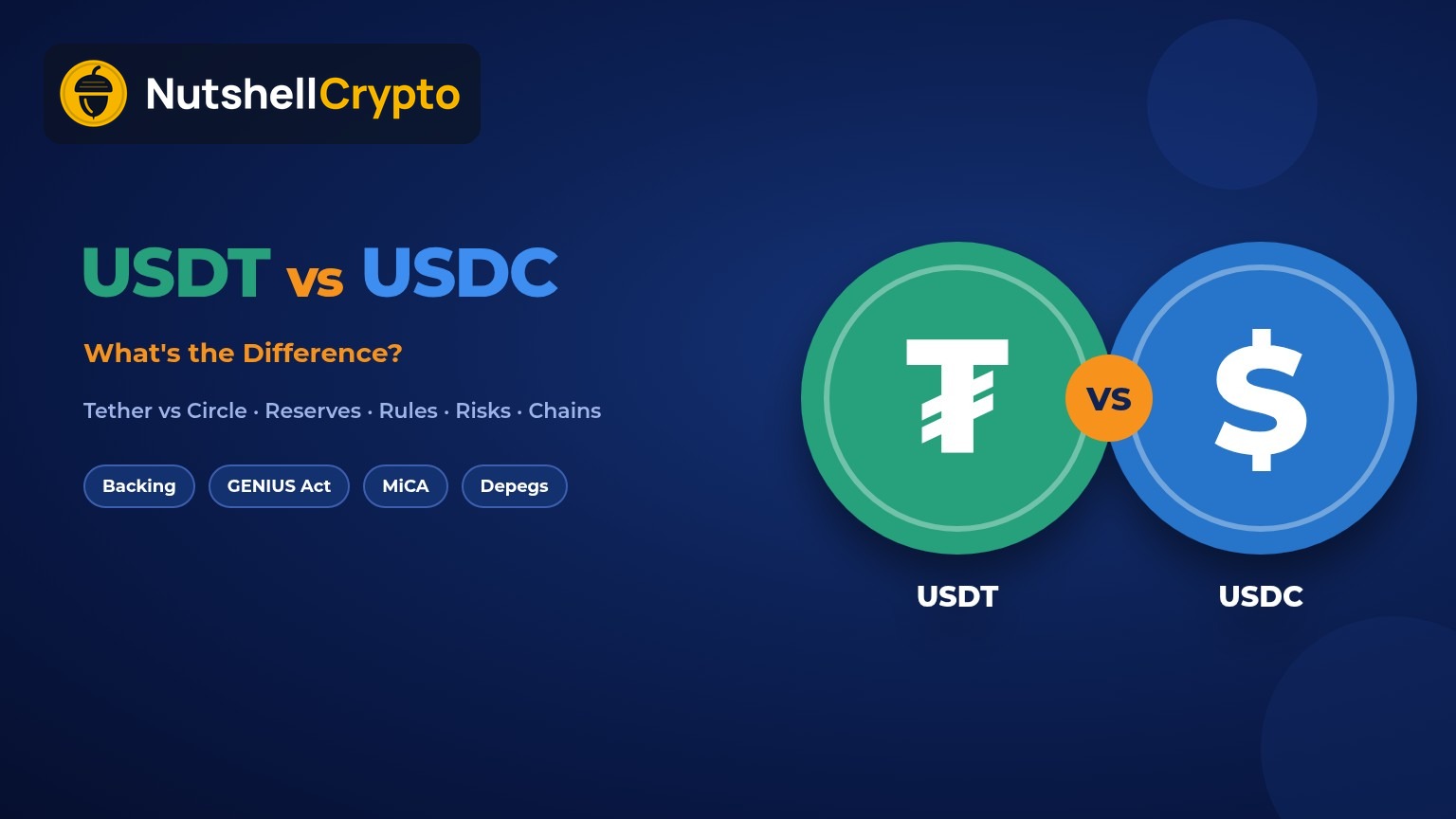
In a nutshell: USDT and USDC are both dollar stablecoins meant to stay at $1, but they come from different companies with different rules. Tether’s USDT is bigger (about $183.5 billion vs. $72.6 billion for USDC, per CoinGecko on Oct 16, 2026, 10:28 PM PKT), trades more, and lives mostly on Tron and Ethereum. Its reserves include Treasury bills plus gold, bitcoin and loans, checked quarterly. Circle’s USDC holds only cash and short-term US government assets, is checked monthly, and is authorized under EU and Canadian rules, where USDT is restricted. Educational only; not financial advice.
Last updated: October 16, 2026. Market data checked on CoinGecko and DefiLlama on October 16, 2026, at about 10:28 PM PKT (5:28 PM UTC). Reserve figures are from each issuer’s latest report.
If you have ever been asked to pick between USDT vs USDC on an exchange, you have met the two biggest dollar stablecoins. They look the same on a screen: both read $1.00 and both move across many blockchains. Under the hood, the issuer, the reserves, the reporting and the legal rules are quite different. This guide compares them side by side. New to the topic? Our beginner guide on what stablecoins are and how the $1 peg works covers the basics, so we keep that part short here.
Table of contents
USDT vs USDC at a Glance
As of October 16, 2026. Market data from CoinGecko and DefiLlama at about 10:28 PM PKT; reserve data from Tether’s June 30, 2026 report and Circle’s August 31, 2026 report.
| Topic | USDT (Tether) | USDC (Circle) |
|---|---|---|
| Issuer | Tether International, S.A. de C.V. (group based in El Salvador) | Circle Internet Financial, LLC (US) and Circle Internet Financial Europe SAS (France); parent listed on NYSE as CRCL |
| Launched | 2014 | 2018 |
| Market cap | About $183.5B (#3 crypto overall) | About $72.6B (#6 crypto overall) |
| 24-hour trading volume | About $50.6B | About $15.6B |
| Reserves | $187.75B: mostly US Treasury bills and repos, plus gold, bitcoin, secured loans and other investments | $73.40B: Circle Reserve Fund (BlackRock-managed government money market fund) plus cash at banks |
| Reserve check | Quarterly attestation by BDO; first full audit (KPMG) of 2025 accounts | Monthly attestation by a Big Four firm; weekly reserve disclosures |
| S&P stability score | 5 (weak), Nov 26, 2025 | 2 (strong), Dec 18, 2025 |
| EU (MiCA) | Not authorized; delisted for EU users on major exchanges | Authorized e-money token since July 1, 2024 |
| Biggest chains | Tron (~51%), Ethereum (~40%) | Ethereum (~62%), Hyperliquid and Solana (~10% each) |
| Can freeze tokens? | Yes | Yes |
Market cap, volume and rank: CoinGecko USDT and CoinGecko USDC, Oct 16, 2026, 10:28 PM PKT. Chain shares: DefiLlama Stablecoins, same time. Other rows are sourced in the sections below.
Issuer: Tether vs Circle
Tether launched USDT in 2014, making it the oldest major stablecoin. The token is issued by Tether International, S.A. de C.V. In January 2025, Tether said it had received a license in El Salvador and was moving its group headquarters there from the British Virgin Islands, per Tether and CoinDesk. Tether is a private company.
Circle launched USDC in 2018. USDC is issued by Circle Internet Financial, LLC in the US and by Circle Internet Financial Europe SAS in the EU, per Circle’s monthly reserve report. Its parent, Circle Internet Group, trades on the New York Stock Exchange under the ticker CRCL. In July 2026, Circle received final approval from the US Office of the Comptroller of the Currency (OCC) to set up a national trust bank, Circle National Trust, per Circle.
One more name to know: in January 2026, Tether launched a separate US-only coin, USAT, issued by Anchorage Digital Bank, N.A. under US federal oversight, per Tether. USAT is not USDT. Anchorage’s USAT disclosures say the two are “separate and distinct.”
Backing and Reserves
Both companies say every token is backed by at least $1 of assets. What those assets are is the biggest difference between the two coins.
What backs USDT
Tether’s latest report, as of June 30, 2026, lists $187.75 billion in reserves against $183.64 billion in liabilities, a cushion of about $4.11 billion, per its Q2 2026 attestation release. The main pieces were:
- US Treasury bills: $114.96 billion (about 61% of assets)
- Overnight and term reverse repos: about $25.6 billion
- Precious metals (gold): $18.84 billion
- Secured loans: $13.45 billion
- Bitcoin: $5.80 billion (about 98,933 BTC, per CoinDesk)
- Other investments and public equities: about $9.0 billion
So roughly three-quarters of USDT’s backing is cash-like US government paper, and the rest is assets whose price can swing. CoinDesk noted the cushion fell by about half in the quarter, from $8.23 billion, as gold and bitcoin prices dropped.
What backs USDC
Circle’s monthly report for August 31, 2026 showed $73.40 billion in reserves against $73.32 billion of USDC in circulation, per the independent accountants’ report. About $62.32 billion sat in the Circle Reserve Fund (USDXX), a government money market fund managed by BlackRock that holds short-term Treasuries, overnight Treasury repos and cash. Most of the rest, about $9.59 billion, was cash at regulated banks. BlackRock lists the fund at about $61.3 billion on October 15, 2026, with a 16-day average maturity, per BlackRock.
USDC holds no gold, bitcoin, loans or stocks. Its cushion above 100% is thin (about $78 million on August 31), but its assets are among the most liquid in finance.
Attestations, Audits and Ratings
Attestations are point-in-time checks by an accounting firm that reserves cover tokens on a given date. A full audit looks at a company’s whole set of financial statements over a year.
- USDT: Tether publishes quarterly attestations prepared by BDO on its transparency page. On August 13, 2026, Tether said KPMG US had completed its first full audit, giving an unqualified (“clean”) opinion on its 2025 financial statements, which showed reserves above liabilities by $6.814 billion, per Tether.
- USDC: Circle publishes reserve holdings weekly and gets a monthly attestation from a Big Four accounting firm under US (AICPA) standards, per Circle’s transparency page. Because Circle is a listed company, its own financial statements are audited every year (by Deloitte) and filed with the SEC.
S&P Global Ratings scores stablecoins from 1 (very strong) to 5 (weak) on how well they can hold their peg. It rates USDC at 2 (strong) as of December 18, 2025, and cut USDT to 5 (weak) on November 26, 2025, from 4, per S&P’s August 2026 summary. S&P cited USDT’s exposure to higher-risk reserve assets and limited disclosure, Reuters reported.
History matters here too. In 2021, the New York Attorney General settled with Tether and Bitfinex for $18.5 million over past reserve claims, per the NY AG, and the CFTC fined Tether $41 million for saying USDT was fully backed by dollars when it was not at all times.
Rules: GENIUS Act, MiCA and Canada
United States: the GENIUS Act
The GENIUS Act, the first US federal law for payment stablecoins, was signed on July 18, 2025 (S. 1582 on Congress.gov). It requires licensed issuers to hold 1:1 reserves in cash, short-term Treasuries and similar assets and to publish monthly reserve reports. Treasury says the law is expected to take effect on January 18, 2027, per its August 2026 proposed rule in the Federal Register. The final rules from regulators are still being written.
For USDT, the key point is that Tether International is a foreign issuer under the Act. Treasury’s proposal explains that from the effective date, US crypto platforms can offer a foreign issuer’s stablecoin only if certain conditions are met, including the issuer being able to comply with lawful orders such as freezes. From July 18, 2028, US platforms may generally offer only stablecoins from permitted issuers. Tether’s answer for the US market is USAT. Circle, a US company with a new OCC trust bank charter, is building toward the US licensed-issuer path.
European Union: MiCA
The EU’s Markets in Crypto-Assets rules (MiCA) require stablecoin issuers to hold an e-money license in an EU country. Circle got one in France and began issuing MiCA-compliant USDC on July 1, 2024, per CoinDesk. Tether has no such license, so Coinbase restricted USDT for EU users in December 2024 and Binance delisted USDT spot pairs for EEA users from March 31, 2025. EU users can usually still hold or convert USDT, but not trade it on licensed platforms. The EU’s supervisor ESMA keeps the MiCA register.
Canada
Canadian securities regulators only let registered crypto platforms offer dollar stablecoins whose issuers sign up to their conditions, per CSA Staff Notice 21-333. Circle says USDC meets those requirements, per Circle. USDT is not offered by registered Canadian platforms, as law firm Norton Rose Fulbright notes.
Risks: Depegs and Freezes
Depeg history
A “depeg” is when a stablecoin trades away from $1. Both coins have done it, briefly:
- USDT, October 15, 2018: fell to about $0.92 amid worries about its banking ties, per CoinDesk.
- USDT, May 12, 2022: dropped as low as $0.95 on some exchanges during the TerraUSD collapse, then recovered to $0.998 the same day, per CNBC.
- USDC, March 11, 2023: fell to about $0.88 (CoinGecko’s all-time low is $0.8776) after Circle disclosed $3.3 billion of reserves stuck at failed Silicon Valley Bank, per CNBC. It regained $1 once US authorities protected SVB depositors.
The lesson: USDT’s past depegs came from doubts about its reserves, while USDC’s came from a bank failure holding its cash. Neither is risk-free. The full story of how the peg can break, including TerraUSD, is in our largest stablecoins by market cap list and the stablecoin guide linked above.
Freezes and blacklisting
Both issuers can freeze tokens in a wallet. Tether says it has helped freeze more than $4.4 billion of assets tied to crime or sanctions, working with more than 340 law enforcement agencies in 65 countries, per Tether (April 2026). Circle’s USDC terms say it can “block” addresses and freeze USDC linked to illegal activity or when a court or government orders it. For normal users this rarely matters, but it means neither coin is censorship-proof. If that matters to you, learn about self-custody and its limits: even in your own wallet, the issuer can still freeze the token contract.
Redemption limits
Only verified customers can swap tokens directly with the issuer. Tether’s minimum is $100,000, with a fee of the greater of $1,000 or 0.1% and a $150 verification fee, per Tether’s fee page. Circle redeems through Circle Mint for approved businesses. Most retail users buy and sell on a centralized exchange instead, so the exchange price matters more to them than the issuer’s.
Market Cap, Supply and Volume
As of October 16, 2026, 10:28 PM PKT (CoinGecko):
- USDT: market cap about $183.5 billion, circulating supply about 183.7 billion tokens, price $0.9993, 24-hour volume about $50.6 billion. Rank #3 among all cryptocurrencies.
- USDC: market cap about $72.6 billion, circulating supply about 72.6 billion tokens, price $0.9999, 24-hour volume about $15.6 billion. Rank #6.
CoinGecko put the whole stablecoin category at about $299.4 billion at the same time, so USDT made up roughly 61% and USDC roughly 24%, about 85% together. In daily trading, USDT moved more than three times as much dollar volume as USDC. For the rest of the field, see the full ranking linked in the risks section.
Chains Supported
Both coins run on many blockchains, but each version only works on its own network. Sending USDT on Tron to an Ethereum-only address is a classic way to lose money, so always match the network. Our guide to crypto wallet addresses and networks explains how to check.
- USDT: Tether lists 14 blockchains where it issues USDT directly, including Tron, Ethereum, BNB Smart Chain, Solana, TON, Avalanche, Aptos, NEAR, Polkadot Asset Hub, Tezos, Celo, Kaia, Kava and Liquid, per Tether’s supported protocols page. It has stopped supporting older chains such as Omni, EOS and Algorand. On DefiLlama, about 51% of USDT ($92.9 billion) sits on Tron and about 40% ($73.3 billion) on Ethereum.
- USDC: Circle lists native USDC on 38 mainnet blockchains, including Ethereum, Solana, Base, Arbitrum, Polygon, Avalanche, Stellar, Sui and the XRP Ledger, per Circle’s developer docs. Circle’s Cross-Chain Transfer Protocol (CCTP) can burn USDC on one chain and mint it on another. On DefiLlama, about 62% of USDC ($44.7 billion) is on Ethereum, with roughly $6.9 billion each on Hyperliquid and Solana and $4.4 billion on Base.
Transfer costs depend on the chain, not the coin. Tron and Solana are usually cheap; Ethereum mainnet can cost more. Exchange withdrawal fees vary too; see our guide to crypto exchange fees.
Which to Use for What
There is no single right answer, and this is not a recommendation. Here is how the facts above line up with common uses:
- Trading on global exchanges: USDT has far more daily volume (about $50.6 billion vs. $15.6 billion on CoinGecko), and many global exchanges quote prices against it.
- Living in the EU or Canada: USDC is authorized in both, so licensed platforms there can offer it. USDT trading is restricted.
- US users and businesses: USDC is widely supported on US platforms and its issuer is a US public company. Tether’s US-regulated option is USAT, a different token.
- Cheap transfers: USDT on Tron is widely used for low-cost transfers. USDC on Solana, Base or other low-fee chains does the same job.
- DeFi: Both are used heavily in decentralized finance (DeFi). USDC is native on more chains, which can make moving between apps simpler.
- Holding a large balance: Compare reserve quality and reporting. USDC’s reserves are all cash and short-term government assets with monthly checks; USDT’s include gold, bitcoin and loans with quarterly checks but a larger cushion.
US readers: swapping crypto for a stablecoin, or one stablecoin for another, can be a taxable event. See our guide to how crypto is taxed in the US.
FAQ
Is USDT the same as USDC?
No. Both aim to equal $1, but USDT is issued by Tether and USDC by Circle, with different reserves, reporting, licenses and blockchains.
Which is bigger, USDT or USDC?
USDT, with a market cap of about $183.5 billion versus about $72.6 billion for USDC, per CoinGecko on October 16, 2026, at 10:28 PM PKT.
Can I swap USDT for USDC 1:1?
Usually close to 1:1, but not exactly. On exchanges you pay the market rate plus trading fees, and the two coins can trade a fraction of a cent apart.
Is USDC backed by real dollars?
Yes, by cash and short-term US government assets. On August 31, 2026, Circle reported $73.40 billion in reserves for $73.32 billion of USDC, most of it in a BlackRock-managed money market fund.
Is USDT backed?
Tether reported $187.75 billion of reserves for $183.64 billion of liabilities on June 30, 2026, mostly Treasury bills and repos, plus gold, bitcoin, loans and other assets.
Can USDT or USDC be frozen?
Yes. Both issuers can block addresses and freeze tokens, usually at the request of law enforcement or because of sanctions.
Is USDT banned in Europe?
Not banned to hold, but it is not authorized under MiCA, so major licensed exchanges have stopped offering USDT trading to EU users.
This article is for education only and is not financial advice. Stablecoins can lose their peg; check each issuer’s latest reserve reports before you use them.
Sources
- CoinGecko: Tether (USDT) and CoinGecko: USDC, checked Oct 16, 2026, 10:28 PM PKT
- CoinGecko: Stablecoins category, checked Oct 16, 2026, 10:28 PM PKT
- DefiLlama: Stablecoins by chain, checked Oct 16, 2026, 10:29 PM PKT
- Tether: Transparency
- Tether: Q2 2026 attestation (BDO)
- Tether: KPMG audit of 2025 financial statements
- Tether: Fees and Supported protocols
- Circle: Transparency
- Circle: USDC reserve report, August 2026
- BlackRock: Circle Reserve Fund (USDXX)
- Circle: USDC contract addresses
- Congress.gov: GENIUS Act (S. 1582)
- Federal Register: Treasury GENIUS Act proposed rule (Aug 18, 2026)
- S&P Global Ratings: Stablecoin Stability Assessments (Aug 2026)
- CFTC: Tether and Bitfinex fines (2021)
- New York Attorney General: Tether and Bitfinex settlement (2021)
- CSA Staff Notice 21-333 (OSC)