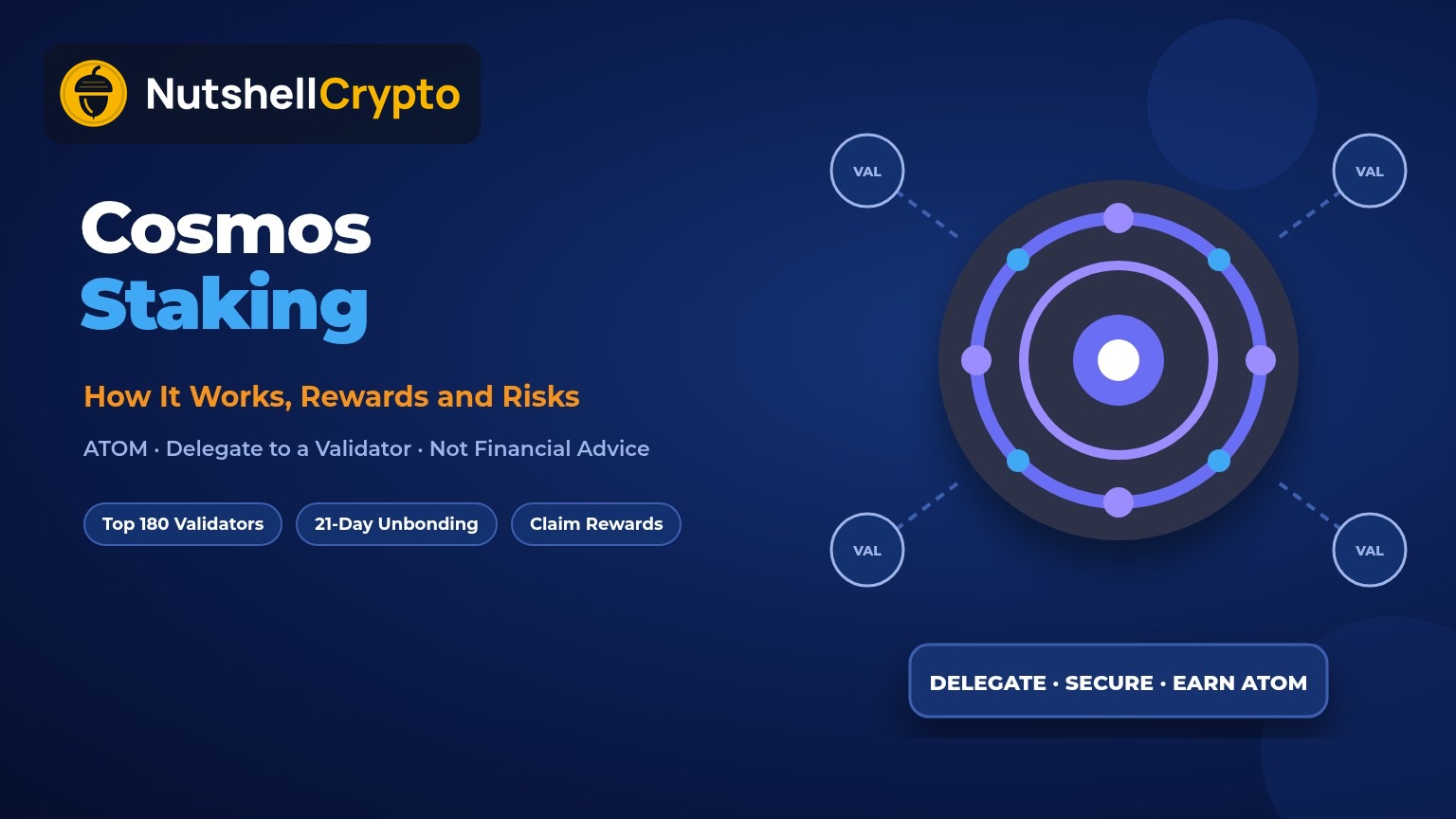
In a nutshell: Cosmos staking means delegating your ATOM to a Cosmos Hub validator so it helps secure the network and you earn a share of block provisions and fees. The active set is the top 180 validators by stake. Unbonding takes 21 days with no rewards during that wait; you can redelegate to another validator immediately. Validators cannot steal your ATOM, but your stake can be slashed if they double-sign (5%) or stay offline too long (0.01%). Claim rewards manually (or via restake-style apps). Educational only; not financial advice.
Last updated: October 15, 2026.
Cosmos staking (often searched as ATOM staking) is how holders of the Cosmos Hub’s native coin, ATOM, take part in securing the Hub and earn more ATOM in return. You do not run a validator yourself. You delegate voting power to one, keep ownership of your coins, and share in the rewards — and the slashing risks — of that validator.
This guide covers what Cosmos staking is, how ATOM delegation works, the key protocol numbers from official docs, a step-by-step walkthrough with Keplr and Ledger, how to compare validators, redelegate vs undelegate, the Liquid Staking Module (LSM), risks, taxes in the US and Canada, and an FAQ. If staking is new to you, start with our explainer on what staking in crypto means.
Table of contents
What Is Cosmos Staking?
The Cosmos Hub is a public proof-of-stake blockchain. Validators run nodes, sign blocks with CometBFT consensus, and earn revenue for that work. ATOM holders who do not want to operate a node can still participate by becoming delegators: they bond ATOM to a validator and share in that validator’s revenue and risks, per the official Cosmos Hub Delegator FAQ.
Key points for beginners:
- You keep ownership of your ATOM. The Validator FAQ is explicit: a validator cannot run away with delegators’ funds. Delegation transfers voting power, not custody.
- There is a lock-up when you exit. Unbonding takes 3 weeks (21 days). During that period you earn no rewards, and the stake is still slashable for faults committed before unbonding started.
- Rewards are not automatic in your spendable balance. You (or a restake-style app you authorize) must claim them.
- ATOM staking and Cosmos staking mean the same thing for the Hub: staking the Hub’s native token. This page is about Hub delegation, not every chain in the wider Cosmos ecosystem.
How much ATOM is bonded? When we queried the public Cosmos Hub LCD (via Keplr’s endpoint) and CoinGecko on October 15, 2026 at about 5:07 PM PKT, about 338 million ATOM was bonded against roughly 536 million ATOM circulating supply, or about 63% bonded — a bit under the protocol’s 2/3 target that drives inflation.
How ATOM Delegation Works
Validators (the active set)
Anyone can signal they want to become a validator by sending a create-validator transaction. From all candidates, the 180 validators with the most total stake (self-delegated plus delegated) form the active set and participate in consensus, per the Validator FAQ. If a validator’s stake falls out of the top 180, they leave the set until stake rises again. The maximum number can change through on-chain governance. When we checked the Hub LCD on October 15, 2026 at about 5:07 PM PKT, max_validators was 180 and there were 180 bonded validators.
Delegators (most beginners)
Delegators send a Delegate transaction naming a validator and an amount. Explorers such as Mintscan’s Cosmos Hub page list validator monikers, commission, self-bond and uptime so you can compare options. You share revenue with the validator after their commission, and you share slashing risk if they misbehave.
Commission and governance inheritance
Each validator sets an initial commission, a maximum commission and a max daily change rate. Commission comes out of your share of rewards before you receive them. Delegators are also expected to vote on Hub proposals. If you do not vote, you inherit your validator’s vote; if you do vote, you override it — a point the Delegator FAQ stresses so you stay an active counterbalance, not a passive passenger.
This differs from Ethereum solo staking, which needs 32 ETH and exposes you to protocol slashing on your own validator key. See our guide on how to stake Ethereum for that contrast.
Cosmos Staking Parameters (Hub Mainnet)
These figures come from the Cosmos Hub Delegator and Validator FAQs. We cross-checked live staking params through the Hub LCD on October 15, 2026 at about 5:07 PM PKT. Parameters can change through governance.
| Item | Value | Source |
|---|---|---|
| Active validator set | Top 180 by total stake | Validator FAQ; LCD max_validators = 180 |
| Unbonding period | 21 days / 3 weeks (1,814,400 seconds) | Delegator FAQ; LCD unbonding_time |
| Rewards during unbonding | None | Delegator FAQ |
| Slashable during unbonding | Yes, for prior validator faults | Validator FAQ |
| Redelegate to another validator | Immediate (skips the 21-day wait) | Delegator FAQ |
| Double-sign slash | 5% | Validator FAQ |
| Downtime slash | 0.01% if miss more than 95% of last 10,000 blocks (~19 hours), then jailed | Validator FAQ |
| Inflation target | Aim for 2/3 bonded; if below, inflation rises toward 20%; if above, falls toward 7% | Delegator FAQ |
| Min commission rate (protocol) | 5% when we checked | LCD min_commission_rate |
| Can validator steal delegated ATOM? | No — only voting power is delegated | Validator FAQ |
How Cosmos Staking Rewards Work
Where rewards come from
Per the Delegator FAQ, revenue comes in two main forms:
- Block provisions (new ATOM): inflation invents new ATOM to incentivize staking. The yearly inflation rate is calculated to target 2/3 bonded stake. If bonded stake stays below 2/3 for a long time, unbonded holders can expect dilution toward the high end of the band (up to about 20% compounded per year in the FAQ’s framing).
- Transaction fees: fees on Hub transfers, paid in whitelisted tokens (ATOM was the first). Fees are distributed to bonded ATOM holders in proportion to stake.
A validator applies commission on the delegators’ share before distribution. You then claim your portion.
Claiming and autocompounding
Unlike some chains that auto-compound in a reward account, Cosmos Hub rewards typically sit as claimable until you withdraw them (or authorize a restake-style service to claim and redelegate on a schedule). Third-party restake apps can help compound, but they need limited permissions and introduce smart-contract or operator trust — read any grant carefully and revoke unused allowances.
What return to expect
There is no fixed APY. Your net rate depends on inflation, fee volume, bonded ratio, your validator’s commission and uptime, and whether you claim/restake promptly. Treat any advertised rate on an exchange or dashboard as that provider’s estimate, not a promise.
How to Stake ATOM Step by Step
- Get a Cosmos-compatible self-custody wallet. Keplr is widely used for Hub staking; many people pair it with a Ledger for key security. Download only from official sites and back up your recovery phrase offline. Our crypto wallet guide covers wallet types if you are choosing one.
- Move ATOM into the wallet. Withdraw from an exchange to your cosmos address. Leave a little ATOM for gas fees so you can delegate, claim and undelegate later.
- Open the staking or Cosmos Hub tab and pick a validator. Compare uptime, commission (including max commission), self-bond and voting power. Prefer spreading stake across a few validators rather than parking everything on one large operator (see the next section).
- Sign a Delegate transaction. Choose the amount of ATOM to bond. Your coins stay under your keys; the validator only gains voting power.
- Claim rewards periodically. Check your wallet’s claim screen, or set up a carefully reviewed restake grant if you want automatic compounding.
- Use Ledger if you want hardware confirmation. Connect Ledger through Keplr (or another supported wallet), verify addresses and amounts on the device screen, and never type your seed into a website.
Exchange staking caveats
Some centralized exchanges offer “ATOM staking” as a product. That is usually custodial: the exchange holds your coins, chooses validators, takes a cut and sets its own lock rules. It is simpler, but you take exchange credit risk, freeze risk and terms that may not match Hub unbonding. Self-custody delegation keeps keys with you.
How to Choose a Validator
We do not rank or endorse specific validators. The Delegator and Validator FAQs highlight criteria you can check on Mintscan and similar explorers:
- Uptime and track record: downtime can lead to a small slash and jailing; double-signing is a much larger slash and permanent jail for that validator.
- Commission and max commission: current rate plus the hard ceiling the operator set at creation. A low rate that can jump to a high max is different from a low rate with a low max.
- Self-bond / validator bond: more “skin in the game.” Under the Liquid Staking Module, validator bond also gates eligibility for liquid-staking provider delegations.
- Decentralization: very large validators concentrate voting power. Spreading stake across smaller, reliable operators supports Hub resilience — and redelegation is immediate, so switching costs are mainly attention, not a 21-day wait.
- Governance participation: if you do not vote yourself, you inherit their vote, so their proposal record matters.
Redelegate vs Undelegate
- Undelegate (unbond): starts the 21-day unbonding period. No rewards during the wait; stake remains slashable for prior faults; after 21 days ATOM returns to your liquid balance.
- Redelegate (rebond): moves stake from one validator to another immediately, without the 21-day wait. The Delegator FAQ calls this out so you can leave a misbehaving or offline validator quickly.
There are limits on how often and how many redelegations you can have in flight (Hub params include max entries). If a wallet errors on redelegate, check whether you already have pending redelegations.
Liquid Staking Module (LSM)
The Hub’s Liquid Staking Module adds safety rails and UX for liquid staking ATOM. Per the Delegator FAQ, the LSM:
- Caps how much of all staked ATOM can be liquid staked (governance-controlled).
- Requires validators to post validator bond before accepting liquid-staking provider delegations or minting LSM tokens.
- Lets users tokenize already-staked ATOM into transferable LSM shares and move into a liquid staking position without waiting 21 days.
Accounts can also disable tokenization (DisableTokenizeShares) as a theft-mitigation lock; re-enabling waits through the unbonding period. Liquid staking tokens add smart-contract and depeg risk on top of Hub staking risk. For the broader trade-offs, see our liquid staking explainer.
Comparing other proof-of-stake setups? Our ADA staking guide uses the same beginner format (Cardano has no unbonding or slashing).
Risks of Cosmos Staking
- Slashing: double-signing costs 5% of the validator’s total stake (including yours); prolonged downtime costs 0.01% and jails the validator. Your principal is at risk in proportional slice terms, even though the validator cannot withdraw your coins.
- Illiquidity: exiting to cashable ATOM takes 21 days. Redelegation helps you change validators without that wait, but it does not make ATOM instantly sellable.
- Price risk: rewards are paid in ATOM. Yield does not protect you from a large drop in ATOM’s price, and inflation dilutes non-stakers when bonded share is low.
- Validator / governance risk: poor uptime, rising commission, or inherited votes you disagree with. Monitor and redelegate when needed.
- Wallet and phishing risk: fake Keplr sites, malicious browser extensions and “support” asking for your seed phrase remain the fastest way to lose funds. No legitimate validator needs your recovery phrase.
- Custody risk: exchange staking means trusting the exchange.
- LSM / liquid staking risk: contract bugs, provider failure and caps on how much can be liquid staked.
- Parameter changes: max validators, inflation bands and slash fractions can change via governance.
Taxes on Cosmos Staking Rewards (US and Canada)
In the US, the IRS’s Revenue Ruling 2023-14 says a cash-method taxpayer includes staking rewards in gross income, at fair market value, in the year they gain dominion and control over them. Claiming Hub rewards can create many small income events, so keep records of each claim’s date and USD value. Selling ATOM later can trigger a capital gain or loss; see our beginner guide to crypto taxes.
In Canada, the CRA’s page on reporting income from crypto mining and staking says rewards from staking on a centralized exchange are generally income when credited, and staking done as a business is business income. Our guide to cryptocurrency tax in Canada covers the CRA rules in more detail.
For examples and record-keeping tips, read our full guide to crypto staking taxes. This is not tax advice; check with a tax professional.
FAQ
What is Cosmos staking in simple terms?
It is ATOM delegation on the Cosmos Hub: you bond ATOM to a validator, they help secure the chain, and you earn a share of block provisions and fees after commission.
Is ATOM staking the same as Cosmos staking?
For the Hub, yes — people use both phrases for staking ATOM. Other Cosmos SDK chains have their own tokens and parameters; this guide is about the Hub.
How long is the Cosmos unbonding period?
21 days (3 weeks). You earn no rewards while unbonding, and the stake can still be slashed for earlier validator faults.
Can I switch validators without waiting 21 days?
Yes. Redelegation takes effect immediately and skips the unbonding wait, subject to Hub redelegation limits.
Can a validator steal my ATOM?
No. Validators receive voting power, not custody. They can still get you slashed if they misbehave, which is why due diligence matters.
What are the Cosmos Hub slashing penalties?
Double signing: 5%. Downtime: 0.01% if the validator misses more than 95% of the last 10,000 blocks, then jail. Figures come from the official Validator FAQ.
Do I have to vote on governance proposals?
You should. If you do not vote, you inherit your validator’s vote. If you vote, you override it.
What is the Liquid Staking Module?
A Hub feature that caps liquid staking, requires validator bond for LSM eligibility, and lets you tokenize staked ATOM into transferable shares without waiting out unbonding. Details are in the Delegator FAQ and our liquid staking guide.
Sources
- Cosmos Hub Docs: Delegator FAQ
- Cosmos Hub Docs: Validator FAQ
- Mintscan: Cosmos Hub
- Cosmos Network
- Cosmos Hub LCD staking pool and params (via Keplr public endpoint), queried October 15, 2026 at about 5:07 PM PKT — bonded ~338M ATOM, max_validators 180, unbonding_time 1,814,400s
- CoinGecko: Cosmos (ATOM) circulating supply, checked October 15, 2026 at about 5:07 PM PKT
- IRS: Revenue Ruling 2023-14
- CRA: Reporting income from crypto-asset mining and staking activities
This article is for educational purposes only and is not financial, investment or tax advice.