In a nutshell: Spot trading crypto means buying or selling the actual coin at the current market price, paying in full, with the trade settling straight into your account. There is no borrowing, no contract and no expiry date: if you buy 0.01 BTC on the spot market, you own 0.01 BTC. You trade in pairs such as BTC/USD or ETH/USDC, using market orders (fast, but the price is not guaranteed) or limit orders (your price or better, but they may never fill). Your main costs are trading fees and the spread. Your loss is capped at what you put in, but prices can still swing hard. Educational only; not financial advice.
Last updated: October 19, 2026.
Spot trading crypto is the simplest way to trade digital assets, and it is what most people are doing when they tap “Buy” on an exchange. This guide explains what spot trading means, how trading pairs and the order book work, the order types you will see (market, limit, stop-loss and stop-limit), what it costs, how it compares with margin and futures, and how to place your first spot trade safely.
Spot trading usually happens on an exchange, so if you are new to platforms like Coinbase or Kraken, start with our explainer on what a centralized exchange is.
Table of contents
- What is spot trading in crypto?
- Trading pairs: what BTC/USD actually means
- The order book, bid, ask and spread
- Spot order types: market, limit, stop-loss and stop-limit
- What spot trading costs: maker vs taker fees
- Spot vs margin vs futures
- How to place your first spot trade
- Risks of spot trading
- Taxes on spot trades in the US and Canada
- FAQ
What Is Spot Trading in Crypto?
Spot trading is buying or selling a crypto asset “on the spot”: at the price available right now, paid for in full, with the coins delivered to your account once the order fills. The spot price is simply the current market price for immediate purchase or sale.
Three things make a trade a spot trade:
- You own the asset. When a spot buy fills, the coin sits in your exchange balance, and you can hold it, sell it, or withdraw it to your own wallet.
- You pay the full amount. There is no loan from the exchange, so there is no interest and no liquidation.
- There is no contract or expiry. You are trading the coin itself, not a bet on its price.
That is why spot trading is where almost every beginner starts. A one-time purchase on a simple “Buy” screen and a limit order on an advanced trading screen are both spot trades. The difference is how much control you have over price and fees. If you just want to buy your first coin, our step-by-step guide on how to buy Bitcoin covers the basics.
Trading Pairs: What BTC/USD Actually Means
Every spot market is a trading pair: one asset priced in another. Coinbase’s help center describes a market pair as either a crypto/crypto or a crypto/fiat trading pair. For example:
- BTC/USD: buy or sell Bitcoin with US dollars.
- ETH/CAD: buy or sell Ether with Canadian dollars.
- SOL/USDC: buy or sell Solana with USDC, a dollar-pegged stablecoin.
- ETH/BTC: trade Ether directly for Bitcoin, with no fiat involved.
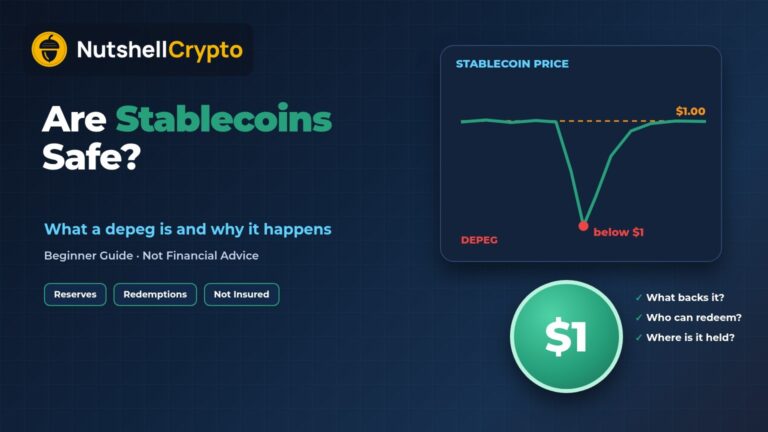
The first asset is the one you are buying or selling (the base), and the second is what you pay or receive (the quote). Big exchanges list a lot of pairs: Kraken says its Kraken Pro spot market covers 1,400+ crypto pairs. Many pairs are quoted in stablecoins, so it helps to understand what stablecoins are before you trade them.
The Order Book, Bid, Ask and Spread
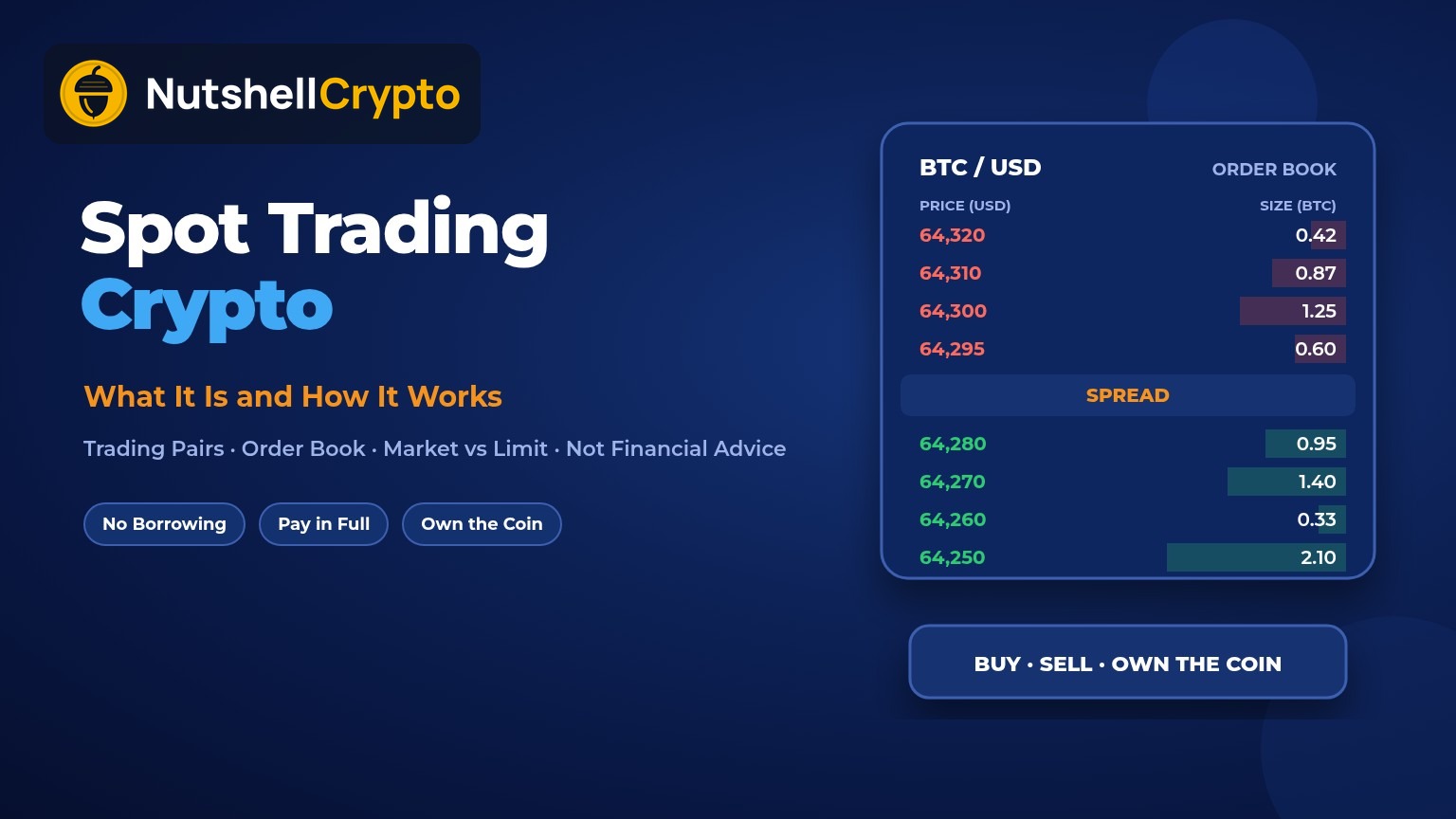
Each pair has an order book: a live list of buy and sell orders waiting to be filled. Kraken’s support guide to market and limit orders explains that an order book is made up of all traders’ limit orders for that trading pair.
- Bid: the highest price a buyer is currently willing to pay.
- Ask: the lowest price a seller is currently willing to accept.
- Spread: the gap between the two. Coinbase defines a spread as the difference between the buying and selling price of an asset.
Exchanges usually show the order book next to a price chart, and our guide to reading a crypto trading chart explains its candles, volume bars and timeframes.
The SEC’s investor site notes that a market order generally executes at or near the current ask when you buy and the current bid when you sell, and that the last-traded price is not necessarily the price you will get. Busy pairs like BTC/USD tend to have tight spreads. Thin, less popular pairs can have wide ones, which quietly raises your cost.
Spot Order Types: Market, Limit, Stop-Loss and Stop-Limit
The SEC’s Investor.gov guide to order types was written for stocks, but the same three basics apply on crypto exchanges.
Market order
A market order buys or sells immediately at the best price available. Investor.gov says it guarantees the order will execute but does not guarantee the price. Coinbase’s trading rules add that a market order may fill at several different prices depending on what is in the order book, and can fill at a price worse than the most recent trade, sometimes significantly. That gap is called slippage. Kraken warns that the order book can change a lot after the last trade, especially in less popular pairs.
Limit order
A limit order lets you set your price. A buy limit only fills at your price or lower, and a sell limit only at your price or higher. The trade-off, as Kraken puts it, is that there is no guarantee the order will fill completely, or at all. On Coinbase you can also set how long a limit order lasts, such as Good ‘Til Canceled or Immediate or Cancel, according to its order types guide.
Stop-loss order
A stop-loss sits dormant until the price touches a level you choose (the stop price), then turns into a market order. Kraken’s stop-loss guide says the triggered order executes as a market order and pays taker fees, and that in volatile, relatively illiquid crypto markets your fill can be significantly lower or higher than the stop price. On a spot market you also need to already hold the coin: Kraken notes you must own the asset in your spot wallet to place a stop-loss sell.
Stop-limit order
A stop-limit order places a limit order, not a market order, once the stop price is hit. Coinbase says it may help protect profits, limit losses or start new positions. You get more price control than with a plain stop-loss, but in a fast drop the price can blow past your limit and leave the order unfilled.
| Order type | Fills fast? | Price guaranteed? | Best for |
|---|---|---|---|
| Market | Yes, right away | No | Small trades on busy pairs |
| Limit | Only if the price reaches your limit | Your price or better | Controlling price and fees |
| Stop-loss | Yes, once triggered | No | Automatic exit if price falls |
| Stop-limit | Only if the limit can fill after the trigger | Your limit or better | Exits with a price floor |
What Spot Trading Costs: Maker vs Taker Fees
Most exchanges charge different fees depending on whether your order adds liquidity to the order book or takes it away. Coinbase’s Advanced fees page explains it like this:
- Taker: orders filled immediately at the market price, such as a market order or a limit order that matches right away, pay the taker fee.
- Maker: orders that are not matched immediately, such as a buy limit below the market price, sit on the order book and pay the maker fee when they fill.
- Partly matched: the part that fills immediately pays the taker rate, and the rest pays the maker rate when it fills.
Coinbase also offers a Post Only setting that rejects your limit order if any part of it would fill immediately, so it only ever pays maker fees. Exact rates depend on the exchange and your monthly volume, and the spread is a cost on top of the posted fee. Our guide to crypto exchange fees breaks down maker, taker, spread and withdrawal fees with a worked example.
Spot vs Margin vs Futures
| Spot | Margin | Futures and perpetuals | |
|---|---|---|---|
| What you get | The actual coin | The actual coin, partly bought with borrowed funds | A contract on the price |
| Borrowing | No | Yes | Usually leveraged |
| Can you be liquidated? | No | Yes | Yes |
| Most you can lose | What you put in | Your deposit, sometimes more | Your margin, sometimes more |
| Can you withdraw the coin? | Yes | Only after repaying the loan | No coin to withdraw |
The big practical difference is leverage. With spot, a 50% price drop means a 50% paper loss, and you can wait it out. With borrowed money, the same drop can wipe out your position. We cover leverage, margin calls and liquidation in detail in our guide to margin trading in crypto. In Canada, crypto trading platforms working toward registration have committed under CSA Staff Notice 21-332 not to offer margin or leverage, so spot trading is effectively the main option there.
Want to understand how futures differ from buying coins? See crypto futures explained.
How to Place Your First Spot Trade
- Pick a regulated exchange available where you live and finish identity verification.
- Fund your account with dollars by bank transfer, or deposit crypto or stablecoins you already own.
- Open the trading pair you want, such as BTC/USD or ETH/USDC. Check the spread between the top bid and ask before you trade.
- Choose an order type. For most beginners, a limit order at or near the current price gives you price control and often a lower fee. Coinbase lists the steps as selecting the pair, choosing Buy or Sell, selecting Limit, entering the size and confirming.
- Enter a small size first. Make a test trade so you see exactly how fees and fills work on that platform.
- Review and confirm, then check the filled price and fee in your order history.
- Decide where the coin lives. You can leave it on the exchange or move it to a wallet you control. Our guide to self-custody explains the trade-offs.
Keep the order history or download it regularly. You will need it at tax time.
Risks of Spot Trading
Spot trading removes leverage risk, but it is not risk-free. The CFTC’s advisory Understand the Risks of Virtual Currency Trading says virtual currencies are more volatile than traditional fiat currencies, and warns that cash-market platforms may lack critical safeguards and customer protections. It also lists flash crashes, market manipulation, hacking and phishing, and platforms selling from their own accounts in a way that disadvantages customers.
- Price swings: you can lose a large part of what you put in, even with no leverage.
- Slippage and thin markets: market orders on small pairs can fill far from the price you saw.
- Platform risk: coins held on an exchange depend on that company staying solvent and secure.
- Overtrading: frequent trades add fees and taxable events. If you only want long-term exposure, dollar cost averaging crypto is a lower-effort approach.
Taxes on Spot Trades in the US and Canada
Every spot sale, and every crypto-to-crypto trade, can be a taxable event.
- United States: the IRS digital assets page says you must check “Yes” on the digital asset question if you sold or exchanged digital assets, including for another digital asset. To work out a gain or loss you need the date and time, the number of units and the fair market value at the time of each transaction. Buying with dollars and simply holding does not by itself require a “Yes”.
- Canada: the CRA’s guide to reporting income from crypto-asset transactions says a disposition may occur when you trade or exchange a crypto-asset for government-issued currency or another crypto-asset. Moving crypto between wallets you own is not a taxable disposition.
For the full picture, see our beginner guide to crypto taxes in the US and our guide to cryptocurrency tax in Canada.
FAQ
What is spot trading in crypto in simple terms?
It is buying or selling the actual coin at the current price and paying in full. When the order fills, you own the coin.
Is spot trading safer than futures?
It removes leverage and liquidation, so the most you can lose is what you put in. Prices can still fall sharply, and coins on an exchange still carry platform risk.
Can you lose money spot trading?
Yes. If you buy and the price falls, you lose money when you sell. You cannot lose more than your investment, because you did not borrow.
Is buying on the Coinbase app spot trading?
Yes. A standard buy of BTC or ETH with dollars is a spot purchase: you receive the coin itself. Advanced trading screens add order types like limit and stop-limit, but you are still trading spot.
Should beginners use market or limit orders?
A limit order gives you price control and can qualify for maker fees, though it may not fill. A market order fills right away but can slip, especially on small pairs. Many beginners use limit orders set close to the current price.
Is spot trading legal in the US and Canada?
Yes, on platforms allowed to operate where you live. Canadian platforms working toward registration have committed not to offer margin or leverage, so Canadians mainly trade spot.
Sources
- Investor.gov (SEC): Types of Orders
- Kraken: Market and limit orders
- Kraken: Stop loss orders
- Kraken Pro: Spot order types
- Kraken Pro: Spot trading
- Coinbase Help: Advanced trade order types
- Coinbase Help: Coinbase Advanced fees
- Coinbase: Trading Rules
- CFTC: Understand the Risks of Virtual Currency Trading
- CSA Staff Notice 21-332
- IRS: Digital Assets
- CRA: Reporting income from crypto-asset transactions
This article is for educational purposes only and is not financial, investment or tax advice.