In a nutshell: Dollar cost averaging (DCA) in crypto means buying a fixed dollar amount of a coin on a regular schedule, such as $50 of Bitcoin every week, whatever the price is that day. Low prices buy more coins and high prices buy fewer, so your average cost lands in between. DCA does not guarantee a profit, but it takes the guesswork out of timing the market. Educational only; not financial advice.
Last updated: October 8, 2026.
Crypto prices can swing 10% in a few days, which makes “when should I buy?” one of the hardest questions for beginners. Dollar cost averaging crypto is the simple answer many long-term buyers use: pick an amount, pick a schedule, and buy on that schedule whether the market is up or down. This guide explains what DCA means, how it works, how to calculate your dollar-cost average, how it compares with a lump sum, how to set up recurring buys in the US and Canada, and how DCA purchases are taxed. Want to test a plan with your own numbers as you read? Try our free crypto DCA calculator.
Table of contents
- DCA meaning in crypto
- How dollar cost averaging works
- How to calculate your dollar-cost average
- DCA vs lump-sum investing
- Benefits and risks of DCA
- How often to DCA, and how fees matter
- Building a crypto DCA strategy
- How to set up automatic DCA (recurring buys)
- DCA and taxes in the US and Canada
- Common DCA mistakes
- The bottom line
- FAQ
- Sources
DCA Meaning in Crypto
DCA stands for dollar cost averaging. The SEC’s investor site, Investor.gov, defines it as investing equal amounts of money at regular intervals, regardless of whether the market is moving up or down. If part of every paycheck goes into a 401(k) or group RRSP, you already do it, as FINRA points out.
The DCA crypto meaning is the same idea applied to digital assets. Instead of buying $1,200 of Bitcoin at once, you might buy $100 on the first of every month for a year. When people say they are “DCAing into BTC,” that is what they mean. Two things DCA is not:
- Not a trading signal. It ignores charts and headlines on purpose.
- Not protection from losses. If a coin falls and never recovers, buying it on a schedule still loses money. DCA changes when you take risk, not whether you take it.
How Dollar Cost Averaging Works, Step by Step
- Choose the coin. Many people DCA into Bitcoin, the largest and most traded crypto asset. New to it? Read our beginner’s guide to Bitcoin.
- Pick a fixed amount you could keep buying even if the price halved, and that you will not need for bills.
- Pick a schedule: daily, weekly, every two weeks or monthly. Many people match it to payday.
- Automate it with a recurring buy, so it happens without you.
- Stick with it and keep records of every purchase for taxes.
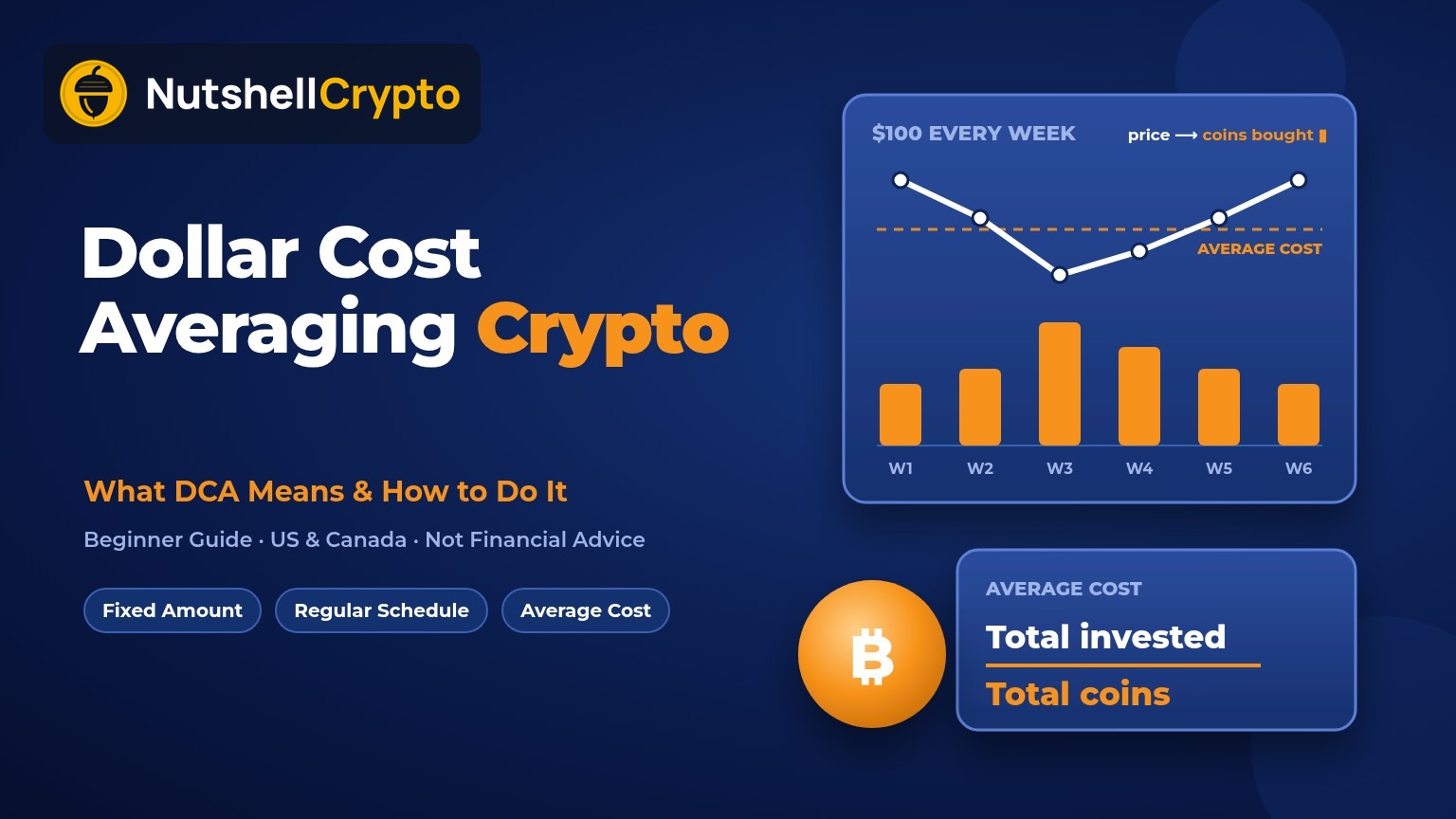
Dollar cost averaging crypto example: $100 a week
Say you buy $100 of a coin every week for six weeks, with no fees. These are made-up prices for an imaginary coin, chosen to keep the math easy. They are not real or predicted prices.
| Week | Amount invested | Coin price (illustrative) | Coins bought | Total coins |
|---|---|---|---|---|
| 1 | $100 | $20.00 | 5.00 | 5.00 |
| 2 | $100 | $16.00 | 6.25 | 11.25 |
| 3 | $100 | $10.00 | 10.00 | 21.25 |
| 4 | $100 | $12.50 | 8.00 | 29.25 |
| 5 | $100 | $16.00 | 6.25 | 35.50 |
| 6 | $100 | $20.00 | 5.00 | 40.50 |
| Total | $600 | 40.50 |
You put in $600 and own 40.5 coins, so your average cost is $600 ÷ 40.5 = about $14.81 per coin. The price ended where it started ($20), yet your coins are worth 40.5 × $20 = $810, a $210 paper gain. Putting all $600 in during week 1 would have bought 30 coins, worth exactly $600 at the end. DCA came out ahead here because it kept buying through the dip.
Also notice that the simple average of the six prices is $15.75, but your real average cost is lower, at $14.81. That is the averaging effect: a fixed dollar amount automatically buys more coins when they are cheap.
When DCA loses: a steadily rising price
Now imagine the price only rises over four weeks: $10, $12.50, $20, then $25. Buying $100 each week gets you 10 + 8 + 5 + 4 = 27 coins, worth $675 at $25. Investing all $400 in week 1 at $10 would have bought 40 coins worth $1,000. When prices climb steadily, buying early wins. Nobody knows in advance which path prices will take.
How to Calculate Your Dollar-Cost Average
To calculate your dollar cost average, you need two numbers: how much money you have put in (including fees) and how many coins you own.
Average cost per coin = total amount invested ÷ total coins bought
For each purchase: fee = amount × fee %; coins bought = (amount − fee) ÷ price that day. Then value today = total coins × today’s price, and profit or loss = value today − total invested.
Worked example with fees
Say you buy $200 of Bitcoin once a month for three months and pay a 1% fee. Prices are illustrative round numbers, not real market data.
| Month | Amount | Fee (1%) | Price (illustrative) | BTC bought |
|---|---|---|---|---|
| 1 | $200 | $2 | $40,000 | 0.00495 |
| 2 | $200 | $2 | $50,000 | 0.00396 |
| 3 | $200 | $2 | $32,000 | 0.0061875 |
| Total | $600 | $6 | 0.0150975 |
Your average cost is $600 ÷ 0.0150975 = about $39,742 per BTC. Without the fee it would be about $39,344. The fee-inclusive number is your true break-even price. At $45,000, your BTC would be worth about $679, a gain of about $79 (13.2%). Below $39,742, you would be at a loss.
Doing this by hand gets tedious after a few dozen buys, so we built a tool for it.
Try our free crypto DCA calculator
Enter the coin, the amount per purchase, how often you buy (daily, weekly, every 2 weeks or monthly), start and end dates, the start price and today’s price, and an optional fee. You can also type in your own buy prices. It shows value today, profit or loss, total invested, coins bought, average buy price, number of purchases and fees, with a chart. There is no live price feed: results come from the prices you enter.
DCA vs Lump-Sum Investing
If you already have a pile of cash, the real question is whether to invest it all now or spread it out. The best-known research comes from Vanguard. Its February 2023 study found that investing a lump sum right away beat cost averaging about two-thirds of the time for stock and bond portfolios, with a win rate of 61.6% to 73.7% across the markets tested over 1976–2022, according to Vanguard’s summary. Markets rose more often than they fell, so waiting cash usually missed gains. Cost averaging still did better in the worst downside scenarios and beat staying in cash.
Keep two caveats in mind: that research covered stocks and bonds, not crypto, which is far more volatile; and past performance does not guarantee future results. Also, if you invest from each paycheck, you are dollar cost averaging by default, and FINRA notes the opportunity-cost argument does not apply then.
| Dollar cost averaging | Lump sum | |
|---|---|---|
| Usually wins when | Prices fall first, then recover | Prices rise steadily |
| Main upside | Less regret; easier to stick with | Money is invested longer |
| Main downside | Idle cash can miss gains; more fees | Bad timing hurts more |
| Fits best | Investing from income; nervous investors | Investors fine with full volatility on day one |
Benefits and Risks of DCA
Benefits
- No market timing and less emotional decision-making, such as panic-selling in a crash or chasing a rally.
- A smoother entry price that does not hinge on one day.
- Easy to start small, since most platforms sell fractions of a coin.
- Automatable, which turns a good intention into a habit.
Risks and limitations
- Fees can eat a big share of small, frequent buys.
- Long declines. In a long bear market you keep buying something that keeps falling. DCA only pays off if the price ends above your average cost.
- Opportunity cost if a lump sum sits in cash while you average in.
- Exchange and custody risk. Recurring buys usually happen on a centralized exchange, and coins left there sit in a custodial wallet. A hack, failure or withdrawal freeze can put them at risk.
- Coin risk. Many coins have lost most of their value and never recovered.
How Often to DCA, and How Fees Matter
There is no magic frequency. Over a year, weekly and monthly plans with the same budget often end up close. The bigger difference is usually the type of fee:
- Percentage fees (say 1% per buy) cost the same in total either way: 1% of $1,200 is $12.
- Flat fees punish frequent small buys. With a $1 flat fee, $1,200 a year as $100 monthly costs $12 (1%). As about $23 weekly it costs $52 (about 4.3%). Daily buys of about $3.30 would cost $365, roughly 30% of what you invest.
- Spreads, the hidden markup on simple buy screens, apply to every purchase.
| Frequency | Buys per year | Good for | Watch out for |
|---|---|---|---|
| Daily | 365 | Smoothest averaging | Flat fees; lots of records |
| Weekly | 52 | Balance of smoothing and simplicity | Minimum fees on small amounts |
| Every 2 weeks | 26 | Matching a biweekly paycheck | Slightly uneven monthly totals |
| Monthly | 12 | Lowest flat-fee cost; simple records | Each buy carries more weight |
Check your platform’s fee page. For example, Wealthsimple’s help centre says that, as of September 24, 2026, crypto orders under $100 carry a $1 small-order surcharge on top of its regular fee and spread, while crypto auto-buys funded by a direct-deposited paycheque have no trading fee. Our how to buy Bitcoin guide explains spreads and fees in more detail.
Building a Crypto DCA Strategy
The best way to DCA crypto
The best DCA strategy for crypto is usually the one you can stick with through a long bear market:
- Build an emergency fund and pay off high-interest debt first.
- Decide what share of your savings can go into a volatile asset, and size the amount to fit.
- Choose a frequency that keeps fees low, then automate it.
- Review once or twice a year, not every day. Change the plan when your finances change, not because of a headline.
What is the best crypto to DCA?
We do not recommend specific coins. Instead, weigh liquidity and size (large, heavily traded assets are easier to buy and sell at fair prices), track record through past crashes, real use beyond speculation, and your own risk tolerance, since small coins swing harder and can go to zero. Many people DCA into Bitcoin for these reasons. That is an observation, not advice.
You may also hear about value averaging (buying more when your holdings fall behind a target growth path and less when ahead) and DCA out (selling in fixed amounts on a schedule). Both are more complex, and every sale can be taxable.
How to Set Up Automatic DCA (Recurring Buys)
Most platforms call automatic DCA a recurring buy. The steps are similar everywhere: verify an account on a regulated platform available where you live, link a bank account or card (or keep cash funded), choose the coin, pick the recurring option instead of a one-time buy, set the amount, frequency and start date, review fees, and confirm. Then check the first few purchases went through.
US platforms (examples)
- Coinbase: its help center covers recurring buys in the app and on the web. The first buy runs immediately when you create the schedule, and to change the amount or frequency you cancel and create a new one.
- Kraken: recurring orders run daily, weekly, biweekly or monthly from a verified account, but not on Kraken Pro.
- Gemini: choose “Recurring” when buying, per its support page; its how-to-buy page lists daily, weekly, twice-monthly and monthly options. Not available on ActiveTrader.
Canadian platforms (examples)
- Wealthsimple: recurring investments buy stocks, ETFs or crypto daily, weekly, bi-weekly or monthly, set up in the app.
- Shakepay: recurring buys for BTC and ETH are paid from your CAD balance. Shakepay says eligible bitcoin recurring buys have no spread from day 8 after setup.
- Newton: recurring buys let you set the coin, amount, start date and frequency, as long as your account holds enough CAD.
- Coinbase offers the same feature in Canada under the name Auto-buy.
These are examples, not endorsements. Features, fees and coin lists change, so confirm on each platform’s help pages. Our guide to centralized exchanges explains what to check.
DCA into a spot Bitcoin ETF instead
If you would rather not hold coins on an exchange, you can DCA into a spot Bitcoin ETF through a brokerage account. Many brokerages offer automatic investing for ETFs; check that yours supports the ticker and fractional shares. In Canada, Wealthsimple’s recurring investments cover ETFs too. You skip managing keys, but you pay the fund’s annual fee and trade only during market hours. Start with our Bitcoin ETF guide, then see how to buy a Bitcoin ETF in the US or in Canada.
Where to keep the coins you accumulate
Recurring buys land in your exchange account. Some people move larger balances to a personal wallet now and then; batching withdrawals saves network fees. See our crypto wallet guide and hot vs cold wallet comparison.
DCA and Taxes in the US and Canada
Buying crypto with dollars is generally not taxable in either country. Tax usually comes when you sell, trade or spend it. Dollar cost averaging crypto matters for taxes because it creates many purchases at different prices, and those prices decide your gain or loss later.
United States
The IRS treats crypto as property. Each DCA purchase is its own tax lot with its own cost basis (what you paid, including fees) and holding period, per the IRS virtual currency FAQs. Coins held more than one year get long-term treatment. When you sell part of your holdings, you can choose which units you sell if you can specifically identify them; otherwise they are treated as first in, first out (FIFO). Brokers report sales on Form 1099-DA for transactions on or after January 1, 2025, per the IRS digital assets page. Learn more in our US crypto taxes guide, crypto capital gains tax guide and guide to crypto tax loss harvesting.
Canada
You still record every purchase, but the CRA does not let you pick lots. For identical properties, you recalculate an average cost after each purchase to get your adjusted cost base (ACB): the total cost, usually including acquisition expenses, divided by the units you own. Selling does not change the per-unit ACB, under the CRA’s identical-property rules. In practice, your ACB looks a lot like the DCA average formula above. The CRA’s crypto-asset guide also notes frequent trading can count as business income. See our guide to cryptocurrency tax in Canada.
General information, not tax advice. Confirm with a qualified tax professional.
Common DCA Mistakes
- Stopping when prices fall, which skips the cheapest buys.
- Investing money you will need soon. If a crash could force you to sell, the amount is too big.
- Ignoring fees, especially flat fees on tiny daily buys.
- Using a simple average of prices instead of total invested ÷ total coins.
- Treating DCA as a guarantee or using it to chase hype coins.
- Losing records. Export your transaction history at least once a year.
- Falling for “auto-DCA” scams. No legitimate recurring buy needs your seed phrase.
The Bottom Line
Dollar cost averaging crypto means buying a fixed amount on a fixed schedule so you do not have to guess the right moment. It will not beat a lump sum every time, but it is a practical way to invest from income, limit regret and stay consistent in a volatile market. Keep fees low, automate the plan, keep tax records, and invest only what you can leave alone through a long downturn. To see how a schedule plays out with prices you choose, plug your numbers into our crypto DCA calculator.
Frequently Asked Questions
What does DCA mean in crypto?
DCA stands for dollar cost averaging: buying a fixed dollar amount of a coin at regular intervals, such as weekly or monthly, regardless of price, so your average cost is spread across many prices.
Is DCA good for Bitcoin?
Many long-term Bitcoin buyers use DCA because it removes the need to time a volatile market. It does not guarantee a profit: if Bitcoin is below your average cost when you sell, you lose money.
How often should I DCA?
Weekly, every two weeks and monthly are most common. Match your income and keep fees low. With flat fees, fewer and larger buys are cheaper; with percentage fees, frequency matters less.
Is DCA better than lump sum?
Not on average in historical stock and bond data: Vanguard found a lump sum won about two-thirds of the time. DCA tends to win when prices fall soon after you start, and it can reduce regret.
How do I calculate my DCA?
Divide the total you have invested, including fees, by the total coins you own. For example, $600 that bought 0.0150975 BTC is about $39,742 per BTC. The calculator linked above does this for any schedule.
Can I DCA into any crypto?
Yes, if your platform supports recurring buys for that coin. But DCA does not reduce the risk that a coin fails, and smaller coins carry much higher risk.
Does DCA work in a bear market?
A bear market is when DCA buys the most coins per dollar, lowering your average cost, but it only pays off if prices later recover above that average. Sharp falls, like the one in our Bitcoin price drop report, are when sticking to the plan is hardest. Past cycles, including those around the Bitcoin halving, do not guarantee future results.
Sources
- Investor.gov (SEC): Dollar Cost Averaging
- FINRA: The Benefits and Limitations of Dollar-Cost Averaging
- Vanguard Research: Cost averaging: Invest now or temporarily hold your cash? (Feb 2023, PDF)
- Vanguard: The truth about cost averaging
- Coinbase Help: How to set up recurring buys
- Kraken Support: Recurring orders
- Gemini Support: What is a recurring buy?
- Wealthsimple Help: Set up a recurring investment
- Shakepay Help: How recurring buys work
- Newton Help: What are recurring buys?
- IRS: FAQs on virtual currency transactions
- IRS: Digital assets
- CRA: Special rules and other transactions (identical properties, ACB)
- CRA: Reporting income from crypto-asset transactions
Educational content only. This is not financial, investment or tax advice. Crypto is volatile and you can lose money, including through a DCA plan. All prices in this article are illustrative examples, not real or predicted prices. Platform features and fees change; check official sources and do your own research before you act.