In a nutshell: Polkadot staking means bonding DOT and nominating validators, either on your own (250 DOT minimum to start) or through a nomination pool (from 1 DOT). Your DOT stays in your account. Since July 2026, nominators can no longer be slashed, unbonding takes about 2 days instead of 28, and validators charge 0% commission. When we checked on October 20, 2026, the network was paying stakers roughly 2.8% a year before any pool fee. Educational only; not financial advice.
Last updated: October 20, 2026.
Polkadot staking (also called DOT staking) is how holders of DOT, the native token of the Polkadot network, help secure the chain and earn more DOT in return. You don’t need to run a validator yourself. You back validators as a nominator, or you join a nomination pool that nominates for you, and you share in the rewards.
Polkadot’s staking rules changed a lot in 2025 and 2026. Many older guides still describe a 28-day lock-up and slashing risk for nominators; neither applies to new nominators today. This guide covers how it works now, live on-chain numbers, a step-by-step walkthrough, unstaking, risks, and US and Canadian taxes. If staking is new to you, start with our explainer on what staking in crypto means.
Table of contents
- What is Polkadot staking?
- How Polkadot staking works
- What changed in 2026
- Polkadot staking numbers (table)
- How DOT staking rewards work
- Nominating vs pools vs exchanges
- How to stake DOT step by step
- How to choose validators or a pool
- How to unstake DOT
- Risks of Polkadot staking
- Taxes in the US and Canada
- FAQ
What Is Polkadot Staking?
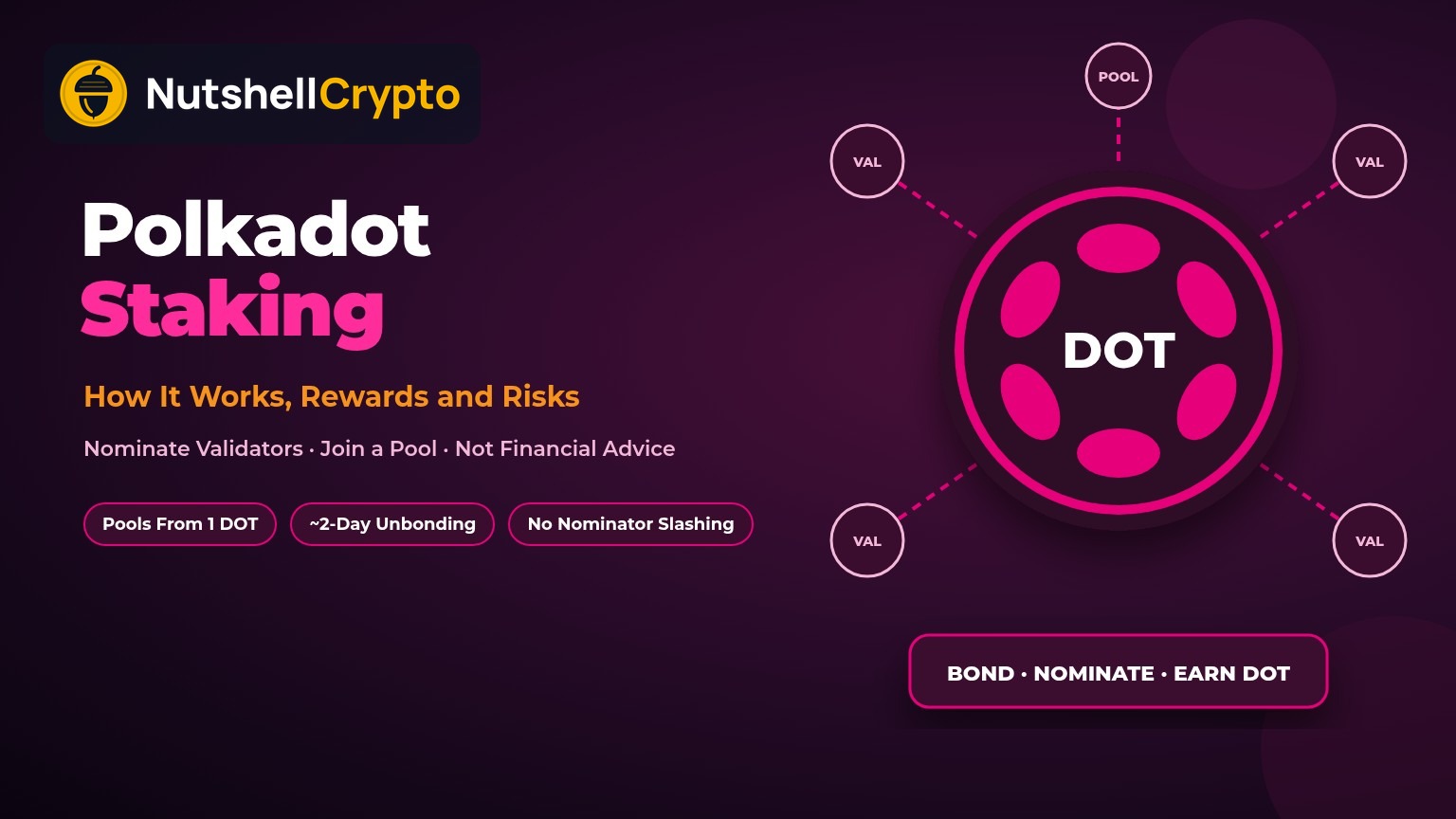
Polkadot runs on a version of proof of stake called Nominated Proof-of-Stake (NPoS). According to the official Polkadot Wiki staking page, validators run the nodes that produce and finalize blocks, while nominators lock up DOT and choose which validators to back. The network then spreads nominators’ stake across the chosen validators so that the active set is backed as evenly as possible.
Key points for beginners:
- Bonding, not sending. Staking locks (“bonds”) your DOT; validators never control it.
- You can back up to 16 validators. The wiki’s nomination pools page says a nominator manages a list of up to 16 validators. The protocol decides which of them your stake actually backs in each era.
- Two ways in. Nominate directly with at least 250 DOT, or join a nomination pool with as little as 1 DOT.
- Rewards are paid in DOT. They’re calculated once per era, which lasts about 24 hours on Polkadot.
How Polkadot Staking Works
Eras and elections
Polkadot works in eras of about 24 hours, each split into 6 sessions. Each era, an election picks the next active validator set. The wiki explains that the election only considers about 22,500 nominators, because it must be computed inside a single block. So the “minimum active stake” moves: it’s set by the smallest nominator who made the cut.
A new nomination doesn’t earn right away. Per the wiki, your stake starts earning once it backs a validator that enters the active set at the next election, which can take up to about 48 hours (one to two eras).
Staking now lives on Polkadot Hub
Staking used to run on the Polkadot Relay Chain. On November 4, 2025, balances, staking and governance moved to Polkadot Asset Hub (now called Polkadot Hub). The wiki’s Asset Hub migration page says no user action was needed and funds never left their accounts. In practice, this means wallets and the Staking Dashboard now read your staking position from Polkadot Hub, and rewards are claimed there.
Claiming rewards
Direct nominators’ payouts have to be triggered, usually by the validator, though anyone can do it. The wiki warns that rewards not claimed within 84 eras (about 84 days) are lost. Pool members claim their own rewards or let other accounts claim and compound for them.
What Changed in Polkadot Staking in 2026
If you read about DOT staking before mid-2026, a lot of it is now out of date. Here’s the sequence, based on the Polkadot Forum’s staking changes timeline and the referendum records:
- March 14, 2026: supply cap and lower issuance. DOT supply is now capped at 2.1 billion, and yearly issuance fell from about 120 million DOT to roughly 55 to 56 million, with more cuts every two years. See the forum post on changes on Polkadot in March 2026.
- 10,000 DOT validator self-stake. Validators must now bond at least 10,000 DOT of their own, so they carry the slashing risk directly.
- Late June 2026: budget split and 0% commission. Referendum 1909 split new DOT into 45.2% for staker rewards, 22.6% for a validator self-stake incentive and 32.2% for a reserve buffer. It also set validator commission to 0%.
- July 6, 2026: nominators become unslashable. Referendum 1910 turned off nominator slashing and cut nominator unbonding from 28 days to 2 eras. The Polkadot Forum announcement confirms it took effect that day.
We checked these settings on-chain on October 20, 2026 (see the table below). The Polkadot Hub runtime reported nominators as not slashable, a 2-era nominator unbonding period, and 0% commission for all 600 active validators. Some wiki pages and third-party articles still mention 28 days, so trust the live chain data and your wallet’s countdown over older guides.
Polkadot Staking Numbers
We pulled these figures from the Polkadot Hub public RPC (polkadot-asset-hub-rpc.polkadot.io) on October 20, 2026 between about 1:08 and 1:10 PM PKT, during era 2328. Network values change every era.
| Item | Value | Source |
|---|---|---|
| Total DOT staked | About 913.2 million DOT (era 2327) | On-chain Staking.ErasTotalStake |
| Share of supply staked | About 53.5% (of ~1.708 billion DOT issued) | On-chain Balances.TotalIssuance |
| Active validators | 600 (744 registered validator candidates) | On-chain Staking.ValidatorCount, CounterForValidators |
| Validator commission | 0% for all 600 active validators | On-chain ErasValidatorPrefs; Referendum 1909 |
| Validator self-stake | At least 10,000 DOT; median about 18,100 DOT among active validators | On-chain MinValidatorBond, ErasStakersOverview |
| Minimum to nominate | 250 DOT | On-chain Staking.MinNominatorBond |
| Minimum active stake (last election) | About 191 DOT | On-chain Staking.MinimumActiveStake |
| Registered nominators | About 28,300 (election cap ~22,500) | On-chain CounterForNominators; Polkadot Wiki |
| Minimum to join a pool | 1 DOT | On-chain NominationPools.MinJoinBond |
| Nomination pools | 221 (185 open), about 33,900 members, about 22.5 million DOT | On-chain NominationPools storage |
| Max pool commission | 10% (144 of 221 pools charge 0%) | On-chain GlobalMaxCommission, BondedPools |
| Staker rewards per era | About 69,200 DOT (10-era average) | On-chain Staking.ErasValidatorReward |
| Nominator unbonding | 2 eras (about 2 days) | On-chain NominatorFastUnbondDuration |
| Nominator slashing | Off | On-chain Staking.AreNominatorsSlashable |
| Reward claim window | 84 eras | On-chain HistoryDepth; Polkadot Wiki |
How DOT Staking Rewards Work
Where rewards come from
Rewards come from newly issued DOT. After Referendum 1909, 45.2% of new issuance goes to staker rewards, shared by everyone who stakes, validators included. Validators get a separate self-stake incentive on top. Within an era, each active validator earns era points for its work. The wiki explains that rewards follow those points and are then split pro rata among the validator’s stakers. With commission now at 0%, the validator no longer takes a cut first.
Rough math on the yield
There’s no fixed APY. As a rough illustration only: staker rewards averaged about 69,200 DOT per era over the 10 eras before our check. That’s about 25.3 million DOT a year, spread over about 913 million staked DOT, or roughly 2.8% a year. A pool charging commission would leave you less. For comparison, Kraken’s Polkadot staking page showed 2.74% APY for bonded DOT and 1.36% for flexible DOT when we checked on October 20, 2026 at about 1:15 PM PKT.
That’s far below the double-digit rates many older articles quote, because issuance was cut in March 2026. Rewards are paid in DOT, so your dollar return depends mostly on DOT’s price.
Compounding
Direct nominators can set their payout destination to “compounding,” so rewards are added to their bonded stake, per the wiki’s Staking Dashboard guide. Pool members have to claim and re-bond rewards themselves, unless they grant a permissionless-compound setting.
Nominating vs Nomination Pools vs Exchanges
| Nominate directly | Nomination pool | Exchange (e.g. Kraken) | |
|---|---|---|---|
| Minimum | 250 DOT | 1 DOT | Set by the exchange |
| Who holds your DOT | You | You (bonded through the pool) | The exchange |
| Who picks validators | You (up to 16) | The pool operator | The exchange |
| Fees | Network fees only (validators at 0%) | Pool commission (0% to 10%) | Exchange’s cut, built into the rate |
| Exit | About 2 days | About 2 days; no rebonding while you wait | Product rules (bonded vs flexible) |
| Main risk | Picking inactive validators | Pool falling below active stake | Platform and custody risk |
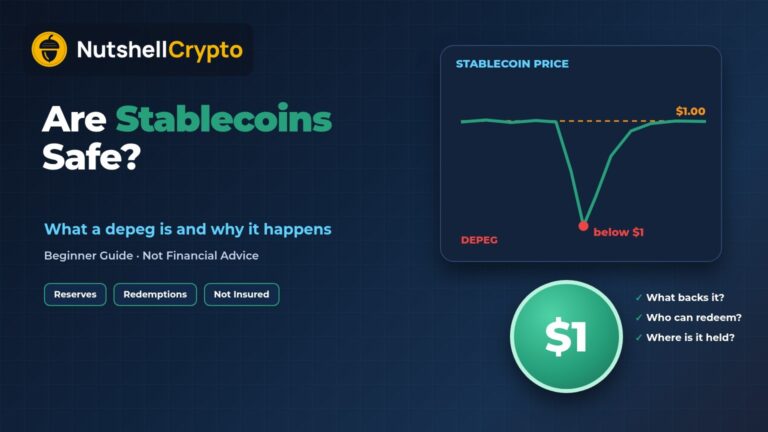
Liquid staking is a fourth route. Bifrost’s vDOT, for example, gives you a token that rises in value against DOT as staking rewards build up, and you can trade it instead of waiting to unbond. It adds smart-contract and depeg risk; our liquid staking explainer covers those trade-offs.
How to Stake DOT Step by Step
These steps use the official Polkadot Staking Dashboard, which the wiki describes as a staking-only web app, not a wallet. The wiki also lists SubWallet, Talisman and PolkaGate as wallets that let you stake from a Ledger account.
Before you start
- Set up a non-custodial Polkadot wallet and write down your recovery phrase offline. Never share it.
- Fund it with DOT on Polkadot Hub. Buy DOT on an exchange and withdraw it to your address. Keep a little extra for transaction fees; Polkadot Hub’s existential deposit (the minimum balance that keeps an account alive) was 0.01 DOT when we checked.
- Open the Staking Dashboard and connect your wallet with the Connect button. The wiki notes the dashboard supports Ledger devices natively.
Option A: join a nomination pool (1 DOT or more)
- Go to Pools and browse the list. Check each pool’s state, commission, member count and which validators it nominates.
- Pick a pool that’s open and earning rewards, then choose Join.
- Enter how much DOT to bond, review the fee and sign the transaction.
- Come back regularly to claim your rewards, or compound them, from the pool panel.
Ledger users: the wiki says joining a pool needs the XL version of the Polkadot Ledger app, which comes on the Nano X and Nano S Plus but not the original Nano S.
Option B: nominate directly (250 DOT or more)
- Go to Nominate and choose to start nominating.
- Choose a payout destination: compound into your stake, or pay out to your account.
- Select up to 16 validators (see the next section), then enter the amount to bond.
- Sign the transaction. Your stake should start earning within about one to two eras.
When we checked, the minimum active stake from the last election was about 191 DOT, below the 250 DOT needed to start nominating. So a new 250 DOT nomination would have cleared the bar on that day. The threshold moves, though, so check the figure on the Nominate page before you commit.
How to Choose Validators or a Pool
With validator commission at 0% across the active set, the old “lowest commission” filter matters much less. The wiki’s validator criteria still apply:
- Performance: validators that are usually active and earn above-average era points.
- Self-stake: more of their own DOT means more skin in the game (every active validator has at least 10,000 DOT).
- Identity and history: a verified on-chain identity and no past slashes.
- Spread: several picks make it likelier that at least one is active each era.
For pools, check that the pool is open, backs active validators, has enough stake to stay in the election, and charges a commission you accept.
How to Unstake DOT
Unstaking takes two steps: unbond, wait, then withdraw. The wiki’s unstaking guide says the unbonding period on Polkadot now lasts 1 to 2 days, depending on when in the era you start.
- Direct nominators: stop nominating, unbond the amount you want, and choose “Withdraw unbonded” once the countdown ends. You earn nothing while unbonding.
- Pool members: choose “Unbond funds” (or “Leave pool”), wait out the period, then withdraw. Unbonding also pays out your unclaimed rewards. You can’t rebond to a pool during the wait, and you can only be in one pool at a time.
- Old requests: per the Polkadot Forum announcement, unbonding started before July 6, 2026 stays on the old 28-day schedule unless you rebond and unbond again.
- Exchange staking: follow the exchange’s rules. Kraken listed a 2-day bonded time for DOT when we checked.
Validators are different: they still face slashing and the full 28-era unbonding period.
Risks of Polkadot Staking
- Price risk: about 2.8% a year in DOT won’t offset a big fall in DOT’s price.
- No rewards if you’re not active: if all your validators are waiting, or your pool drops below the active stake, you earn nothing for that era.
- Rule changes: issuance, budgets and staking settings are decided by on-chain governance (OpenGov) and can change again.
- Pool, platform and contract risk: a pool can raise its commission or be shut down, exchange staking means trusting the exchange, and liquid staking means trusting smart contracts.
- Phishing: fake staking sites and “support” accounts asking for your recovery phrase are a common way people lose DOT.
Nominator slashing, the biggest risk in older guides, is switched off today. That’s still a governance setting, not a permanent promise. If you’re comparing networks, our Cosmos staking guide shows a chain where delegators can still be slashed and unbonding takes 21 days.
Taxes on DOT Staking Rewards (US and Canada)
In the US, the IRS’s Revenue Ruling 2023-14 says a cash-method taxpayer includes staking rewards in gross income, at fair market value, in the year they gain dominion and control over them. With DOT, that usually means when a payout lands in your account or when you claim pool rewards. Keep a record of each reward’s date and USD value, because selling DOT later can trigger a capital gain or loss.
In Canada, the CRA’s page on reporting income from crypto mining and staking explains how staking rewards are reported as income.
For worked examples and record-keeping tips, read our full guide to crypto staking taxes. This is not tax advice; check with a tax professional.
FAQ
What’s the minimum to stake DOT?
1 DOT to join a nomination pool and 250 DOT to nominate directly, based on on-chain values we checked on October 20, 2026. Direct nominators also need enough stake to make it into the election.
How long does it take to unstake DOT?
About 2 days (2 eras) for nominators and pool members since July 6, 2026. It used to be 28 days, and that still applies to validators.
Can I lose DOT by staking?
Not through slashing as a nominator or pool member today, because nominator slashing is turned off. You can still lose value if DOT’s price falls, if you fall for a phishing scam, or if an exchange or liquid staking protocol you use fails.
What is the Polkadot staking APY?
It isn’t fixed. Based on on-chain rewards and total stake on October 20, 2026, it worked out to roughly 2.8% a year before any pool commission. Kraken showed 2.74% for bonded DOT at the same time.
Can I stake DOT on a Ledger?
Yes. The Polkadot Staking Dashboard supports Ledger devices natively. To join a pool, you need the XL version of the Polkadot Ledger app.
Sources
- Polkadot Wiki: Staking on Polkadot
- Polkadot Wiki: Nomination Pools
- Polkadot Wiki: How to Unstake Your Tokens
- Polkadot Wiki: Asset Hub Migration
- Polkadot Wiki: Polkadot Staking Dashboard
- Polkadot Forum: Staking Changes, Progress and Timeline
- Polkadot Forum: Changes on Polkadot in March 2026
- Polkadot Forum: Nominators No Longer Slashable and 2-Day Unbonding
- Polkassembly: Referendum 1909
- Polkassembly: Referendum 1910
- Polkadot Hub public RPC (
Staking,NominationPoolsandBalancesstorage and constants), queried October 20, 2026 at about 1:08 to 1:10 PM PKT - Kraken: Polkadot Staking (rates checked October 20, 2026 at about 1:15 PM PKT)
- Bifrost: vDOT
- IRS: Revenue Ruling 2023-14
- CRA: Reporting income from crypto-asset mining and staking activities
This article is for educational purposes only and is not financial, investment or tax advice.