In a nutshell: Ethereum gas fees are what you pay, in ETH, for the computing work your transaction needs. The fee is the gas your action uses multiplied by the price per unit of gas, which is a protocol-set base fee (burned) plus an optional tip for validators. Fees change because the base fee moves up or down with demand on every block, and because complex actions like swaps use far more gas than a simple transfer. On October 20, 2026, a basic ETH transfer cost about $0.03 and a token swap about $0.48 on Ethereum mainnet, per Etherscan. To pay less, check a gas tracker before you send, use a layer 2 network such as Base or Arbitrum, and avoid rushing transactions that can wait. Educational only; not financial advice.
Last updated: October 20, 2026. Gas prices and transaction costs were checked on Etherscan’s gas tracker on October 20, 2026, at about 8:49 PM PKT (3:49 PM UTC), when ETH traded near $2,431. Layer 2 figures are growthepie’s daily data, last updated at 10:35 AM PKT (5:35 AM UTC) the same day. Gas prices change every 12 seconds, so check a live tracker before you send.
Ethereum gas fees are the reason the same action can cost a few cents one day and several dollars another. They are not a charge set by your wallet or exchange. They are a price the Ethereum network itself sets, block by block, based on how busy it is. Once you understand the three parts of the fee, you can usually tell whether a quote is normal, why it changed, and how to pay less. If you are new to the network, our beginner guide on what Ethereum is and how ETH works covers the basics first.
Table of contents
What Is Gas on Ethereum?
According to ethereum.org’s gas and fees page, gas is “the unit that measures the amount of computational effort required to execute specific operations on the Ethereum network.” Every transaction uses computing resources, so every transaction has to pay for them. That payment keeps people from spamming the network or running code that loops forever.
A few basics:
- Gas is paid in ETH. Even if you are sending USDC or an NFT, the network fee is paid in ether, the network’s native coin.
- Gas prices are quoted in gwei. One gwei is one-billionth of an ETH (0.000000001 ETH). The smallest unit, the wei, is named after cryptographer Wei Dai, per ethereum.org.
- Different actions use different amounts of gas. A standard ETH transfer uses 21,000 units of gas. Smart contract actions, like a swap on a decentralized exchange (DEX), use more because they run more code.
- You pay even if it fails. ethereum.org says the fee “is paid regardless of whether a transaction succeeds or fails,” because the network still did the work.
How Gas Fees Are Calculated
Since the London upgrade on August 5, 2021, which brought in EIP-1559, an Ethereum fee has had this shape (dates per ethereum.org’s upgrade history):
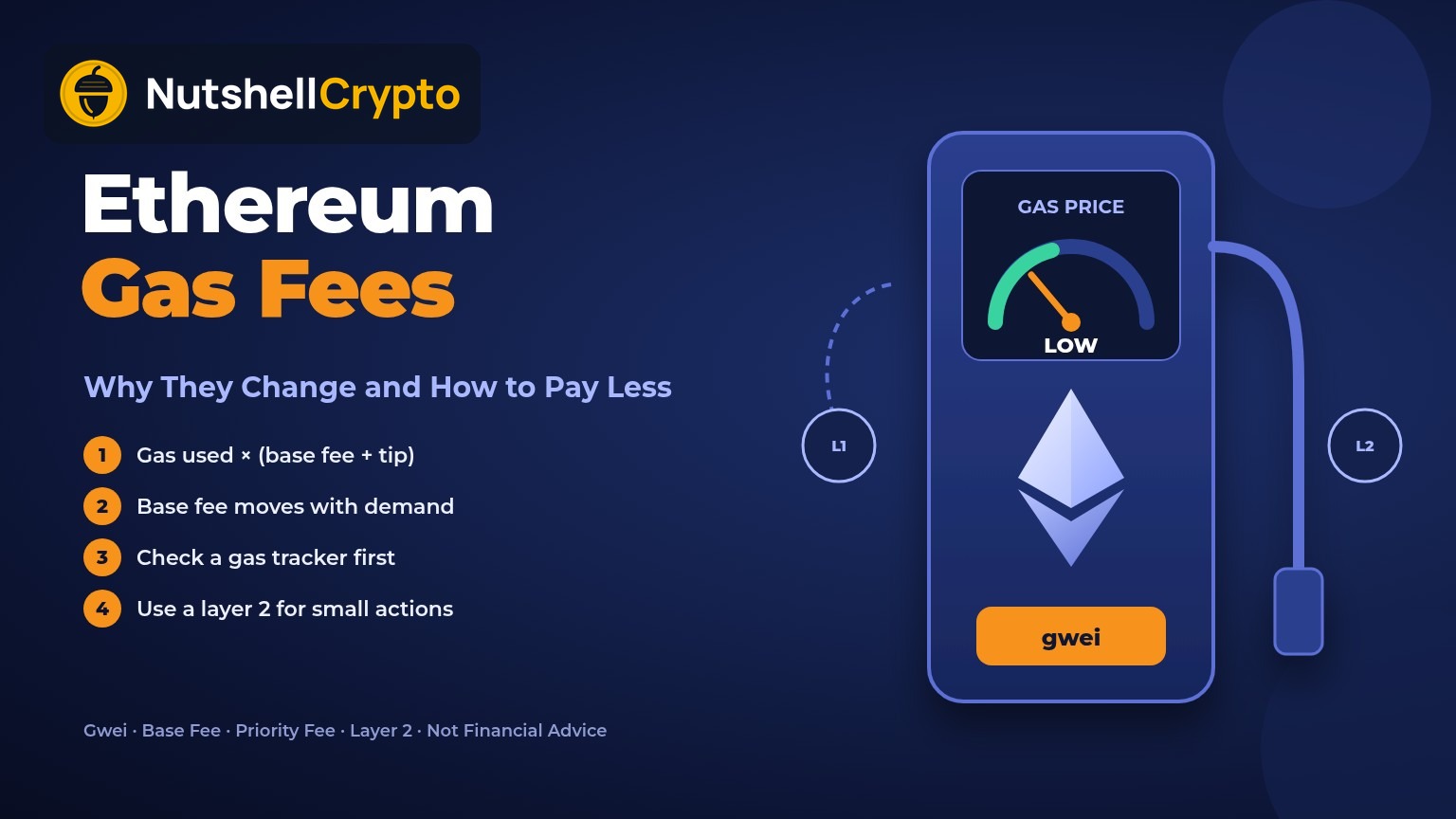
Gas fee = gas units used × (base fee + priority fee)
| Part | Who sets it | Where it goes |
|---|---|---|
| Gas units used | The action itself (21,000 for a plain ETH transfer) | N/A: it is the amount of work |
| Base fee | The protocol, automatically, for each block | Burned, so it leaves circulation |
| Priority fee (tip) | You, or your wallet on your behalf | The validator who includes your transaction |
| Max fee | You (optional cap) | Anything unused is refunded |
ethereum.org’s own example: an ETH transfer uses 21,000 gas, the base fee is 10 gwei and the sender adds a 2 gwei tip. The fee is 21,000 × (10 + 2) = 252,000 gwei, or 0.000252 ETH. The validator gets the 0.000042 ETH tip and the 0.00021 ETH base fee is burned.
At the gas price Etherscan showed on the evening of October 20, 2026 (0.554 gwei), the same transfer worked out to 21,000 × 0.554 = 11,634 gwei, or about 0.0000116 ETH. With ETH near $2,431, that is roughly $0.03, which matches Etherscan’s own estimate of $0.028.
What about the “gas limit”? In your wallet, the gas limit is the most gas you allow a transaction to use. If you set 50,000 for a simple transfer, the network uses 21,000 and returns the rest. Set it too low and the transaction fails. ethereum.org notes that if a transaction runs out of gas partway through, its changes are reverted but the gas is still spent. Most wallets set this for you, and it is usually best left alone.
How Much Gas Fees Cost Right Now
Here is what common actions cost on Ethereum mainnet at the “standard” speed on Etherscan’s gas tracker, October 20, 2026, at about 8:49 PM PKT:
| Action | Estimated fee (standard) | Estimated fee (rapid) |
|---|---|---|
| Send ETH | $0.028 | $0.031 |
| Bridging | $0.154 | $0.17 |
| Borrowing | $0.407 | $0.448 |
| Token swap | $0.48 | $0.528 |
| NFT sale | $0.811 | $0.893 |
Etherscan put the gas price at 0.554 gwei with a priority fee of 0 at the standard and fast levels, and 0.61 gwei at the rapid level. On the day before, growthepie counted 1.7 million Ethereum mainnet transactions and $264.5K in fees paid by users on its Ethereum page, which works out to an average of roughly $0.16 per transaction.
These numbers are low by Ethereum’s historical standards, but they are a snapshot, not a promise. The base fee can climb quickly when demand jumps, as the next section explains.
Why Gas Fees Change
1. Demand. Each block has a target size of half the block gas limit. ethereum.org explains that when a block is fuller than the target, the base fee for the next block rises, by up to 12.5%. When a block is emptier, it falls by up to 12.5%. A run of full blocks therefore pushes fees up fast: in ethereum.org’s example, eight full blocks in a row lift the base fee from 100 gwei to 202.7 gwei.
2. Competition for the next block. When many people want in at once, a bigger tip makes validators more likely to pick your transaction. ethereum.org says high fees come from Ethereum’s popularity: “If there’s too much demand, users must offer higher tip amounts.”
3. Complexity. A swap, a loan or an NFT mint runs more code than a transfer, so it uses more gas units. That is why the swap above costs about 17 times as much as sending ETH, even at the same gas price.
4. Network capacity. The block gas limit decides how much work fits in each block. The ethereum.org Fusaka page says the limit had not changed since the Merge in September 2022 until it rose from 30 million to 36 million in February 2025, then to 45 million, and that clients shipped 60 million as the default with Fusaka. A recent block, block 26,234,796, shows a 60 million gas limit. More room per block means less bidding for space.
5. The ETH price. Gas is priced in gwei, but you feel it in dollars. The same 0.554 gwei fee costs twice as much in USD or CAD if ETH’s price doubles.
How Upgrades Changed Gas Fees
Several recent Ethereum upgrades were aimed at fees, mostly by making layer 2 networks cheaper rather than cutting mainnet fees directly.
| Upgrade | Date | What it did for fees |
|---|---|---|
| London (EIP-1559) | Aug 5, 2021 | Introduced the burned base fee and tip, making fees more predictable |
| Dencun | Mar 13, 2024 | Added “blobs,” a cheaper data space for layer 2s with its own fee market |
| Pectra | May 7, 2025 | Raised blob target from 3 to 6 per block (max 6 to 9); let regular wallets batch transactions and use sponsored gas (EIP-7702) |
| Fusaka | Dec 3, 2025 | PeerDAS for more blob capacity; 60 million default gas limit; blob-only forks to raise blob counts between upgrades |
| Glamsterdam | Expected Q4 2026 (not confirmed) | Planned cut to the base cost of sending ETH (EIP-2780) and groundwork for higher gas limits |
Sources: Dencun, Pectra and Glamsterdam pages on ethereum.org, plus the Fusaka page above. Two caveats from those pages: ethereum.org says Dencun would “not significantly” reduce mainnet gas, and that Fusaka “does not lower gas fees on L1, at least not directly.” For Glamsterdam, ethereum.org listed it as testing on devnets with a Sepolia testnet fork on October 6, 2026, and said a mainnet date was not yet confirmed. Treat its fee effects as planned, not delivered.
Layer 2 Fees: The Cheaper Option
Layer 2 networks (L2s) such as Base, Arbitrum and OP Mainnet bundle many transactions together and post the data back to Ethereum. ethereum.org calls layer 2 scaling “a primary initiative to greatly improve gas costs.” Using growthepie’s daily figures (last updated October 20, 2026, 5:35 AM UTC), here is what users paid on average per transaction, by our division of total fees by transaction count:
| Network | Daily transactions | Fees paid by users | Average fee per transaction |
|---|---|---|---|
| Ethereum mainnet | 1.7M | $264.5K | about $0.16 |
| Arbitrum One | 1.3M | $17.5K | about $0.013 |
| Base | 8.2M | $66.2K | under $0.01 |
| OP Mainnet | 1.5M | $2.2K | about $0.0015 |
Averages hide a lot: a swap costs more than a transfer on any chain, and busy days cost more than quiet ones. Still, the gap is large. The trade-off is that your ETH or tokens must be on the L2 to get those prices, which means bridging, or withdrawing from an exchange directly to that network. Pick the same network on both ends when you send. Our guide on how to buy Ethereum covers choosing a network when you withdraw, and our explainer on crypto wallet addresses explains why the same address can exist on several chains.
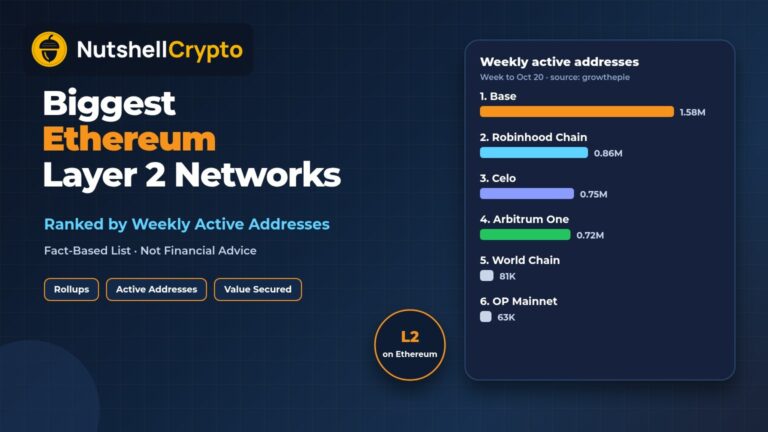
To see which of these networks people actually use most, check our list of the biggest Ethereum layer 2 networks by active addresses.
How to Pay Less in Gas Fees
- Check a gas tracker first. ethereum.org points to tools such as Etherscan and Blockscout. If the price looks unusually high and your transaction can wait, wait.
- Use a layer 2 for small, frequent actions. Swaps, small payments and NFT mints are where L2 savings show up most.
- Don’t overpay the tip. On a quiet network, Etherscan’s standard and fast levels showed a tip of zero. Your wallet’s “market” or “standard” setting is usually enough; “aggressive” only helps when you are racing other people.
- Set a sensible max fee. The max fee caps what you will pay, and the difference is refunded, per ethereum.org. It protects you from a sudden spike.
- Bundle actions where your wallet allows it. Pectra’s EIP-7702 lets regular wallets support transaction batching and gas sponsorship, according to ethereum.org. Fewer separate transactions means fewer fees.
- Move money in fewer, larger transfers. Gas is charged per transaction, not per dollar, so ten small withdrawals cost about ten times one larger one.
- Compare exchange withdrawal fees. Coinbase says the fee it charges to send crypto off the platform is based on its estimate of current network fees (Coinbase Help). Some exchanges also let you withdraw straight to an L2, which can skip a bridging fee.
Common Gas Fee Mistakes
- Having tokens but no ETH. USDT or USDC on Ethereum still needs ETH to move, because gas is paid in ETH. Keep a small ETH balance in the same wallet and on the same network. Our USDT vs USDC comparison covers the chains each stablecoin runs on.
- Cutting the gas limit to “save” money. A limit that is too low just makes the transaction fail. Unused gas is already refunded, so a lower limit saves nothing.
- Spamming retries on a failed swap. Each failed attempt can still cost gas. Find out why it failed (slippage, approval, too little ETH) before trying again.
- Forgetting the approval step. The first time you use a token in a DeFi app, you often pay gas twice: once to approve the token, once for the action. Our guide to DeFi wallets covers how to approve only what you understand.
- Trusting “gas refund” messages. Nobody refunds gas over DMs or email. A message offering one is a scam; never share a seed phrase or sign something you don’t understand.
Gas Fees vs Exchange Fees
Gas fees go to the network: the base fee is burned and the tip goes to a validator. Exchange fees go to the company: trading fees, spreads and processing fees. When you buy ETH on an exchange and leave it there, you usually pay exchange fees but no gas. Gas appears when coins move on-chain, such as a withdrawal to your own wallet. Our breakdown of crypto exchange fees explains the exchange side, including maker, taker and spread costs.
Gas also connects to ETH’s supply. Because the base fee is burned, busy periods remove more ETH from circulation, while validators who secure the network earn the tips. That is part of what stakers earn; see how to stake Ethereum for the reward side.
Gas Fees and Taxes in Brief
In the US, the IRS says your cost basis in crypto you buy is “the amount you spent to acquire the virtual currency, including fees, commissions and other acquisition costs” (IRS FAQ, Q8). Keep records of the fees you pay. How gas on other actions, like transfers between your own wallets, is treated depends on the situation, so check our beginner crypto tax guide and a tax professional, especially in Canada, where the CRA has its own rules.
FAQ
What are Ethereum gas fees in simple terms?
They are the price of getting a transaction processed on Ethereum, paid in ETH. Simple transfers use little gas; apps and swaps use more.
Why are my gas fees so high?
Usually because the network is busy, because the action is complex (a swap or mint), or because your wallet added a large tip. Check a gas tracker; if the price is high and you can wait, try again later or use a layer 2.
Why did I pay gas on a failed transaction?
The network did the computing work before the transaction failed, and ethereum.org says the fee is paid whether a transaction succeeds or fails.
What is gwei?
A unit of ETH used for gas prices: one gwei is 0.000000001 ETH, or one billion wei.
Do I need ETH to send USDC or USDT on Ethereum?
Yes. Gas on Ethereum is paid in ETH, so you need a little ETH in the same wallet. Layer 2s like Base and Arbitrum also use ETH for gas.
Will gas fees go down in the future?
Ethereum’s developers are working on it. Glamsterdam, which ethereum.org expected in Q4 2026 without a confirmed date, includes a planned cut to the gas cost of sending ETH. No one can promise a fee level, because demand also matters.
Are gas fees the same in every wallet?
The network’s base fee is the same for everyone in a given block. Wallets differ in the tip they suggest, and some apps add their own service fee on top, so compare the total before you confirm.
This article is for education only and is not financial or tax advice. Fees and network rules change; confirm current numbers on a live gas tracker before you transact.
Sources
- ethereum.org: Gas and fees
- EIP-1559: Fee market change for ETH 1.0 chain
- ethereum.org: Ethereum upgrade history
- ethereum.org: Dencun upgrade
- ethereum.org: Pectra upgrade
- ethereum.org: Fusaka upgrade
- ethereum.org: Glamsterdam upgrade
- Etherscan: Ethereum gas tracker (checked Oct 20, 2026, 8:49 PM PKT)
- Etherscan: Block 26,234,796
- growthepie: Ethereum, Base, Arbitrum and OP Mainnet chain data (Oct 20, 2026)
- Blockscout: Ethereum gas tracker
- Coinbase Help: Pricing and fees disclosures
- IRS: Frequently asked questions on virtual currency transactions