In a nutshell: Liquidation in crypto happens when a leveraged position loses so much that your deposit (margin) can no longer cover it, so the exchange closes the position for you. You usually lose most or all of that deposit, and on some platforms you can owe more. Large waves of liquidations can speed up market crashes. Educational only; not financial advice.
Last updated: October 21, 2026.
Quick note: the mango example in this guide is just a fruit market story. It has nothing to do with Mango Markets, the Solana crypto exchange that the SEC says was drained of about $116 million in October 2022.
Liquidation is one of the most common words in crypto news, especially on big red days. This guide explains what it means for derivatives traders, starting with a mango deal gone wrong. If you trade spot coins with borrowed money, our margin trading guide covers margin calls and liquidation on margin accounts.
Table of contents
The Mango Market Story
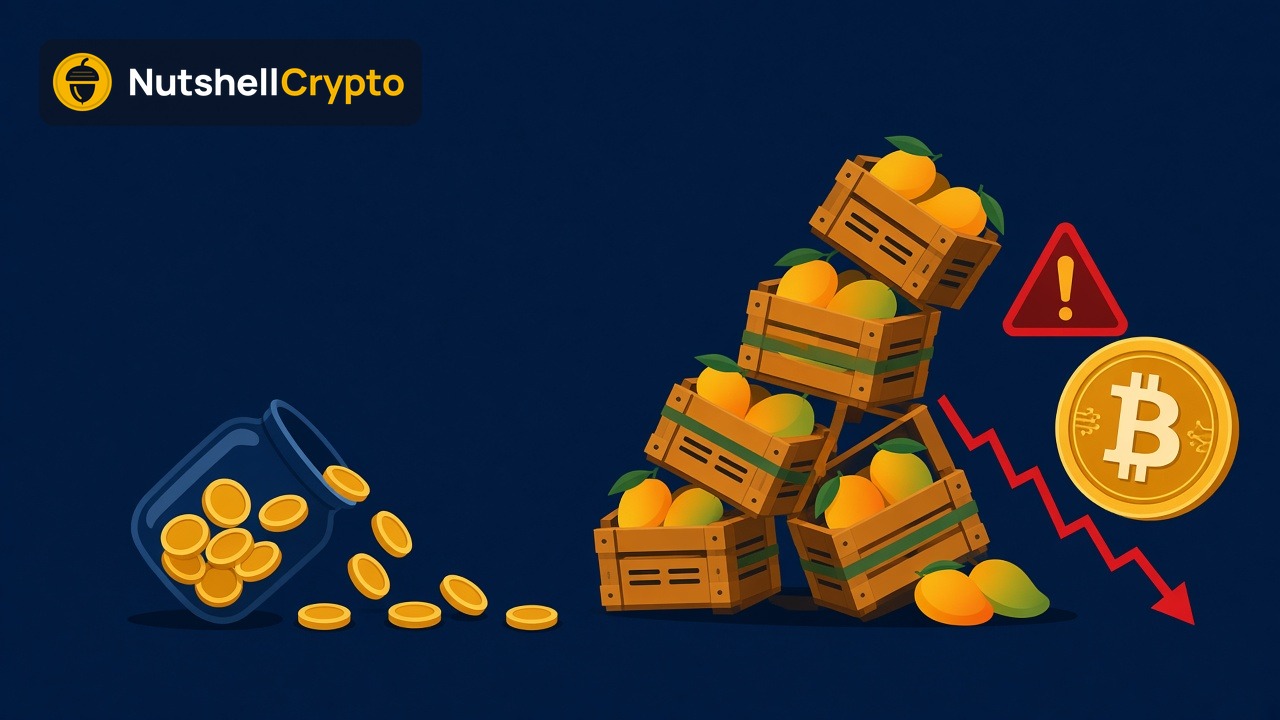
Ben wants a deal on 100 boxes of mangoes at $10 a box, a $1,000 deal. The market organizer lets him in with only a $100 deposit. That small deposit controls a big deal.
If mangoes fall to $9.50, Ben’s deal is down $50, so half his deposit is gone. The organizer warns him to add money. If prices fall to about $9, the $100 loss eats the whole deposit. The organizer won’t risk being left with the bill, so it closes Ben’s deal and keeps the deposit. That forced closing is liquidation.
What Is Liquidation in Crypto?
In general finance, liquidation means converting assets to cash, as Investopedia notes. In crypto trading, it means a platform automatically closes a leveraged position because your margin has fallen below the required level. Coinbase explains that if your margin balance falls below the maintenance margin requirement, you may face liquidation, per its US derivatives help page.
Liquidation applies to crypto futures, perpetual futures, margin accounts and some DeFi lending positions. It does not apply to coins you simply bought and hold on the spot market.
How Liquidation Works Step by Step
- You open a position with initial margin. This is the deposit.
- The market moves against you. Losses reduce your available margin.
- Warnings arrive. On Coinbase US derivatives, a margin ratio of 80-89% is a warning zone and 90-99% is “danger,” per Coinbase Help.
- Liquidation begins. At a 100% margin ratio, Coinbase cancels open orders and closes futures positions, starting with the most liquid ones.
- You may owe more. Coinbase says liquidation can come at worse prices and higher fees, losses can exceed your margin, and you are responsible for any deficit (EEA retail customers get negative-balance protection).
Global exchanges add more steps. Coinbase’s international exchange describes partial liquidation, an insurance fund, and auto-deleveraging as later stages, per its liquidation management page.
Liquidation Price and Leverage
Your liquidation price is roughly where losses would use up your margin. Higher leverage pushes it closer to the current price:
| Leverage | Deposit for a $10,000 BTC position | Approx. drop that wipes the deposit |
|---|---|---|
| 2x | $5,000 | ~50% |
| 5x | $2,000 | ~20% |
| 10x | $1,000 | ~10% |
These are simplified figures. Real liquidation happens earlier, because platforms liquidate at the maintenance margin level, before the deposit hits zero, and fees and funding rate payments also eat into margin. Coinbase notes its liquidation price display is only an estimate.
Liquidation Cascades
When many traders are liquidated at once, the forced selling pushes prices lower, which triggers more liquidations. On October 10, 2025, more than $19 billion of leveraged crypto positions were wiped out in 24 hours, which Reuters called the largest liquidation in crypto history; CNBC, citing CoinGlass, put it at $19.37 billion across more than 1.6 million traders.
Smaller versions show up in daily market moves. Our coverage of the NEAR price drop and the Polkadot sell-off both traced part of the decline to waves of long liquidations.
US and Canada Note
United States: In the US, crypto futures and perpetual-style futures for everyday traders run through CFTC-regulated venues. CME Group has listed Bitcoin futures since December 18, 2017, and Coinbase Financial Markets, a CFTC-registered futures commission merchant, began offering US perpetual-style futures on July 21, 2025. The CFTC’s perpetuals explainer advises traders to stick to CFTC-registered exchanges and avoid offshore venues outside its reach.
Canada: Retail traders on Canadian crypto platforms rarely face liquidation there, because those platforms are not allowed to lend or offer leverage, and regulated dealers must hold at least half the contract value as margin on exchange-traded crypto futures, which leaves far more room before a forced close. See our full US and Canada rules in crypto futures explained.
How Traders Reduce Liquidation Risk
This is educational, not a trading plan. Common risk controls include:
- Using little or no leverage, or no derivatives at all.
- Keeping extra margin in the account and watching the margin ratio.
- Adding funds early: Coinbase notes bank transfers can take 3-5 business days, per its futures cash balance page.
- Using defined-risk tools: an option buyer can lose only the premium; see how crypto options limit losses.
Risk warning: Liquidation can wipe out your entire deposit in minutes, and on some platforms you can owe more than you put in. The CFTC warns that virtual currency prices can swing sharply and that leveraged trading can multiply losses. Only use money you can afford to lose, and consider simply buying coins on the spot market without leverage if you just want exposure.
FAQ
Can I lose more than my deposit in a liquidation?
On some platforms, yes. Coinbase US says you are responsible for any deficit.
Can spot holders be liquidated?
No, not if they bought with their own money and did not borrow.
Why do crypto news stories mention liquidation totals?
Because large forced closings can accelerate price moves, and trackers publish the totals daily.
Sources
- Investopedia: Liquidation
- Coinbase Help: Margin ratio and liquidation risk management (US Derivatives)
- Coinbase Help: Cash balances (Futures)
- Coinbase Help: Liquidation management (International Derivatives)
- Reuters: After record crypto crash, a rush to hedge (October 13, 2025)
- CNBC: The biggest crypto wipeout (October 22, 2025)
- CFTC: Crypto Asset Perpetual Contracts (one-pager)
- CFTC: Understand the Risks of Virtual Currency Trading
- CME Group: Bitcoin futures to launch December 18, 2017
- Coinbase: Perpetual futures have arrived in the U.S. (July 21, 2025)
- CSA Staff Notice 21-332 (Ontario Securities Commission)
- CIRO: Crypto asset trading platforms becoming a Dealer Member
- CIRO: Margin requirements for cryptocurrency futures contracts
- SEC: SEC Charges Avraham Eisenberg with Manipulating Mango Markets (January 20, 2023)