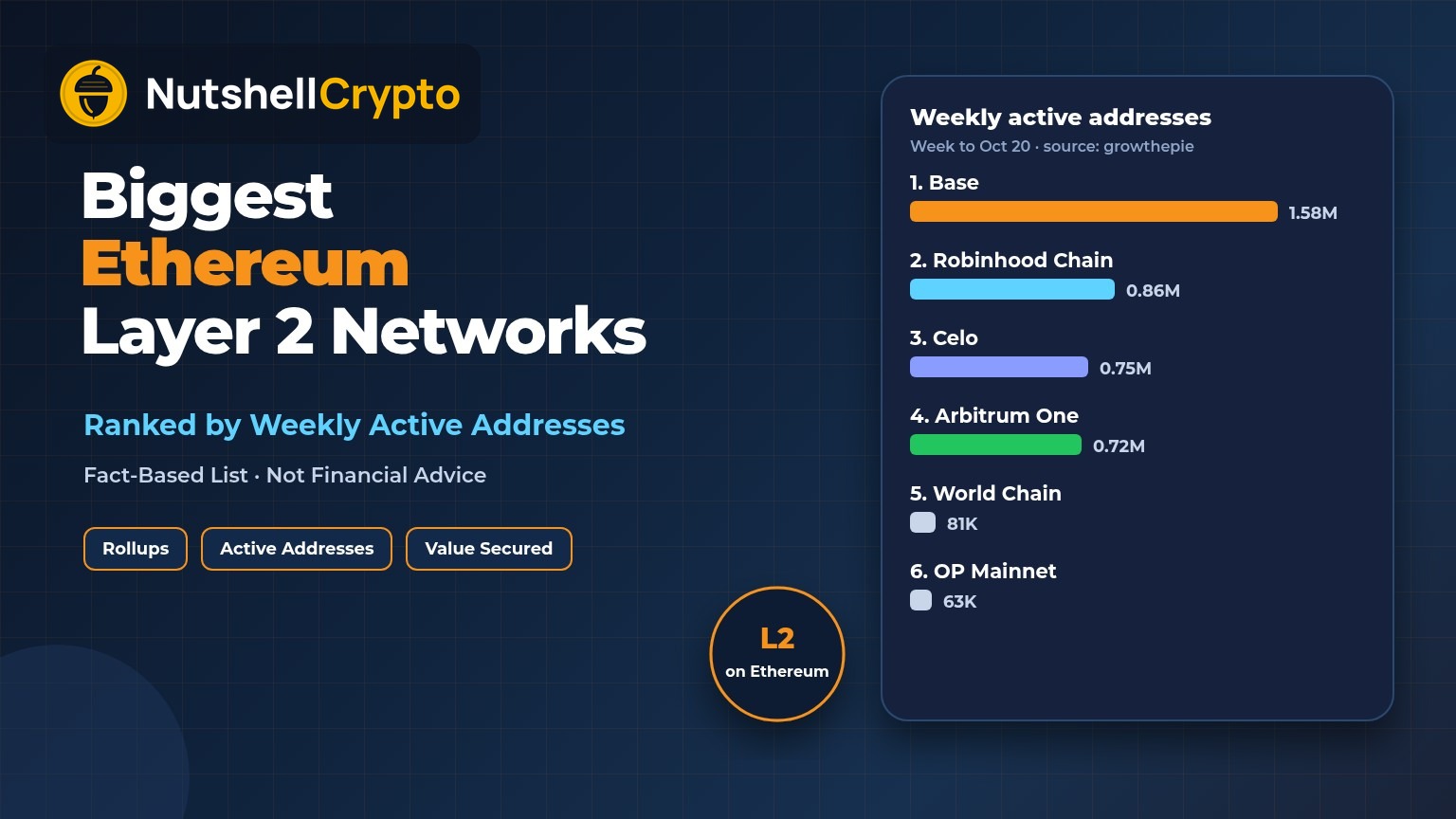
In a nutshell: Measured by weekly active addresses, the biggest Ethereum layer 2 networks right now are Base (1,577,783), Robinhood Chain (864,077), Celo (749,419) and Arbitrum One (721,733), according to growthepie data for the seven days to October 20, 2026. After those four, activity drops off sharply: World Chain is fifth with 80,583. Base and Arbitrum also secure the most value, at $15.91 billion and $10.58 billion per L2BEAT. Active addresses are wallets, not people, so treat this as a rough guide to usage, not a count of users or a reason to buy anything. Educational only; not financial advice.
Last updated: October 21, 2026. Active-address data is from growthepie’s public API (daily data last updated October 21, 2026, 10:30 AM PKT / 5:30 AM UTC; fetched October 21, 2026, at about 10:15 PM PKT (5:15 PM UTC)). Value secured and stages are from L2BEAT, fetched the same evening at about 10:15 PM PKT. We refresh this list monthly, and the numbers move a lot from week to week.
Ethereum’s main chain is secure but busy, so most everyday activity on Ethereum now happens on Ethereum layer 2 networks: separate chains that bundle transactions and settle them back to Ethereum. There are dozens of them, and their marketing all claims to be the biggest. This list ranks them by one thing you can check yourself: how many addresses were active on each network in a week. If you are new to the main chain, start with our guide on what Ethereum is and how ETH works.
Table of contents
What Is an Ethereum Layer 2?
ethereum.org describes a layer 2 as a separate blockchain “that extends Ethereum and inherits the security guarantees of Ethereum.” Ethereum itself is the layer 1. A layer 2 runs its own fast, cheap chain, then posts a compressed record of its transactions to Ethereum, so anyone can check the history later.
Most of the networks below are rollups, and they come in two main types:
- Optimistic rollups (Base, Arbitrum One, OP Mainnet) assume transactions are valid unless someone proves fraud during a challenge window. Per ethereum.org’s optimistic rollups page, that window is why withdrawals through a rollup’s own bridge back to Ethereum can take about a week.
- ZK rollups (Linea, ZKsync Era, Starknet, Scroll) post a cryptographic validity proof with each batch, so the chain on Ethereum can check the math instead of waiting for challenges, as ethereum.org’s ZK rollups page explains.
Some networks on this list store their transaction data outside Ethereum (for example on EigenDA) to cut costs. L2BEAT still counts them as Ethereum layer 2s, but it labels them differently, because users then also rely on that outside data layer. Layer 2s are popular mainly because they are cheaper; our guide to how Ethereum gas fees work compares typical L2 and mainnet costs, so we will not repeat those numbers here.
How We Ranked Them
- Main metric: weekly active addresses. growthepie’s active addresses data counts “the number of distinct wallet addresses that actively interacted with a blockchain,” meaning addresses that sent a transaction or called a smart contract. We use its seven-day figure for the week to October 20, 2026 (UTC), because a single day can be skewed by one event.
- Also shown: active addresses on October 20 alone, and the same seven-day figure four weeks earlier (week to September 22) so you can see how fast things change.
- Second column: value secured (TVS). From L2BEAT’s scaling summary: the dollar value of assets on each chain, including bridged and natively issued tokens.
- Stage: L2BEAT’s maturity rating, explained in the risks section below.
- What we left out: Ethereum mainnet itself (2,413,499 weekly active addresses on growthepie in the same week, still more than any L2) and Polygon PoS, which growthepie describes as an EVM sidechain rather than a layer 2.
Important: an address is not a person. One person can use many addresses, bots and apps can create thousands, and the same wallet can be active on several networks. Do not add the numbers together, and do not read them as “users” in the everyday sense.
Ethereum Layer 2 Networks Ranked by Active Addresses
As of October 21, 2026, at about 10:15 PM PKT (5:15 PM UTC). Sources: growthepie (active addresses), L2BEAT (value secured and stage).
| Rank | Network | Weekly active addresses (to Oct 20) | Active addresses on Oct 20 | Weekly active, 4 weeks earlier (to Sep 22) | Value secured (L2BEAT) | L2BEAT stage |
|---|---|---|---|---|---|---|
| 1 | Base | 1,577,783 | 344,705 | 1,475,012 | $15.91B | Stage 1 |
| 2 | Robinhood Chain | 864,077 | 241,245 | 1,577,011 | $2.46B | Stage 0 |
| 3 | Celo | 749,419 | 452,373 | 807,163 | $262M | Stage 0 |
| 4 | Arbitrum One | 721,733 | 201,145 | 608,660 | $10.58B | Stage 1 |
| 5 | World Chain | 80,583 | 16,259 | 37,579 | $517M | Stage 0 |
| 6 | OP Mainnet | 63,285 | 12,740 | 279,632 | $2.05B | Stage 1 |
| 7 | Ronin | 47,087 | 10,744 | 30,694 | $230M | Stage 0 |
| 8 | Ink | 47,044 | 18,594 | 57,343 | $390M | Stage 1 |
| 9 | Mantle | 42,878 | 2,165 | 5,887 | $1.35B | Stage 0 |
| 10 | Soneium | 21,182 | 12,852 | 28,713 | $20M | Stage 0 |
| 11 | Linea | 20,282 | 4,550 | 17,950 | $362M | Stage 0 |
| 12 | ZKsync Era | 18,704 | 2,422 | 32,116 | $295M | Stage 0 |
| 13 | Starknet | 18,503 | 5,152 | 13,807 | $549M | Stage 1 |
| 14 | Scroll | 8,757 | 1,466 | 11,667 | $41M | Stage 0 |
| 15 | Unichain | 6,735 | 1,881 | 7,735 | $92M | Stage 1 |
Two things stand out. First, the top four are far ahead: Base had about 1.8 times as many weekly active addresses as second-placed Robinhood Chain, and every chain from fifth place down had fewer than 100,000. Second, the ranking is jumpy. Robinhood Chain’s weekly count fell about 45% from four weeks earlier, OP Mainnet’s fell about 77%, and Mantle’s rose more than sevenfold. Short campaigns, airdrops and bots can swing these figures, which is why we refresh the list monthly instead of treating one week as permanent.
The Top 10 Networks in Brief
1. Base
Base is the layer 2 built by Coinbase on the OP Stack, the open-source software behind OP Mainnet. growthepie lists its launch as August 2023. It is an optimistic rollup that posts its data to Ethereum, rated Stage 1 by L2BEAT, and it uses ETH for gas. Base led on both measures here: 1,577,783 weekly active addresses and $15.91 billion in value secured, the most of any L2 in the table.
2. Robinhood Chain
Robinhood Chain is Robinhood’s Ethereum layer 2, built with Arbitrum’s technology and opened to the public on July 1, 2026. Robinhood says it is built for tokenized real-world assets such as stock tokens, uses ETH for gas, and is not connected to your Robinhood brokerage or crypto account. It is the newest chain in the top 10. L2BEAT rates it Stage 0 and lists it under “Other” rather than as a rollup. It had 864,077 weekly active addresses, down from 1,577,011 four weeks earlier.
3. Celo
Celo started as its own layer 1 blockchain in 2020 and, per growthepie, migrated to become an Ethereum layer 2 in 2025, using the OP Stack. It keeps its transaction data on EigenDA rather than Ethereum, which is why L2BEAT classifies it as an “optimium” rather than a rollup, at Stage 0. Celo had the highest one-day count in the table (452,373 on October 20), meaning many of its 749,419 weekly addresses come back day after day.
4. Arbitrum One
Arbitrum One is an optimistic rollup developed by Offchain Labs, live since 2021. L2BEAT rates it Stage 1. It ranks fourth by weekly active addresses (721,733) but second by value secured ($10.58 billion), which reflects its long-running DeFi apps. Its ARB token is used for governance; gas is paid in ETH.
5. World Chain
World Chain is an OP Stack chain from the World project (formerly Worldcoin). growthepie says it was built to scale “Proof of Personhood,” giving priority blockspace to users verified with a World ID. It launched in October 2024 and is Stage 0 on L2BEAT. Its weekly count roughly doubled in four weeks, to 80,583.
6. OP Mainnet
OP Mainnet, run by the Optimism Collective, is one of the oldest optimistic rollups (live since December 2021) and the original home of the OP Stack that Base, Ink, Soneium, World Chain and others use. It is Stage 1 on L2BEAT with $2.05 billion secured. Its weekly active addresses dropped from 279,632 to 63,285 over four weeks, one of the biggest swings in the table.
7. Ronin
Ronin is the gaming chain best known for Axie Infinity. It ran as an Ethereum sidechain until May 2026, when it moved onto the OP Stack as an Ethereum layer 2. Ronin still uses its own RON token for gas and keeps data on EigenDA. L2BEAT rates it Stage 0.
8. Ink
Ink is Kraken’s OP Stack layer 2, launched in December 2024. It is an optimistic rollup that posts data to Ethereum and is rated Stage 1 by L2BEAT. It had 47,044 weekly active addresses, almost tied with Ronin.
9. Mantle
Mantle is built on the OP Stack but uses zero-knowledge validity proofs (OP Succinct), according to growthepie, and pays gas in its own MNT token. L2BEAT lists it as a ZK rollup at Stage 0 with $1.35 billion secured. Its weekly figure jumped from 5,887 to 42,878, yet only 2,165 addresses were active on October 20, a sign the spike came from a few busy days earlier in the week.
10. Soneium
Soneium is Sony’s OP Stack layer 2, launched in January 2025. L2BEAT rates it Stage 0 and lists it under “Other.” It has the smallest value secured in the top 10, about $20 million.
Where the ZK Rollups Rank
ZK rollups get a lot of attention, but none made the top 10 by addresses this week. Linea, ZKsync Era and Starknet were close together at about 18,000 to 21,000 weekly active addresses each, with Scroll further back:
- Linea (20,282 weekly): a ZK rollup built by ConsenSys, the company behind MetaMask (linea.build). Stage 0.
- ZKsync Era (18,704): a ZK rollup built with the ZK Stack (zksync.io). Stage 0.
- Starknet (18,503): a ZK rollup developed by StarkWare that uses its own Cairo programming language instead of Ethereum’s virtual machine (starknet.io). Stage 1, with $549 million secured. Its STRK token can move sharply on news; see our note on why Starknet’s token dropped.
- Scroll (8,757): a general-purpose zkEVM rollup launched in October 2023 (scroll.io). Stage 0.
Uniswap’s Unichain, an OP Stack rollup rated Stage 1, came in 15th with 6,735.
Risks to Know Before You Use an L2
Layer 2s are cheaper than Ethereum mainnet, but they add risks of their own. Check these before you move meaningful money:
- Maturity (L2BEAT stage). L2BEAT’s Stages framework says Stage 0 “represents a project who is fully controlled by few entities, Stage 2 represents a project that is fully controlled by code, and Stage 1 as something in between.” No network in this table is Stage 2. Base, Arbitrum One, OP Mainnet, Ink, Starknet and Unichain are Stage 1; the rest are Stage 0. L2BEAT also notes the framework measures decentralization, not whether the code is bug-free.
- Sequencer centralization. On most L2s a single operator, the sequencer, orders transactions. If it goes down or censors you, some chains let you force a transaction through Ethereum: L2BEAT says that on Base this can take up to 12 hours. On others there is no guarantee; L2BEAT lists Robinhood Chain and Linea with “no mechanism” for this.
- Upgrade risk. L2BEAT shows an exit window of “None” for every network in this table, meaning the contracts can be upgraded without a delay that would let users leave first.
- Bridge and withdrawal risk. Moving funds between Ethereum and an L2 uses a bridge, and bridges are a frequent target for hacks. Native withdrawals from optimistic rollups can take about a week; third-party bridges are faster but add another party you have to trust.
- Wrong-network mistakes. The same wallet address works on Ethereum and many L2s, so it is easy to send tokens on a network the receiver does not support. Our explainer on how crypto wallet addresses work across chains covers this.
- Tokens are not the network. A busy L2 does not mean its token (ARB, OP, MNT, STRK and so on) will rise. This list ranks usage only and is not a buying guide.
How Beginners Usually Use an L2
Most people never “join” an L2 directly. They use one when an exchange or wallet offers it as a cheaper network for withdrawals, or when an app they want lives there. Some common patterns:
- Withdraw from an exchange straight to the L2. Many exchanges let you choose Base, Arbitrum or another L2 as the withdrawal network, which avoids a separate bridge step. Our guide on buying Ethereum and choosing a withdrawal network walks through it.
- Keep a little gas. Most L2s in this list use ETH for gas, but Ronin uses RON and Mantle uses MNT.
- Use apps on that chain. Swaps on a decentralized exchange (DEX) and stablecoin payments are where low L2 fees help most.
- Start small. Send a test amount first, and check the network’s L2BEAT page if you plan to leave larger sums there.
This article is for education only and is not financial advice. Network data changes daily; confirm current figures on growthepie and L2BEAT before relying on them.
FAQ
What is the biggest Ethereum layer 2?
By weekly active addresses and by value secured, Base, as of October 21, 2026: 1,577,783 addresses in the week to October 20 (growthepie) and $15.91 billion secured (L2BEAT).
Is Arbitrum or Base bigger?
On these figures, Base: about 2.2 times Arbitrum One’s weekly active addresses and more value secured ($15.91 billion vs $10.58 billion).
Are active addresses the same as users?
No. One person can control many addresses, and bots or apps can generate large numbers of them. Treat address counts as a sign of activity, not a headcount.
Is Polygon an Ethereum layer 2?
growthepie describes Polygon PoS as an EVM sidechain rather than a layer 2, so we left it out of the ranking. It had 1,934,925 weekly active addresses on growthepie in the same week.
Are layer 2 networks safe?
They are widely used, but none in this table has reached L2BEAT’s Stage 2, and most still depend on a single sequencer and on upgradeable contracts. Use small amounts first and read each network’s risk page on L2BEAT.
How often is this list updated?
Monthly. Weekly address counts can change by more than half in a month, so always check the “as of” date at the top.
Sources
- growthepie: Base chain data (Oct 21, 2026)
- growthepie: Total value secured
- L2BEAT: OP Mainnet project page
- ethereum.org: Scaling Ethereum
- Arbitrum blog: Robinhood Chain mainnet is live (July 1, 2026)
Active-address figures were pulled from growthepie’s public fundamentals API (api.growthepie.com/v1/fundamentals.json) on October 21, 2026, at about 10:15 PM PKT. Other sources (ethereum.org, growthepie, L2BEAT and each network’s official site) are linked where they are used above.