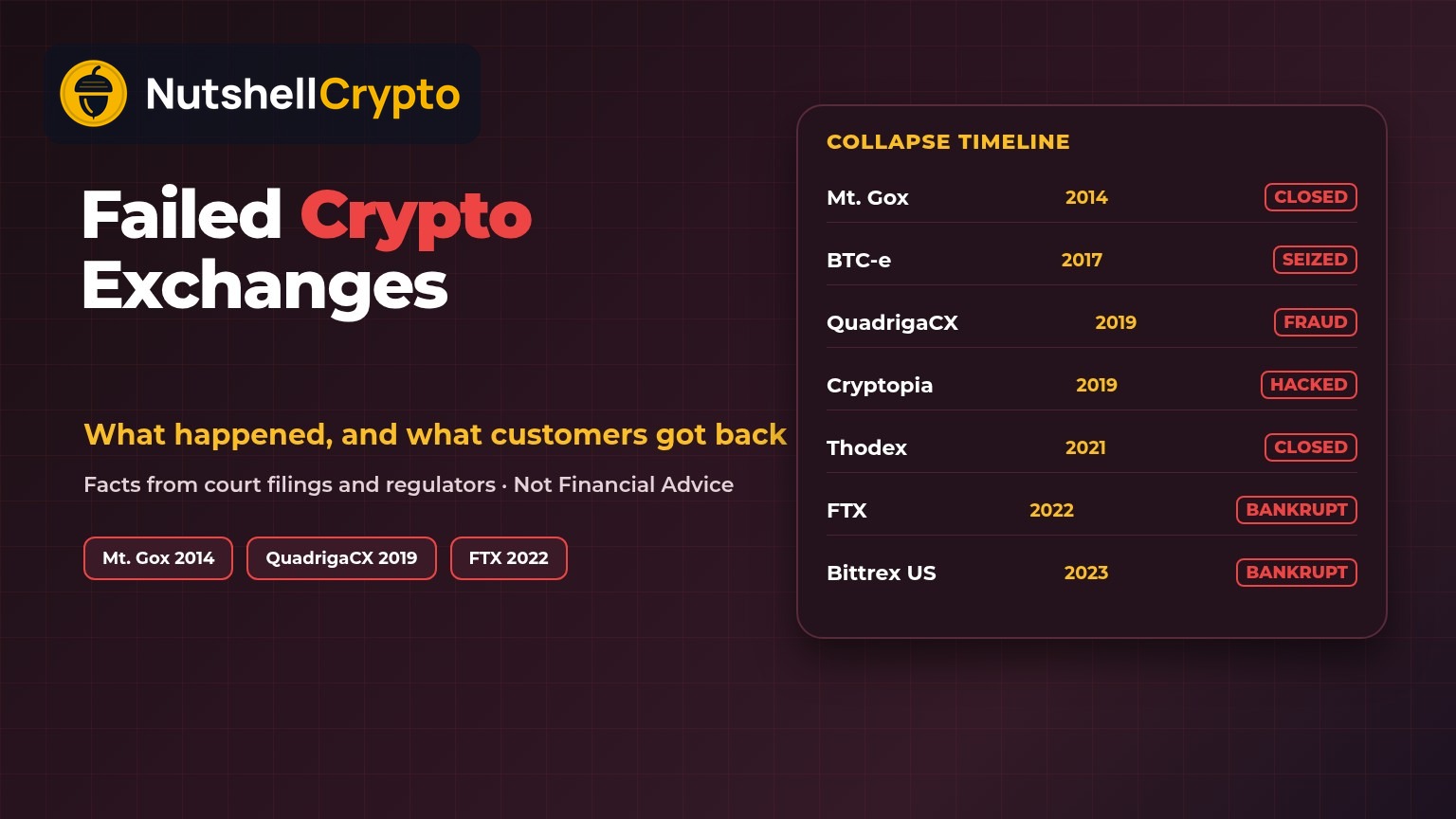
In a nutshell: The best-known failed crypto exchanges are Mt. Gox (2014), BTC-e (2017), QuadrigaCX and Cryptopia (2019), Thodex (2021), FTX (2022) and Bittrex’s US business (2023). Most did not fail because of crypto prices. They failed because of hacks, missing customer funds, fraud, or regulators shutting them down. In nearly every case, customers who left coins on the exchange waited years to get some or all of their money back, and some never did.
Last updated: October 24, 2026. Facts checked against court filings, regulators and official notices on October 24, 2026 (PKT).
When people search for a list of failed crypto exchanges, they usually want two things: what happened, and whether it could happen again. This page answers both with facts only. Each entry gives the year, the country, what went wrong, and where things stand for customers today, with a source for every number.
We list exchanges that actually stopped serving customers, plus two well-known lending and broker apps that people often lump in with them. We do not include exchanges that were hacked but kept running. This article is educational and is not financial or legal advice.
Table of contents
Failed Crypto Exchanges at a Glance
Ordered by the year each exchange stopped operating. Amounts are as reported by the sources linked in each section below.
| Exchange | Based in | Failed | What went wrong | Customers today |
|---|---|---|---|---|
| Mt. Gox | Japan | February 2014 | About 850,000 BTC missing (200,000 later found) | Repayments mostly done; deadline moved to Oct 31, 2027 |
| BTC-e | Served Russia, servers in the US | July 2017 | Seized by US authorities; money laundering charges | Shut down by law enforcement, not a bankruptcy |
| QuadrigaCX | Canada | January to February 2019 | Founder’s fraud; C$215 million owed to 76,000+ clients | About C$46 million recovered |
| Cryptopia | New Zealand | Hacked January 2019, liquidation May 2019 | Theft of about NZ$24 million in crypto | Refunds began December 2024 |
| Thodex | Turkey | April 2021 | Founder shut it down and fled; 391,000 users | Founder jailed 2023 |
| FTX | Bahamas | November 2022 | About an $8 billion hole in customer accounts | Payouts began February 2025 |
| Bittrex (US) | United States | April to May 2023 | Closed US business after SEC complaint; Chapter 11 | Handled in bankruptcy court |
The List, One by One
1. Mt. Gox (Japan, 2014)
Mt. Gox, based in Tokyo, was the giant of early bitcoin. According to its Wikipedia history, it was handling more than 70% of all bitcoin transactions by early 2014. In February 2014 it suspended trading, closed its site and filed for bankruptcy protection in Tokyo, after revealing that around 850,000 bitcoin were missing. About 200,000 BTC were later found in an old wallet, which cut the loss to roughly 650,000 BTC.
Where it stands: repayments to creditors began in 2024, a decade after the collapse. In an official notice dated October 16, 2026, the rehabilitation trustee said repayments are “largely completed” for creditors who finished the required steps, but many still have not been paid. With court permission, the deadline moved from October 31, 2026 to October 31, 2027 (Japan time). CoinMarketCap notes this follows similar one-year extensions in 2024 and 2025.
2. BTC-e (2017)
BTC-e mainly served Russian-speaking users but ran servers in the United States. It handled about 3% of bitcoin exchange volume in 2015. On July 26, 2017, the US Justice Department charged BTC-e and its operator Alexander Vinnik in a 21-count indictment for an alleged international money laundering scheme, including laundering funds from the Mt. Gox hack, and the government seized the site and its funds, as summarized on BTC-e’s Wikipedia page.
3. QuadrigaCX (Canada, 2019)
QuadrigaCX was believed to be Canada’s largest crypto exchange. On January 14, 2019, it announced that its co-founder and CEO, Gerald Cotten, had died in India the month before. By February 5 the platform had stopped operating and filed for creditor protection.
The Ontario Securities Commission’s report found that the collapse “resulted from a fraud” by Cotten. He opened accounts under fake names, credited himself with made-up balances and traded them against real clients, which meant Quadriga “operated like a Ponzi scheme.” Over 76,000 clients were owed a combined C$215 million, and the bankruptcy trustee, Ernst & Young, could recover or identify only about C$46 million.
Why it matters for Canadians: Canadian crypto trading platforms now register with securities regulators and commit to keeping most client crypto with third-party custodians. Our custodial wallet guide covers those rules.
4. Cryptopia (New Zealand, 2019)
Cryptopia was a popular exchange for small altcoins, based in Christchurch. In January 2019, a theft took about 10% of its crypto assets, then worth about NZ$24 million. Trading collapsed afterward and the company entered liquidation on May 14, 2019, according to Cryptopia’s Wikipedia page.
Where it stands: the case produced Ruscoe v. Cryptopia, in which the New Zealand High Court held that cryptocurrency is a form of property. Liquidators Grant Thornton began the first round of Bitcoin and Dogecoin refunds in December 2024, returning about NZ$400 million in crypto to more than 10,000 verified account holders.
5. Thodex (Turkey, 2021)
Thodex had 391,000 users when it froze in April 2021. Its founder, Faruk Fatih Özer, left Turkey and shut the company down, with an estimated $2 billion of investors’ money involved. He was arrested in Albania in 2022 and, on September 7, 2023, a Turkish court sentenced him to 11,196 years in prison, according to Thodex’s Wikipedia page, which cites BBC News and Bloomberg. The same page reports he was found dead in his prison cell in November 2025.
6. FTX (Bahamas, 2022)
FTX was the third-largest crypto exchange by volume, with over one million users. In early November 2022, a report about its sister trading firm Alameda Research triggered a rush of withdrawals that exposed an $8 billion hole in its accounts. On November 11, 2022, FTX, Alameda and more than 100 affiliates filed for bankruptcy in Delaware, and founder Sam Bankman-Fried resigned, as covered in the history of the FTX bankruptcy. Bankman-Fried was found guilty on all seven charges in November 2023 and sentenced to 25 years in prison in March 2024.
Where it stands: FTX began paying creditors on February 18, 2025 through BitGo and Kraken. The estate’s CEO, John J. Ray III, estimated customers would recover between 118% and 142% of their claims. One catch: claims were valued in US dollars on the bankruptcy date, when bitcoin was far cheaper, so customers did not get their actual coins back.
7. Bittrex Inc. (United States, 2023)
Seattle-based Bittrex was one of the older US exchanges. It stopped all US operations on April 30, 2023 and filed for Chapter 11 bankruptcy in Delaware on May 8, 2023, about three weeks after the SEC accused it of operating an unregistered securities exchange, Reuters reported. Its petition listed both assets and liabilities between $500 million and $1 billion.
Where it stands: unlike most entries here, Bittrex said in its bankruptcy statement that customer funds were “safe and secure” and that it wanted customers made whole. The filing did not cover Bittrex Global, its non-US arm at the time.
Related Collapses: Crypto Lenders and Brokers
These were not exchanges, but they held customer crypto the same way, and many people remember them alongside FTX.
- Voyager Digital (US broker, 2022). After hedge fund Three Arrows Capital failed to repay loans of about $666 million, Voyager froze trading and withdrawals on July 1, 2022 and filed for Chapter 11 on July 5, per Voyager’s Wikipedia page.
- Celsius Network (US lender, 2022). Celsius paused withdrawals in June 2022 and filed for Chapter 11 on July 13, 2022, reporting a $1.2 billion hole in its balance sheet. Founder Alex Mashinsky pleaded guilty to two fraud counts and was sentenced to 12 years in prison in May 2025, according to Celsius Network’s Wikipedia page.
What the Failures Have in Common
- Customer funds were not where customers thought. At QuadrigaCX and FTX, investigators found client money had been used by insiders. At Mt. Gox and Cryptopia, it was stolen.
- Withdrawals stopped first. In almost every case, the first public sign was paused or slow withdrawals, often blamed on technical problems or “market conditions.”
- Repayment takes years. Mt. Gox creditors waited about ten years, Cryptopia users nearly six, and FTX customers more than two.
- Getting money back is not the same as getting coins back. FTX paid claims in dollars at November 2022 prices, which was far less than the coins later became worth.
- There is no deposit insurance. The FDIC states that deposit insurance does not cover crypto or the failure of crypto exchanges, as we explain in our centralized exchange guide.
How to Lower Your Exchange Risk
- Keep only what you are trading on an exchange. Move long-term holdings to a wallet you control. Our self-custody guide and cold wallet transfer guide show how.
- Use regulated platforms in your country. In the US, check state licensing; in Canada, check that the platform is registered with the Canadian Securities Administrators. Registration does not remove risk, but it adds rules on custody and disclosure. Exchanges that ask for ID are part of that system, as our KYC guide explains.
- Be wary of high yields. Celsius and Voyager paid interest by lending out customer crypto. If a platform pays a return, ask where it comes from.
- Watch for warning signs. Delayed withdrawals, sudden new withdrawal limits, and an exchange’s own token falling sharply have all come before past collapses.
- Keep records. Save account statements and transaction history. If a platform fails, you will need them to file a claim, and for crypto taxes.
FAQ
What was the biggest crypto exchange collapse?
By dollar size, FTX, with about an $8 billion shortfall when it filed for bankruptcy in November 2022. By share of the market at the time, Mt. Gox, which handled more than 70% of bitcoin trading before it failed in 2014.
Did FTX customers get their money back?
Many did, in dollars. Payouts began on February 18, 2025, and the estate estimated recoveries of 118% to 142% of claim values. Claims were priced at November 2022 levels, so customers did not receive the later rise in crypto prices.
Are Mt. Gox creditors still being paid?
Yes. As of the trustee’s October 16, 2026 notice, most creditors who completed the required steps have been paid, and the deadline for the rest is October 31, 2027 (Japan time).
What happened to QuadrigaCX customers in Canada?
More than 76,000 clients were owed about C$215 million. The Ontario Securities Commission found the losses came mainly from founder Gerald Cotten’s fraud, and the trustee recovered or identified only about C$46 million.
Is my crypto insured if my exchange fails?
Not by the FDIC in the US. Some exchanges describe their own insurance or reserves, but those policies vary and usually do not cover everything. That is why many people keep long-term holdings in self-custody.
Sources
- MtGox trustee: Notice Concerning Change of Repayments Deadline (October 16, 2026)
- CoinMarketCap: Mt. Gox pushes creditor repayment deadline to October 2027
- Ontario Securities Commission: QuadrigaCX report
- FTX: Initial distributions to Convenience Class (February 18, 2025)
- Reuters: Crypto exchange Bittrex files for bankruptcy after SEC complaint
- Business Wire: Bittrex, Inc. statement on Chapter 11 bankruptcy
- Wikipedia: Mt. Gox, BTC-e, Cryptopia, Thodex, Bankruptcy of FTX, Voyager Digital, Celsius Network
Disclaimer: This article is for informational and educational purposes only. It is not financial, investment, legal or tax advice. Details of bankruptcy and repayment cases can change; check the official case websites for the latest information.