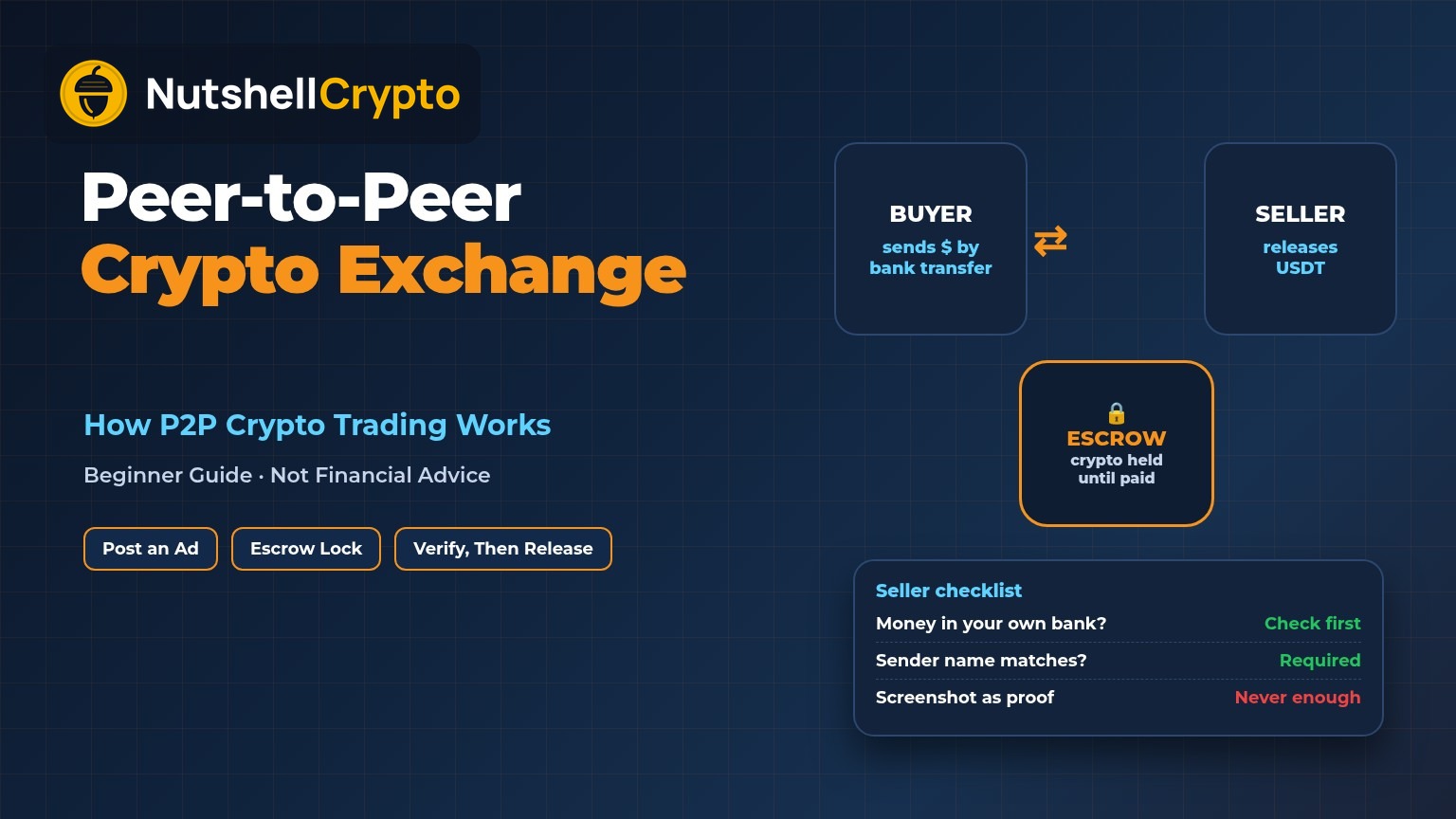
In a nutshell: A peer-to-peer (P2P) crypto exchange is a marketplace where you buy or sell crypto directly with another person instead of with the exchange itself. One side posts an ad with a price and payment methods, the other side accepts it, the crypto is locked in escrow, the buyer pays (usually by bank transfer or a payment app), and the seller releases the crypto once the money has really arrived. P2P gives you more payment options and sometimes lower fees, but it adds a new risk: the person on the other side. Fake payment screenshots and chargebacks are the classic P2P scams. Educational only; not financial advice.
Last updated: October 25, 2026.
On a normal exchange like Coinbase or Kraken, you click Buy and the exchange fills your order from its order book. On a P2P marketplace, there is a real person on the other side of every trade, and you pay that person directly. That one difference changes how prices, fees, payment methods and safety work.
This guide explains how a peer-to-peer crypto exchange works step by step, the main types of P2P platforms, the scams to watch for, and what US and Canadian users should know about rules and taxes.
Table of contents
What Is a Peer-to-Peer Crypto Exchange?
A peer-to-peer crypto exchange is a platform that matches buyers and sellers of crypto and lets them settle the trade between themselves. The platform usually does three jobs: it lists ads, it holds the crypto in escrow while the trade is open, and it settles disputes.
OKX describes its own P2P marketplace this way in its P2P trading help article: users buy and sell crypto “directly between users,” and to finish a trade they “directly send or collect cash” with their chosen payment app, while OKX “monitors the transaction process and provides escrow services.” When you trade there, OKX says plainly, you are not trading with OKX but “with other verified users.”
That is the key idea. On a centralized exchange (CEX), the exchange takes your money and fills your order. On a P2P marketplace, the platform is more like a referee and a safe box. The money moves between you and a stranger, outside the platform.
How a P2P Crypto Trade Works, Step by Step
Most custodial P2P marketplaces follow the same flow. Here is a typical purchase of USDT with a bank transfer:
- The seller posts an ad. The ad shows the coin, the price, the minimum and maximum amount, and the payment methods the seller accepts. Prices can be fixed or “floating,” meaning they follow the market price plus a margin the seller picks.
- You pick an ad and open an order. Most platforms show each trader’s completion rate and number of past trades, so you can avoid brand-new or poorly rated accounts.
- The crypto is locked in escrow. The seller’s coins are set aside by the platform, so the seller can’t spend them elsewhere while your order is open.
- You pay the seller directly. You send the money from your own bank or payment app, in your own name, within the time limit shown on the order. Then you mark the order as paid.
- The seller checks and releases. The seller logs in to their own bank or app, confirms the money really arrived, and releases the crypto from escrow to your account.
- If something goes wrong, open a dispute. If you paid but the seller won’t release, the platform’s support team reviews the chat and payment proof and can release the escrowed crypto to you.
OKX advises keeping all communication inside its in-app chat, because it “can be used as supporting evidence during a dispute.” That advice applies on every P2P platform: a trader who asks you to move to WhatsApp or Telegram is removing your evidence.
Selling works the same way in reverse. You post or accept a buy ad, your crypto goes into escrow, and you release it only after you have checked your own account and seen the payment.
Types of P2P Platforms
1. P2P marketplaces inside big exchanges
Large exchanges such as Binance, OKX and Bybit run P2P sections inside their apps. You need a verified account (see our guide to KYC in crypto), the exchange holds the escrow, and it runs the dispute process. OKX’s help page says it charges no service fee for P2P trades, though your bank or payment app may charge its own transfer fee. Which of these marketplaces you can use depends on where you live, and several large exchanges don’t serve US residents at all, so check each platform’s terms for your country.
2. Non-custodial P2P platforms
Some platforms never hold your coins. Hodl Hodl says it doesn’t hold user funds and instead creates a unique multisig escrow Bitcoin address for each contract. The seller locks bitcoin there, the buyer pays, and the seller releases it straight to the buyer’s wallet. Its FAQ lists a trading fee of 0.75% per user (0.5% for referrals) and says trades happen without KYC. It only supports bitcoin.
Bisq goes further: it is open-source desktop software where trading happens on a P2P network of users running Bisq on their own computers. Bisq says it “never holds your funds,” uses security deposits held in 2-of-2 multisig wallets to encourage honest trades, and routes every node through Tor by default. If you want to understand the multisig part, see our explainer on multisig wallets.
Non-custodial platforms reduce the risk of the platform itself losing or freezing your funds, but there is usually less hand-holding when a trade goes wrong, and “no KYC” does not mean “no rules.” See the US and Canada section below.
3. Informal P2P trades
Some people buy and sell crypto through social media groups, classified ads or in person, with no escrow at all. This is where most of the risk sits: there is no one to hold the coins, no record and no dispute process. If you trade this way, you are trusting a stranger completely.
P2P vs Regular Exchanges vs DEXs
| P2P marketplace | Centralized exchange | Decentralized exchange (DEX) | |
|---|---|---|---|
| Who you trade with | Another person | The exchange’s order book | A smart contract or liquidity pool |
| How you pay | Bank transfer, payment apps, sometimes cash, set by each trader | Deposits to the exchange | Crypto only, from your own wallet |
| Price | Set by each advertiser, can be above or below market | Market price plus trading fees | Pool price plus swap and network fees |
| Main risk | The counterparty (fake payments, chargebacks) | The exchange itself (hacks, freezes, failure) | Smart contract bugs, scam tokens, wrong network |
| Speed | Minutes to an hour, depends on the payment | Instant once funded | Seconds to minutes |
For more on the other two, see our guides to crypto DEXs and crypto exchange fees. Very large private trades are a different thing again, handled by OTC desks.
Pros and Cons of P2P Crypto Trading
Pros
- More ways to pay. Each trader chooses the payment methods they accept, so P2P can work where an exchange doesn’t support your bank or currency.
- You can pick your price. Sellers compete on price, and you can post your own ad instead of taking the market price.
- Low or zero platform fees on some marketplaces. The trade-off is often a wider spread built into the advertised price.
- Self-custody options. Non-custodial platforms let you buy straight into your own wallet. See our guide to self-custody.
Cons
- Counterparty risk. The person on the other side may lie about paying, or reverse the payment later.
- Slower. You wait for a human and for a bank transfer to land.
- Price can be worse than the market. A “zero fee” ad can still cost more than buying on a regular exchange once you compare the price.
- Bank account problems. Receiving payments from many strangers can trigger fraud checks at your bank, and money that turns out to be stolen can get your account frozen.
Common P2P Scams and How to Avoid Them
Binance’s guide on how to spot and avoid P2P scams lists the tricks that come up again and again. The main ones:
- Fake payment proof. The buyer sends an edited screenshot or a fake “payment sent” text and pushes you to release the crypto. Binance’s advice: “Never release funds based on receipts only.” Check your own bank or app first.
- Chargeback fraud. The buyer pays with a method that can be reversed, receives the crypto, then tells their bank or payment app the payment was unauthorized. You lose the crypto and the money.
- Third-party payments. The money comes from an account whose name doesn’t match the verified buyer. It may be a stolen account, and the real owner can claw it back. Refuse payments that don’t come from the buyer’s own name.
- “Wrong transfer” pressure. After the trade, the scammer claims the payment was a mistake or their account was hacked, and threatens you unless you send money back outside the platform.
- Moving off the platform. Any request to finish the deal by DM, or to release early “because the bank is slow,” removes escrow protection.
Simple rules that stop most of these:
- As a seller, release only after the money shows in your own account, in full, from a sender whose name matches the buyer.
- Avoid payment methods that are easy to reverse, and don’t accept checks.
- Keep every message in the platform’s chat and take screenshots of payments.
- Start with small amounts and traders with a long, clean history.
- Never pay a “fee” or “tax” to unlock a trade or a frozen balance. That is a scam pattern, not a platform rule.
Crypto fraud is a big business. The FBI’s 2025 Internet Crime Report counted 181,565 complaints involving cryptocurrency, with more than $11 billion in reported losses. Not all of that is P2P, but the same pressure tactics show up everywhere.
US and Canada: Rules and Taxes
Buying or selling now and then for yourself is generally treated differently from running a P2P trading business, and the line matters.
United States. FinCEN’s 2019 guidance on convertible virtual currencies has a section on P2P exchangers. It says a person who is in the business of buying and selling crypto for others is a money transmitter, “regardless of the regularity or formality of such transactions,” and must register with FinCEN and follow anti-money-laundering rules. A person doing it “on an infrequent basis and not for profit or gain” is exempt. Many states also require their own money transmitter licenses. If you are thinking of posting P2P ads to earn a spread, talk to a lawyer first.
Canada. FINTRAC’s money services business page lists “dealing in virtual currency,” which includes exchanging funds for crypto and crypto for funds, as a money services business activity. Businesses offering it must register with FINTRAC before they start operating, and foreign businesses that serve Canadians must register too. You can look up any platform in FINTRAC’s MSB registry.
Taxes. Buying crypto through P2P doesn’t change how it is taxed. In the US, the IRS treats digital assets as property, so selling crypto for cash through a P2P trade is a taxable sale just like on an exchange. Keep your own records of the date, price and amount, because a P2P platform or a non-custodial app may not give you a tax form. See our guides to crypto capital gains tax and cryptocurrency tax in Canada.
P2P Platforms That Shut Down
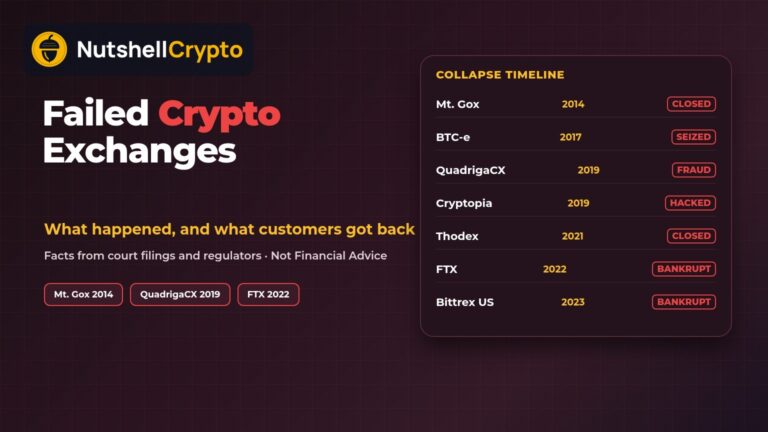
Two of the best-known P2P bitcoin marketplaces no longer operate, which is a good reminder that a custodial P2P platform carries the same platform risk as any exchange:
- LocalBitcoins, a Finland-based marketplace founded in 2012, announced on February 9, 2023 that it would stop operating later that month, according to Wikipedia’s summary of its history.
- Paxful said in its closure announcement that it would wind down all operations by November 1, 2025, citing past misconduct by its former co-founders and compliance costs. It later reported a guilty plea and a $4 million criminal fine in a US Justice Department case, plus a $3.5 million FinCEN civil penalty, according to its resolution update.
For a wider history, see our list of failed crypto exchanges. The lesson is the same: don’t leave a balance sitting on any platform longer than you need to.
FAQ
Is P2P crypto trading safe?
It can be reasonably safe on a reputable platform with escrow, if you follow the rules above: verify payments in your own account, refuse third-party payments, and keep everything in the platform’s chat. It is riskier than buying on a regular exchange because a stranger is involved.
Is P2P crypto trading legal in the US and Canada?
Buying and selling crypto for yourself is legal in both countries. Running P2P trades as a business is regulated: in the US it can make you a money transmitter under FinCEN rules, and in Canada dealing in virtual currency as a business requires FINTRAC registration.
Why is the P2P price different from the market price?
Each advertiser sets their own price. Sellers often charge a premium for convenient payment methods, fast release or larger amounts, while some buyers bid below market. Always compare the P2P price with the price on a regular exchange.
Do I need KYC for P2P trading?
On P2P marketplaces run by big exchanges, yes, you need a verified account. Some non-custodial platforms don’t require ID, but that doesn’t remove your tax or legal obligations.
What should I do if a buyer reverses a payment?
Open an appeal or dispute with the platform right away, include screenshots of the chat and the payment, and contact your bank. Report fraud to the FBI’s IC3 in the US or the Canadian Anti-Fraud Centre in Canada.
This article is for education only and is not financial, legal or tax advice. Platform features, fees and availability change often. Check the platform’s own pages for your country before you trade.