In a nutshell: A crypto wallet for business is a wallet set up so a company, not one person, controls its digital assets, usually with multiple approvers (multisig or MPC), role-based access and exportable records for accounting. Most businesses choose between a regulated custodian, a self-custody multisig wallet, or a mix of both, based on how much crypto they hold and how often they move it. Educational only; not financial advice.
Last updated: October 9, 2026.
Accepting crypto payments, paying contractors in stablecoins or holding bitcoin on the balance sheet all raise the same question: where should the company’s coins live, and who is allowed to move them? A personal wallet on the founder’s phone is the most common answer and the riskiest one. This guide explains the main types of business crypto wallets, the features that matter, how to secure one step by step, and what US and Canadian businesses should know about records and tax.
Table of contents
What Is a Crypto Wallet for Business?
A crypto wallet does not store coins. It stores, or gives access to, the private keys that sign blockchain transactions. A crypto wallet for business is any wallet arrangement where those keys are controlled on behalf of a company, with rules that match how the company works: who can see balances, who can propose a payment, how many people must approve it, and how every transaction is recorded.
In practice this is either an account with a company that holds the keys for you (a custodial wallet), a wallet the company controls itself (self-custody), or a combination. The US SEC’s investor bulletin on crypto asset custody basics describes the same core trade-off: a third party can lose or freeze assets, while self-custody puts the full burden of key safety on you.
Why a Personal Wallet Is Not Enough
Many small businesses start with one employee’s phone wallet or one login at an exchange. That creates problems that grow with the balance:
- Single point of failure. If one person loses a device, forgets a password, leaves the company or is phished, the funds can be gone.
- No separation of duties. The same person can create and send a payment with no second check, which is exactly what internal controls are meant to prevent.
- Mixed funds. Business and personal coins in one wallet make bookkeeping and tax reporting much harder.
- Weak records. Auditors, accountants and tax authorities expect dates, amounts, fair market values and counterparties for each transaction.
The FBI’s Internet Crime Complaint Center reported cryptocurrency-related losses of more than $9.3 billion in its 2024 Internet Crime Report, and business email compromise remains one of the costliest scam types. A wallet that requires more than one approval is a strong defense against a single tricked employee.
Types of Business Crypto Wallets
1. Custodial business accounts
Large exchanges and specialist custodians offer business or institutional accounts. The provider holds the keys, and your team logs in with user roles, withdrawal allowlists and approval rules. This is the simplest option and often comes with integrations for payments and accounting. The trade-off is counterparty risk: if the provider fails, is hacked or freezes your account, access to funds depends on them. The collapse of FTX in 2022, covered by Reuters, is the standard reminder. Check whether the custodian is regulated, for example as a trust company in the US or registered with provincial regulators in Canada, and how client assets are segregated.
2. Multisig wallets (self-custody)
A multisig wallet needs several keys to approve a transaction, for example 2 of 3 or 3 of 5. Each key can sit with a different person on a different hardware device. On Ethereum and compatible chains, smart-contract wallets such as Safe are widely used by companies and DAOs; on Bitcoin, multisig is built into the protocol and supported by several wallet tools. Multisig removes the single point of failure without trusting a custodian, but someone on the team must understand how it works and how to recover it.
3. MPC wallets
Multi-party computation (MPC) wallets split one key into shares held by different devices or parties, so no complete key ever exists in one place. They look like a normal wallet on-chain and work across many blockchains. Many institutional platforms use MPC with policy engines for approvals. You are trusting the vendor’s software and recovery process, so ask how you would access funds if the vendor disappeared.
4. Hardware wallets for small balances
A very small business can start with a hardware wallet kept in a safe, with the recovery phrase stored separately. It is cheap and secure against online attacks, but it is still effectively one key. See our guide to hot vs cold wallets for how cold storage fits in.
5. Hybrid setups
Many companies use a hot or custodial account for daily payments and keep the bulk of reserves in a cold multisig vault, topping up the operating wallet as needed, much like a checking and savings account.
Quick Comparison
| Option | Who holds keys | Best for | Main risk |
|---|---|---|---|
| Custodial business account | Provider | Payments, simple ops | Provider failure or freeze |
| Multisig wallet | Your team (several keys) | Treasury, larger balances | Setup and recovery mistakes |
| MPC wallet | Shared between you and vendor/devices | Multi-chain teams | Vendor dependence |
| Single hardware wallet | One device | Very small balances | One key, one person |
Features to Look For
- Multiple approvers. Payments above a set amount should need at least two people.
- Role-based access. Separate viewers, proposers and approvers, and remove access quickly when staff leave.
- Address allowlists. Only send to pre-approved addresses, with a delay on adding new ones.
- Spending limits and policies. Daily caps and rules by asset or destination.
- Audit logs and exports. CSV or API exports that your accounting software or crypto tax tool can read.
- Supported assets and networks. Make sure it supports the coins and stablecoins you actually use.
- Recovery plan. A documented way to recover if a key holder or device is lost.
- Transparency. For self-custody, open-source wallet code that has been audited is a plus.
- Insurance and regulation. For custodians, ask what is insured, by whom and up to what limit, and read the fine print.
How to Secure a Business Crypto Wallet
- Write a short treasury policy. Decide who can propose and approve payments, the limits, and how much stays in cold storage.
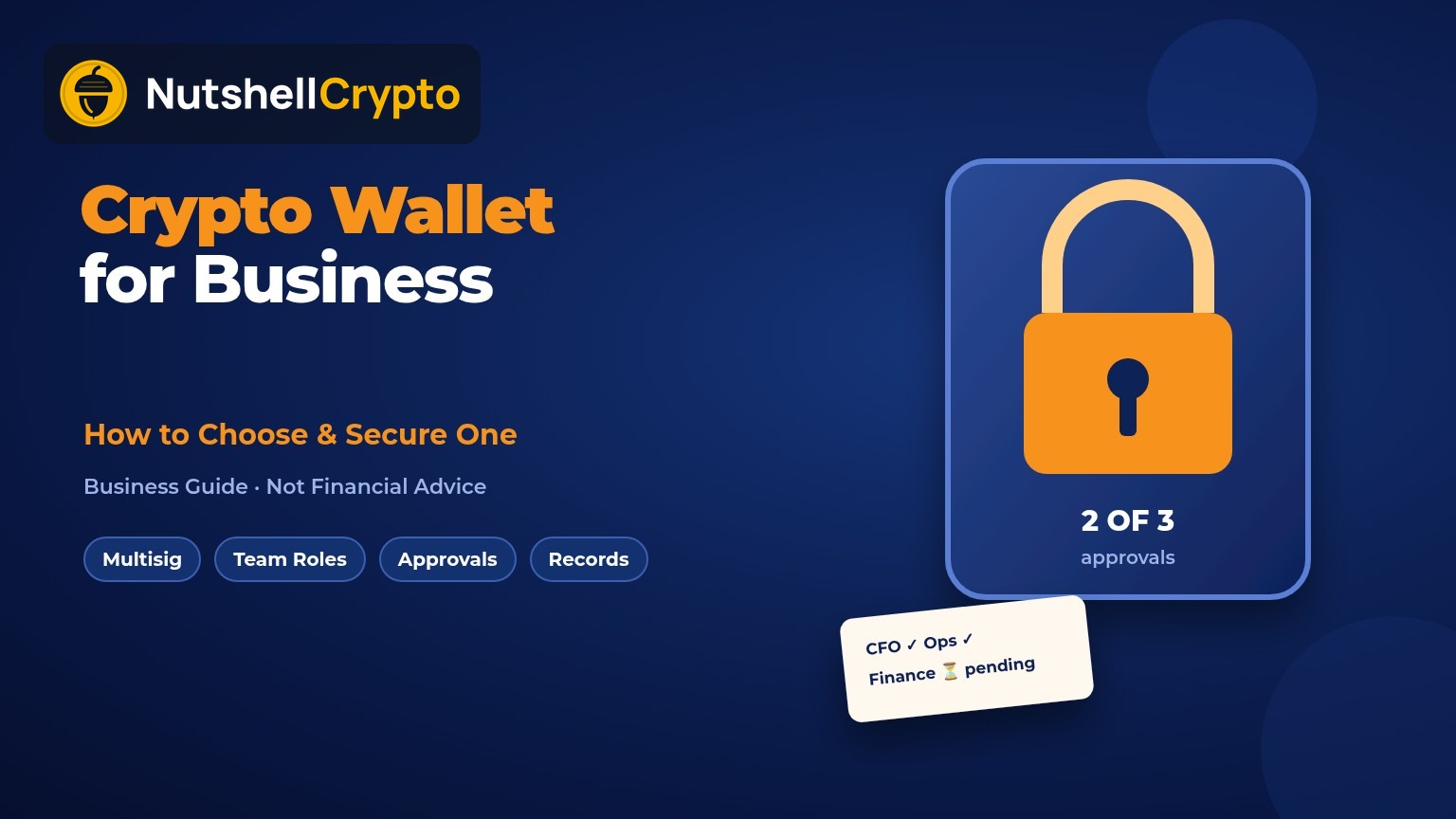
- Use a threshold. A 2-of-3 multisig is a common starting point: two officers each hold a key, and a third backup key is stored securely (for example in a bank safe deposit box or with a trusted adviser).
- Use dedicated hardware. Keep signing keys on hardware wallets bought directly from the maker, not on everyday laptops.
- Protect recovery phrases. Store them offline, in separate locations, never in email, cloud notes or photos. Bitcoin.org’s wallet security tips cover the basics.
- Turn on strong 2FA. For custodial accounts use security keys or authenticator apps rather than SMS, as CISA recommends.
- Verify every address. Confirm new payment addresses by a second channel, such as a phone call, and send a small test first. Scammers often change addresses in invoices.
- Train staff on scams. The FTC’s crypto scam guide is a good primer: no real business partner demands urgent crypto payments.
- Test recovery. Practice restoring a wallet with a small amount before you rely on it.
- Review access regularly. Rotate keys and permissions when people change roles or leave.
Rules and Taxes in the US and Canada
United States. The IRS treats digital assets as property, so a business that receives crypto as payment generally reports income at fair market value when received, and later sales or spending can create gains or losses. See the IRS digital assets page and our guide on how crypto is taxed in the US. Businesses that hold crypto for customers or transmit it for others may count as money services businesses under FinCEN guidance; simply accepting crypto for your own goods or services usually does not, but get legal advice if you are unsure.
Canada. The CRA treats crypto received for goods or services as a barter-type transaction to be included in business income, and expects detailed records. See the CRA cryptocurrency guide and our post on crypto tax in Canada. Businesses dealing in virtual currency for others may need to register with FINTRAC as a money services business.
In both countries, keep business wallets separate from personal ones and export transaction history regularly. Your accountant will thank you.
FAQ
What is the best crypto wallet for a small business?
There is no single best one. A business account at a reputable, regulated exchange is easiest for accepting payments. Once balances are meaningful, many small businesses add a 2-of-3 multisig vault for reserves.
Can an LLC or corporation open a crypto wallet?
Yes. Self-custody wallets need no account at all. Custodial business accounts usually require company documents and identity checks on owners and directors (KYB).
Is multisig better than MPC?
Both remove single-key risk. Multisig is transparent on-chain and vendor-independent; MPC is often easier across many chains but relies more on the provider’s software.
Should business and personal crypto be in the same wallet?
No. Keep them separate for security, accounting and tax reasons.
Sources
- SEC / Investor.gov: Crypto Asset Custody Basics
- FBI IC3: 2024 Internet Crime Report
- IRS: Digital assets
- FinCEN: Guidance on convertible virtual currency business models
- CRA: Guide for cryptocurrency users
- FINTRAC: Money services businesses
- CISA: Turn on MFA
- FTC: Cryptocurrency scams
- Safe (smart-account wallet)
Educational content only. This is not financial, legal, tax or investment advice. Talk to a qualified professional before setting up company crypto holdings.