In a nutshell: An open source crypto wallet is a wallet whose source code is published under a license that lets anyone read, check, and reuse it. That matters because you, or independent experts, can confirm the app does what it claims with your keys instead of just trusting the company. Open source is a strong plus, but it does not make a wallet safe on its own: you still need to download the real app and verify it. Educational only; not financial advice.
Last updated: October 6, 2026.
A crypto wallet holds the keys that control your coins, so the software behind it deserves a close look. An open source crypto wallet lets you take that look. This guide explains what “open source” really means for a wallet, how it differs from closed source, which well-known wallets fall where, and how a beginner can check a wallet before trusting it. New to wallets in general? Start with our crypto wallet guide.
Table of contents
What Does Open Source Mean for a Crypto Wallet?
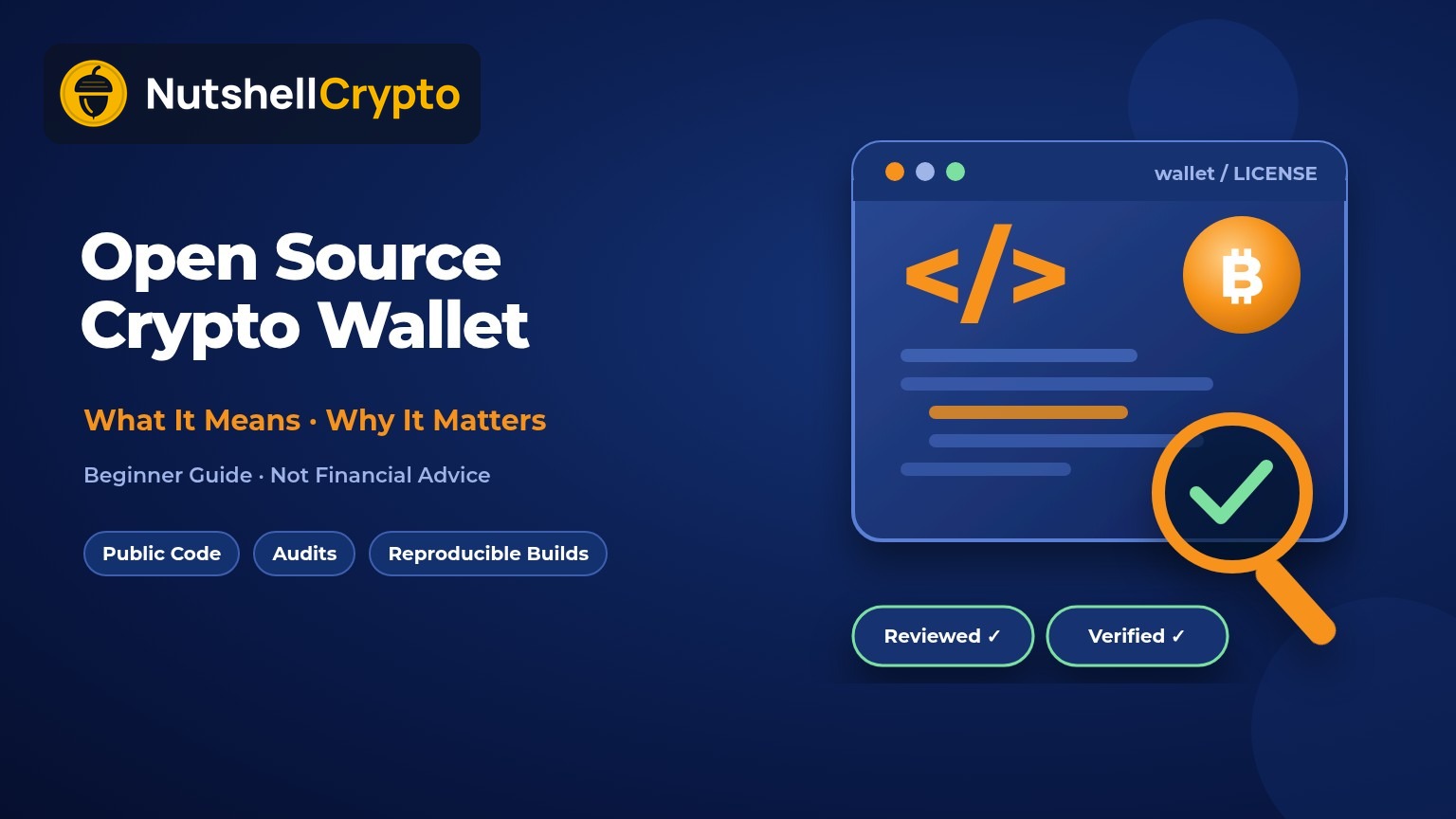
“Open source” is more than “the code is on GitHub.” The Open Source Initiative’s definition says the program must include source code, must allow redistribution, must allow modified versions, and must not restrict anyone from using it in a specific field, such as business. In practice, an open source wallet usually has four traits:
Public code
The full source code is published, usually on GitHub, under a license such as MIT, Apache 2.0, or GPL. Anyone can read how keys are generated, stored, and used to sign transactions.
Auditability
Because the code is public, security researchers, auditors, and curious users can inspect it for bugs or hidden behavior, such as code that quietly sends your seed phrase somewhere.
Reproducible builds
Most people install a ready-made app, not the source code. A reproducible build closes that gap. As the Reproducible Builds project defines it, a build is reproducible if anyone with the same source code, build environment, and instructions can recreate bit-by-bit identical files. That lets independent people confirm the app you download really came from the published code.
Community review
Open projects accept bug reports, code reviews, and contributions in public.
Why Open Source Matters for Your Crypto
With a self-custody wallet, the software touches your private keys. If it is buggy or malicious, your funds are at risk. Open source reduces how much you have to trust the company behind it. You do not need to read code yourself: what matters is that many independent people can, and that builds can be checked against the code.
Ethereum.org’s wallet finder reflects this. It lets you filter wallets by “open source,” and it requires listed wallets to be security-tested through an audit, an internal security team, or open-source code review.
Open Source vs Closed Source Wallets
| Open source wallet | Closed source wallet | |
|---|---|---|
| Code visibility | Full source published | Some or all code kept private |
| Who can audit | Anyone | The company and auditors it hires |
| Verify the app matches the code | Often, via reproducible builds | Not possible for the private parts |
| Main trust in | Public code, review, and signed releases | The company’s reputation and audits |
| Main trade-off | Easy for scammers to copy the look | You cannot check hidden code yourself |
Closed source does not mean a wallet is a scam. Some companies keep code private for business or security reasons. It just means you are trusting them more.
Examples: Where Popular Wallets Stand
Each status below comes from the wallet’s own license file, website, or support pages. Projects can change, so check the linked source before you rely on it.
Bitcoin Core: open source
Bitcoin Core is released under the MIT license. Its Guix build system is designed so people can reproduce release binaries. The official download page explains how to check that the SHA256SUMS file is PGP-signed by builders you trust.
Electrum: open source
Electrum, one of the oldest Bitcoin wallets, uses the MIT license. Its Windows build notes say the binaries should be reproducible. Its docs also show how to verify the GPG signature of a download.
Sparrow Wallet: open source
Sparrow, a desktop Bitcoin wallet popular for hardware wallet and multisig setups, is licensed under Apache 2.0. Its download page walks you through verifying a signed release manifest and has a built-in “Verify Download” tool.
Trezor: open source firmware
Trezor publishes its device firmware in the trezor-firmware repository (licensed GPL-3.0) and documents a reproducible build process so you can compare your own build with the official firmware. For the Safe 3, Trezor says it chose a secure element not restricted by NDAs to keep its open-source approach.
Ledger: mostly open, secure element partly closed
Ledger says most of its software is open source or available for review, including its companion app, SDK, and device apps. But its agreement with chipmaker STMicroelectronics legally prevents it from publishing the low-level code that talks to the secure element. Ledger argues the hardened chip is worth that trade-off.
MetaMask: code is public, but the license is restrictive
MetaMask’s extension code is on GitHub, so it can be read and reviewed. However, its license, owned by Consensys, limits reuse to non-commercial use, which includes projects under 10,000 monthly active users. Because the OSI definition forbids limits on business use, MetaMask is better described as source-available than open source in the strict sense.
Exodus: partly closed source
Exodus’s own support article says that, although it is built on many open-source components, some parts of Exodus are not open source. It says that keeping them closed makes it harder for hackers to build fake copies of the app.
Limits: Open Source Does Not Mean Safe Automatically
Open source is a useful signal, not a guarantee. Keep these limits in mind:
- Public code is not always reviewed code. Many eyes can look, but on a small project few may actually do it.
- Supply-chain attacks. In December 2023, attackers phished a former Ledger employee’s npm account and published malicious versions of the open-source Ledger Connect Kit library, which drained some users who signed transactions on affected dApps. Ledger says a fix was live within 40 minutes of it becoming aware, and that Ledger hardware and Ledger Live were not affected (Ledger incident report). NIST’s Secure Software Development Framework exists partly because this kind of risk affects all software.
- Fake apps. Open code is easy to copy, and scammers clone wallet names and icons. In April 2026, Kaspersky reported 26 fake wallet apps on Apple’s App Store imitating MetaMask, Ledger, Trust Wallet, Coinbase, and others, which led users to trojanized apps that try to steal seed phrases.
- You are still the last line of defense. No code review protects you if you type your seed phrase into a phishing site. Our hot wallet vs cold wallet guide covers the everyday risks.
How to Check If a Wallet Is Open Source
- Find the official repository. Start from the wallet’s official website and follow its link to GitHub or similar. Do not trust a repo you found through an ad or search result alone.
- Read the license file. Look for
LICENSE,LICENCE, orCOPYING. MIT, Apache 2.0, and GPL are standard open source licenses. A custom license with “non-commercial” limits usually means source-available. - Check that the whole wallet is covered. Some companies open-source libraries but keep the main app closed. Check the official FAQ, as with the Exodus and Ledger pages above.
- Look for reproducible builds. The project’s docs should explain how to rebuild and compare. Independent sites such as WalletScrutiny try to check whether wallet binaries match their public code.
- Look for activity and audits. Recent commits, public issue tracking, and published security audits are good signs.
How to verify a wallet download
Desktop wallets such as Bitcoin Core, Electrum, and Sparrow publish a signature or signed checksum file next to each release. The basic idea:
- Download the installer and its signature or checksum file from the official site only.
- Import the developer’s public PGP key from the source the project names.
- Verify the signature (for example with
gpg --verify), then check that the installer’s SHA-256 hash matches the signed list. - If anything fails or the key does not match, do not install it.
For phone apps, open the store listing from the wallet’s official website and check that the publisher name matches the real company.
Simple Steps for Beginners
- Decide what you need. A Bitcoin-only desktop wallet, a multi-coin phone app, or a hardware wallet for savings.
- Shortlist wallets with a public license and check their status from their own GitHub or support pages.
- Download only from the official site, and verify desktop downloads when instructions are provided.
- Back up your seed phrase offline and never type it into a website or share it with “support.” See our paper wallet guide for why loose paper keys carry their own risks.
- Test with a small amount first, then send a small withdrawal back before moving more.
- Keep the app updated from the same official source.
FAQ
Is an open source crypto wallet safer?
It can be, because anyone can audit the code and, with reproducible builds, confirm the app matches it. But safety also depends on audits, maintenance, and downloading the genuine app.
Is MetaMask open source?
Its code is public on GitHub, but its license restricts commercial use, so it does not meet the OSI open source definition. It is best described as source-available.
Is Ledger open source?
Partly. Ledger says most of its software is open or reviewable, but low-level secure element code is closed because of its agreement with STMicroelectronics.
Sources
- Open Source Initiative: The Open Source Definition
- Reproducible Builds: Definitions
- Ethereum.org: Find a wallet
- Bitcoin Core on GitHub and Bitcoin Core downloads
- Electrum on GitHub and Electrum: Verifying GPG signatures
- Sparrow Wallet on GitHub and Sparrow downloads
- Trezor firmware on GitHub and Trezor: Reproducible build
- Ledger: Ledger is 95% open source, why not 100%?
- MetaMask extension license
- Exodus: Is Exodus open source?
- Ledger: Connect Kit security incident report
- Kaspersky: 26 fake crypto wallet apps on the App Store
- NIST: Secure Software Development Framework
Educational content only. This is not financial or investment advice. Crypto is volatile and you can lose money. Do your own research before you act.