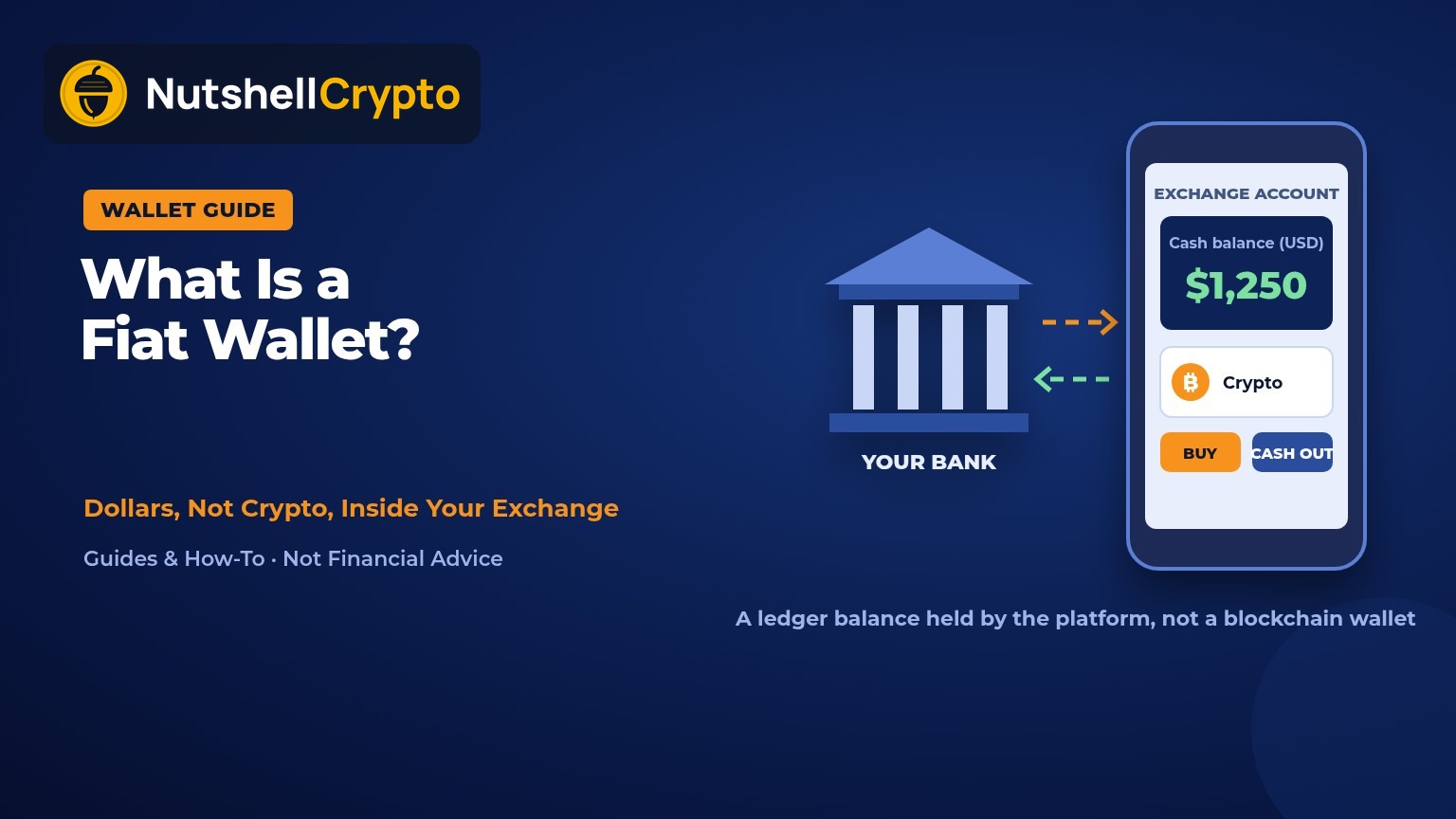
In a nutshell: A fiat wallet is the cash balance inside a crypto exchange or finance app. It holds government money such as US or Canadian dollars, not crypto. You use it to park money before you buy crypto and after you sell, then move it back to your bank. It is not a blockchain wallet and it is not a stablecoin: it is an entry on the company’s books, backed by money the company keeps at banks or in other approved holdings. FDIC pass-through insurance may cover that cash if a partner bank fails, but it never covers the exchange or app itself going under. Educational only; not financial advice.
Last updated: October 26, 2026.
Open almost any crypto exchange and you will see two kinds of balances: your coins, and a line that says something like “USD,” “Cash” or “CAD balance.” That second line is what people call a fiat wallet. “Fiat” just means government-issued money, like the US dollar, the Canadian dollar or the euro.
This guide explains what a fiat wallet is, how money moves in and out of one, how it differs from holding a stablecoin, and the one question most people never ask: what actually protects that cash if something goes wrong?
Table of contents
What Is a Fiat Wallet?
A fiat wallet is a balance of regular currency held for you by a company, usually a crypto exchange, a broker or a payment app. Coinbase calls it your cash or USD balance, and other platforms use names like “fiat account” or “cash wallet.” The idea is the same everywhere: dollars sit in your account, ready to buy crypto or to be withdrawn to your bank.
The word “wallet” is a little misleading. There is no private key, no seed phrase and no blockchain address. You cannot send your USD balance to someone’s MetaMask. It is closer to the cash sweep in a brokerage account than to a crypto wallet. Because the company holds the money and controls access, a fiat wallet is always a custodial product.
How a Fiat Wallet Works
Here is the usual path money takes:
- Deposit. You send dollars from your bank by ACH, wire, debit card, Interac e-Transfer in Canada, or a similar method. Your fiat balance goes up.
- Buy. When you buy Bitcoin or another coin, the platform takes dollars from your fiat balance and credits crypto to your account.
- Sell. When you sell, the reverse happens: crypto goes out, dollars land in your fiat balance.
- Withdraw. You move the dollars back to your bank account. Our guide on how to cash out on Coinbase walks through this step on one platform.
Behind the scenes, your balance is a number in the company’s ledger. The real dollars are pooled with other customers’ money. Coinbase, for example, says in its help center that it combines US customers’ dollar balances and holds them in custodial accounts at US financial institutions, liquid US Treasuries, or US dollar money market funds, as allowed under state money transmission laws, and that customers should not assume the money is held one way rather than another.
Deposits, card purchases and withdrawals can carry fees and holding periods. Our breakdown of crypto exchange fees explains what to look for.
Fiat Wallet vs Crypto Wallet vs Stablecoin
These three get mixed up a lot, so here they are side by side.
| Feature | Fiat wallet | Stablecoin (e.g. USDC) | Crypto wallet |
|---|---|---|---|
| What it holds | Government currency (USD, CAD, EUR) | A token designed to track a currency | Keys to coins and tokens on a blockchain |
| Where the record lives | The company’s private ledger | A public blockchain | A public blockchain |
| Can you send it to any wallet address? | No, only withdraw to a linked bank or account | Yes | Yes |
| Who controls it | The platform | You, if it sits in a self-custody wallet | You, if it is self-custody |
| Possible FDIC pass-through coverage | Sometimes, for cash held at insured banks | No | No |
A stablecoin is a crypto asset even when it is worth about $1. The FDIC lists crypto assets among the things deposit insurance does not cover. To learn how stablecoins hold their value, see what are stablecoins, and if you want to keep dollar-pegged tokens in your own custody, our stablecoin wallet guide covers that side.
Where You Will See Fiat Wallets
- Centralized crypto exchanges. Almost every centralized exchange that accepts bank deposits keeps a fiat balance for you.
- Brokerage and investing apps that also sell crypto, where your cash balance funds both stock and crypto trades.
- Payment apps that let you hold a balance and buy crypto inside the same app.
- Crypto debit card programs, where a fiat balance is what you actually spend at the till after the app sells your crypto.
- Businesses. Some companies use “fiat wallet” services from payment firms to hold customer money in several currencies next to crypto. That is a business tool, not something most individuals need.
Decentralized exchanges and self-custody wallet apps do not have fiat wallets. They only handle tokens, which is why a dollar-pegged stablecoin is the closest thing to “cash” there.
Is Money in a Fiat Wallet Insured?
This is the part that matters most, and the honest answer is: it depends, and the coverage is narrower than many people think.
The FDIC explains on its Banking With Third-Party Apps page that nonbank companies themselves are never FDIC-insured. Money you send to a nonbank only becomes eligible once the company deposits it at an FDIC-insured bank and meets other conditions, such as keeping records of who owns the money and how much. That is called pass-through insurance, and it protects you if the bank fails, up to the standard limit of $250,000.
What it does not do is protect you if the exchange or app fails. The FDIC says plainly that deposit insurance does not protect against the insolvency or bankruptcy of a nonbank company, and that getting money back through a bankruptcy can take time. The Consumer Financial Protection Bureau made the same point in a consumer advisory on payment apps: pass-through coverage insures you against the failure of the bank holding the money, not the failure of the app company.
Coinbase’s own wording follows this pattern. Its help center says that, to the extent US customer dollars are held as cash, they sit in pooled custodial accounts at FDIC-insured banks or NCUSIF-insured credit unions set up to allow pass-through claims up to $250,000 per depositor, and that this depends on Coinbase keeping accurate records and on the regulator’s decision if a bank fails. Money held in Treasuries or money market funds is not bank cash, so it is not covered by that pass-through arrangement.
Canada works differently. The Canada Deposit Insurance Corporation insures eligible deposits at its member institutions, generally up to $100,000 per category, and its coverage page lists cryptocurrencies, including stablecoins, as not eligible. A crypto platform is not a CDIC member, so the protection you get depends on how the platform holds client money and how it is regulated. Our guide to regulated crypto exchanges in Canada shows how to check a platform’s status.
A Real Example: The Synapse Freeze
The risk is not just theory. Synapse Financial Technologies was a middleware company that connected fintech apps to the banks holding their customers’ money. It filed for Chapter 11 bankruptcy on April 22, 2024. According to the CFPB’s enforcement page, the partner banks then found they were holding less money for consumers than Synapse’s records showed, a shortfall of between $60 million and $90 million. Consumers had no access to their funds for weeks or months, and many did not get their full balance back.
FDIC insurance did not help, because no bank failed. The New York Times reported that about $300 million in deposits were affected. More than two years later, Banking Dive reported that the CFPB had allocated $55.2 million so far to repay customers of the fintechs Yotta and Juno. Synapse was not a crypto exchange, but the lesson carries over: a “balance” in an app is only as safe as the company’s records and the way it holds your money.
Crypto has its own examples. Customers of collapsed platforms often found their cash balances frozen along with their coins; our list of failed crypto exchanges shows what happened and what customers recovered.
Other Risks to Know
- Account freezes. A platform can lock your account during a compliance review, a dispute or a security check, and your cash is stuck with it.
- Withdrawal holds. New bank deposits are often held for several days before you can withdraw them, even if you can trade sooner.
- No interest, or interest with strings. Many fiat balances earn nothing. Where a platform offers a yield, read how the money is held, since it may no longer sit as bank cash.
- Currency conversion. Holding a currency other than your own means exchange-rate risk and conversion fees.
- Taxes on the way in. Holding dollars in a fiat wallet is not a taxable event on its own, but selling crypto to get those dollars usually is. The IRS digital assets page explains that selling a digital asset is a disposal you report; our guide if I sell crypto, do I pay taxes? covers the basics.
How to Use a Fiat Wallet Safely
- Treat it as a waiting room, not a savings account. Keep only what you plan to trade soon, and move the rest to your bank.
- Read the platform’s disclosure on cash. Look for which banks hold the money and whether it may also sit in Treasuries or funds.
- Check the named bank. The FDIC suggests confirming that the bank a nonbank names is actually FDIC-insured using its BankFind tool.
- Mind the $250,000 limit. Coinbase notes that money you already hold directly at the same bank counts toward the same per-depositor limit.
- Turn on strong security. Use an authenticator app or security key for two-factor sign-in and set up withdrawal address or bank allowlists if offered.
- Use regulated platforms. Registration does not remove every risk, but it means rules about how client money is held apply.
FAQ
Is a fiat wallet the same as a bank account?
No. A bank account is a deposit at an insured bank in your name. A fiat wallet is a balance a nonbank company owes you, even if the company keeps the money at a bank behind the scenes.
Can I send money from my fiat wallet to another crypto wallet?
Not directly. You first buy crypto, often a stablecoin, and then send that token. The fiat balance itself can only go back to your linked bank or account.
Is USDC in my exchange account a fiat wallet?
No. USDC is a stablecoin, a crypto asset on a blockchain. It is not covered by FDIC insurance, even when an exchange displays it next to your dollar balance.
Does a fiat wallet pay interest?
Some platforms pay a yield on cash or on a stablecoin balance, and many pay nothing. Check the terms, because a yield product may change how the money is held.
What happens to my fiat balance if the exchange goes bankrupt?
FDIC pass-through insurance does not cover that case. You would usually become a claimant in the bankruptcy, and getting money back can take a long time and may not be complete.
Sources
- FDIC: Banking With Third-Party Apps
- FDIC: The Importance of Deposit Insurance and Understanding Your Coverage
- CFPB: Consumer advisory on money held in payment apps
- Coinbase Help: How is Coinbase insured?
- Coinbase Help: How is US dollar cash stored at Coinbase?
- CFPB: Synapse Financial Technologies enforcement action
- The New York Times: Synapse bankruptcy and the $95 million shortfall
- Banking Dive: Synapse victims look to small-claims court
- CDIC: What’s covered
- IRS: Digital assets
This article is for education only and is not financial or legal advice. Platform policies on how cash is held change; check your platform’s current disclosures.