In a nutshell: In Canada, a crypto exchange that holds your coins for you counts as a crypto asset trading platform (CTP), and it must be registered with Canadian securities regulators. As of October 26, 2026, the Ontario Securities Commission lists 14 registered entries, including Coinbase Canada, Kraken, Crypto.com, Wealthsimple, Bitbuy (Coinsquare), Newton, Shakepay, Ndax, Netcoins and Webull. Platforms such as Binance, KuCoin and Bybit are not on that list. To check any platform, look it up on the Canadian Securities Administrators (CSA) list or your provincial regulator’s page, not on the company’s own website. Registration helps, but your crypto is still not covered by CIPF or deposit insurance. Educational only; not financial or legal advice.
Last updated: October 26, 2026.
Many crypto apps say they are “licensed” or “compliant” in Canada. Some of them really are registered with securities regulators. Others only hold a FINTRAC money services business number, which is not the same thing. If a platform collapses, that difference can decide whether a regulator was watching how your coins were stored.
This guide explains what makes a crypto exchange regulated in Canada, which platforms are registered right now, what “restricted dealer” and “investment dealer” mean, how the $30,000 limit on some coins works, and how to check any platform yourself in a few minutes.
Table of contents
- What makes a crypto exchange regulated in Canada?
- Registered crypto trading platforms (Ontario list)
- Restricted dealer vs investment dealer
- The $30,000 limit and other investor rules
- Platforms that are not registered
- How to check if a crypto exchange is regulated
- What registration does not protect you from
- How this compares with the US
- FAQ
What Makes a Crypto Exchange Regulated in Canada?
Canada does not have one national securities regulator. Each province and territory has its own, and they coordinate through the Canadian Securities Administrators (CSA). When a platform keeps custody of your crypto and you hold a claim on it (a “crypto contract”), regulators treat that arrangement as falling under securities law. That is why exchanges need to be registered as dealers and get exemptive relief that spells out their rules.
New Brunswick’s regulator puts it simply on its registered platforms page: crypto asset trading platforms “that hold cryptocurrencies on behalf of their clients are subject to securities legislation and must be registered with the Commission.”
A third body matters too. The Canadian Investment Regulatory Organization (CIRO) oversees investment dealers across Canada. On August 6, 2024, the CSA and CIRO said platforms are expected to apply for investment dealer registration and CIRO membership, and the CSA stopped accepting new pre-registration undertakings (PRUs), according to the Alberta Securities Commission’s announcement. So the long-term goal is for crypto platforms to be supervised much like stock brokers.
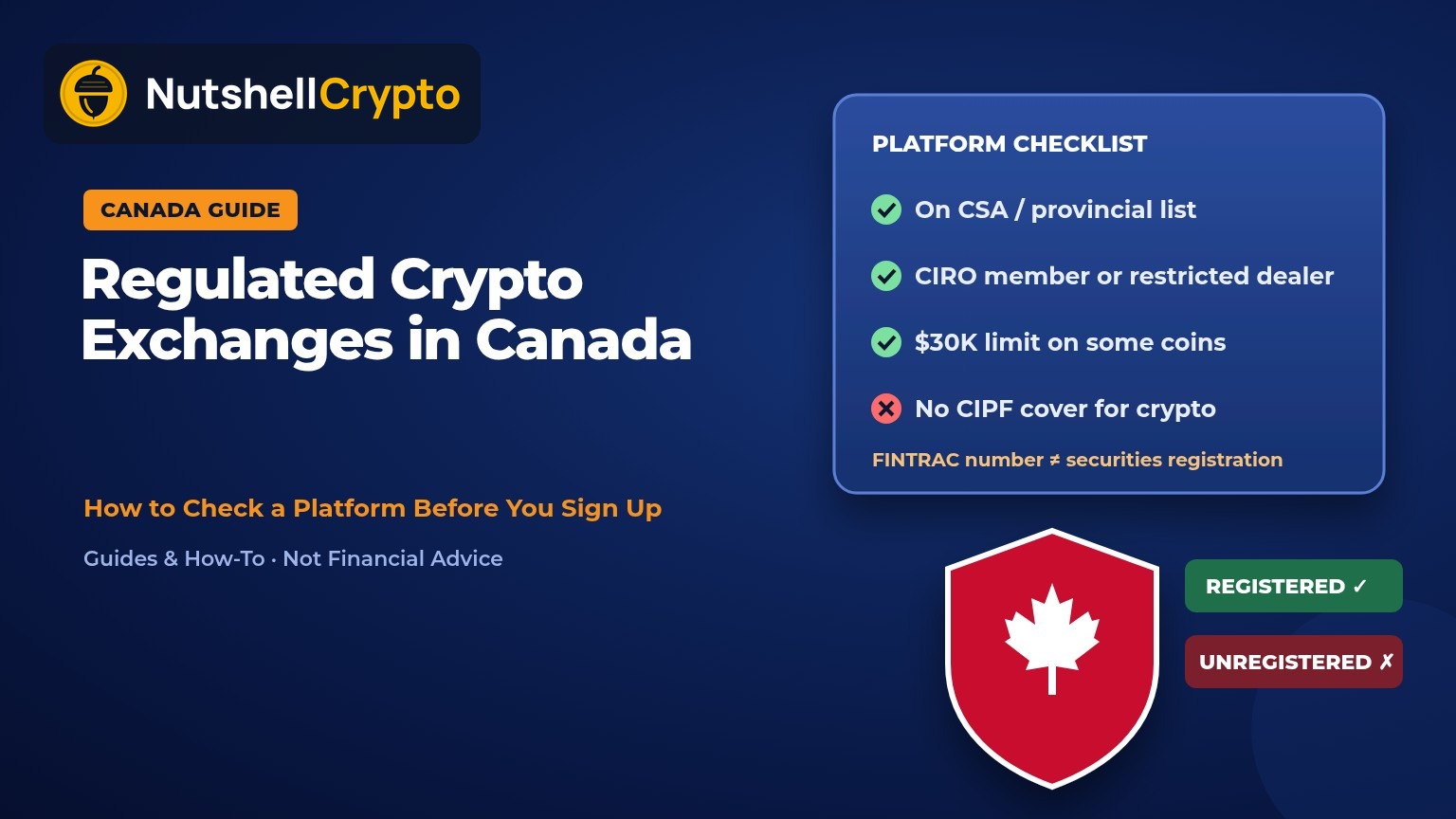
A FINTRAC number is not the same. FINTRAC registration as a money services business is about anti-money-laundering rules and KYC checks. CIRO warns on its crypto risk page that “some crypto trading platforms claim to be registered businesses, but this isn’t the same as being registered with a securities regulator.”
Registered Crypto Trading Platforms (Ontario List)
The Ontario Securities Commission (OSC) keeps the clearest public list. Its crypto businesses page, last updated October 23, 2026 (checked October 26, 2026), shows these entries as registered or exempt to serve Ontario investors:
| Platform (legal name) | Category |
|---|---|
| Bitbuy (Coinsquare Capital Markets Ltd.) | Investment Dealer |
| Coinbase Canada Inc. | Restricted Dealer |
| Crypto.com (Foris DAX CAN ULC and affiliates) | Restricted Dealer |
| Cybrid Canada Inc. | Restricted Dealer (Ontario only) |
| Fidelity Clearing Canada ULC (Fidelity Digital Assets) | Investment Dealer |
| Fidelity Digital Asset Services, LLC | Exempt Marketplace and Clearing Agency |
| Kraken (Payward Canada Inc. and Payward, Inc.) | Restricted Dealer |
| Ndax Canada Inc. | Investment Dealer |
| Netcoins Inc. | Restricted Dealer |
| Newton Crypto Ltd. | Investment Dealer |
| Satstreet Inc. | Restricted Dealer |
| Shakepay Inc. | Investment Dealer |
| Wealthsimple Investments Inc. | Investment Dealer |
| Webull Canada Crypto Limited | Investment Dealer |
Two points about this table. First, it is Ontario’s list. Registration is granted province by province, so a platform can serve some provinces and not others. Cybrid, for example, is listed for Ontario only. Second, the list changes often. Newton, for instance, appears as an investment dealer on the OSC page but still as a restricted dealer on New Brunswick’s page, which shows how lists can lag each other. Always check the live page for your province.
Restricted Dealer vs Investment Dealer
You will see two main labels on these lists:
- Restricted dealer. This was the interim category used while platforms worked toward full registration. The platform can only do the activities set out in its terms and conditions. Coinbase Canada, Kraken, Crypto.com and Netcoins are in this group on the OSC list.
- Investment dealer. This is the same category used by traditional brokerages, and it comes with CIRO membership. Platforms like Wealthsimple, Shakepay, Ndax, Bitbuy and Webull have reached it. CIRO’s dealers page lists membership terms for crypto firms such as Coinsquare, Ndax, Shakepay, Newton and Webull.
Both labels mean a regulator has reviewed the platform and set rules for it, such as how client assets are held, what coins can be offered, and how marketing must look. Investment dealer status adds CIRO’s capital, audit and conduct rules on top.
The $30,000 Limit and Other Investor Rules
Registered platforms must apply some investor protection rules that offshore exchanges skip. The best known is the investment limit.
According to OSC Staff Notice 33-757, clients outside Alberta, British Columbia, Manitoba and Quebec can buy a net maximum of $30,000 CAD over 12 months of crypto assets that are not “Specified Crypto Assets.” Platforms using the suitability model can allow $100,000 for eligible crypto investors and no limit for accredited crypto investors. Bitcoin, Ether, Bitcoin Cash, Litecoin and approved stablecoins are excluded from the limit.
Platforms apply this in slightly different ways. Coinbase’s Canada FAQ says no limits apply to BTC, ETH, SOL, USDC, BCH or LTC, and that residents of Alberta, British Columbia, Manitoba, Saskatchewan and Quebec have no limit on other coins either. Sales count back toward your room, so selling restricted coins frees up more buying space.
Other rules you will notice on a registered platform:
- Account appropriateness questions. You answer questions about your income, experience and risk tolerance when you sign up.
- Stablecoin limits. Platforms can only offer stablecoins (called value-referenced crypto assets, or VRCAs) that meet CSA conditions. The OSC page lists issuer undertakings for Circle’s USDC and QCAD only. For background on the two biggest stablecoins, see USDT vs USDC.
- Limits on leverage and derivatives. Retail access to crypto futures and margin is much tighter than on offshore exchanges. Our crypto futures guide covers what Canadians can and can’t use.
Platforms That Are Not Registered
The OSC page also lists platforms that were once in the process but are no longer registered. They include Gemini (pre-registration undertaking expired; the OSC says it “no longer offers services to retail clients in Canada”), Uphold (withdrawn), DigiFinex and ByteX (expired), CatalX (withdrawn, under an Alberta cease trade order), Hibit (expired) and VirgoCX (registration suspended effective November 24, 2025). Bitbuy Technologies, Coinberry, CoinSmart and Bitvo dropped off because their businesses were bought by other registered platforms.
Some large global exchanges never got registered:
- Binance announced on May 12, 2023 that it was leaving Canada, saying new “guidance related to stablecoins and investor limits” made the market “no longer tenable,” as reported by Reuters. The Nova Scotia Securities Commission noted it had already stopped serving Ontario at the end of 2021.
- KuCoin was permanently banned from Ontario’s capital markets in June 2022 and ordered to pay a $2,000,000 administrative penalty plus $96,550.35 in costs, according to the Capital Markets Tribunal decision.
- Bybit settled with the OSC in 2022, giving up US$2,468,910 in Ontario revenue and agreeing to stop opening new Ontario accounts, per the OSC’s news release.
Using an unregistered offshore exchange is not the same as committing a crime as a customer, but it means no Canadian regulator supervises how your money is held. Many of the platforms in our list of failed crypto exchanges were offshore and lightly supervised when they collapsed.
How to Check If a Crypto Exchange Is Regulated
This takes about five minutes:
- Find the legal company name. Look in the app’s terms of service or footer. Kraken in Canada, for example, operates through Payward Canada Inc.
- Check the CSA list. The CSA keeps a page of crypto trading platforms authorized to do business with Canadians, organized by decision. You can also search the firm in the CSA National Registration Search.
- Check your own province. Use the OSC page if you live in Ontario, or your provincial regulator. Quebec residents can check the AMF’s cryptoasset trading platforms register.
- Look for warnings. Regulators publish investor warnings and alerts about unregistered firms. If the name shows up there, walk away.
- Read the terms and conditions. Each registered platform’s decision document lists what it can offer. If an app offers 50x leverage to Canadian retail clients, it is very unlikely to be a registered platform.
Be careful with lookalike names and fake apps. Scammers often copy the branding of real registered platforms. Type the website address yourself instead of clicking ads or links in messages.
What Registration Does Not Protect You From
Registration lowers some risks, but it does not make crypto safe:
- No CIPF cover for crypto. The Canadian Investor Protection Fund says crypto assets held by a member firm “are not eligible for CIPF coverage.” CIPF can cover cash held in a crypto account at a member firm, and crypto ETFs or funds held there, but not the coins themselves.
- No deposit insurance. CIRO says federal and provincial deposit insurance plans don’t cover crypto assets either.
- Price risk. A regulated platform will not stop a coin from falling 50%.
- Your own mistakes. Sending coins to the wrong address or to a scammer usually can’t be reversed.
Some people move long-term holdings off exchanges into a wallet they control. Our self-custody guide explains the trade-offs. Remember that selling or swapping crypto is usually a taxable disposition in Canada; see cryptocurrency tax in Canada.
How This Compares With the US
US readers face a different system. There is no single “registered crypto exchange” list like the CSA’s. Exchanges usually operate under state money transmitter licenses, with federal regulators involved in some products. If you are in the US, check the exchange’s licenses page and your state’s financial regulator, and read our explainer on how a centralized exchange works. For buying crypto exposure through a regular brokerage in Canada instead, see how to buy a Bitcoin ETF in Canada.
FAQ
Is Coinbase regulated in Canada?
Yes. Coinbase Canada Inc. appears on the OSC’s list as a restricted dealer, with an amended decision dated April 1, 2026.
Is Kraken regulated in Canada?
Yes. Kraken operates in Canada through Payward Canada Inc. and Payward, Inc., listed by the OSC as a restricted dealer.
Is Binance legal in Canada?
Binance is not a registered crypto trading platform in Canada. It announced its exit from the Canadian market in May 2023.
What is the safest regulated crypto exchange in Canada?
No regulator ranks platforms by safety. A practical approach is to choose a platform on your province’s registered list, check whether it is a CIRO member, read how it holds client assets, and keep only what you need on any exchange.
Why can I only buy $30,000 of some coins?
Registered platforms must cap net purchases of coins other than specified assets like Bitcoin and Ether for many retail clients outside Alberta, BC, Manitoba and Quebec (and Saskatchewan, on some platforms). The cap is meant to limit losses on smaller, riskier coins.
This article is for education only and is not financial, legal or tax advice. Registration lists change often. Check the CSA and your provincial regulator’s live pages before you open an account.