In a nutshell: Automated crypto trading means using software, usually called a trading bot, to place buy and sell orders for you based on rules you set, such as “buy $25 of Bitcoin every Monday” or “buy a little each time the price falls by a set amount.” Bots can run around the clock and remove some emotion from trading, but they cannot predict prices. They can lose money through bad settings, bugs, fees, sudden market moves and stolen API keys, and many “AI bots” promising guaranteed profits are scams. Educational only; not financial advice.
Last updated: October 22, 2026.
Search for crypto trading online and you will quickly find ads for bots that “trade while you sleep.” Automated crypto trading is real and widely used, from simple recurring buys on a big exchange to complex programs run by professional firms. It is also one of the most common hooks scammers use.
This guide explains how bots work, how they connect to your account, the main strategy types and the risks to understand before letting software touch your money.
Table of contents
- What is automated crypto trading?
- How a crypto trading bot works
- How bots connect: API keys and permissions
- Common types of crypto trading bots
- What bots can do well
- The real risks of automated trading
- Trading bot scams and fake “AI bots”
- Fees, slippage and hidden costs
- A quick note on taxes
- A safety checklist before using any bot
- FAQ
What Is Automated Crypto Trading?
Automated crypto trading is trading where a computer program, not a person clicking buttons, decides when to place orders and then sends them to an exchange. In traditional finance this is called algorithmic trading. Investopedia’s algorithmic trading explainer describes it as automating trade decisions using mathematical models based on price, volume and timing, and notes that by 2009 more than 60% of all US trades were already executed by computers.
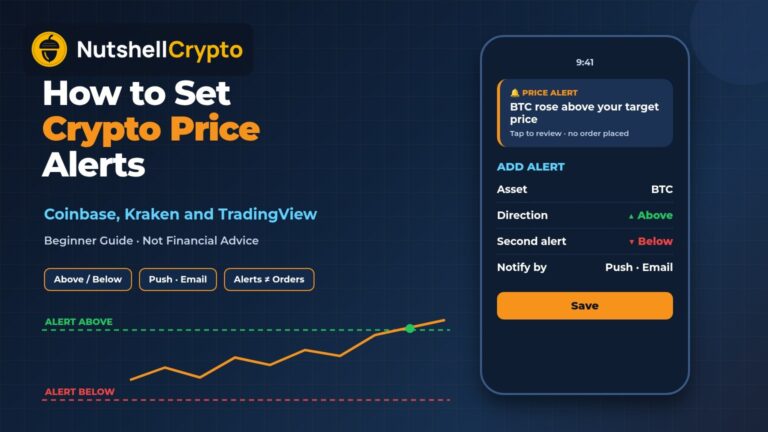
Because crypto trades 24/7 and most large exchanges let customers connect software, “bots” now range from a one-tap recurring purchase to custom code written by the user. If you only want to know when a price is reached, without any trades placed for you, simple Coinbase price alerts or similar exchange alerts are enough.
The key idea to hold onto: a bot only follows instructions. It does not know where the price is going.
How a Crypto Trading Bot Works
Almost every bot runs the same loop: it reads data (prices, the order book or simply the clock), checks that data against the rules you set, places or cancels orders when a condition is met, then repeats until you stop it, it runs out of funds, or something breaks.
People use bots in three main ways:
- Built-in exchange bots. Some exchanges offer bots inside their own platform. Crypto.com’s help center, for example, describes its exchange trading bots as tools that automatically place orders “based on pre-set parameters,” and lists DCA and grid bots among them.
- Third-party bot services. A separate company runs the software, connected to your account with an API key.
- Your own code. Developers call the exchange’s API directly, with full control and full responsibility for every bug.
If order types are new to you, start with our guide to spot trading and how orders fill, because every bot is just placing those same orders faster.
How Bots Connect: API Keys and Permissions
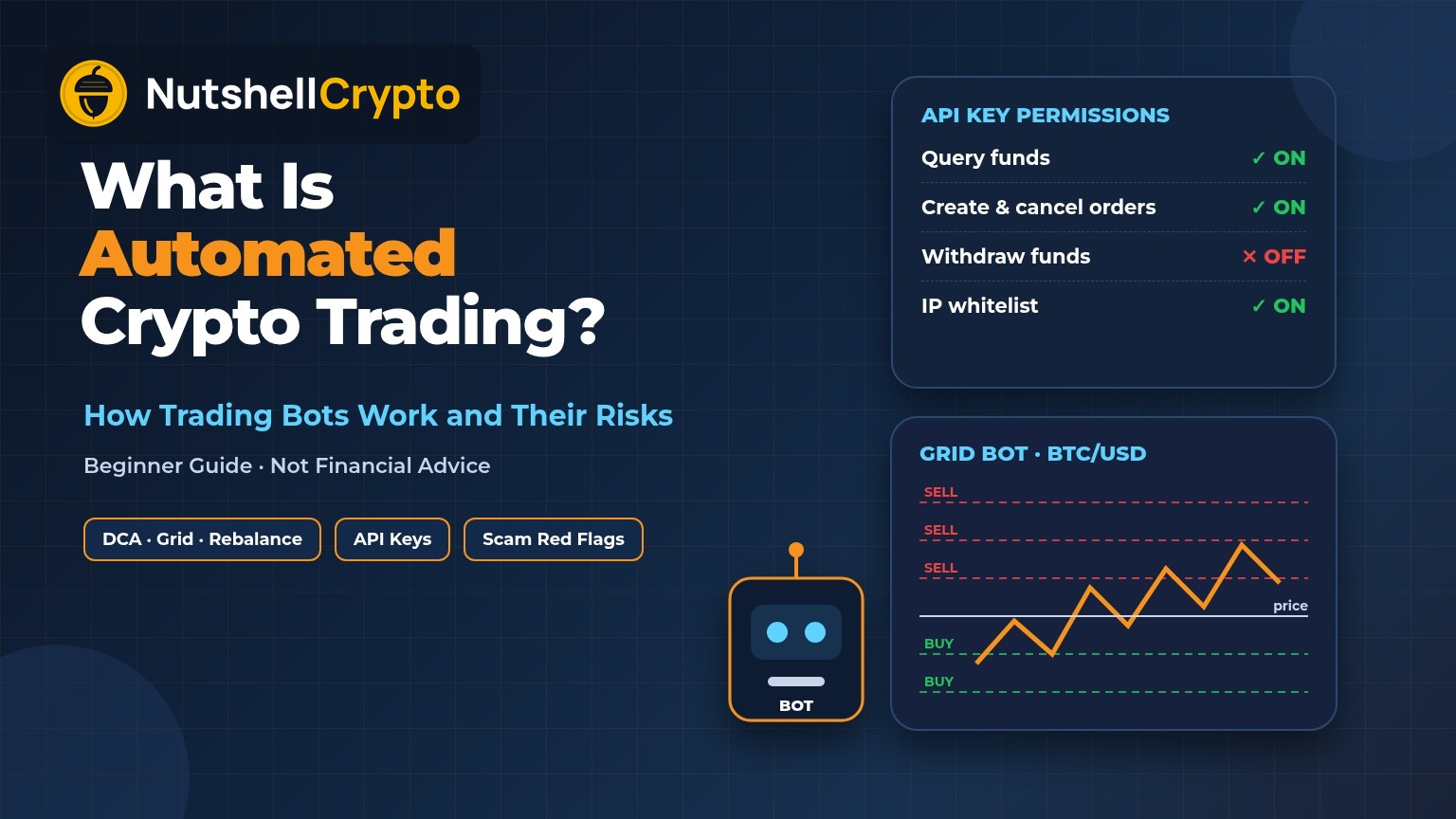
An API key is a pair of codes (a public key and a secret) that lets software act on your exchange account without your password. Whoever holds it can do whatever its permissions allow, so setting it up carefully is the most important safety step.
Kraken’s guide to creating an API key shows how this works. Each key has separate permissions, such as querying funds, placing and cancelling orders, depositing and withdrawing. Kraken gives the example of a key handed to a third party for trading: it would need order permissions, but “would almost certainly not require Withdraw Funds permission.”
Practical rules:
- Trade-only, never withdraw. A bot needs to place and cancel orders, not move coins off the exchange. Leave withdrawal permission off.
- IP whitelisting. Many exchanges let you lock a key to specific IP addresses, so it only works from the server your bot runs on. Kraken’s developer guide to API key permissions calls IP whitelisting a measure that “prevents almost all key misuse even if the key is leaked.”
- One key per purpose. The same guide suggests separate keys for separate jobs, never putting keys in source code, rotating them periodically and granting the minimum permissions needed.
- Be careful with third parties. Kraken’s page on the withdrawal addresses API permission warns that a third-party service holding your key “could be compromised,” even if it is reputable, and that you have no control over how it stores your credentials.
Even a trade-only key is not harmless: a thief could still place bad trades with it. Treat every key like a password and delete keys you no longer use.
Common Types of Crypto Trading Bots
Most bots fall into a few families. None is “best”; each suits some market conditions and fails in others.
DCA and recurring-buy bots
The simplest automation is buying a fixed amount on a fixed schedule, known as dollar cost averaging. Many exchanges and apps offer this as a recurring buy, and Crypto.com’s help center describes its DCA bot as buying or selling “at regular intervals over a preset time frame.” There is no market prediction involved. Our full guide to dollar cost averaging in crypto covers it with worked examples.
Grid bots
A grid bot places a ladder of buy orders below the current price and sell orders above it, inside a price range you choose. When a buy fills, it places a matching sell one step higher, and the reverse. OKX’s spot grid bot FAQ describes the goal as systematically buying lower and selling higher within the range, and adds: “As with all bots, there’s no guarantee that this aim will be achieved.”
Grid bots tend to work best when price moves sideways. In a strong downtrend, the bot keeps buying as the price falls and can end up holding a coin worth much less than you paid. Investopedia’s grid trading overview notes the strategy is easy to automate but can bring large losses if stop-loss limits aren’t respected.
Rebalancing bots
A rebalancing bot keeps a portfolio at target weights, such as 60% Bitcoin and 40% Ether. When one coin grows past its target, the bot sells some and buys the other. Investopedia’s rebalancing guide notes the trade-offs: transaction costs and possibly missing further gains in the asset that was trimmed.
Signal and rule-based bots
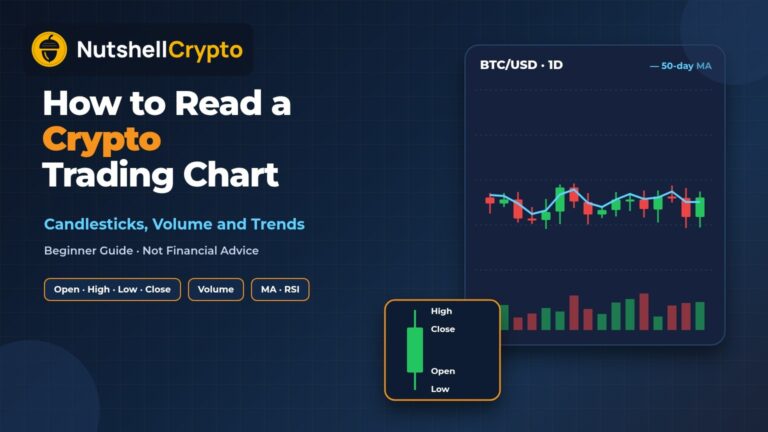
These bots trade when a technical condition is met, for example when a short moving average crosses above a long one, or when RSI drops below a level. They are only as good as their rules. Our guide on how to read a crypto trading chart explains candlesticks, moving averages and RSI, which describe the past rather than predict the future.
Arbitrage bots
Arbitrage bots look for the same coin trading at slightly different prices on different venues and try to buy low and sell high at almost the same moment. In practice, fees, transfer delays and competition from professional firms close most gaps within seconds. Our explainer on crypto arbitrage and why the gaps disappear goes through the costs in detail.
Market-making bots
Market makers keep quoting both a buy price and a sell price, and aim to earn the difference. Investopedia’s market maker definition explains that they earn from the bid-ask spread. For individuals, a sharp move can leave the bot holding coins bought at the wrong price.
What Bots Can Do Well
Used carefully, automation has real advantages. Investopedia’s algorithmic trading page lists speed, fewer manual errors, round-the-clock operation and emotion-free execution among the benefits. A bot sticks to the plan when headlines are scary, and you can test its rules on past data before risking money. What it can’t do is guarantee profit: if the strategy is poor or the market changes, the bot executes losses just as efficiently.
The Real Risks of Automated Trading
Bugs and technical failures
Code has bugs, exchanges go down and connections drop. A bot that misreads a price can place many bad trades in minutes, and Investopedia lists system failure as the first con of algorithmic trading. Start small and know how to stop the bot fast.
Overfitting and misleading backtests
A backtest runs a strategy on historical data to see how it would have done. It is useful, but easy to fool yourself with. Investopedia’s overfitting explainer describes how searching historical market data long enough can produce rules that seem to predict returns closely, but turn out to fit “chance occurrences” when applied to new data.
Its backtesting guide adds that a fair test should cover different market conditions, include all trading costs, and be checked with out-of-sample and forward (paper) testing. A perfect backtest screenshot from someone selling a bot proves very little.
API key theft
Keys leak through malware, phishing, public code repositories or a breach at the bot provider. With withdrawals off and an IP whitelist on, a leak does far less damage.
Market risk does not go away
Crypto is volatile. The CFTC’s advisory on the risks of virtual currency trading notes that crypto values are driven by supply and demand and are more volatile than traditional currencies, and that profits and losses from that volatility are amplified with margin. A bot cannot protect you from a sudden crash.
Leverage multiplies everything
Some bots trade futures or margin. With borrowed money, a run of small mistakes can wipe out your deposit, because the exchange can close your position automatically. If a bot offers leverage, read our guides on the costs and risks of margin trading and how liquidation works in crypto first. For beginners, spot-only with no leverage is far safer.
Trading Bot Scams and Fake “AI Bots”
Regulators repeatedly warn that trading bots are a favorite cover story for fraud. The CFTC’s customer advisory “AI Won’t Turn Trading Bots into Money Machines” says fraudsters tout automated trading algorithms and crypto schemes that promise “unreasonably high or guaranteed returns,” and that “AI technology can’t predict the future or sudden market changes.” Scammers, it says, claim returns of “sometimes tens of thousands of percent” or “100 percent ‘win’ rates.”
The advisory’s case study is Mirror Trading International. According to the CFTC’s September 2023 press release, the company and its founder accepted at least 29,421 bitcoin, valued at over $1.7 billion, from at least 23,000 people in the US and thousands more worldwide, claiming a proprietary trading “bot” would trade for them. The order says all of the bitcoin was misappropriated, and the company was ordered to pay over $1.7 billion in restitution.
US securities regulators say the same. A joint SEC, NASAA and FINRA investor alert on AI and investment fraud warns about unregistered platforms promoting AI trading systems with claims like “Our proprietary AI trading system can’t lose!” It suggests checking registration on Investor.gov in the US or the Canadian Securities Administrators’ National Registration Search in Canada. The FTC’s guide to cryptocurrency scams puts it simply: “Only scammers will guarantee profits or big returns.”
Common red flags:
- Guaranteed, fixed or “passive” daily, weekly or monthly returns
- You must send crypto to the bot company’s own wallet or platform instead of keeping it in your exchange account
- Withdrawals that require extra “fees” or “taxes” first
- Pitches from strangers on social media, messaging apps or dating apps
- “AI” buzzwords with no explanation of what the strategy actually does
The CFTC suggests researching the company and its people, checking how old the website’s domain is at lookup.icann.org, and getting a second opinion before investing. In the US, the FTC lists ReportFraud.ftc.gov, the CFTC, the SEC and the FBI’s IC3 for reporting crypto scams.
Fees, Slippage and Hidden Costs
Bots trade often, so small costs add up:
- Trading fees. Every fill pays a maker or taker fee. A grid bot making many small trades can lose much of its gains to fees. Our breakdown of crypto exchange fees explains maker, taker and spread costs.
- Slippage. Investopedia’s slippage explainer defines it as the gap between the expected price and the price you actually get, and says it is most common in volatile or low-liquidity markets. Limit orders can reduce it.
- Subscription costs. Paid bot services add their own charges, and the CFTC advisory tells users to weigh “fees, spreads, and subscription costs” against any returns.
A Quick Note on Taxes
Automation does not change the tax rules, but it can multiply the number of taxable events. In the US, the IRS digital assets page says income from digital assets is taxable and that you may have to report transactions such as selling or exchanging crypto. In Canada, the CRA’s guide to reporting income from crypto-asset transactions lists frequent buying and selling and short holding periods among the factors that can make your gains business income rather than capital gains. Export your bot’s trade history regularly. Our crypto taxes guide covers the basics; for your situation, talk to a tax professional.
A Safety Checklist Before Using Any Bot
- Understand the rules. If you can’t explain what the bot does in a sentence or two, don’t run it.
- Start simple. A recurring buy carries far less risk than a leveraged signal bot.
- Use a regulated exchange available where you live, and keep funds in your own account, never in a bot provider’s wallet.
- Lock down the API key: trade-only, withdrawals off, IP whitelist on, one key per bot, two-factor authentication on the account.
- Start small with money you can afford to lose, and check the first trades, fees and fills.
- Distrust perfect backtests, skip leverage as a beginner, and keep records.
FAQ
Is automated crypto trading legal?
Using software to place your own trades is generally allowed, and many exchanges offer built-in bots or API access. Check your exchange’s terms and local rules.
Are crypto trading bots profitable?
Some strategies make money in some periods and lose in others. No bot can reliably predict prices, and guaranteed profits are a red flag.
Can a trading bot steal my crypto?
A properly set up key with withdrawals switched off cannot move coins off your exchange account, but a stolen key can still be used to place harmful trades. Fake bot platforms that ask you to deposit funds with them can simply keep your money.
Is an AI trading bot better than a regular one?
Not necessarily. “AI” is a label, not a guarantee. Regulators warn that AI claims are widely used to market fraudulent schemes, and that AI cannot predict sudden market changes.
This article is for education only and is not financial, investment or tax advice. Crypto is highly volatile, automated strategies can lose money, and you can lose some or all of what you put in.
Sources
- CFTC: AI Won’t Turn Trading Bots into Money Machines
- CFTC Press Release 8772-23: Mirror Trading International restitution order
- CFTC: Understand the Risks of Virtual Currency Trading
- SEC/NASAA/FINRA: Artificial Intelligence and Investment Fraud
- FTC: What To Know About Cryptocurrency and Scams
- Kraken: How to create an API key
- Kraken Developers: API key permissions
- OKX: Spot grid bot FAQ
- Crypto.com Help Center: DCA Trading Bot
- Investopedia: Algorithmic Trading
- Investopedia: Overfitting
- Investopedia: Backtesting
- Investopedia: Slippage
- IRS: Digital Assets
- CRA: Reporting income from crypto-asset transactions