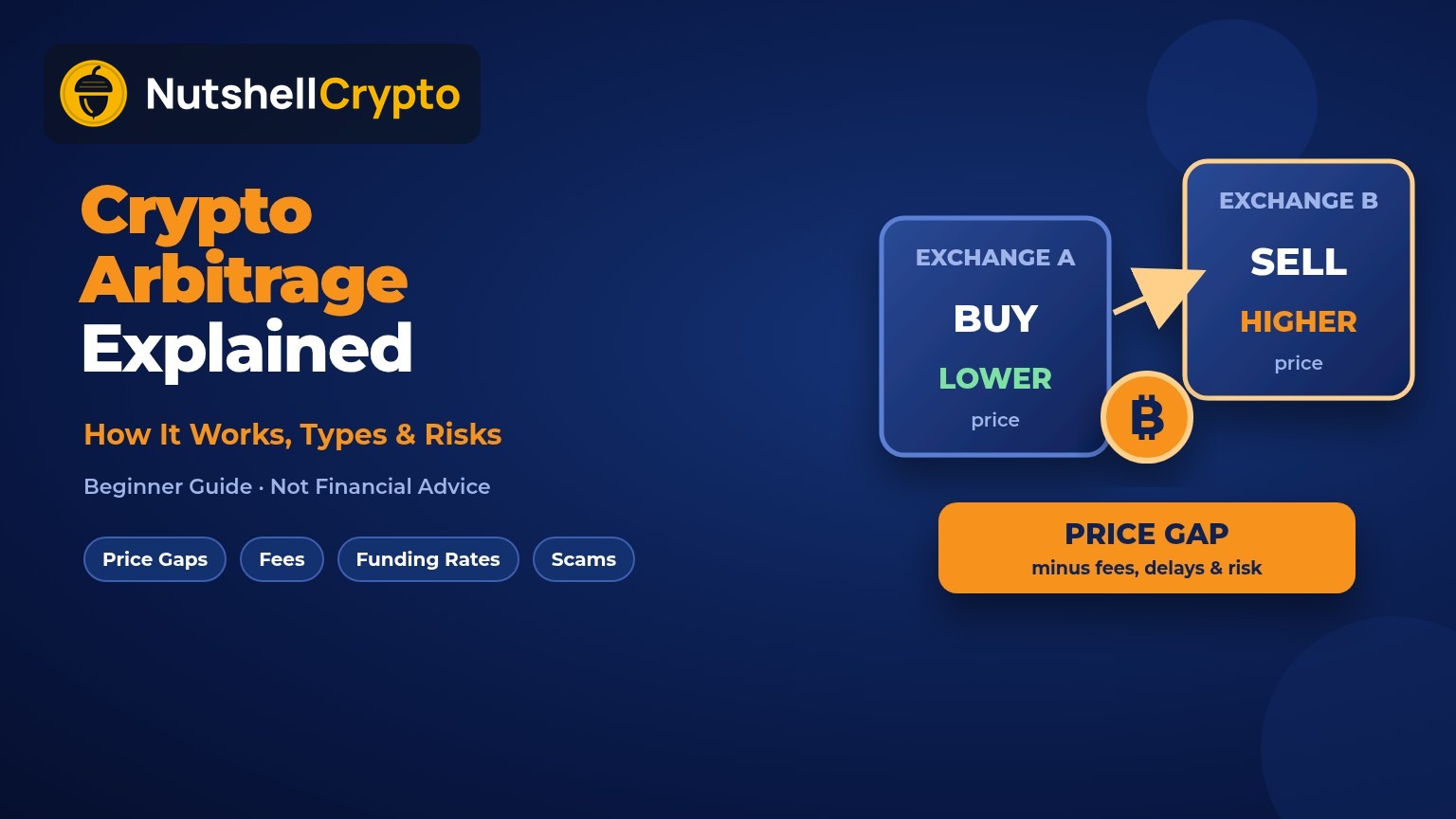
In a nutshell: Crypto arbitrage means buying a coin where it is cheaper and selling it where it is more expensive at almost the same time, keeping the price gap as profit. In practice, fees, transfer delays and fast-moving prices wipe out most gaps, and “guaranteed arbitrage bot” offers are a common scam. Educational only; not financial advice.
Last updated: October 8, 2026.
The same coin can trade at slightly different prices on different exchanges. Arbitrage traders try to capture that difference. This guide explains how crypto arbitrage works, the main types, a simple worked example, why most beginners don’t profit from it, how to spot arbitrage scams, and how it is taxed in the US and Canada. If you are new to exchanges, start with our guide to centralized exchanges.
Table of contents
What Is Crypto Arbitrage?
Investopedia defines arbitrage as trading that “exploits the tiny price differences between identical or similar assets in two or more markets.” The trader buys in one market and sells in another at the same time to keep the difference.
In crypto, that usually means spotting bitcoin, ETH or another coin priced lower on one exchange than on another, buying the cheaper one and selling the pricier one. The trader is not betting on whether the price goes up or down. The goal is to profit from the gap alone.
That is the theory. The catch is that the gap has to be bigger than every cost involved, and it has to still be there by the time both trades are done.
Why Crypto Prices Differ Between Exchanges
Each centralized exchange runs its own order book with its own buyers and sellers. There is no single official bitcoin price, so small differences appear all the time. The main reasons are:
- Local demand. A burst of buying on one platform can push its price above others for a while.
- Liquidity. Smaller exchanges and thinly traded coins move more on each order, so their prices drift further from the bigger markets.
- Currency and capital rules. Prices quoted in different fiat currencies, or in countries with strict money-transfer rules, can stay apart for long periods.
- Transfer friction. Moving coins or cash between platforms takes time and costs fees, which lets gaps survive.
The best-known example is South Korea’s “kimchi premium,” where bitcoin has often traded higher on Korean exchanges than abroad. Researchers Choi, Lehar and Stauffer found bitcoin was on average 2.27% more expensive in Korea than in the US between January 2016 and January 2020. They argue that capital controls amplify the delays and costs of moving bitcoin, which limits arbitrageurs. CNBC reported that only South Korean nationals or registered foreign residents can open full bank accounts there, which effectively locks most overseas traders out of the domestic exchanges.
The Main Types of Crypto Arbitrage
1. Cross-exchange (spatial) arbitrage
This is the classic version: buy on Exchange A, sell on Exchange B. Serious traders keep money and coins on both platforms ahead of time so they can trade both sides at once instead of waiting for a transfer.
2. Triangular arbitrage
This happens on a single exchange across three trading pairs. For example, a trader converts USD to BTC, BTC to ETH, and ETH back to USD. If the three exchange rates are slightly out of line, the loop ends with a little more USD than it started with. These gaps are tiny and usually last seconds, so this is almost entirely done by bots.
3. Spot-futures and funding-rate arbitrage
Perpetual futures are derivative contracts with no expiry date. Coinbase explains that they use a funding rate, a periodic payment between long and short traders that keeps the futures price close to the spot price. When the rate is positive, longs pay shorts; when it is negative, shorts pay longs.
A “cash-and-carry” trader buys the coin on the spot market and opens an equal short futures position. Price moves roughly cancel out, and the trader collects funding payments while the rate stays positive. The risks are real: the rate can turn negative, the futures leg can be liquidated in a sharp move, and the exchange holding the position can fail. Perpetual futures are also restricted or unavailable for many retail users depending on where they live.
4. DEX arbitrage
On decentralized exchanges, the same token can be priced differently in different liquidity pools. Ethereum.org calls DEX arbitrage “the simplest and most well-known” form of MEV (maximal extractable value). A trader can buy on the cheaper DEX and sell on the pricier one in a single atomic transaction, meaning both legs succeed or neither does.
Ethereum.org also says it is the most competitive form. Searchers may pay 90% or more of their MEV revenue in gas fees to get their trade included first, and it warns that DEX arbitrage is unlikely to be profitable for new searchers. If you want the background, read our guide to DeFi.
A Simple Worked Example
Hypothetical numbers only. The prices and fees below are made up to show the math, not quotes from any exchange.
Say bitcoin shows $100,000 on Exchange A and $100,400 on Exchange B, a 0.4% gap. You buy 0.1 BTC on A for $10,000 and sell 0.1 BTC on B for $10,040. The gross gap is $40.
- Taker fee on Exchange A at 0.40%: about $40
- Taker fee on Exchange B at 0.40%: about $40
- Bitcoin network withdrawal fee to rebalance later: a few dollars
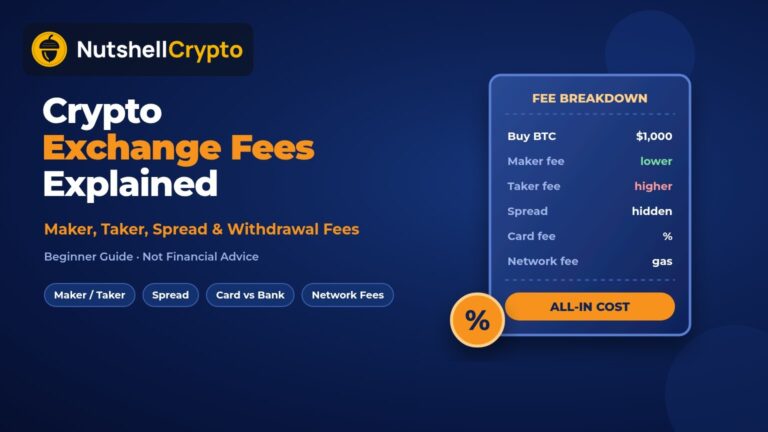
Result: roughly a $40 loss before the price even moves. To break even, the gap would need to be wider than both trading fees plus transfer costs combined. Lower fee tiers help, which is why professional firms trade huge volumes. Our guide to crypto exchange fees explains maker, taker, spread and withdrawal costs in detail.
Why Arbitrage Is Harder Than It Looks
- Fees eat small gaps. Two trading fees, spreads and withdrawal fees often add up to more than the price difference.
- Speed. Bots and market makers close visible gaps in seconds. By the time you see one on a price site, it is often gone.
- Transfer risk. If you must move coins between exchanges, the price can move while you wait for confirmations. Choi, Lehar and Stauffer link bigger premiums to higher transaction costs, slower blockchain confirmation and higher volatility, which are exactly the frictions that make the trade risky.
- Slippage and depth. The quoted price may only apply to a small amount. A larger order fills at worse prices.
- Withdrawal limits and freezes. Exchanges can pause deposits or withdrawals for a coin. A gap that exists because withdrawals are halted is usually not one you can actually capture.
- Counterparty risk. Keeping money on several exchanges means trusting several companies with it. Our hot wallet vs cold wallet guide explains why many people prefer to hold long-term coins themselves.
Crypto Arbitrage Scams and Red Flags
Because arbitrage sounds low-risk, fraudsters use the word to sell fake “guaranteed” returns. In May 2026, the SEC charged Texas resident Nathan Fuller, alleging he raised about $12.3 million from about 150 investors by claiming AI trading bots would run high-frequency crypto arbitrage. The SEC says he promised some investors profits of more than 100% in as little as 21 days, that the bots did not work as described, and that he misappropriated at least $6.2 million and used about $5.5 million for Ponzi-like payments. These are allegations in a civil case.
It is not new. Back in 2013 the SEC charged the operator of Bitcoin Savings and Trust, who promised up to 7% weekly interest from bitcoin “market arbitrage activity.” The SEC called it a sham and a Ponzi scheme.
The CFTC warns that fraudsters tout automated trading bots and crypto schemes that promise “unreasonably high or guaranteed returns,” and that “AI technology can’t predict the future.” Red flags include:
- Guaranteed or fixed daily, weekly or monthly returns
- “Risk-free” claims for a strategy you can’t see or verify
- Referral bonuses for bringing in friends
- Pressure to deposit more before you can withdraw
- Unregistered firms, or claims of FDIC insurance on crypto deposits
Real arbitrage profits are small, uncertain and shrink as more people compete. Anyone promising large, steady returns from “arbitrage” deserves extra suspicion.
How Crypto Arbitrage Is Taxed in the US and Canada
United States. The IRS virtual currency FAQ says that exchanging virtual currency held as a capital asset for other property, “including for goods or for another virtual currency,” triggers a capital gain or loss. Every sale or swap in an arbitrage loop is a taxable event, so frequent trading creates many short-term gains and losses to track. See our guide to crypto capital gains tax for how short-term and long-term rates differ.
Canada. The CRA crypto-asset guide explains that gains can be business income or capital gains depending on how you trade. Frequent trading, short holding periods and a business-like approach point toward business income, which is fully taxable rather than half-included. Our guide to cryptocurrency tax in Canada covers the details.
Either way, keep a record of every trade, fee and transfer. Tax rules can change, so check with a tax professional for your situation.
Is Crypto Arbitrage Legal?
In the US and Canada, buying a coin on one regulated exchange and selling it on another is generally legal. What can cross the line is how it is done. Using platforms that are not allowed in your country, getting around capital controls, or pooling other people’s money and promising returns without the required registration can break the law. Futures and derivatives also come with their own rules, so check what your exchange permits where you live.
FAQ
Is crypto arbitrage profitable?
It can be for well-funded firms with low fees, fast systems and accounts on many exchanges. For most beginners, fees, slippage and speed mean visible gaps are gone or too small to profit from after costs.
Is crypto arbitrage risk-free?
No. Only an atomic on-chain trade, where both legs happen together, avoids price risk between legs, and even then gas fees and competition can make it lose money. Cross-exchange trades carry price, transfer, exchange and withdrawal risks.
What is triangular arbitrage in crypto?
It is a loop of three trades on one exchange, such as USD to BTC, BTC to ETH and ETH back to USD, to profit if the three prices are briefly out of line.
Can stablecoins be used for arbitrage?
Yes. Traders often hold stablecoins on several exchanges so they can buy quickly without waiting for a bank transfer. Stablecoins can also briefly trade above or below $1 on some venues.
Sources
- Investopedia: Arbitrage
- Choi, Lehar and Stauffer: Bitcoin Microstructure and the Kimchi Premium (SSRN)
- CNBC: South Korea’s kimchi premium in the spotlight
- Coinbase: Understanding funding rates in perpetual futures
- Ethereum.org: Maximal extractable value (MEV)
- SEC: Litigation release on Nathan Fuller (May 2026)
- SEC: Charges in Bitcoin Savings and Trust Ponzi scheme (2013)
- CFTC: AI won’t turn trading bots into money machines
- IRS: Frequently asked questions on virtual currency transactions
- CRA: Guide for cryptocurrency users and tax professionals
Educational content only. This is not financial, tax or investment advice. Crypto arbitrage can lose money through fees, price moves, exchange failures and scams. Crypto is volatile and you can lose money.