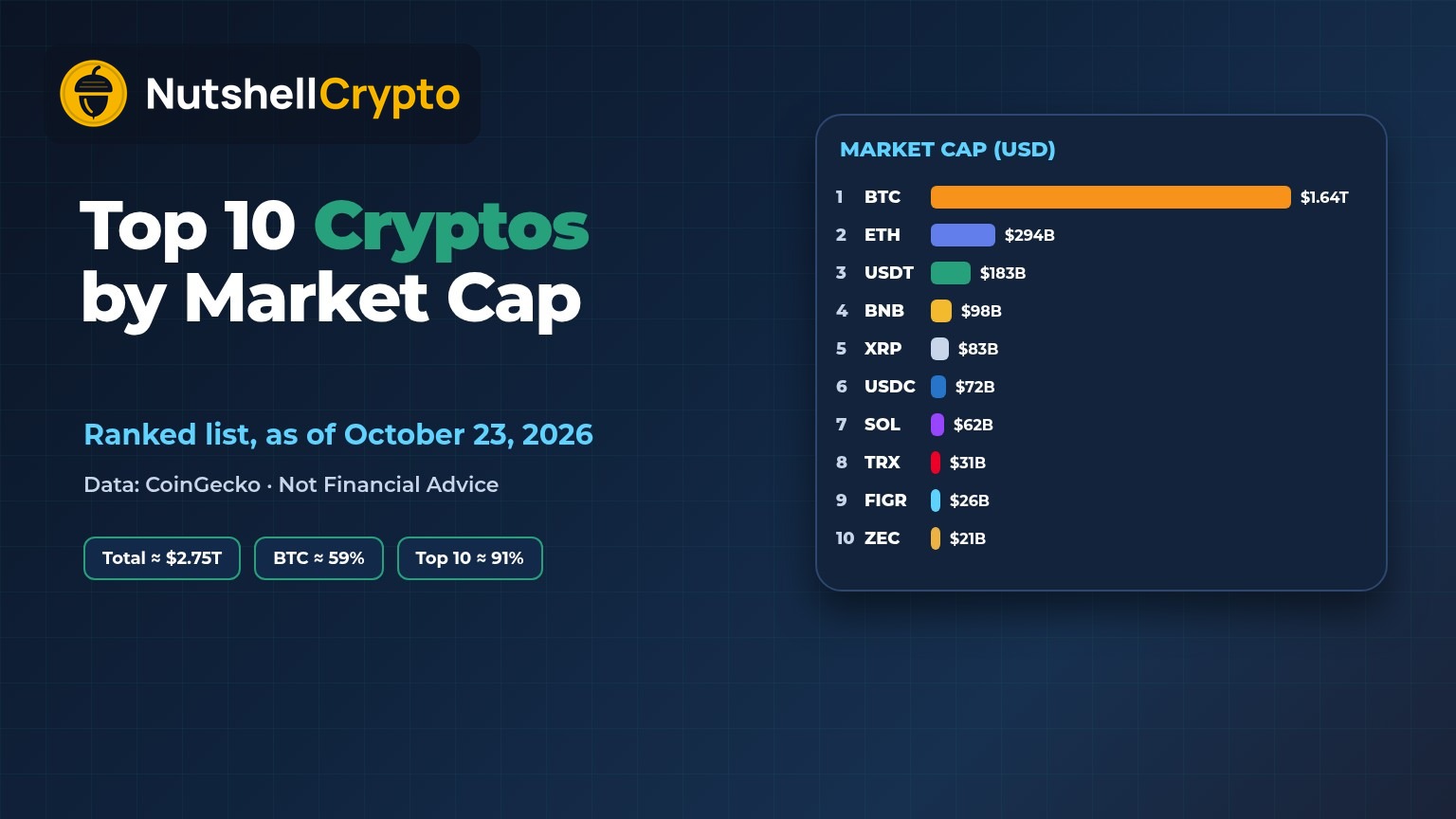
In a nutshell: As of October 23, 2026, the top 10 cryptocurrencies by market cap on CoinGecko are Bitcoin, Ethereum, Tether (USDT), BNB, XRP, USDC, Solana, TRON, Figure Heloc and Zcash. Bitcoin alone is worth about $1.64 trillion, close to 60% of the whole crypto market, and the top 10 together hold about 91% of the market’s roughly $2.75 trillion value. Market cap shows size, not quality or safety, so this list is not a buying guide.
Last updated: October 23, 2026. Data checked on CoinGecko at 10:31 PM PKT (5:31 PM UTC). We refresh this list monthly.
Market cap is the quickest way to see which cryptocurrencies are the biggest right now. This list ranks the top 10 cryptocurrencies by market cap, with each coin’s price, size and a plain-English line on what it actually does, plus a link to our deeper guide where we have one.
The ranking uses one source, CoinGecko, checked at a single moment, and we compare it with CoinMarketCap below. Prices move every minute, so treat the numbers as a snapshot. This article is educational only and is not financial advice.
Table of contents
Top 10 Cryptocurrencies by Market Cap
As of October 23, 2026, 10:31 PM PKT. Market caps and prices from CoinGecko, rounded. Share is each coin’s slice of the total crypto market of about $2.75 trillion.
| Rank | Coin | Market cap | Price | Share of market | What it is |
|---|---|---|---|---|---|
| 1 | Bitcoin (BTC) | $1.64 trillion | $81,546 | 59.4% | Digital money with a fixed supply |
| 2 | Ethereum (ETH) | $293.8 billion | $2,405 | 10.6% | Smart contract blockchain |
| 3 | Tether (USDT) | $182.6 billion | $0.9991 | 6.6% | US dollar stablecoin |
| 4 | BNB (BNB) | $98.0 billion | $745.39 | 3.6% | Token of BNB Chain and Binance |
| 5 | XRP (XRP) | $82.6 billion | $1.31 | 3.0% | Payments token of the XRP Ledger |
| 6 | USDC (USDC) | $71.8 billion | $0.9996 | 2.6% | US dollar stablecoin |
| 7 | Solana (SOL) | $61.6 billion | $104.44 | 2.2% | Fast smart contract blockchain |
| 8 | TRON (TRX) | $31.3 billion | $0.3294 | 1.1% | Blockchain used heavily for USDT transfers |
| 9 | Figure Heloc (FIGR_HELOC) | $26.0 billion | $1.02 | 0.9% | Tokenized home equity loans |
| 10 | Zcash (ZEC) | $21.2 billion | $1,247.37 | 0.8% | Privacy-focused digital money |
Just outside the top 10 on CoinGecko were Hyperliquid (HYPE) at about $17.4 billion and Dogecoin (DOGE) at about $12.5 billion. Together, the top 10 add up to about $2.51 trillion, or roughly 91% of all crypto market value.
What Market Cap Means
Market cap = current price × circulating supply. Circulating supply is the number of coins that are out in the market now, not coins that are locked up or not yet created.
That is why a coin’s price alone tells you little about its size. Zcash costs over $1,200 per coin but has only about 17 million coins in circulation, so its market cap is smaller than TRON’s, which costs about 33 cents but has roughly 95 billion coins. Bitcoin’s share of the total is its own tracked number, called Bitcoin dominance.
The Top 10, One by One
1. Bitcoin (BTC): about $1.64 trillion
Bitcoin is the first cryptocurrency. Its network started in January 2009, and the software caps the supply at 21 million coins, per Bitcoin.org. About 20.1 million are already in circulation. People mainly use it as a store of value and to send value without a bank in the middle. New to it? Read our beginner guide to what Bitcoin is and how it works.
2. Ethereum (ETH): about $293.8 billion
Ethereum launched in 2015 and is a blockchain that runs smart contracts: programs that power DeFi apps, NFTs and many stablecoins. It switched to proof of stake in 2022, per ethereum.org. ETH pays the network’s fees. Our guide explains what Ethereum is and how ETH is used.
3. Tether (USDT): about $182.6 billion
USDT is a stablecoin designed to stay at $1. It launched in 2014, is issued by Tether, and the company publishes reserve reports on its transparency page. It is the largest stablecoin and is used mostly for trading and moving dollars across borders. See how it compares in our USDT vs USDC comparison.
4. BNB (BNB): about $98.0 billion
BNB started in 2017 as the token of the Binance exchange. Today it pays transaction fees on BNB Chain, a smart contract network, and gives holders fee discounts on Binance, per BNB Chain. Its value is closely tied to the Binance ecosystem.
5. XRP (XRP): about $82.6 billion
XRP is the native token of the XRP Ledger, a payments-focused blockchain that went live in 2012, per XRPL.org. Ripple, a US company, uses it in cross-border payment products. Read our guide to what XRP is and how Ripple uses it.
6. USDC (USDC): about $71.8 billion
USDC is the second-largest stablecoin. Circle launched it in 2018 and says it is backed by cash and short-term US Treasuries, per Circle. Two stablecoins in the top 10 show how much of crypto activity runs on digital dollars. Our list of the largest stablecoins by market cap covers the rest.
7. Solana (SOL): about $61.6 billion
Solana is a smart contract blockchain built for speed and low fees. Its mainnet beta launched in 2020, per Solana, and it is popular for trading apps, payments and memecoins. SOL pays fees and is staked to secure the network. For how it stacks up, see Solana vs Ethereum.
8. TRON (TRX): about $31.3 billion
TRON is a smart contract blockchain founded by Justin Sun; CoinGecko lists its start as 2017. It is one of the busiest networks for sending USDT because transfers are cheap, per TRON. TRX is used to pay for and stake on the network.
9. Figure Heloc (FIGR_HELOC): about $26.0 billion
This one is not a typical cryptocurrency. It represents home equity lines of credit (HELOCs), a type of loan, that the US lender Figure records on its Provenance blockchain. CoinGecko classes it as a tokenized real-world asset (RWA) and private credit. It is mainly for institutions, its price sits near $1, and CoinMarketCap does not show it in its top 10.
10. Zcash (ZEC): about $21.2 billion
Zcash launched in 2016 as a privacy coin. Like Bitcoin it has a 21 million coin limit, but it adds optional “shielded” transactions that hide the sender, receiver and amount, per Z.cash. Its price has swung hard in 2026, as our report on why Zcash dropped in October shows.
Why CoinGecko and CoinMarketCap Rankings Differ
The two biggest data sites mostly agree, but not on every spot. At about the same time, CoinMarketCap showed the same top 8 in the same order, then Zcash at #9 and Hyperliquid (HYPE) at #10 with about $19.9 billion. Figure Heloc did not appear in CoinMarketCap’s top 10.
Differences like this come from three things:
- Which assets are counted. Each site decides whether tokenized loans, wrapped coins or staked tokens belong in the main ranking.
- Circulating supply. Sites can count unlocked or treasury coins differently. For Hyperliquid, CoinGecko used about 222 million HYPE and CoinMarketCap about 254 million.
- Timing and price sources. Each site averages prices from its own list of exchanges.
Hyperliquid, by the way, is a decentralized exchange best known for perpetual futures, and HYPE is its token.
What Market Cap Does Not Tell You
- It is not how much money went in. A coin’s market cap can rise far more than the cash that bought it, because the latest price is applied to every coin.
- It ignores future supply. Coins that will unlock later are not in today’s number. “Fully diluted” value shows what the cap would be with every coin out.
- Liquidity matters too. A big cap does not mean you can sell easily. Check real trading volume, and be careful with exchanges that show inflated numbers, as explained in our guide to wash trading and fake crypto volume.
- Rank is not safety. Large coins can still fall fast, stablecoins can lose their peg, and rankings change. Past coins in the top 10 have dropped out of it.
FAQ
What is the biggest cryptocurrency by market cap?
Bitcoin, at about $1.64 trillion on October 23, 2026, per CoinGecko. That is roughly 59% of the total crypto market.
How many cryptocurrencies are worth over $100 billion?
Three on that date: Bitcoin, Ethereum and Tether. BNB was just under, at about $98 billion.
Why are stablecoins in the top 10?
Their market cap equals roughly the number of tokens issued, since each is worth about $1. USDT and USDC are huge because traders, exchanges and apps use them as digital dollars.
How often does this ranking change?
Prices change every second, so close spots like #9 and #10 can swap within a day. We update this list monthly with a new “as of” date.
Disclaimer: This article is for informational and educational purposes only. It is not financial, investment, legal or tax advice. Crypto prices and market caps are volatile and can change quickly. Always do your own research.