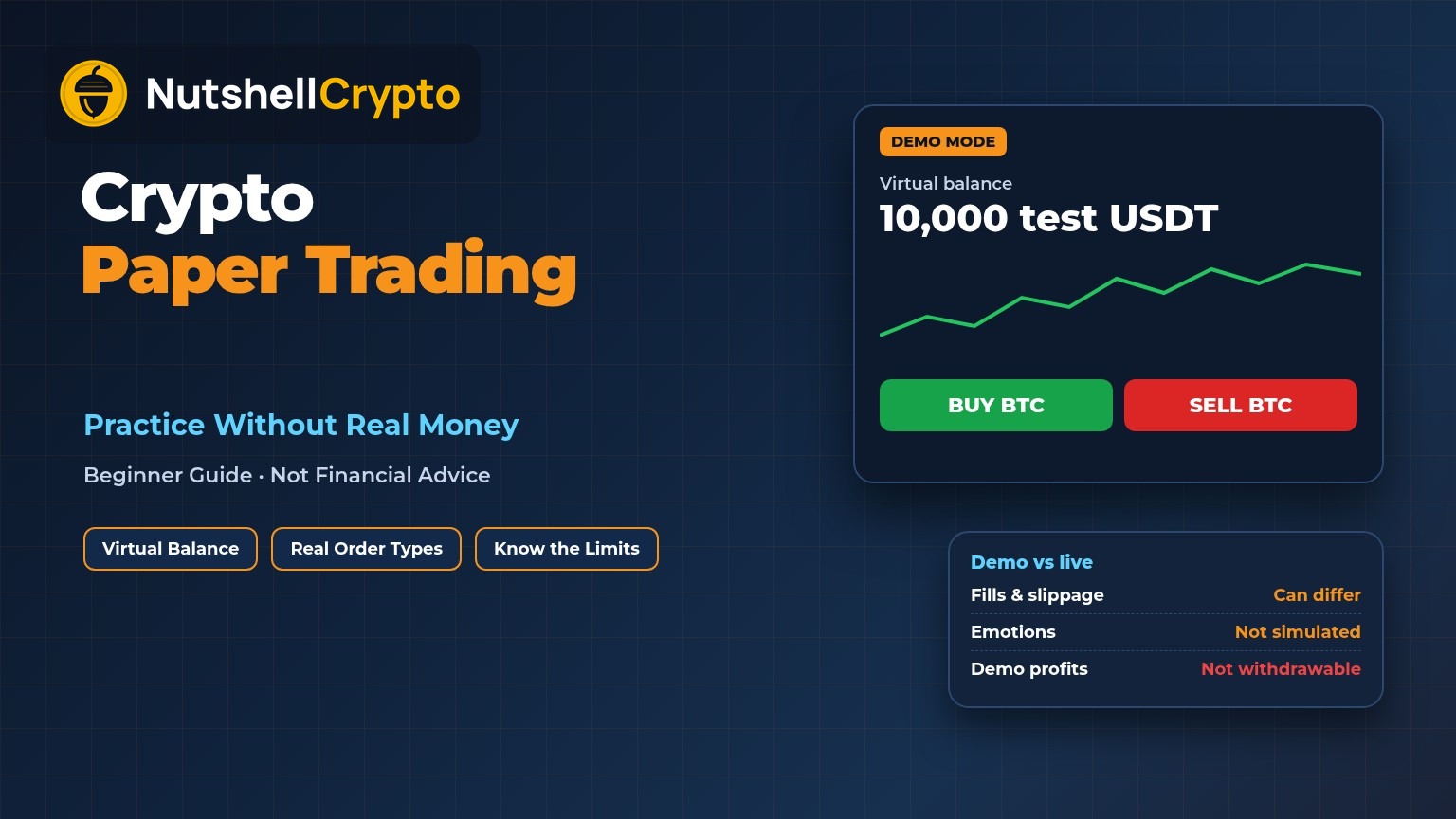
In a nutshell: Crypto paper trading means practicing crypto trades with virtual money instead of real funds. Tools like TradingView’s Paper Trading and the demo modes on Binance and OKX let you place buy and sell orders against live or near-live prices, track a fake balance, and learn order types without risking cash. It is great for learning how an exchange works and testing a plan. It is a poor predictor of real results, because demo fills, slippage and your own emotions are different when real money is on the line. Demo profits can’t be withdrawn, and any “trial” that later asks you to deposit to unlock gains is a red flag. Educational only; not financial advice.
Last updated: October 24, 2026.
Most people learn to trade crypto the expensive way: they buy, panic, sell, and only later understand what a limit order or a stop-loss would have done. Paper trading flips that order. You make the beginner mistakes with pretend money first.
This guide explains what crypto paper trading is, where you can do it, how to set up a practice routine that actually teaches you something, and the limits you should know before you trust any demo result.
Table of contents
What Is Crypto Paper Trading?
The name comes from the old habit of writing trades down on paper to see how they would have worked out. Today it means using a trading simulator. Investopedia describes paper trading as a way to test a strategy before using it in a live account, so beginners can learn “without financial risk.”
In crypto, you’ll also see it called demo trading or practice trading. OKX’s help center puts it simply: demo trading, “commonly referred to as crypto paper trading,” is a simulated environment where you practice trading “without the involvement of real money.”
A typical paper trading account gives you:
- A virtual balance (for example, test USDT or test dollars) that you can usually reset.
- The same order screens as the real platform: market, limit and stop orders, and sometimes futures with leverage.
- Prices that follow, or roughly follow, the live market.
- A record of your trades and profit or loss, so you can review what worked.
What you don’t get: real coins, real profits you can withdraw, or the stress of watching your own money move.
Where to Paper Trade Crypto
Here are the main options we checked on October 24, 2026. Features change often, so confirm on each platform’s own pages before you start.
| What it covers | Account needed | Worth knowing | |
|---|---|---|---|
| TradingView Paper Trading | Crypto, stocks, forex, futures | TradingView account | Available globally; you trade from the charts |
| Binance Demo Trading | Spot and futures | Binance account, no KYC or deposit | Subject to region and IP checks |
| OKX Demo Trading | Spot, margin and futures | OKX account | Web only; demo markets can be thin |
| Kraken CLI paper mode | Spot and futures (simulated) | None for paper mode | Command-line tool, more for developers |
| A spreadsheet | Anything | None | Free and private, but you log prices yourself |
TradingView Paper Trading
TradingView’s help page on Paper Trading says it lets you “practice buying and selling assets using simulated money,” with “no deposits and no real money involved.” It says Paper Trading “is available globally for all users”: from Supercharts you click Trade, pick Paper Trading, and connect. You can place orders from an order ticket, a depth-of-market window, or straight from the chart. Because it isn’t tied to one exchange, it’s a good choice if you’re in the US or Canada and just want to learn the mechanics.
Binance Demo Trading
Binance’s announcement of Demo Trading says it is a simulated environment for both spot and futures, using virtual funds, at demo.binance.com. Binance says you don’t need to complete identity checks or deposit funds, and you can reset your virtual balances “at any time.” It also says access “is subject to IP address validation and other eligibility requirements,” and users in restricted regions may not be able to use it. Check whether Binance serves your country before you sign up.
Binance’s own developer docs for Demo Mode add a warning worth remembering: “Realistic market data is not equal to ‘real’ market data. Do not assume trading strategies that work in Demo Mode will work in the live exchange.”
OKX Demo Trading
OKX’s help article What’s demo trading and how do I use it? (updated October 15, 2026) says demo trading is available on the web: hover over Trade and pick Demo trading. You can simulate spot and margin trading, and practice futures contracts. Demo balances and any profit or loss are virtual, have “no cash value,” and “can’t be withdrawn.” You can reset a demo asset back to its starting amount once you have no open demo positions or pending orders.
OKX is also unusually honest about a weakness: demo markets “usually see far less trading activity than live markets,” so a demo chart can look almost flat and move differently from the live chart. A thin demo order book also changes how your orders fill. Not every OKX product is offered in every country, so check what applies to your account.
Kraken’s command-line paper mode
Kraken’s developer docs for kraken-cli describe a built-in paper trading engine that “runs against live prices with no authentication required,” for both spot and futures. It’s a command-line tool, so it suits people testing scripts or automated trading strategies more than first-time traders.
The spreadsheet method
The original paper trading still works. Write down the date, coin, entry price, size, your reason for the trade, your planned exit and your stop. Check the price later and record what happened. It’s slower, but it forces you to explain every trade, which is often the most useful habit of all.
How to Paper Trade Crypto: Step by Step
- Pick one platform. Choose the one closest to where you might trade for real, so the screens feel familiar later. If you’re not sure, TradingView is exchange-neutral.
- Set a realistic balance. Investopedia suggests starting with the amount you’d actually use: if you plan to trade with $1,000, practice with $1,000, not $100,000. Some demos give you a fixed starting balance; in that case, only trade a slice of it.
- Write a simple plan before each trade. Which coin, why, where you’ll take profit, and where you’ll admit you’re wrong (your stop-loss). Keep the position size the same as you would with real money.
- Place the order and watch the fill. Try a market order and a limit order and compare the price you got with the price you expected. Our guide to spot trading explains the main order types.
- Include fees. Not every demo charges realistic fees. Add them yourself using the platform’s real fee schedule; our crypto exchange fees guide shows how maker and taker fees work.
- Keep a trade journal. Record every trade, including the boring and losing ones. Review weekly: Did you follow your plan? Where did you break your own rules?
- Run it long enough. A few lucky trades prove nothing. Aim for dozens of trades across calm and volatile weeks before drawing conclusions.
What to Practice (and What Not to)
Paper trading is best at teaching mechanics and habits:
- Order types: limit vs market, stop-loss and take-profit orders. Investopedia notes simulators help you get familiar with stop-loss, limit and market orders.
- Reading charts: spotting trends, support and resistance and volume. See our guide on how to read crypto charts.
- Position sizing: deciding how much to risk per trade, and sticking to it.
- Using alerts: setting price alerts instead of staring at a screen all day.
- How futures behave: if you’re curious about crypto futures, a demo is the safest place to see how leverage and liquidation work. Seeing a demo position get liquidated is a cheap lesson.
What not to do: don’t use the fake balance to make giant, all-in bets you’d never make with real money. Investopedia warns that paper trading “may provide a false sense of security” and distorted returns. Huge demo wins from reckless sizing teach the wrong lesson.
Why Paper Trading Results Can Mislead You
A profitable demo account is not proof you’ll make money for real. The main gaps:
- Emotions: Investopedia says paper trading “may not represent the true emotions” of real market conditions. Holding through a 10% drop is easy with fake money and much harder with your savings.
- Fills and liquidity: demo order books may be thinner or different from live ones. OKX says a large demo market order can end up cancelled instead of filled, and Binance’s Demo Mode docs warn that “realistic” data is not “real” data.
- Slippage: in fast markets you often get a worse price than you clicked. Investopedia notes that trades in highly volatile markets tend to face higher slippage because of wider spreads. Some simulators fill you at perfect prices.
- Fees and funding: if the demo ignores trading fees or futures funding rates, your results will look better than reality.
- Too few trades: a short winning streak is often luck, not skill.
Moving From Paper to Real Money
There’s no magic number of demo trades. A sensible approach:
- Only move on once you’ve followed your own rules consistently for a while, not just made a profit.
- Start live with a very small amount you can afford to lose, and keep the same plan and position sizing you practiced.
- Expect results to be worse than in the demo, at least at first, because of fees, slippage and nerves.
- Many beginners do better skipping active trading entirely and buying on a schedule instead. See our dollar-cost averaging guide.
- Avoid leverage until you fully understand it. Our margin trading guide explains why losses can exceed what you expect.
When you open a real exchange account, expect identity checks; our guide to KYC in crypto explains why. Real trades can also have tax consequences in the US and Canada, while demo trades with virtual funds don’t involve real assets.
Fake “Demo” and “Trial” Scams
Scammers love the idea of practice trading, because fake profits are easy to show on a screen. The US Commodity Futures Trading Commission describes a common pattern on its Digital Asset Frauds page: you sign up, get a welcome email offering “personalized help during your free trial,” and are nudged into a small payment. The CFTC says that in these platform frauds, “no trading actually takes place.” If you appear to make money, you’re pushed to add more, and when you try to withdraw, you’re told to pay fees or fake taxes first.
Red flags to watch for:
- A “demo” or “trial” that asks you to deposit real crypto to “unlock” or withdraw your profits.
- Someone you met online or in a messaging app guiding your trades.
- Guaranteed or “risk-free” returns.
- Being asked to pay a fee or tax before you can withdraw. The CFTC’s advice: “Never pay more money to withdraw from your own account.”
Legitimate demo modes, like the ones above, say plainly that demo balances are virtual and can’t be withdrawn. Also be wary of paid “signal” groups that show off demo screenshots as proof; our guide to crypto signals covers how those schemes work.
FAQ
Is crypto paper trading free?
The options covered here (TradingView Paper Trading, Binance Demo Trading, OKX Demo Trading and Kraken’s CLI paper mode) don’t charge for paper trading, based on their own pages as of October 24, 2026. Some platforms may limit features or require an account.
Can I withdraw profits from a demo account?
No. OKX states that demo balances and any profit or loss have no cash value and can’t be withdrawn. If a platform says you can withdraw “demo” profits after a deposit, treat it as a likely scam.
How long should I paper trade before using real money?
There’s no fixed rule. A better test than time is consistency: can you follow your plan, sizing and stop-losses across many trades and different market conditions?
Is paper trading good for learning futures?
It’s the safest way to see how leverage, margin and liquidation work. Just remember that demo order books and funding may differ from live markets, and leveraged trading carries a high risk of fast losses.
This article is for education only and is not financial, legal or tax advice. Crypto prices are volatile, and practice results do not predict real results. NutshellCrypto is not affiliated with any platform mentioned.
Sources
- Investopedia: How Paper Trading Works
- TradingView: Paper trading main functionality
- Binance: Learn to Trade Crypto With Zero Risk Using Binance Demo Trading
- Binance Developers: Demo Mode for Spot Trading
- OKX: What’s demo trading and how do I use it? (updated October 15, 2026)
- Kraken Developers: kraken-cli
- CFTC: Digital Asset Frauds
- CFTC: Beware of Fee Scams