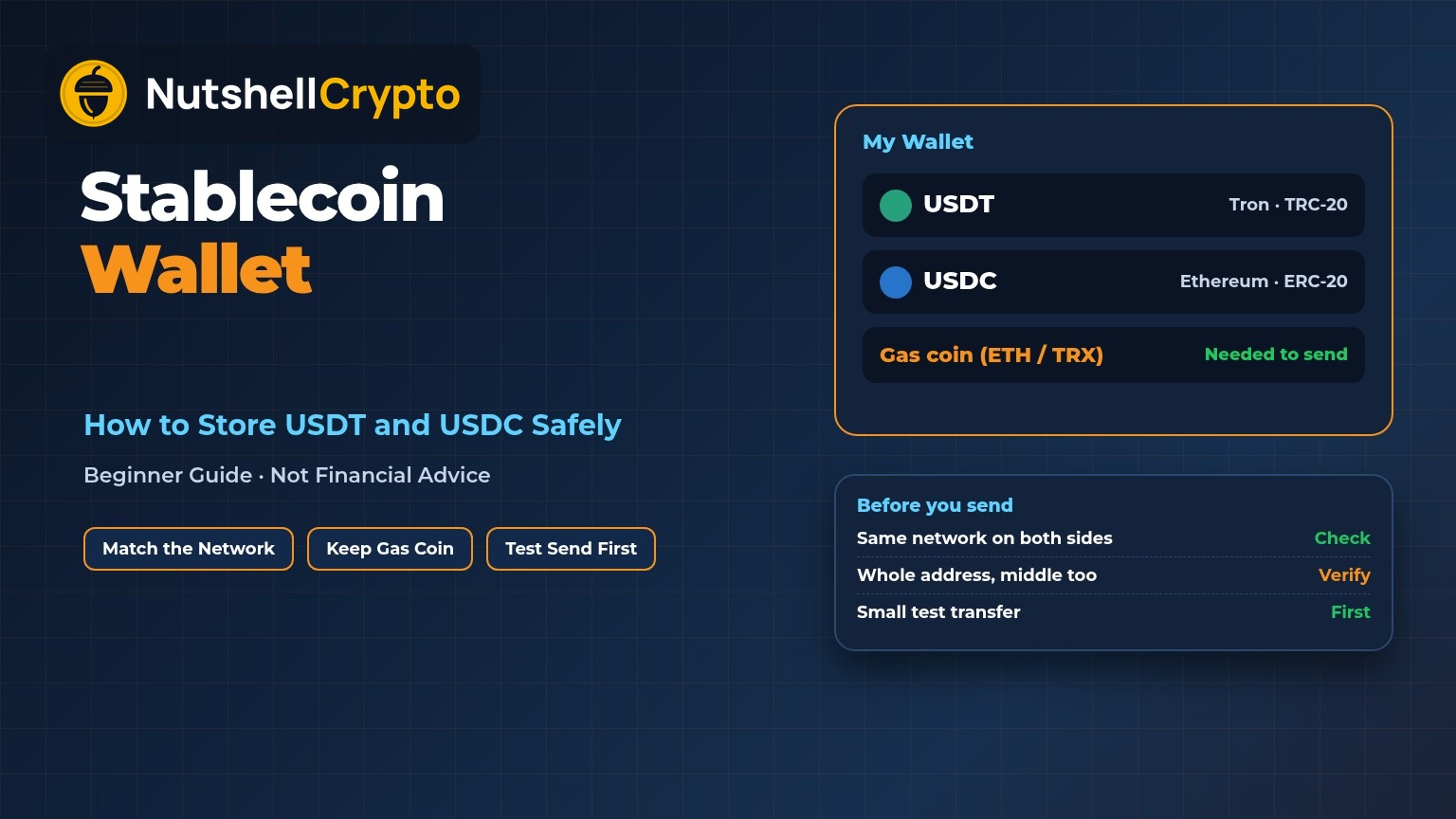
In a nutshell: A stablecoin wallet is any crypto wallet that can hold stablecoins like USDT or USDC. There is no special “stablecoin wallet” technology: stablecoins are tokens that live on blockchains such as Ethereum, Tron and Solana, so the wallet just has to support the right blockchain. You can keep stablecoins on an exchange (custodial), in a phone or browser wallet (hot wallet), or on a hardware wallet (cold wallet). The two mistakes that cost people the most are sending on the wrong network and not holding a little of the network’s own coin to pay fees. Educational only; not financial advice.
Last updated: October 25, 2026.
Stablecoins are meant to stay at $1, which makes them feel like cash. But once you move them off an exchange, you are dealing with a blockchain, a wallet address and network fees, just like with any other crypto. Getting one detail wrong can mean a stuck or lost transfer.
This guide explains what a stablecoin wallet is, which wallet types can hold USDT and USDC, how networks and fees work, and the safety checks to run before you send or store stablecoins. If you are new to stablecoins, start with what stablecoins are.
Table of contents
What Is a Stablecoin Wallet?
A stablecoin wallet is a crypto wallet you use to receive, hold and send stablecoins. The coins themselves never sit “inside” the wallet. They are recorded on a blockchain, and the wallet holds the keys that let you move them. Our crypto wallet guide explains this in more detail.
The two biggest dollar stablecoins, Tether’s USDT and Circle’s USDC, are issued on many blockchains at once. Circle says USDC “is a dollar-backed stablecoin that runs on multiple blockchains” and lists its contract on networks such as Ethereum, Solana, Base, Arbitrum, Polygon, Avalanche and Stellar on its USDC contract addresses page. Tether lists USDT on Ethereum, Tron, Solana, Avalanche, TON, Aptos and others on its supported protocols page, and says 1 USDT on one blockchain equals 1 USDT on another.
So when people ask for a “stablecoin wallet,” what they really need is a wallet that supports the blockchain their stablecoin is on. For a side-by-side look at the two coins, see USDT vs USDC.
Types of Stablecoin Wallets
You have three main choices. They differ in who holds the keys and how exposed the keys are to the internet.
| Wallet type | Who holds the keys | Good for | Main risk |
|---|---|---|---|
| Exchange account (custodial) | The exchange | Small amounts you trade or cash out often | The exchange freezes withdrawals, gets hacked or fails |
| Hot wallet (phone or browser app) | You | Payments, DeFi apps, everyday transfers | Phishing, malware, bad token approvals |
| Cold wallet (hardware device) | You, offline | Larger balances you hold for a long time | Losing the seed phrase, sending on the wrong network |
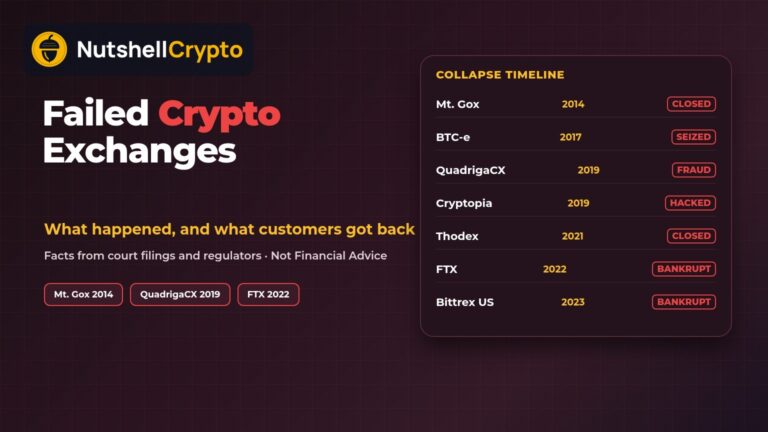
Custodial: Leaving USDT or USDC on an exchange is the easiest option, but you rely on the company. Our custodial wallet guide and our list of failed crypto exchanges show what can go wrong.
Hot and cold self-custody: With a self-custody wallet you hold the keys and the seed phrase. Nobody can lock you out, but nobody can recover your funds if you lose the phrase. See hot wallet vs cold wallet and self-custody for the trade-offs.
Networks: The Part Most People Get Wrong
Because USDT and USDC live on many blockchains, every deposit and withdrawal asks you to pick a network. You will often see labels like these:
- ERC-20: the token standard on Ethereum. Ethereum.org explains ERC-20 as the standard for fungible tokens on its ERC-20 page. Many networks built on Ethereum technology, like Arbitrum, Base and Polygon, use the same style of address starting with 0x.
- TRC-20: tokens on the Tron blockchain. Addresses usually start with a capital T.
- SPL / Solana: tokens on Solana, with addresses that look like a long string of letters and numbers.
The network matters because the same coin is held in very different amounts on each chain. DefiLlama’s stablecoin dashboard showed about $182.4 billion of USDT in circulation when we checked on October 25, 2026 (8:44 PM PKT), with about $92.5 billion on Tron and $72.6 billion on Ethereum. USDC was at about $71.7 billion, with about $44.3 billion on Ethereum and smaller amounts on Hyperliquid, Solana, Base and Arbitrum.
The rule: the network you pick when sending must match the network the receiving wallet or exchange supports for that coin. An ERC-20 address and an Arbitrum address can look identical (both start with 0x), but USDC sent on Arbitrum only shows up if the receiver supports Arbitrum. Some exchanges can recover a wrong-network deposit for a fee, and some cannot. With a self-custody wallet you can often still reach the funds by adding the right network, but don’t count on it. Send a small test amount first.
Also watch for bridged versions. Circle notes on its contract page that some networks have a separate bridged USDC, labeled USDC.e, that Circle does not issue. A bridged token is not always accepted where native USDC is.
Why You Need a Little ETH, TRX or SOL
Stablecoins don’t pay their own network fees. Each blockchain charges fees in its own coin:
- On Ethereum, “gas fees have to be paid in Ethereum’s native currency, ether (ETH),” according to ethereum.org’s gas page. Our Ethereum gas fees guide explains why fees change.
- On Tron, smart contract transactions like a USDT transfer use “Energy,” which you get by staking TRX or pay for by burning TRX, per the Tron resource model docs.
- On Solana, fees are paid in lamports, tiny units of SOL, per Solana’s fee docs.
If your wallet holds 500 USDT on Ethereum but zero ETH, you can’t send the USDT anywhere. This is the most common “my stablecoins are stuck” problem. Keep a small amount of the network’s coin in the same wallet. Layer 2 networks such as Arbitrum and Base usually cost much less per transfer than Ethereum mainnet; see our list of Ethereum layer 2 networks.
How to Set Up a Stablecoin Wallet
- Decide where you’ll use the stablecoins. Payments and DeFi point to a hot wallet; long-term savings point to a cold wallet; frequent trading may mean keeping some on an exchange.
- Pick the network first. Check which networks your exchange supports for withdrawals of that coin, and which the wallet supports. Choose one both support.
- Install the wallet from the official site or app store, and write the seed phrase on paper. Never type it into a website or share it with “support.”
- Add the network and the token. Some wallets hide tokens until you add them. If you add a token by contract address, copy it from the issuer’s official page (Circle or Tether), never from a social media post.
- Fund the wallet with a little gas coin (ETH, TRX, SOL or the network’s coin).
- Send a small test amount of the stablecoin, confirm it arrives, then send the rest. Our guide to crypto wallet addresses shows how to check an address, and how to transfer crypto to a cold wallet walks through a full transfer.
Can Stablecoins in My Wallet Be Frozen?
Yes, and this is a real difference from bitcoin. Even in a self-custody wallet, the stablecoin issuer controls the token’s smart contract.
Circle’s USDC terms say Circle reserves the right to “block” certain USDC addresses it determines may be associated with illegal activity, and that if you send USDC to or receive it from a Blocked Address, Circle may freeze that USDC. Tether’s terms of service say Tether may “freeze any Tether Tokens held by you” when required by law or when it decides it is prudent, and list blacklisting addresses as a possible sanction.
For an ordinary user this rarely matters, but it means a hardware wallet protects you from hackers, not from the issuer. It is also one reason not to accept stablecoins from unknown sources. For the other risks, like a coin losing its $1 peg, read are stablecoins safe?
Stablecoin Wallet Safety Checklist
- Check the whole address, not just the ends. MetaMask describes address poisoning as a scam where attackers “send you a tiny transaction from an address that closely resembles one you’ve used before,” hoping you copy it by mistake. Its help page says to check the middle characters too. Stablecoin users are common targets because balances are easy to read in dollars.
- Don’t copy addresses from your transaction history. Use a saved address book entry or the original source.
- Be careful with token approvals. When you use a DeFi app, you often give it permission to spend your USDC or USDT. Revoke.cash explains that token approvals give “permission to a smart contract to spend your tokens on your behalf” in its approvals guide. Revoke approvals you no longer use.
- Ignore “free USDT” tokens and airdrops you didn’t expect. Fake tokens can copy the name and logo.
- Use a hardware wallet or a multisig wallet for larger balances.
- Remember the issuer can freeze tokens, and a stablecoin can depeg. Don’t treat any one stablecoin as a bank account.
How to Choose a Stablecoin Wallet
Instead of looking for a “best” wallet, check these points against your own needs:
- Network support: Does it support the exact networks you use, such as Ethereum, Tron, Solana or Base?
- Custody: Do you hold the seed phrase, or does a company hold your keys?
- Hardware option: Can it connect to a hardware wallet for larger amounts?
- Warnings: Does it warn about look-alike addresses, new addresses or risky approvals?
- Open code and track record: How long has it been around, and is the code public?
- Fees: Does the wallet add its own swap or send fees on top of network fees?
Many people use two: a hot wallet for spending and a cold wallet for savings, with a small balance left on an exchange for cashing out.
FAQ
Is there a special wallet just for stablecoins?
No. Any wallet that supports the stablecoin’s blockchain can hold it. Some apps market themselves as stablecoin wallets, but under the hood they hold the same ERC-20, TRC-20 or Solana tokens as other wallets.
Can I store USDT and USDC in the same wallet?
Yes, as long as the wallet supports the networks each one is on. Both have the same type of 0x address on Ethereum, for example.
What happens if I send USDT on the wrong network?
It depends on the receiver. If you sent to your own self-custody wallet, you can often reach the funds by adding that network in the wallet. If you sent to an exchange that doesn’t support that network, recovery depends on the exchange and may not be possible. Always send a test amount first.
Do I earn interest by holding stablecoins in my wallet?
No. Holding USDT or USDC in a wallet earns nothing by itself. Platforms that offer yield on stablecoins do it by lending or using your coins, which adds risk.
Are stablecoins in a wallet insured?
Generally no. The FDIC’s crypto fact sheet says FDIC deposit insurance “does not apply to financial products such as stocks, bonds, money market mutual funds, other types of securities, commodities, or crypto assets,” and does not protect against the failure of non-bank crypto companies. Any protection at an exchange depends on the company and its terms, so read them before you deposit.
This article is for education only and is not financial advice. Wallet features and network support change, so check the official pages of the wallet and the stablecoin issuer before you move funds.