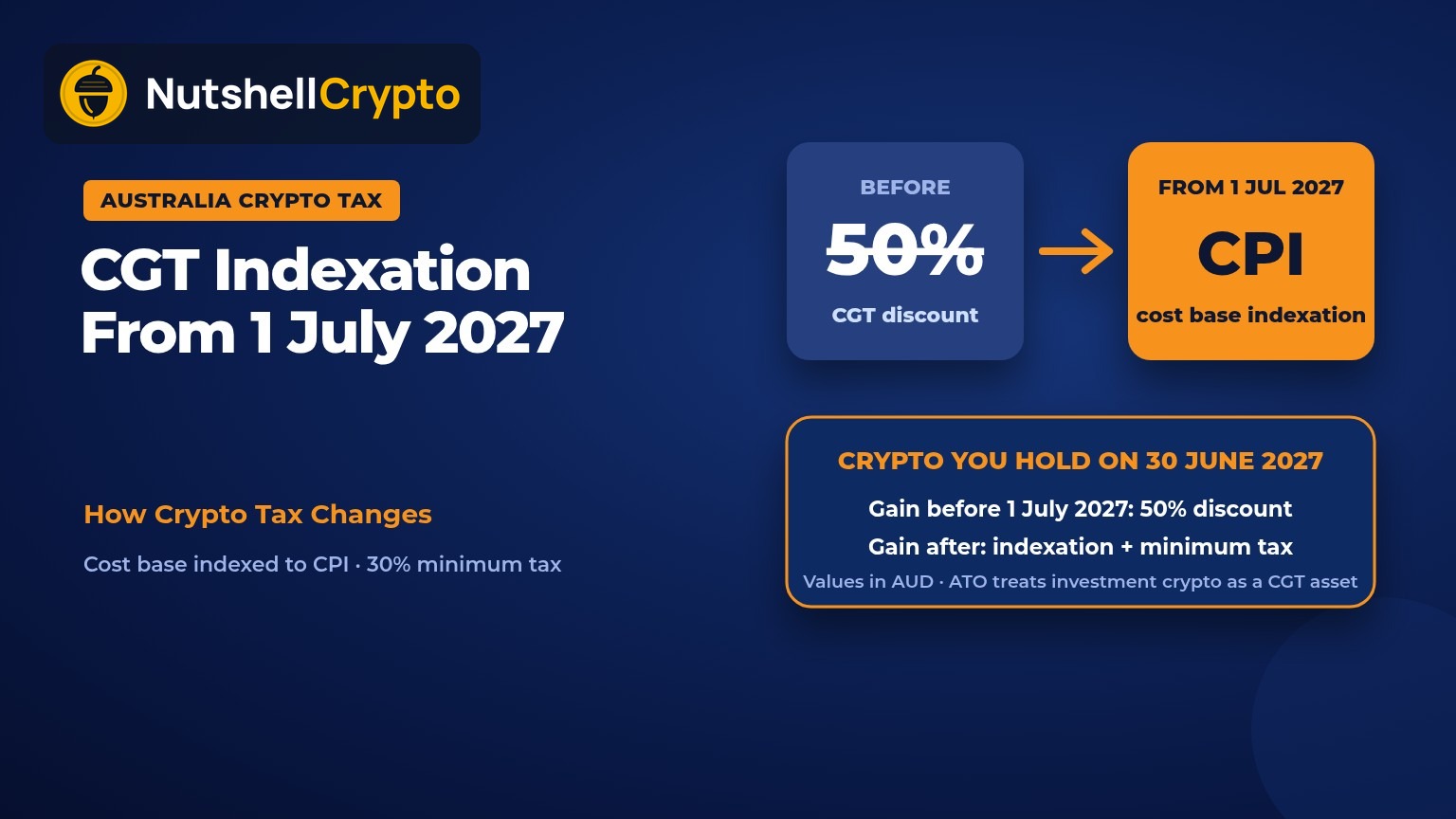
In a nutshell: Australia has legislated the end of the 50% CGT discount for gains that build up from 1 July 2027. For Australian resident individuals and trusts, crypto held for at least 12 months will instead get CPI indexation of its cost base, so only the after-inflation gain is taxed, and individuals may face a 30% minimum tax on those newer gains. Gains built up before 1 July 2027 keep the old 50% discount: coins you hold on 30 June 2027 are treated as sold just before 1 July 2027 and bought back on that date, but you don’t report that split until you actually dispose of them. Companies, super funds and foreign residents sit outside the new indexation rules. Educational only; not tax advice.
Last updated: October 31, 2026.
Since 21 September 1999, Australian investors who held an asset for at least 12 months could cut their taxable capital gain in half. That includes crypto, which the Australian Taxation Office (ATO) treats as a capital gains tax (CGT) asset when you hold it as an investment. That rule is now on a countdown. The Treasury Laws Amendment (Tax Reform No. 1) Act 2026 swaps the flat 50% discount for an older idea, indexing your cost base to inflation, and adds a minimum tax on capital gains.
This guide covers what the law says, who it applies to, how a coin you already own gets split into “before” and “after” 1 July 2027, how the 30% minimum tax works, and what crypto holders can do now. For the basics of how crypto disposals are taxed, start with our crypto taxes guide.
Table of contents
What the New Law Is
The changes come from the Treasury Laws Amendment (Tax Reform No. 1) Act 2026, Act No. 49 of 2026. The bill was introduced in the House of Representatives on 28 May 2026, passed both Houses on 25 June 2026 with Senate amendments, and received Royal Assent on 26 June 2026 (Parliament of Australia). It was the first tranche of the tax reforms announced in the 2026–27 Budget on 12 May 2026.
The CGT part of the Act (Schedule 1) formally started on 1 July 2026, but its rules bite on CGT events from 1 July 2027 (Federal Register of Legislation). The ATO says the 2027–28 tax return is the first one that could be affected, and only if you have a CGT event that year.
The Budget papers sum the CGT measure up in one line: the Government “will replace the 50 per cent Capital Gains Tax (CGT) discount with a discount based on inflation and introduce a minimum 30 per cent tax on gains from 1 July 2027”, and the reforms “will only apply to gains arising after 1 July 2027” (Budget 2026–27). The same Act also limits negative gearing on residential property to new builds, which matters for property investors but not for crypto.
What CGT Indexation Means
Under the current rules, an eligible individual works out the nominal gain (sale proceeds minus cost base) and, if the asset was held for at least 12 months, includes only half of it in assessable income.
Under indexation, you first increase your cost base in line with the consumer price index (CPI), then subtract that higher cost base from your proceeds. The ATO describes it as adjusting “an asset’s purchase price for inflation using the consumer price index (CPI) before calculating the capital gain.” The idea is that you are taxed only on the real, after-inflation gain, but that real gain is then taxed in full rather than halved.
A few details from the Act:
- 12-month rule. Indexation only applies if you acquired the asset at least 12 months before the CGT event, the same holding test as today’s discount (Act, item 17).
- Quarter by quarter. Costs are indexed from the quarter in which you incurred them, using CPI figures.
- Not every cost. Costs of ownership (the “third element” of the cost base) can’t be indexed.
- Gains only. Indexation can shrink a capital gain, but it is not used when working out a capital loss.
Australia has done this before. Between 1985 and September 1999, CGT was charged only on inflation-adjusted gains, before the 50% discount replaced indexation (Bills Digest).
Who the Changes Apply To
According to the Parliamentary Library’s Bills Digest, the new indexation regime applies to:
- Australian resident individuals;
- trusts, broadly to the extent gains flow to eligible Australian resident individuals; and
- individuals for their share of partnership gains.
The Digest says companies, complying superannuation entities, life insurance companies, foreign residents and temporary residents “are generally excluded from the new indexation regime” (Bills Digest). The Act’s residency test says that to index, an individual must be neither a foreign resident nor a temporary resident during the testing period.
The 50% discount keeps applying to gains that built up before 1 July 2027. There is also an option to keep the 50% discount for eligible new residential dwellings and affordable housing, but that doesn’t help crypto.
If you hold crypto through a self-managed super fund, the indexation and minimum-tax changes for individuals don’t apply in the same way. Super funds have their own CGT rules, so check those separately.
Why Crypto Is Caught
The reform doesn’t name crypto, and it doesn’t need to. The ATO says “the most common use of crypto is as an investment, in which case the crypto asset is a capital gains tax (CGT) asset” (ATO). The Budget measure applies to all CGT assets held by individuals, trusts and partnerships, so bitcoin, ether and other tokens you hold as an investment are inside it.
The disposals that trigger CGT stay the same. The ATO lists these as CGT events for crypto: selling it, gifting it, trading or swapping one crypto for another, converting it to Australian or foreign currency, and buying goods or services with it. Each token is a separate CGT asset, and values have to be converted to Australian dollars (ATO).
The narrow personal use asset exemption, for crypto kept or used mainly to buy items for personal use or consumption, still exists. It won’t cover coins you hold as an investment.
For a side-by-side with other countries, see our guides to crypto capital gains tax in the US and cryptocurrency tax in Canada, where only 50% of a capital gain is included in income.
Crypto You Hold on 30 June 2027
This is the part most existing holders need to understand. If you are an eligible individual and you hold a CGT asset through the end of 30 June 2027, the Act treats you as having sold it just before 1 July 2027 and bought it back on 1 July 2027, as long as you still hold it when a real disposal (a “realisation event”) happens on or after that date (Act, s 112-155). Trusts have a matching rule.
Your gain is effectively split into two parts:
- Before 1 July 2027: the gain from your original cost base up to the deemed sale price. The current rules apply, so the 50% discount is available if you meet the 12-month test.
- From 1 July 2027: the gain from the deemed reacquisition price up to what you eventually sell for. Indexation applies to this part, and the 30% minimum tax may apply.
The deemed sale price is the asset’s market value just before 1 July 2027, unless you choose an apportioning method the Minister sets by legislative instrument under s 112-185. The deemed sale doesn’t create a tax bill in 2027. Any gain or loss from it is disregarded and deferred until the income year when the real disposal happens, and you can wait until then to work it out.
The ATO says taxpayers don’t need a valuation on 30 June 2027 and shouldn’t obtain one before that date, because “a valuation can’t be forward-looking”. It also says the Government is still developing the apportionment method and the ATO will give more guidance once it is made (ATO). For a widely traded coin, the market value just before 1 July 2027 should be easier to evidence than for a house. Even so, keep a record of the AUD price you rely on and where it came from.
One detail helps recent buyers. The deemed sale and reacquisition are ignored for the 12-month rule (Act, s 114-10(9)). The ATO’s example: if you buy an asset less than 12 months before 1 July 2027 but hold it for at least 12 months in total, you can apply the CGT discount to the pre-1 July 2027 gain and indexation to the post-1 July 2027 gain.
Coins you buy on or after 1 July 2027 fall entirely under the new rules.
Worked Example in AUD (Illustrative)
All numbers below are made up to show the mechanics. They are not price forecasts, and the CPI figure is an assumption, not an official index.
Alex is an Australian resident individual. She buys 1 BTC for A$60,000 in August 2025 and sells it for A$140,000 in August 2029. Assume BTC’s market value just before 1 July 2027 was A$100,000, and that CPI rose a total of 6% between the September 2027 quarter and the sale quarter. Ignore fees.
| Step | Old rules (50% discount on whole gain) | New rules (split at 1 July 2027) |
|---|---|---|
| Pre-1 July 2027 gain | A$140,000 − A$60,000 = A$80,000 | A$100,000 − A$60,000 = A$40,000 |
| Post-1 July 2027 gain | A$140,000 − (A$100,000 × 1.06) = A$140,000 − A$106,000 = A$34,000 | |
| Discount or indexation | 50% discount: A$40,000 | Pre part halved: A$20,000. Post part already indexed: A$34,000 |
| Net capital gain added to income | A$40,000 | A$54,000 |
Both parts are reported in the 2029–30 income year, when Alex actually sells. In this example the new rules add A$14,000 to her taxable amount, because inflation was low compared with the coin’s price growth. Indexation removes the inflation part of the gain, while the old discount removed half of the whole gain. For a volatile asset that rises much faster than CPI, the old 50% discount is usually worth more. The more the gain is driven by inflation, the more indexation helps.
Alex may also have to pay the 30% minimum tax on the A$34,000 post-July-2027 part if her ordinary tax on it comes to less than 30%. See the next section.
The 30% Minimum Tax
New Division 119 of the Income Tax Assessment Act 1997 adds a minimum tax for Australian resident individuals. Its stated aim is to make sure, before offsets, “a rate of tax of 30%” applies to certain capital gains (Act, Division 119). In plain terms, the Act’s method statement works like this:
- Work out your “minimum tax capital gain” for the year (broadly, your covered capital gains left after capital losses, reduced by certain gift and conservation-covenant deductions) and multiply it by 30%.
- Work out how much of your normal income tax is due to those gains, by comparing your tax with and without them.
- If 30% of the gain is more than the tax the gain actually generated, you pay the difference as extra income tax.
The Bills Digest says the minimum tax applies only to gains accruing after 1 July 2027 and excludes the deferred pre-July-2027 gains from the deemed sale (Bills Digest). It doesn’t apply in a year when you receive certain payments the Minister prescribes, which the Government has said will include income support payments such as the Age Pension.
The people most likely to pay it are those on lower marginal rates in the year they sell. Examples include a retiree or student, or someone who takes a year off and sells a large crypto position then. The Government says the aim is to reduce the incentive to time disposals for low-income years. If you are already on a high marginal rate, the minimum tax may not change your bill. Your exact position depends on your other income, so model it with a tax agent.
Short-Term Trades and Capital Losses
Frequent crypto traders lose less from this change than long-term holders. Swaps, sells and coin-to-coin trades held for under 12 months never got the 50% discount, and they won’t get indexation either. Their whole nominal gain stays taxable, and from 1 July 2027 those gains count toward the minimum-tax calculation too.
Capital losses still offset capital gains, and you still can’t deduct a net capital loss from other income. Losses aren’t indexed. The order in which you apply losses against different kinds of gains is also changing, because the new method statement in s 100-50 makes you reduce certain kinds of gains before others. If you use tax-loss harvesting, check how it interacts with the new ordering rules before 2027–28.
What Is Still Pending
The Act is not the whole package. The Bills Digest describes it as framework legislation, with “a second tranche of proposed legislation to implement the detailed measures” to follow. One example it gives is how the rules work for someone who is a foreign or temporary resident for part of an income year (Bills Digest). As of this update, that second tranche hasn’t been passed, so we aren’t describing its contents.
Also still open:
- The apportionment method. The s 112-185 instrument isn’t final yet. The ATO says it will publish guidance once it is made.
- Discretionary trusts. The Budget separately announced a 30% minimum tax on discretionary trusts from 1 July 2028, with some exceptions. That is a different measure from the CGT minimum tax.
- ATO guidance. Expect more detailed ATO material, including on record-keeping, before the 2027–28 returns.
What Crypto Holders Can Do Now
- Get your cost base records in order. The pre-July-2027 part of your gain still needs your original AUD cost for each token, and the ATO already requires records for each crypto asset.
- Plan to capture 30 June 2027 values. Don’t buy a valuation in advance, but plan to save the AUD market price of each coin you hold just before 1 July 2027, with its source.
- Know your 12-month dates. The 12-month test still decides whether you get any discount or indexation, and the deemed reacquisition doesn’t reset it.
- Don’t sell just for tax. Selling before 1 July 2027 to “lock in” the 50% discount isn’t needed for the gain built up to that date, because the transition rules already preserve the discount on that part. A sale is also a CGT event that brings the tax forward.
- Check your structure with an adviser. Holdings in a company, trust or SMSF are treated differently from holdings in your own name.
FAQ
When does the CGT indexation change start in Australia?
It applies to CGT events from 1 July 2027, so the 2027–28 tax return is the first one that could be affected. The Act received Royal Assent on 26 June 2026.
Do I lose the 50% discount on crypto I already own?
Not on the gain built up before 1 July 2027. Crypto you hold on 30 June 2027 is treated as sold just before 1 July 2027 and reacquired, so the earlier gain can still get the 50% discount when you eventually sell, if you meet the 12-month test. Gains after that date use indexation.
Is crypto included in the CGT changes?
Yes, if you hold it as an investment. The ATO treats investment crypto as a CGT asset, and the reform applies to CGT assets held by resident individuals, trusts and partnerships.
Do I have to pay tax on 1 July 2027 because of the deemed sale?
No. Any gain or loss from the deemed sale is deferred until the year you actually dispose of the asset.
Who pays the 30% minimum tax?
Australian resident individuals whose ordinary tax on their covered post-July-2027 capital gains comes to less than 30% of those gains. People who receive certain prescribed payments, which the Government has said will include the Age Pension, are exempt.
Do the changes apply to SMSFs or companies?
The Bills Digest says companies and complying super funds are generally excluded from the new indexation regime. They keep their own CGT rules.
Sources
- Parliament of Australia: Treasury Laws Amendment (Tax Reform No. 1) Bill 2026, bill page
- Parliamentary Library: Bills Digest 26bd067
- Federal Register of Legislation: Treasury Laws Amendment (Tax Reform No. 1) Act 2026 (No. 49, 2026)
- Budget 2026–27: Tax reform
- Treasurer: Second reading speech
- ATO: Reforming negative gearing and capital gains tax
- ATO: CGT reform, guidance and market valuations
- ATO: How to work out and report CGT on crypto
This article is for education only and is not tax, legal or financial advice. The rules depend on your residency and circumstances, and the second tranche of legislation and the apportionment method aren’t final yet. Check with the ATO or a registered tax agent.