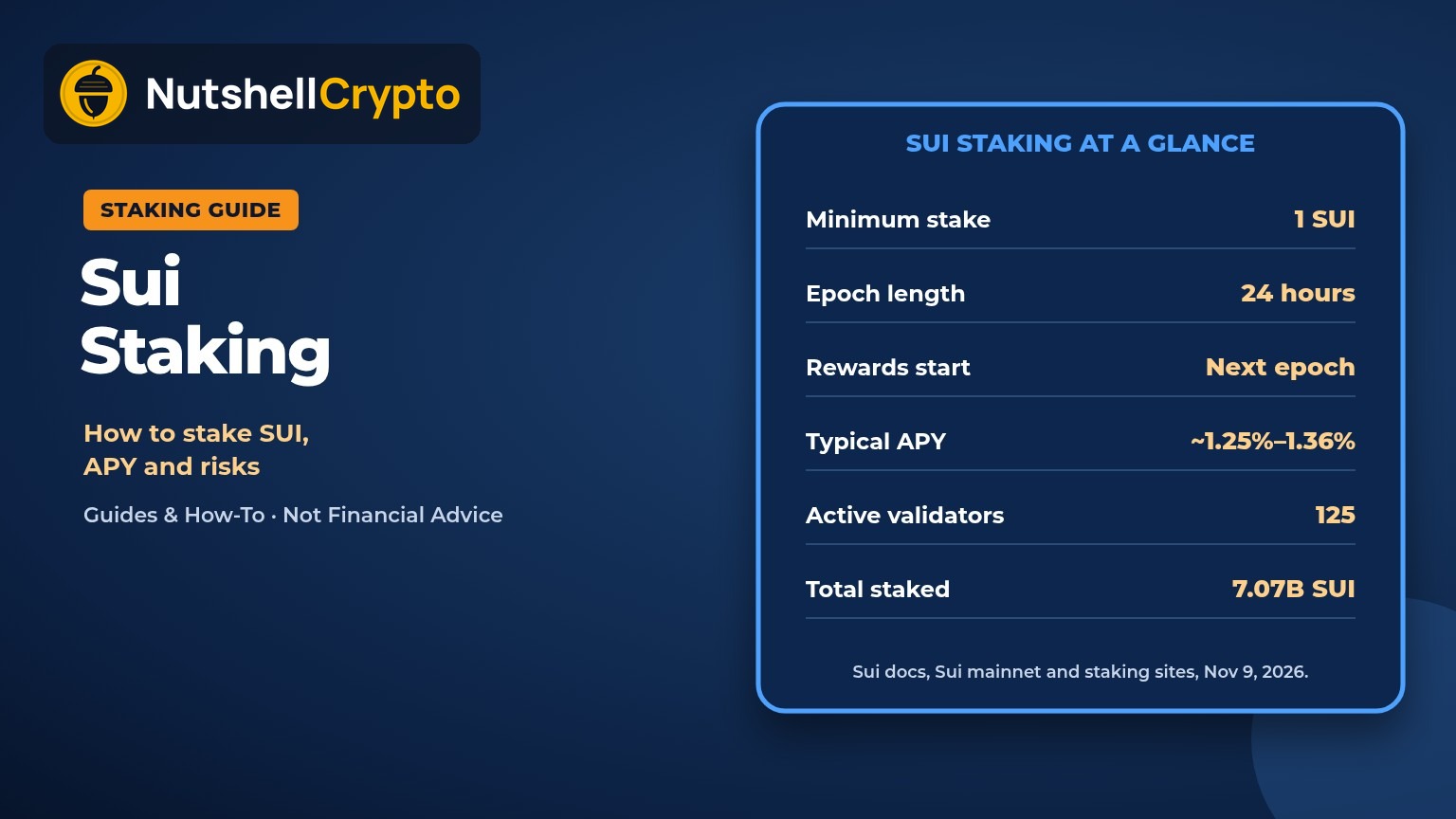
In a nutshell: Sui staking means delegating SUI to one of the network’s validators to help secure it and earn a share of rewards. You can start with 1 SUI from a wallet such as Slush or Ledger Wallet, your coins stay in your own wallet as a stake object, and rewards start from the next 24-hour epoch. On November 9, 2026, staking sites showed rates of about 1.25% to 1.36% a year, so the yield is low. Educational only; not financial advice.
Sui works a little differently from most proof-of-stake chains. There is no slashing of your principal, rewards compound inside the staking pool instead of arriving as payments, and you can get your SUI back quickly when you unstake. The trade-off is a small yield that is shrinking over time.
This guide covers what Sui staking is, how to stake step by step, how epochs and unstaking work, what rates validators were showing on November 9, 2026 (checked between about 5:40 and 6:00 PM PKT), liquid staking options, the main risks, and short tax notes for the US, Canada and Australia.
Table of contents
What Is Sui Staking?
Sui is a proof-of-stake blockchain, which means validators are chosen to process transactions based on how much SUI is staked with them. SUI holders who do not run a validator can delegate their coins to one and earn part of the rewards. If you are new to the idea, start with our guide to what staking in crypto is.
The Sui documentation on validator rewards lists the features that matter most to stakers:
- Staking is self-custodial: you keep your staked SUI in an object that you own.
- Rewards auto-compound, because they raise the exchange rate of the validator’s staking pool each epoch.
- A new stake starts counting the epoch after you create it, and Sui uses 24-hour epochs.
- At the end of each epoch, gas fees and stake subsidies are shared out as staking rewards, and the validator keeps its commission.
The minimum is 1 SUI. The Sui staking pool code sets a minimum staking threshold of 1 SUI (staking_pool.move on GitHub), and the Coinbase Developer Platform Sui guide also lists 1 SUI as the minimum to stake.
How Sui Staking Works
When you stake, your wallet creates a stake object (called StakedSui) linked to the validator’s pool. You never get a separate reward payment. Instead, the pool’s exchange rate rises at every epoch boundary, so the same stake object is worth more SUI over time. When you withdraw, you get your principal plus the rewards earned up to the previous epoch, according to the Sui docs.
The validator does not take custody of your coins. It gets voting power from your stake, and in return it keeps a commission on the rewards. The Sui docs give the example that a validator with a 10% commission rate keeps 10% of its stakers’ rewards each epoch.
Sui does not slash principal. If other validators report a validator for poor performance under the tallying rule, the network cuts that validator’s staking rewards for the epoch, per the same Sui docs page. Your stake stays intact, but you can lose that epoch’s rewards.
| Item | Sui native staking |
|---|---|
| Minimum | 1 SUI |
| Epoch length | 24 hours |
| Rewards start | The epoch after you stake |
| Compounding | Automatic, through the pool exchange rate |
| Slashing | Rewards can be cut; principal is not slashed |
| Custody | Your own wallet (stake object) |
How to Stake SUI Step by Step
Slush is the wallet built by Mysten Labs, the team behind Sui. It replaced Sui Wallet in April 2025 and is available as a browser extension, iOS and Android apps, and a web app, according to the Sui blog. The Slush help center describes the path as Earn, then Staking, then Earn by Native Staking.
- Get SUI into your wallet. Buy SUI on an exchange and withdraw it to your Slush (or other Sui) address. Keep a little SUI unstaked to pay gas.
- Open the staking screen. In Slush, go to Earn, choose Staking, then Earn by Native Staking.
- Choose a validator. Compare commission and APY (see how to pick a validator below).
- Enter the amount. At least 1 SUI.
- Confirm the transaction. Your stake becomes active at the next epoch boundary, and rewards build up from then.
With a Ledger: Ledger added Sui to Ledger Wallet (formerly Ledger Live) for sending, receiving and staking SUI, according to the Ledger blog, and P2P.org says the “Ledger by P2P.org” validator can be picked inside the app, with approval on the device. Our Ledger staking guide explains how staking from a hardware wallet works in general.
How Long Unstaking Takes
On the protocol level, unstaking is fast. The Sui docs say stake withdrawals are processed immediately using the previous epoch’s exchange rate, and do not have to wait for the current epoch to close. The catch is that you give up the rewards for the epoch in which you withdraw, because they are not known until that epoch ends.
Wallets can describe this differently. The Slush help center says native staking has a 24-hour “unbonding” period and that it takes one full epoch for your SUI to become available after you unstake. Plan for up to a day either way. For how this compares with other networks, see our unbonding period by coin guide.
You also cannot withdraw part of a single stake object. The Sui docs say you must withdraw all of that stake at once, but you can split your SUI into several stake objects and unstake only some of them. Ledger’s enterprise help page for Sui says each part of a split must keep at least 1 SUI.
Sui Staking APY on November 9, 2026
Sui staking pays low single digits. Here is what different sources showed on November 9, 2026, during epoch 1,306:
| Source | Rate shown | Notes |
|---|---|---|
| suistaking.io | 1.25% average APY, 1.09% to 1.38% range | Across 125 active validators; median commission 8% |
| Staking Rewards | 1.35% reward rate | Staking ratio 70.72%, inflation 2.31% |
| Kraken | Up to 1.36% APY | Bonded staking, 1-day bonding time, paid weekly |
| Sui mainnet data | About 1.3% a year before commission | Our own estimate: 256,663 SUI of rewards in epoch 1,305 divided by about 7.07 billion SUI staked |
For that last row, we read the Sui mainnet GraphQL service on November 9, 2026. Epoch 1,305 (November 8 to 9, 2026, UTC) paid about 256,663 SUI in staking rewards, almost all of it from stake subsidies (about 254,187 SUI) and only about 2,476 SUI from gas fees. A month earlier, epoch 1,276 paid about 284,863 SUI. That shows how much the yield depends on subsidies, which are paid on a falling schedule.
In money terms, SUI was about $0.84 (C$1.19, A$1.22) on CoinGecko at 5:42 PM PKT on November 9, 2026. At a 1.3% rate, 1,000 SUI would earn roughly 13 SUI in a year, before any price change. To learn how APR and APY differ, read our staking APR guide, and to model rewards over time, try our Chainlink staking calculator with Sui’s rate entered.
How to Pick a Sui Validator
We counted 125 active validators and about 7.07 billion SUI staked on Sui mainnet on November 9, 2026. These were the five biggest by stake, with the commission each charged that epoch:
| Validator | Stake (SUI) | Commission |
|---|---|---|
| Mysten-1 | 218.9 million | 2% |
| Mysten-2 | 212.9 million | 2% |
| Coinbase | 191.6 million | 10% |
| Galaxy Digital | 148.8 million | 5% |
| Kraken | 145.5 million | 8% |
Commission across the active set ranged from 0% to 20%, with a median of 8%. A few things to weigh:
- Commission. Lower commission leaves more for you, but validators can change it.
- Performance. A validator reported under the tallying rule loses that epoch’s rewards, and so do its stakers.
- Spreading out. Staking with smaller, well-run validators helps keep stake from piling up with a few big operators.
Validator lists with live APY are on suistaking.io and tide.ad. Some staking providers we have covered also run Sui validators, such as Figment.
Liquid Staking on Sui
Liquid staking protocols stake SUI for you and give you a token that represents the stake, which you can use in DeFi or sell instead of unstaking. Our liquid staking guide covers the general idea. The biggest Sui liquid staking protocols by total value locked on DefiLlama on November 9, 2026 were:
| Protocol | Token | TVL (Nov 9, 2026) |
|---|---|---|
| SpringSui (by Suilend) | sSUI | About $55.4 million |
| Haedal | haSUI | About $29.5 million |
| Volo | vSUI | About $23.3 million |
| Aftermath | afSUI | About $2.4 million |
These amounts are small next to the roughly 7 billion SUI staked natively, so most SUI is staked directly with validators. Liquid tokens add smart-contract risk and can trade below the value of the SUI behind them.
Staking SUI on an Exchange
Kraken offers SUI staking with a 1-day bonded option and a flexible Auto Earn option, and its launch post says geographic restrictions apply. Coinbase runs one of the biggest Sui validators, but its SUI staking page said “SUI staking is not supported by Coinbase” when we checked on November 9, 2026, and only offers SUI for trading. On an exchange, the exchange holds your coins and takes a cut of the rewards, so compare it with native staking from your own wallet. Our flexible vs locked staking guide explains the two exchange options.
Risks of Sui Staking
- Low and falling yield. Most rewards come from stake subsidies, and the epoch rewards we checked fell by about 10% between October 10 and November 8, 2026. Staking Rewards also lists inflation of 2.31%, higher than the reward rate, so stakers are mostly keeping their share of supply rather than earning a real return.
- Price risk. A 1.3% reward does little if the SUI price drops.
- Lost rewards. A badly performing validator can lose an epoch’s rewards, and you lose the rewards for the epoch in which you withdraw.
- Wallet risk. Native staking stays in your wallet, so anyone with your recovery phrase or login can unstake and move it. Never share your recovery phrase.
- Smart-contract and platform risk. Liquid staking tokens and exchanges add their own risks on top of the network’s.
US, Canada and Australia Tax Notes
This section is general information, not tax advice. We found no IRS, CRA or ATO page that deals with Sui specifically, or with rewards that build up inside a staking pool and only reach you when you unstake, so please confirm with a qualified tax professional. For the full picture, see our crypto staking taxes guide.
United States: the IRS says to answer “Yes” to the digital asset question on your return if you received digital assets from staking, and that income from staking is reported on Schedule 1 (IRS digital assets). Revenue Ruling 2023-14 says validation rewards are included in gross income in the year you gain dominion and control, meaning the ability to sell, exchange or otherwise dispose of them (Rev. Rul. 2023-14). On Sui, rewards grow inside the pool until you withdraw, so when you gain control of them is a question for your tax professional.
Canada: the CRA says rewards from staking on a centralized exchange are generally income when they are credited to your wallet on the platform, and that business income from staking has its own rules (CRA: mining and staking income). That page does not address native staking from your own wallet. More in our Canada crypto tax guide.
Australia: the ATO says the money value of the additional tokens you receive for staking is ordinary income at the time you receive them, and that this value becomes their cost base for working out a capital gain or loss when you later dispose of them (ATO: staking rewards and airdrops). Values are recorded in Australian dollars (AUD). For upcoming changes to the CGT rules, see our guide to Australia’s CGT indexation changes.
FAQ
What is the minimum to stake SUI?
1 SUI. That minimum is set in the Sui staking pool code and listed in wallet and custody guides such as Slush, Ledger and Coinbase Developer Platform.
How long does Sui staking take to start earning?
Your stake becomes active at the next epoch, and Sui epochs last 24 hours. Rewards for an epoch only count if your stake was active for the whole epoch.
Can I unstake SUI at any time?
Yes. The Sui docs say withdrawals are processed immediately at the previous epoch’s exchange rate, though you give up the current epoch’s rewards. Slush describes a 24-hour unbonding period, so allow up to a day.
What is the APY for Sui staking?
On November 9, 2026, suistaking.io showed a 1.25% average (1.09% to 1.38%), Staking Rewards showed 1.35%, and Kraken showed up to 1.36%. Rates change every epoch.
Can you lose SUI by staking?
Sui does not slash principal, but a validator’s rewards can be cut for poor performance, and the SUI price can fall. Liquid staking and exchanges add their own risks.
Is Sui staking taxable?
In the US, Canada and Australia, staking rewards are generally treated as income, and selling later can trigger gains or losses. Check the country sections above and confirm with a tax professional.
Sources: Sui documentation, Sui framework code on GitHub, Sui mainnet GraphQL data, Sui blog, Slush help center, Ledger, P2P.org, Coinbase Developer Platform, Coinbase, Kraken, suistaking.io, Staking Rewards, tide.ad, DefiLlama, CoinGecko, IRS, CRA and ATO, all checked on November 9, 2026. Rates, fees and minimums change. This article is for education only and is not financial or tax advice.