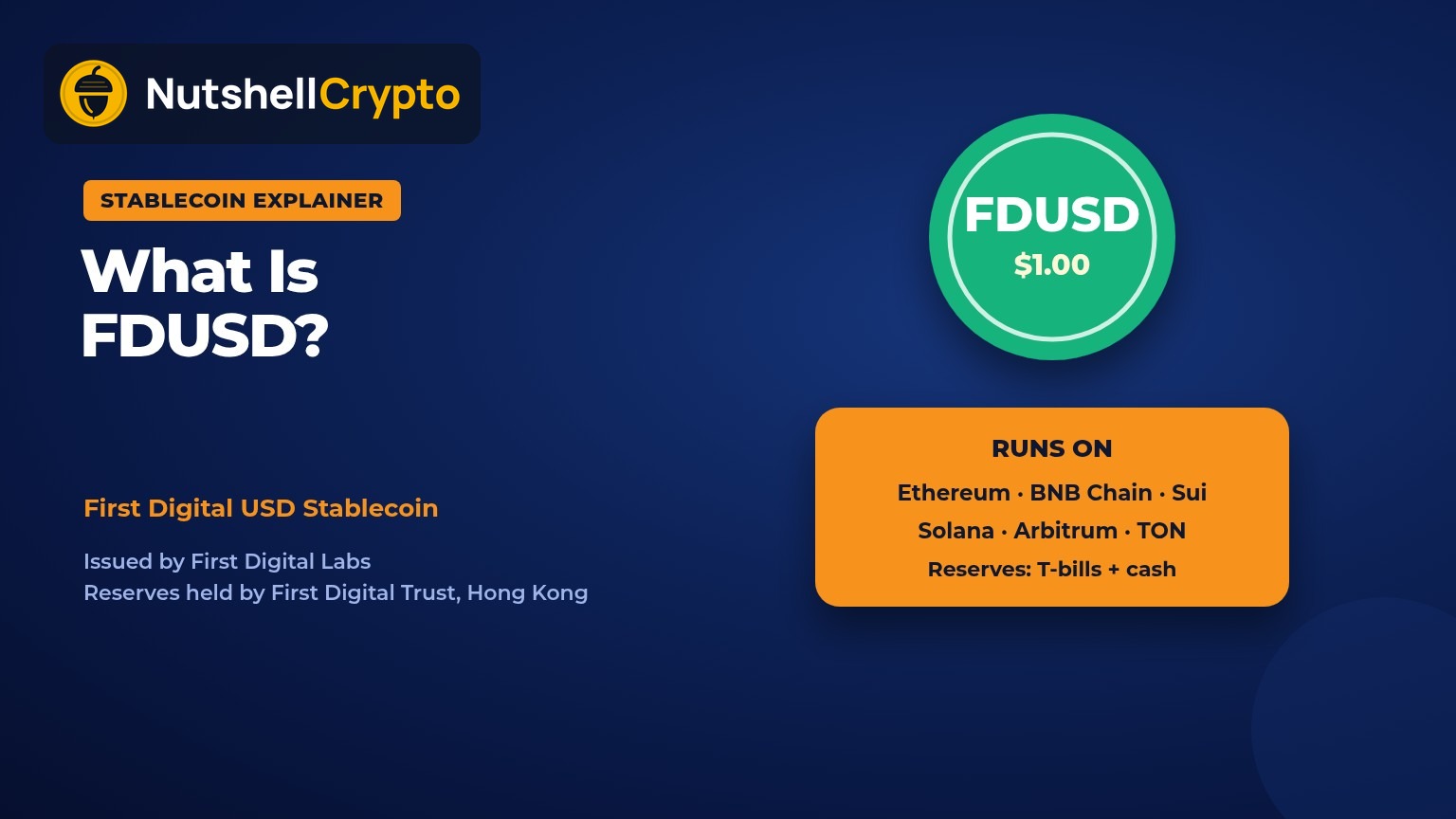
In a nutshell: FDUSD, or First Digital USD, is a US dollar stablecoin issued by First Digital Labs (legally FD121 (BVI) Limited), part of the Hong Kong-based First Digital group, with its reserves held by First Digital Trust in Hong Kong. Each token is meant to be redeemable 1:1 for US dollars and is backed mostly by short-term US Treasury bills and cash, with monthly attestation reports. It trades mainly on Binance, it is not meant for US persons, and it briefly fell to about $0.87 in April 2025. As of November 11, 2026 (3:28 PM PKT), about 284 million FDUSD were in circulation, according to CoinGecko.
FDUSD was one of the fastest-growing stablecoins of 2023 and 2024, mostly because Binance made it a main trading currency. It has shrunk a lot since then. This guide explains who stands behind it, how minting and redemption work, what backs it, how big it is today, the April 2025 depeg, fees, where you can and cannot get it, the main risks, and the tax rules in the US, Canada and Australia.
New to the topic? Start with our explainer on what stablecoins are and how they work.
Table of contents
- What is FDUSD?
- Who issues FDUSD: First Digital Labs and First Digital Trust
- How FDUSD minting and redemption work
- What backs FDUSD: reserves and attestations
- How big is FDUSD, and which chains is it on?
- The April 2025 FDUSD depeg
- FDUSD fees
- Where FDUSD trades, and the US, Canada and Australia
- How to buy, use and hold FDUSD
- FDUSD risks
- Is FDUSD taxable?
- FAQ
What Is FDUSD?
First Digital describes FDUSD as “your global digital dollar, issued by FD121 (BVI) Limited and custodied by FDT, redeemable on a 1:1 basis for US dollars” (First Digital Labs: FDUSD). FDT is First Digital Trust Limited, the group’s Hong Kong trust company. Like USDT or USDC, FDUSD is a fiat-backed stablecoin: for every token in circulation, the issuer says it holds one US dollar or an equal amount of dollar assets.
FDUSD launched in 2023. Binance listed it on July 26, 2023, with BNB/FDUSD, FDUSD/BUSD and FDUSD/USDT pairs and zero trading fee promotions, at a time when it was first live on Ethereum and BNB Chain (Binance). In an October 6, 2026 announcement, First Digital said FDUSD reached $1 billion in market cap within four months of launch, peaked at more than $4.4 billion in circulation in April 2024, and has recorded more than $4 trillion in cumulative trading volume. It also said Binance “remains the largest centralised secondary market for FDUSD” (First Digital).
FDUSD is a different kind of coin from the newer US-regulated stablecoins such as World Liberty’s USD1 or Paxos’s USDG Global Dollar. Its home is the offshore exchange market, mainly Binance, rather than US brokers or payment apps.
Who Issues FDUSD: First Digital Labs and First Digital Trust
Three names matter:
- FD121 (BVI) Limited, trading as First Digital Labs, is the issuer. The FDD Terms define it as “a company limited by shares incorporated in the British Virgin Islands.” On August 1, 2025, it took over the role from an earlier entity, FD121 Limited, which assigned all its rights and obligations under the terms to the BVI company (First Digital Labs: FDD Terms). First Digital’s own disclosure stresses that FD121 (BVI) Limited “is not a trust company” and “is a financial technology company, not a bank” (First Digital Labs).
- First Digital Trust Limited (FDT) holds the reserves. First Digital says FDT is a licensed Trust or Company Service Provider under Hong Kong’s anti-money laundering law and a registered trust company under Hong Kong’s Trustee Ordinance, and that the reserves are segregated from the trust company’s own assets (First Digital Labs: Transparency).
- First Digital Group Limited is the Hong Kong parent. In October 2026 it signed a deal to combine with CSLM Digital Asset Acquisition Corp III (Nasdaq: KOYN), a SPAC, at a $250 million pre-money valuation. First Digital expects the deal to close in the first half of 2027, subject to shareholder and regulatory approvals (First Digital).
FDUSD is not issued under a stablecoin licence. First Digital’s transparency page says it “is actively working to secure regulatory authorisation for its stablecoin issuance activities from a recognised and reputable financial regulatory authority.” Hong Kong’s stablecoin licensing regime is now live, but when we checked the Hong Kong Monetary Authority’s register on November 11, 2026, it listed only two licensed issuers, Anchorpoint Financial and HSBC, both effective April 10, 2026 (HKMA register). First Digital’s own September 2026 notice is clear on this: “FDUSD has not been licensed under the Hong Kong Stablecoins Ordinance,” and its minting and redemption services “are not offered to persons located in the United States or acting on behalf of U.S. persons” (First Digital Labs).
How FDUSD Minting and Redemption Work
Only approved clients deal with the issuer. First Digital says that if you are “a key industry player, a financial intermediary, or a professional investor of a certain stature,” you can buy FDUSD directly, but “First Digital Labs does not sell tokens directly to retail customers” (First Digital Labs). The process works like this:
- Open an FD121 Account. The client passes anti-money laundering (AML) and counter-terrorist financing (CTF) checks.
- Mint. The client wires US dollars to FD121 and receives newly issued FDUSD. The terms say the wire should be in US dollars; if it is sent in another currency, conversion fees are deducted in FDUSD.
- Redeem. The client sends FDUSD back and receives US dollars, and the tokens are taken out of circulation.
The FDD Terms add some important limits. Anyone who receives FDUSD gets the right to sell it to FD121 for dollars, but only “so long as the Holder is eligible to, and does, register a FD121 Account.” FD121 can also “cancel, suspend, restrict, defer or limit” buying and selling, including during heavy redemption requests or market stress (FDD Terms). For most people, then, the realistic way out of FDUSD is to sell it on an exchange, not to redeem it.
What Backs FDUSD: Reserves and Attestations
First Digital says FDUSD is backed one-to-one “by cash and cash equivalents only,” made up of cash, very short-dated US Treasury bills and overnight reverse repos, held in a bankruptcy-remote trust structure. Its figures as of September 30, 2026, checked on November 11, 2026 (First Digital Labs: Transparency):
- Tokens issued and in circulation: $325.042 million
- Total assets held in reserve accounts: $326.311 million, about 0.4% more than the tokens outstanding
- Mix: US Treasury bills 89.16%, cash 10.26%, fixed deposits 0.58%
Attestation reports are published monthly by an independent accounting firm and can be downloaded from the transparency page. The FDUSD smart contracts were audited by PeckShield and Quantstamp, according to the same page. An attestation is a point-in-time check of the reserves, not a full financial audit of the company.
Two details are worth knowing. First, the FDD Terms say the reserves “are owned beneficially by FD121” and that holders are not entitled to any interest earned on them, so FDUSD pays no yield (FDD Terms). Second, not everyone is convinced by the bankruptcy protection. In April 2025, stablecoin rating firm Bluechip gave FDUSD a C grade and told CoinDesk that “in case of bankruptcy, the reserves could be used to pay off the parent company’s debt” (CoinDesk). First Digital, for its part, describes the reserves as held in “segregated, bankruptcy-remote trust accounts.”
How Big Is FDUSD, and Which Chains Is It On?
We checked these figures on November 11, 2026, at 3:24 to 3:28 PM PKT:
- Price: $0.9963 on CoinGecko, slightly under $1. Over the previous 30 days, CoinGecko’s FDUSD price ranged from about $0.9957 to $0.9988.
- Circulating supply: about 283.8 million FDUSD, for a market cap of about $282.8 million, ranked #137 among all crypto assets on CoinGecko (CoinGecko).
- 24-hour trading volume: about $118.8 million on CoinGecko, which is high relative to its size and shows that FDUSD is mostly used for trading.
- Rank among dollar stablecoins: about 25th on DefiLlama, far behind the leaders in our list of the largest stablecoins by market cap.
DefiLlama’s chain breakdown on the same day (DefiLlama):
- Ethereum: about 175.7 million FDUSD
- BNB Chain: about 55.9 million
- Sui: about 43.6 million
- Solana: about 8.5 million
- Arbitrum and TON: small amounts (about 44,700 and 1,100)
The trend has been downward for a long time. DefiLlama’s history shows FDUSD at about $4.0 billion in late April 2024, about $1.4 billion in mid-April 2025, about $730 million a year ago in November 2025, and about $284 million now. Supply fell by roughly $40 million between First Digital’s September 30 reserve figures and November 11.
The April 2025 FDUSD Depeg
FDUSD’s biggest test came on April 2, 2025. CoinDesk had reported that some reserves of another stablecoin, TrueUSD (TUSD), were stuck in illiquid investments. First Digital Trust had been appointed to manage TUSD’s reserves. Tron founder Justin Sun, who had bailed out TUSD’s issuer, then posted that “First Digital Trust (FDT) is effectively insolvent and unable to fulfill client fund redemptions.”
FDUSD fell to 0.87 against USDT and 0.76 against USDC on Binance, then steadied at around $0.96 to $0.98, CoinDesk reported. First Digital replied that it was “completely solvent,” that every dollar backing FDUSD was “accounted for with US backed T-Bills,” and that the dispute was about TUSD, not FDUSD (CoinDesk). By April 4, First Digital had honored about $25.8 million in FDUSD redemptions, based on Etherscan data cited by Cointelegraph (Cointelegraph). First Digital Trust later filed a defamation claim against Sun in Hong Kong’s High Court, and CoinDesk reported that FDUSD had “virtually recovered” by April 9, 2025 (CoinDesk).
The lesson is that a stablecoin can lose its peg on fear alone, even when the issuer says its reserves are intact, especially when only a small group of clients can redeem directly. Our guide to whether stablecoins are safe covers other depegs and what to watch.
FDUSD Fees
- Minting and redemption: First Digital advertises “zero fee minting and redemption, as long as you mint more than you redeem” (First Digital Labs). That applies to FD121 account holders only, and wires in a currency other than US dollars carry conversion fees under the FDD Terms.
- Exchange fees: If you buy or sell FDUSD on an exchange, you pay that exchange’s normal trading fees and spread. Because FDUSD has recently traded a little under $1, the price you get can differ slightly from $1.
- Network fees: Sending FDUSD on-chain costs gas on the network you use. Ethereum is usually the most expensive; BNB Chain, Solana and Sui are usually much cheaper.
Where FDUSD Trades, and the US, Canada and Australia
Binance dominates FDUSD trading. On November 11, 2026, CoinGecko’s market list showed 32 Binance pairs carrying about $88 million of FDUSD’s roughly $119 million in 24-hour volume, followed by smaller venues such as Gate, BTCC and MEXC and decentralized exchanges such as PancakeSwap (CoinGecko). In September 2026, First Digital also added FDUSD/USD, BTC/FDUSD and ETH/FDUSD pairs for professional investors on HashKey Exchange, a Hong Kong platform licensed by the SFC, which it called “the first direct fiat route for FDUSD” (First Digital Labs).
United States. FDUSD is not built for US users. Under the FDD Terms, anyone holding or using FDUSD represents that they are “not, and are not acting for the benefit or account of, an individual or entity in the United States” (FDD Terms). Binance.com, the main market, does not accept anyone located in, resident of or a citizen of the United States, according to its List of Prohibited Countries updated January 5, 2026 (Binance). US rules are also tightening: the GENIUS Act generally bars platforms from offering payment stablecoins to people in the US unless the issuer is permitted or is a foreign issuer that meets set requirements, and it takes effect on January 18, 2027 (OCC Bulletin 2026-50).
Canada. Binance.com also does not serve people located in or resident of Canada, per the same list. Under CSA Staff Notice 21-333, registered Canadian crypto platforms can only offer US or Canadian dollar stablecoins whose issuers meet conditions on reserves, redemption and disclosure (OSC: CSA Staff Notice 21-333). We did not find FDUSD on any registered Canadian platform, so check your platform’s current list rather than trusting generic “buy FDUSD” pages.
Australia. Binance Australia, which is registered with AUSTRAC, lists FDUSD among its supported assets, according to Finder’s review (Finder). Before using any exchange, check it on AUSTRAC’s virtual asset service provider register. If you pay in Australian dollars, your cost in AUD moves with the exchange rate even if FDUSD holds its peg: CoinGecko showed 1 FDUSD at about A$1.45 (and C$1.42) on November 11.
How to Buy, Use and Hold FDUSD
- Check you are allowed to. If you are in the US, FDUSD’s own terms rule you out. In Canada, use only a registered platform and only stablecoins it offers.
- Use a platform that lists it. On Binance, FDUSD is mostly bought with USDT or USDC, or used as the quote currency for pairs such as BTC/FDUSD.
- Pick the right network to withdraw. FDUSD is issued on Ethereum, BNB Chain, Solana, Sui, Arbitrum and TON, and each has its own contract address listed on First Digital’s FDUSD page. Your wallet and the sending platform must use the same network.
- Store it in a wallet that supports the chain. Our guide to choosing a stablecoin wallet explains the custodial and self-custody options.
Remember that FDUSD can be frozen. After the Binance hack, First Digital CEO Vincent Chok said the company had frozen FDUSD stolen in the attack and was working with Binance to stop the funds from moving (TokenPost). Our Binance hack report has the wider story of that incident.
FDUSD Risks
- Depeg risk. FDUSD fell to 0.87 against USDT in April 2025 and has traded slightly under $1 in recent weeks.
- Limited redemption. Only approved FD121 clients can redeem, and the issuer can suspend or limit redemptions under its terms. Everyone else depends on exchange prices.
- No stablecoin licence and offshore structure. The issuer is a BVI company that is not a bank, the custodian is a Hong Kong trust company, and disputes go to Hong Kong courts under the FDD Terms.
- Reserve and custodian risk. Holders rely on monthly attestations and on how reserves would be treated in an insolvency, a point rating firm Bluechip questioned in 2025. There is no deposit insurance.
- Concentration on Binance. Most trading happens on one exchange, so outages, listing changes or problems at Binance hit FDUSD directly.
- Shrinking supply. FDUSD’s circulation is a small fraction of its 2024 peak, which can mean thinner markets outside Binance.
- Freezes. The issuer can blacklist addresses, as it did after the Binance attack, and the terms let it block prohibited transactions.
- Regulatory change. US rules for foreign issuers start in January 2027, and the planned Nasdaq listing of First Digital’s parent is still subject to approvals.
To compare FDUSD with the two largest stablecoins, see our USDT vs USDC comparison.
Is FDUSD Taxable?
United States. The IRS says digital assets, which include stablecoins, are treated as property, not currency, for US tax purposes. Selling, swapping or spending a stablecoin is a disposal, so you work out a capital gain or loss against what you paid, which is usually small for a coin that stays near $1 but can add up after a depeg. Keep records of each purchase, sale and swap (IRS: Digital assets). Note that FDUSD’s own terms exclude US persons, so most US readers will meet it only on foreign platforms they are not meant to use.
Canada. The CRA says trading a crypto-asset for government currency or another crypto-asset, or using it to buy goods or services, is a disposition. The result is business income or a capital gain or loss depending on how you trade, and half of a capital gain is taxable. Moving crypto between your own wallets is not a taxable disposition. Because you would normally buy a US dollar stablecoin with Canadian dollars, exchange-rate moves can create a gain or loss in CAD (CRA: Reporting income from crypto-asset transactions).
Australia. The ATO treats crypto held as an investment as a CGT asset. Selling it for Australian or foreign currency or swapping it for another crypto asset is a CGT event, and values are worked out in Australian dollars, so AUD exchange-rate moves count even for a dollar stablecoin (ATO: Crypto asset investments).
Our stablecoin taxes guide goes through these cases in more detail. This is general information, not tax advice.
FAQ
Who issues FDUSD?
FD121 (BVI) Limited, trading as First Digital Labs, a British Virgin Islands company in the Hong Kong-based First Digital group. The reserves are held by First Digital Trust Limited in Hong Kong.
Is FDUSD backed 1:1?
First Digital says so. Its September 30, 2026 figures showed $326.3 million in reserves, about 89% US Treasury bills and 10% cash, against $325.0 million FDUSD in circulation.
Did FDUSD lose its peg?
Yes, briefly. On April 2, 2025, after Justin Sun claimed First Digital Trust was insolvent, FDUSD fell to 0.87 against USDT on Binance. First Digital denied the claim, processed redemptions, and the price largely recovered within days.
Can I use FDUSD in the US?
It is not intended for US persons. The FDD Terms require holders to confirm they are not acting for anyone in the United States, and Binance.com does not serve US users.
Does FDUSD pay interest?
No. The terms say holders are not entitled to interest earned on the reserves. Any reward on an exchange would come from that exchange, not from First Digital.
Is FDUSD the same as TUSD?
No. TrueUSD (TUSD) is a separate stablecoin from a different issuer. First Digital Trust’s past role in managing TUSD’s reserves is what triggered the April 2025 scare.
Sources
- First Digital Labs: Home and disclosures
- First Digital Labs: FDUSD
- First Digital Labs: Transparency and monthly reserve reports
- First Digital Labs: FDD Terms (August 1, 2025)
- First Digital: Definitive agreement with KOYN (Oct 6, 2026)
- First Digital Labs: FDUSD on HashKey Exchange (Sep 1, 2026)
- Binance: FDUSD listing (Jul 26, 2023)
- Binance: List of Prohibited Countries (Jan 5, 2026)
- HKMA: Register of licensed stablecoin issuers
- CoinGecko: First Digital USD
- DefiLlama: First Digital USD
- CoinDesk: FDUSD drops on Justin Sun allegations (Apr 2, 2025)
- CoinDesk: First Digital Trust files defamation claim (Apr 9, 2025)
- Cointelegraph: First Digital redeems $26M after depeg (Apr 4, 2025)
- TokenPost: First Digital froze FDUSD stolen in Binance attack (Oct 29, 2026)
- OCC Bulletin 2026-50: GENIUS Act final rule
- OSC: CSA Staff Notice 21-333
- Finder: Binance Australia review
- AUSTRAC: Virtual asset service provider register
- IRS: Digital assets
- CRA: Reporting income from crypto-asset transactions
- ATO: Crypto asset investments
This article is for education only and is not financial or tax advice. Stablecoins can lose their peg; check the issuer’s latest reserve report before you rely on one.