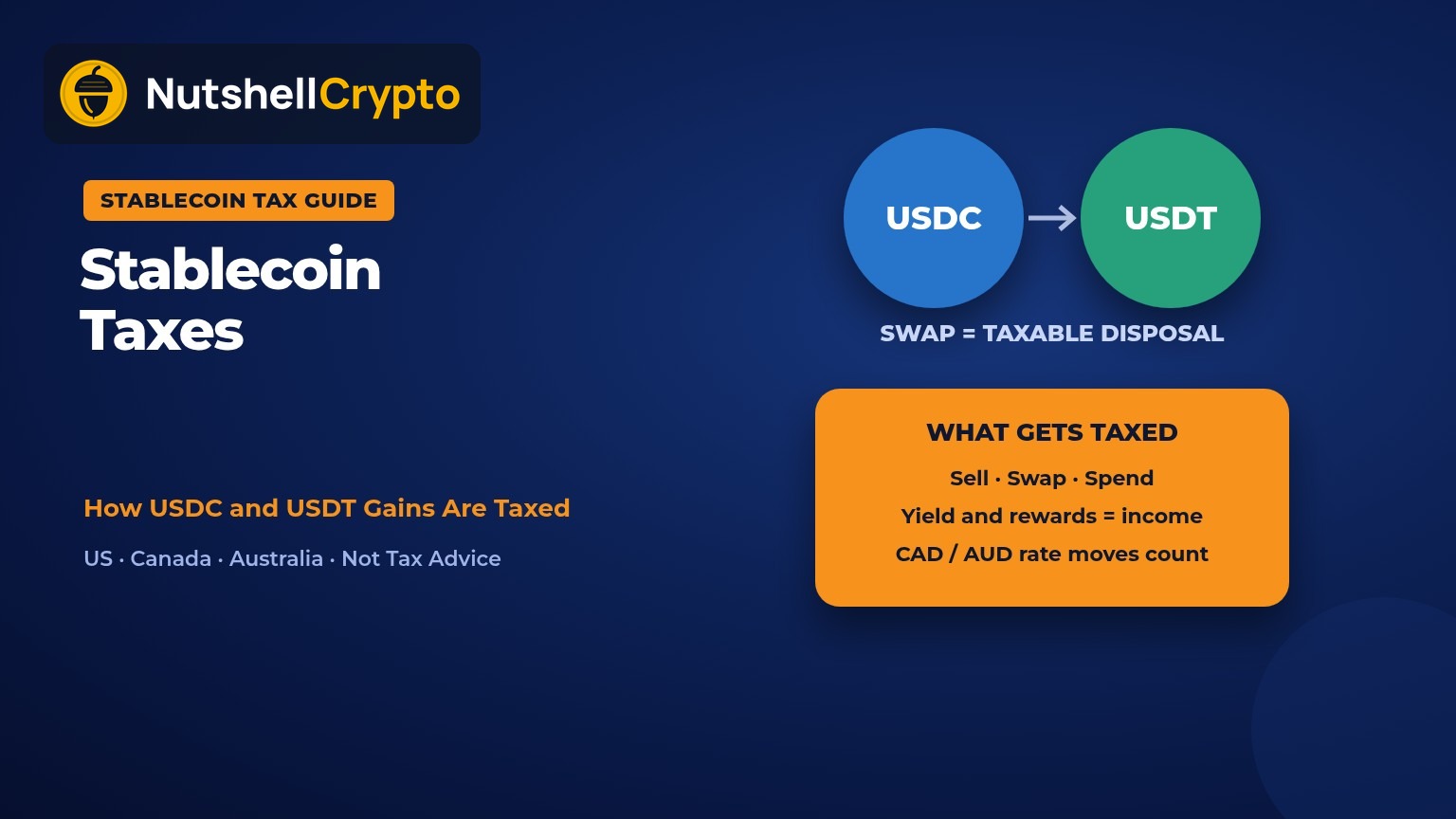
In a nutshell: Stablecoins such as USDC and USDT are taxed like other crypto, not like cash. In the US they are property, so selling, swapping or spending them is a taxable disposal, even if the gain is only a few cents. Canada and Australia work the same way, with one extra twist: because these coins track the US dollar, their value in CAD or AUD moves with the exchange rate, so a “stable” coin can still produce a real gain or loss. Interest or rewards paid in stablecoins are income. A US bill that would treat qualified dollar stablecoins at their $1 redemption value passed a House committee in September 2026 but is not law. Educational only; not tax advice.
Last updated: October 29, 2026.
Many people assume a coin that always trades near $1 can’t create a tax bill. The tax rules don’t look at whether the price is stable. They look at what the coin is, and in the US, Canada and Australia a stablecoin is a crypto asset, not money.
This guide covers when stablecoin transactions are taxable, how small “peg” gains add up, the exchange-rate effect for Canadian and Australian holders, how income from stablecoin yield is taxed, what brokers now report to the IRS, and the US bill that could change the rules. For the general picture, start with our crypto taxes guide.
Table of contents
- Are stablecoins taxed like cash?
- Which stablecoin transactions are taxable
- Small peg gains and losses
- Canada and Australia: the exchange-rate effect
- Stablecoin yield and rewards are income
- What US brokers report on Form 1099-DA
- The US bill that would change stablecoin taxes
- Record-keeping checklist
- FAQ
Are Stablecoins Taxed Like Cash?
No. The IRS says that for US tax purposes digital assets are property, not currency, and it lists stablecoins by name as an example of a digital asset (IRS). That means the normal property rules apply: you have a cost basis when you acquire the coin, and a gain or loss when you dispose of it.
Canada takes the same view. The Canada Revenue Agency lists stablecoins as one type of crypto-asset, described as coins pegged to a commodity, a government currency such as the US dollar, or managed by an algorithm (CRA). Australia’s tax office treats crypto held as an investment as a capital gains tax (CGT) asset, and the same disposal rules apply to stablecoins (ATO).
So the useful question is not “is it stable?” but “did I dispose of it, and what was it worth in my home currency when I did?” If you’re new to how these coins work, our explainer on what stablecoins are covers the basics.
Which Stablecoin Transactions Are Taxable
The three tax offices describe disposals in very similar terms. Across the US, Canada and Australia, these usually count as a taxable event:
- Selling stablecoins for cash (USD, CAD, AUD or any other currency).
- Swapping one crypto for another, including stablecoin to stablecoin, such as USDT to USDC. The ATO says that when you swap one crypto asset for another you dispose of one CGT asset and acquire a new one (ATO).
- Buying another coin with stablecoins, such as using USDC to buy ETH. The stablecoin is what you dispose of.
- Spending stablecoins on goods or services. The CRA treats paying with crypto as a barter transaction (CRA).
- Gifting them, in Canada and Australia; US gift rules are different and usually put the tax on the person who later sells.
Usually not taxable: buying stablecoins with cash, and moving them between wallets you own. The CRA says transfers between your own wallets don’t create a taxable disposition (CRA). Network fees paid in crypto during a transfer are a separate question; our guide to taxes on crypto transfers goes through it.
The IRS has made the stablecoin-swap point directly. In its digital asset FAQ it says that if you held stablecoins as capital assets, you recognize capital gain or loss when you exchange them for other digital assets, even if your broker didn’t report the trade to you (IRS FAQ Q100).
Small Peg Gains and Losses
For a US holder, a dollar stablecoin bought at $1.00 and sold at $1.00 gives no gain. But prices drift by fractions of a cent, and trading fees change your cost basis, so tiny gains and losses appear all the time. Here is a simple example with made-up numbers:
- You buy 10,000 USDT for $10,005 including fees, so your basis is about $1.0005 per coin.
- You later swap all 10,000 USDT for ETH when USDT is worth $0.9998.
- Your proceeds are $9,998, so you have a capital loss of about $7.
Each amount is small, but an active trader can have thousands of these lines a year, and each one is technically reportable. That is a big part of why Congress is now looking at a special rule for dollar stablecoins (see below).
Bigger moves happen when a coin loses its peg. On March 10, 2023, after Circle said $3.3 billion of USDC reserves were held at the failed Silicon Valley Bank, USDC fell to about $0.88 over the weekend before recovering (CNBC). Anyone who sold or swapped USDC in that window locked in a real capital loss. Our guide on whether stablecoins are safe looks at depeg risk in more detail, and crypto tax-loss harvesting explains how losses can offset gains.
Canada and Australia: The Exchange-Rate Effect
Outside the US, a US-dollar stablecoin is not stable in your tax currency. The CRA generally accepts a crypto-asset’s fair market value at the time of a trade for tax reporting (CRA), and the ATO says you must convert crypto values into Australian dollars before working out CGT (ATO). Both are measured in local currency, so the CAD/USD or AUD/USD rate flows straight into your gain or loss.
An Australian example, with made-up numbers:
- You buy 5,000 USDC for A$7,500 (about A$1.50 per US dollar).
- Months later the Australian dollar has weakened, and you sell the 5,000 USDC for A$7,800.
- USDC stayed at $1 the whole time, but you have an A$300 capital gain, because each coin is now worth more Australian dollars.
The same thing works in reverse if the Australian or Canadian dollar strengthens: you get a capital loss. In Canada, half of a capital gain is taxable and half of a capital loss can offset taxable capital gains, and crypto disposals go on Schedule 3 (CRA). Our Canada crypto tax guide covers the business-income versus capital question.
In Australia, the ATO says crypto held for at least 12 months may qualify for the CGT discount, and crypto held as an investment is not exempt as a personal use asset (ATO). The ATO also runs a crypto data-matching program that compares tax returns with transaction data from designated service providers, so exchange records will usually be in front of it already.
Stablecoin Yield and Rewards Are Income
Earning on stablecoins, whether through an exchange “earn” product, a DeFi lending pool or rewards, is generally ordinary income when you receive it, valued at fair market value. The IRS asks you to keep records of the US dollar fair market value of digital assets received as income (IRS).
The ATO gives a stablecoin example directly: a person who “lends” 100 stablecoin tokens through Compound and receives newly issued stablecoins as a 1% return must declare the market value of those new tokens as assessable income (ATO). The ATO also notes that many DeFi “lending” arrangements are themselves a CGT event, because you transfer the tokens to an address you don’t control. When you later sell the reward coins, you have a second, separate gain or loss measured from that income value.
Our guide to stablecoin staking explains where that yield comes from and the risks behind it.
What US Brokers Report on Form 1099-DA
Since January 1, 2025, US custodial brokers must report digital asset sales on the new Form 1099-DA. They report gross proceeds for transactions from 2025 and must also report cost basis for certain transactions from January 1, 2026 (IRS).
Stablecoins get a lighter option. The IRS instructions define a “qualifying stablecoin” as one that tracks a single government currency one-to-one, uses an effective stabilization mechanism, and is generally accepted as payment by people other than the issuer. A broker using the optional method doesn’t have to report a customer’s designated stablecoin sales at all if their total gross proceeds from them with that broker are $10,000 or less for the year, and above that it can report them as one aggregate total per coin (IRS Form 1099-DA instructions).
The key point: that $10,000 threshold is a reporting rule for brokers, not a tax exemption for you. The IRS FAQ is explicit that you still recognize gains and losses on stablecoin disposals even when no 1099-DA arrives (IRS FAQ). Exchanges also publish their own tax reports, which can help you match your records.
The US Bill That Would Change Stablecoin Taxes
On September 14, 2026, H.R. 10357, the Digital Asset Tax Certainty Act, was introduced in the House. Two days later the Ways and Means Committee ordered it reported, as amended, by a 38 to 5 vote (Ways and Means). As of late October 2026 the committee vote is its latest recorded step; it has not passed the full House or the Senate, so it is not law (Congress.gov).
According to the Joint Committee on Taxation’s description, the bill would cover “qualified U.S. dollar stablecoins”: payment stablecoins issued by a permitted issuer, or a foreign issuer registered with the OCC, under the GENIUS Act signed on July 18, 2025. For those coins (JCT):
- Your basis would generally equal the coin’s redemption value (the dollar amount the issuer must pay out), if you paid at least 99.5% of it.
- A sale would generally be treated as made at redemption value, if you received no more than 100.5% of it. In practice, normal trading near $1 would produce no gain or loss.
- Traders, brokers and dealers in these stablecoins, and people with more than 5,000 digital asset transactions in the prior year (with some carve-outs), would be excluded.
- The JCT describes the stablecoin rule as applying to taxable years beginning after December 31, 2026.
A separate Senate bill, S. 5616 (the ADAPT Act), was introduced on September 30, 2026 and referred to the Finance Committee; it would also stop certain payment-stablecoin purchases of goods and services from creating gain or loss (TokenPost). Until one of these passes both chambers and is signed, the current property rules above still apply.
Record-Keeping Checklist
Stablecoins tend to be the most-used coins in a crypto account, so they create the most rows in a tax report. For each acquisition and disposal, keep:
- The date and time, the coin and the network (USDC on Ethereum and USDC on Solana are easy to mix up in records).
- The amount, the value in your tax currency (USD, CAD or AUD) at that moment, and any fees.
- What you received in return: cash, another coin, goods or a service.
- Wallet addresses, so transfers between your own wallets aren’t mistaken for sales.
- Income records for any rewards, with the value on the day you received them.
The ATO says to keep records for each crypto asset because each one is a separate CGT asset, and the IRS says you must keep enough records to support what you file. A crypto tax tool or an accountant can turn exchange CSVs into the right forms.
FAQ
Do I pay tax on stablecoins if I just hold them?
Holding alone is usually not taxable. Tax arises when you sell, swap, spend or (in Canada and Australia) gift them, or when you receive stablecoins as income.
Is swapping USDT for USDC taxable?
Generally yes. In the US, Canada and Australia, exchanging one crypto asset for another is a disposal, even between two dollar stablecoins. The gain or loss is often tiny in USD terms, but it still needs to be reported.
Are stablecoins tax-free under $10,000 in the US?
No. $10,000 is the level below which a broker using the optional method doesn’t have to report designated stablecoin sales on Form 1099-DA. Your own reporting duty doesn’t change.
Why do I have a gain on USDC if it’s always $1?
If you’re in Canada or Australia, your gain is measured in CAD or AUD, so exchange-rate moves create gains and losses. In the US, small differences in purchase price, sale price and fees can still create gains or losses of a few cents or dollars.
Is stablecoin interest taxed as capital gains?
No. Interest, yield or rewards paid in stablecoins are generally income at their value when received. Selling those coins later is a separate capital event. See our crypto capital gains tax guide for how gains are calculated.
Sources
- IRS: Digital assets
- IRS: Instructions for Form 1099-DA
- IRS: Frequently asked questions on digital asset transactions
- CRA: Understanding crypto-assets and your tax obligations
- CRA: Reporting income from crypto-asset transactions
- CRA: Reporting your capital gains as a crypto-asset user
- ATO: How to work out and report CGT on crypto
- ATO: Crypto to crypto exchange or swap
- ATO: Decentralised finance and wrapping crypto
- Joint Committee on Taxation: Description of H.R. 10357
- Ways and Means: Committee vote on H.R. 10357
- Congress.gov: H.R. 10357 actions
- TokenPost: House and Senate crypto tax bills
- CNBC: USDC breaks dollar peg
This article is for education only and is not tax, legal or financial advice. Tax rules depend on your country, residency and circumstances, and proposed laws can change before they pass. Check with the IRS, CRA or ATO, or a qualified tax professional.