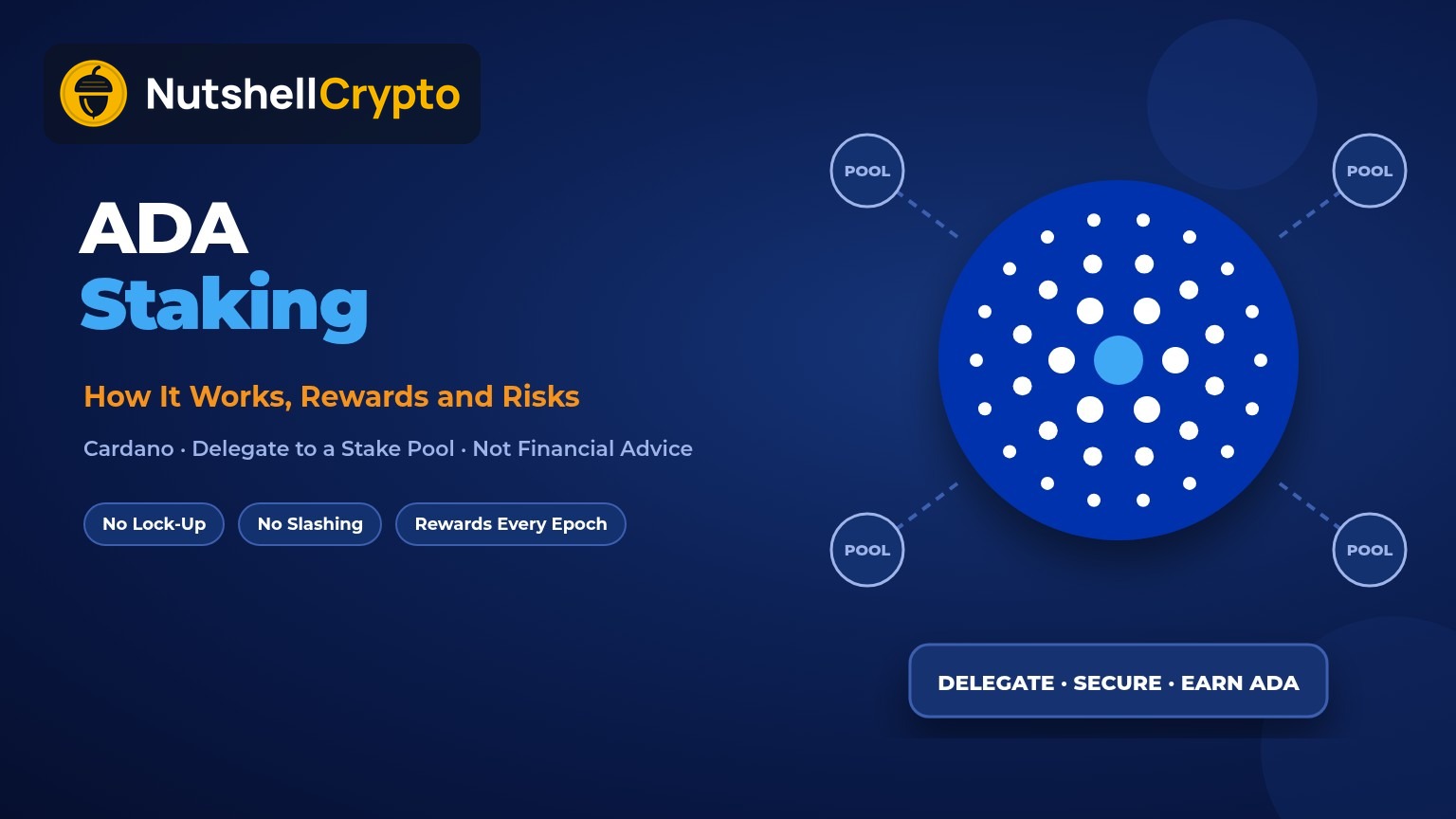
In a nutshell: ADA staking means delegating your ada to a Cardano stake pool so it counts toward that pool’s chance of producing blocks, and you get a share of the rewards. Your ADA never leaves your wallet, there is no lock-up, no minimum amount and no slashing. A first-time delegation needs a refundable 2 ADA stake key deposit. First rewards arrive about 15 to 20 days after you delegate, then every 5-day epoch. To withdraw rewards you also need a vote delegation (a DRep, Abstain or No Confidence). Educational only; not financial advice.
Last updated: October 15, 2026.
ADA staking is how holders of Cardano’s native coin, ada (ADA), take part in securing the Cardano blockchain and earn more ADA in return. Unlike many proof-of-stake networks, Cardano does not ask you to lock your coins or hand them to anyone. You simply delegate the “stake rights” attached to your wallet to a stake pool, and your ADA stays spendable the whole time.
This guide covers what ADA staking is, how Cardano delegation works, the key protocol numbers, a step-by-step walkthrough, how to compare stake pools, exchange options, risks, taxes in the US and Canada, and an FAQ. If staking is new to you, start with our explainer on what staking in crypto means.
Table of contents
What Is ADA Staking?
Cardano runs on Ouroboros, a proof-of-stake protocol. Instead of miners competing with computing power, stake pools are chosen to produce blocks in proportion to the ada delegated to them, according to Cardano’s official How Cardano Works page. Cardano.org’s stake pool delegation page puts it simply: “Staking on Cardano means delegating your ada to a stake pool.”
What makes ADA staking different from staking on many other chains:
- Your ADA never leaves your wallet. You sign an on-chain certificate that counts your stake toward a pool. You keep full spending control, per the Cardano Developer Portal’s staking page.
- No lock-up. Your ADA stays liquid and spendable at any time. Cardano Docs notes that “you can spend your ada at any time, regardless of how you delegated it” (How to delegate?).
- No minimum. Any amount counts toward the pool.
- No slashing. If a pool underperforms or misbehaves, you miss rewards, but delegated ada is never at risk.
How much ADA is staked? When we queried the community Koios API on October 15, 2026 at about 1:27 PM PKT (epoch 661), the active stake was about 21.26 billion ADA against about 36.80 billion ADA in circulation, or roughly 58%.
How Cardano Delegation Works
There are two roles in Cardano staking:
Stake pool operators
A stake pool is a block-producing node run by an operator who keeps it online around the clock. Operators register the pool on-chain and declare a pledge (their own ada committed to the pool), a fixed cost per epoch and a margin (a percentage of rewards). Running a pool is a technical job with relays, keys and monitoring; Cardano treats it as a separate discipline in its developer docs. Cardano.org says close to three thousand pools are registered, and roughly a thousand produce blocks in a given epoch.
Delegators (most beginners)
Delegators do not run anything. Cardano Docs explains that since not everyone has the time, knowledge or resources to run a stake pool, ada holders can delegate their stake to a preferred pool and let an operator maintain it on their behalf. Your wallet registers a stake key, then submits a delegation certificate pointing that key at a pool. Delegating does not move funds; it only assigns the staking rights attached to your address.
When the protocol picks a pool as slot leader, the block it makes earns rewards. The protocol first pays the operator its declared fixed cost and margin, then splits the rest among everyone in the pool in proportion to their stake, per Cardano Docs on pledging and rewards. Pool operators never control your coins.
This is very different from Ethereum, where validators deposit ETH that can be slashed for misbehavior and solo staking needs 32 ETH. See our guide on how to stake Ethereum for the comparison.
ADA Staking Parameters (Mainnet)
These figures come from Cardano’s official pages, and we cross-checked the live protocol parameters through the Koios API on October 15, 2026 at about 1:27 PM PKT. Protocol parameters can change through on-chain governance.
| Item | Value | Source |
|---|---|---|
| Minimum to delegate | None (any amount counts) | Cardano Developer Portal |
| Stake key deposit (first time) | 2 ADA, refundable when you deregister | Developer Portal; Koios stakeAddressDeposit = 2,000,000 lovelace |
| Lock-up | None; ADA stays spendable | Cardano.org |
| Slashing | None | Cardano.org |
| Epoch length | 5 days (432,000 one-second slots) | How Cardano Works |
| First rewards | About 15 to 20 days after delegating | Cardano.org |
| Reward frequency after that | Every epoch (about 5 days) if the pool mints blocks | Developer Portal |
| Target number of pools (k0) | 500 | Developer Portal; Koios stakePoolTargetNum = 500 |
| Minimum pool fixed cost | 170 ADA per epoch | Koios minPoolCost = 170,000,000 lovelace |
| Withdrawing rewards | Needs an active vote delegation (DRep, Abstain or No Confidence) | Cardano.org |
A transaction fee also applies when you sign the delegation. Cardano’s fee is a formula (a fixed part plus a per-byte part), and How Cardano Works says a typical transfer costs around 0.17 ADA.
How ADA Staking Rewards Work
Where rewards come from
Rewards are generated by the protocol, not paid by pool operators. Per Cardano Docs, they come from two sources: transaction fees from blocks minted in the epoch, and monetary expansion, a fixed but adjustable percentage of the remaining ada reserve released each epoch (part of which goes to the treasury).
The 15 to 20 day delay
Because Ouroboros uses a stake snapshot to choose slot leaders, a fresh delegation does not earn immediately. Cardano.org gives the timeline:
- Epoch N: you delegate.
- Epoch N+1: your stake is counted in the snapshot at the epoch boundary.
- Epoch N+2: your stake becomes active and the pool produces blocks with it.
- Epoch N+3: rewards for that epoch are calculated.
- Epoch N+4: rewards are paid to your reward account.
After that first wait, rewards arrive every epoch as long as the pool produces blocks.
Automatic compounding
Rewards land in a separate reward account linked to your stake key and count toward your delegated stake automatically, so they compound with no action on your part. Any ADA you add to the wallet is also included from the next snapshot.
Vote delegation to withdraw
Since the Plomin hard fork, Cardano.org says staking rewards can only be withdrawn once your stake key also has an active vote delegation. You can delegate your vote to a DRep (delegated representative) or choose Abstain or No Confidence. Rewards keep accumulating either way; you just cannot move them into your spendable balance until you pick one.
What return to expect
There is no fixed APY. Cardano.org’s rewards calculator gives estimates but warns it cannot predict the future, since rewards depend on pool performance, fees and total stake. For reference only, Coinbase’s Cardano staking page showed an estimated reward rate of 1.35% APY for its own service when we checked on October 15, 2026 at about 1:30 PM PKT, subject to location and change. Your result through a self-custody wallet will depend on the pool you choose.
How to Stake ADA Step by Step
Cardano.org describes delegation in four steps. Here they are in plain language:
- Get a Cardano wallet that supports delegation. Cardano.org says most current self-custody Cardano wallets support delegation, and Cardano Docs links tutorials for wallets such as Daedalus and Yoroi. Download only from official sites and back up your recovery phrase offline. Our crypto wallet guide explains wallet types if you are choosing one.
- Move ADA into the wallet. If your ADA is on an exchange, withdraw it to your wallet address. Leave a little extra for the 2 ADA deposit and the network fee.
- Open the staking or delegation tab and pick a pool. Compare pools by performance, fees, pledge and saturation (see the next section). You can also use pool explorers listed on cardano.org to compare pools and delegate from the pool’s page.
- Sign one transaction. It includes a small fee and, if your stake key is new, the refundable 2 ADA deposit. Your wallet delegates your whole balance; you do not choose an amount.
- Set your vote delegation. Choose a DRep, Abstain or No Confidence so you can withdraw rewards later. Many wallets offer this next to staking.
- Wait for your first rewards. Expect about 15 to 20 days, then a payout every epoch if the pool mints blocks.
To switch pools later, just delegate again. Cardano.org says a re-delegation becomes active in the epoch after next, your old pool still earns you rewards for three more payouts, and the new pool takes over from the fourth, so there is no gap.
How to Choose a Stake Pool
We do not recommend specific pools. These are the factors cardano.org lists for comparing them:
- Performance: blocks a pool actually made versus blocks it was expected to make. Judge it over many epochs; a small pool may show low performance in an epoch simply because it was not picked yet.
- Uptime: a pool that is offline when elected misses that block and its rewards.
- Margin fee: the percentage the operator takes. Lower can mean more for you, but performance matters too.
- Fixed fee: every pool charges at least the protocol minimum per epoch (170 ADA when we checked). The fixed cost comes out of the pool’s total reward, so it weighs more heavily on small pools.
- Saturation: saturation equals total stake divided by k0 (500). Past that point, rewards per ADA drop for everyone in the pool. Most wallets and explorers show each pool’s saturation level.
- Pledge: operators commit their own ada. If the owners delegate less than their declared pledge, Cardano Docs says pool rewards for that epoch are zero.
- Size and variance: small pools mint blocks less often, so their rewards vary more from epoch to epoch.
Some wallets let you split ADA across several accounts and delegate each to a different pool, which spreads pool risk.
Exchange and Liquid Staking Options
Exchange staking
Some centralized exchanges stake ADA for customers. Coinbase, for example, offers Cardano staking only in locations where staking is allowed and says rates change. It is simple, but it is custodial: the exchange holds your coins, chooses the pool, takes a share of rewards and sets its own terms. If the exchange freezes withdrawals or fails, your ADA is at risk in a way it never is with self-custody delegation.
Liquid staking
On networks with lock-ups, liquid staking tokens let you stay liquid while staking. Native Cardano delegation is already liquid, so the main reason for liquid staking on other chains matters less here. Any token-based staking product built on smart contracts adds contract and depeg risk; our liquid staking explainer covers those trade-offs.
Comparing chains? Our AVAX staking guide and Polygon staking guide use the same format, so you can see how lock-ups and minimums differ.
Risks of ADA Staking
- Price risk: rewards are paid in ADA. A small yield does not protect you from a large drop in ADA’s price.
- Missed-reward risk: a poorly run, offline, saturated or under-pledged pool can earn you less or nothing in an epoch. Your principal is not touched.
- Wallet security: fake wallet apps, phishing sites and “support” scammers asking for your recovery phrase are the biggest real threat. No legitimate pool or wallet needs your recovery phrase to stake.
- Custody risk: exchange staking means trusting the exchange with your coins.
- Parameter changes: deposits, fees and reward parameters can change through Cardano’s on-chain governance.
- Forgetting vote delegation: rewards keep accruing, but you cannot withdraw them until your stake key has a vote delegation.
Taxes on ADA Staking Rewards (US and Canada)
In the US, the IRS’s Revenue Ruling 2023-14 says a cash-method taxpayer includes staking rewards in gross income, at fair market value, in the year they gain dominion and control over them. Because Cardano rewards arrive every epoch, that can mean many small income events a year, so keep records of each payout’s date and value. Selling ADA later can trigger a capital gain or loss; see our beginner guide to crypto taxes.
In Canada, the CRA’s page on reporting income from crypto mining and staking says rewards from staking on a centralized exchange are generally income when credited, and staking done as a business is business income. Our guide to cryptocurrency tax in Canada covers the CRA rules in more detail.
For examples and record-keeping tips, read our full guide to crypto staking taxes. This is not tax advice; check with a tax professional.
FAQ
Is there a minimum amount for ADA staking?
No. Any amount counts toward a pool. A first-time delegation needs a refundable 2 ADA stake key deposit plus a small network fee.
Is my ADA locked when I stake?
No. Your ADA stays in your wallet and remains spendable at any time. There is no unbonding period.
Can I lose ADA by staking?
Not through the protocol: Cardano has no slashing, and a badly run pool only costs you rewards. You can still lose value if ADA’s price falls, or lose coins to scams or by staking on an exchange that fails.
How long until I get ADA staking rewards?
About 15 to 20 days after you delegate, then every 5-day epoch as long as the pool mints blocks.
Do I need to claim or restake rewards?
No. Rewards compound automatically in your reward account. To move them into your spendable balance, your stake key needs an active vote delegation.
Can I change stake pools?
Yes, at any time. The new pool becomes active in the epoch after next, and your old pool still pays for three more payouts, so nothing is lost.
Do I get my 2 ADA deposit back?
Yes. The stake key deposit is returned when you deregister your stake key.
Sources
- Cardano.org: Stake your ada on Cardano (delegation FAQ)
- Cardano.org: How Cardano Works
- Cardano Developer Portal: Staking
- Cardano Docs: How to delegate?
- Cardano Docs: Pledging and rewards
- Koios API (protocol parameters, epoch 661 info and totals), queried October 15, 2026 at about 1:27 PM PKT
- Coinbase: Cardano staking page (checked October 15, 2026 at about 1:30 PM PKT)
- IRS: Revenue Ruling 2023-14
- CRA: Reporting income from crypto-asset mining and staking activities
This article is for educational purposes only and is not financial, investment or tax advice.