In a nutshell: Restaking means taking crypto that is already staked, usually ETH or a liquid staking token, and pledging it again to secure extra services in return for extra rewards. The trade-off is extra risk: each service adds its own slashing rules, withdrawals take longer, and you rely on more smart contracts. Educational only; not financial advice.
Last updated: October 8, 2026.
Restaking builds directly on staking. If you are new to the basics, start with our guides to staking in crypto and liquid staking. This guide explains how restaking works, the main types, where the extra rewards come from, the risks, and what US and Canadian readers should know about rules and taxes.
Table of contents
What Is Restaking?
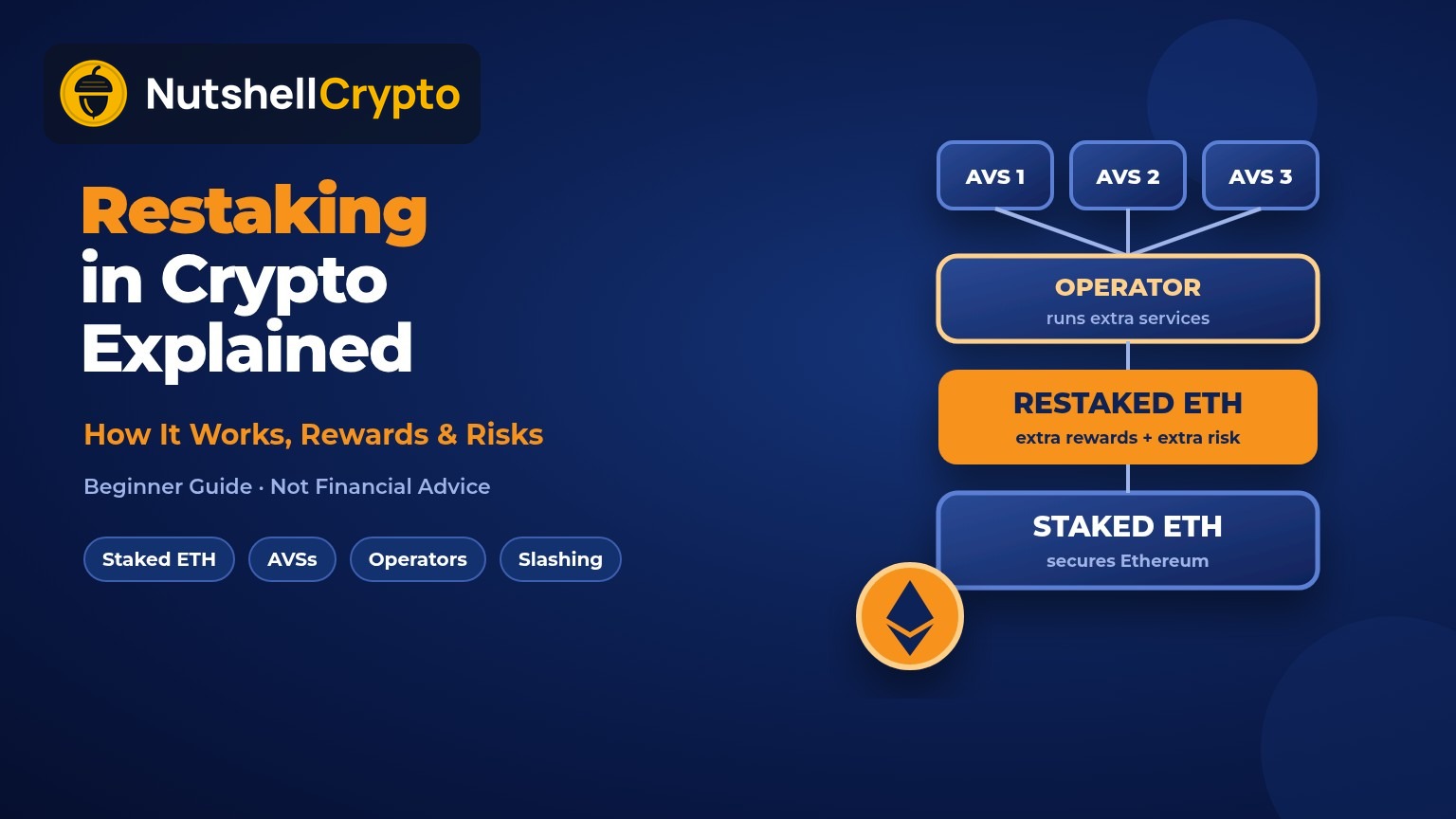
On Ethereum, people stake ETH to run validators that process transactions and secure the network. Ethereum.org describes restaking as stakers using “their already-staked ETH to secure other decentralized services,” earning extra rewards from those services on top of normal staking rewards.
The services secured this way are usually called Actively Validated Services (AVSs). Ethereum.org gives price oracles, token bridges and data systems as examples, and notes that other platforms use different names, such as “Networks.”
The idea is that a new service does not have to build its own validator network and token from scratch. It can “rent” security from ETH that is already staked. Ethereum.org adds an important point: restaking is built by third parties on top of Ethereum and “is not part of Ethereum protocol staking,” so the extra rewards do not come from Ethereum itself.
How Restaking Works, Step by Step
Using EigenLayer, the best-known restaking protocol, as the example, the flow looks like this:
- Stake first. You stake ETH directly or hold a liquid staking token (LST) such as stETH or rETH.
- Restake. You deposit the LST into the restaking contracts, or point your validator’s withdrawals to them.
- Delegate to an operator. According to the EigenLayer restaker docs, you assign your restaked balance to one operator at a time, and delegation is “all or nothing.”
- The operator runs services. Operators are usually professional node runners. They run the software each AVS requires.
- Rewards flow back. AVSs pay rewards to operators and their delegators. You receive fees “according to the AVSs that the Operator chooses to run.”
- Bad behavior gets punished. If an operator breaks an AVS’s rules, part of the stake behind it can be slashed.
Most restakers delegate rather than run AVS software themselves. Ethereum.org notes this avoids complicated technical requirements, but delegators get a lower reward rate than operators.
Native vs Liquid Restaking
The EigenLayer docs describe two main types:
- Native restaking. You change an Ethereum validator’s withdrawal credentials to EigenLayer’s smart contracts. You must operate a validator, and ethereum.org says your own validator needs at least 32 ETH.
- Liquid restaking. You deposit liquid tokens, including LSTs, the EIGEN token and other approved ERC-20 tokens, into EigenLayer’s contracts. No validator needed.
A third layer sits on top: liquid restaking tokens (LRTs). Just as stETH represents staked ETH, an LRT like eETH or Renzo’s ezETH represents a restaked position, according to ethereum.org. LRTs can be traded or used in DeFi, which adds convenience but also another layer of risk.
Staking vs Liquid Staking vs Restaking
| Staking | Liquid staking | Restaking | |
|---|---|---|---|
| What you do | Lock coins to help secure one network | Stake through a provider and get a token back | Pledge staked ETH or LSTs again to secure extra services |
| Rewards | Network staking rewards | Network rewards minus provider fee | Staking rewards plus extra AVS rewards |
| Slashing | Network rules only | Network rules, via the provider’s validators | Network rules plus each AVS’s rules |
| Extra risks | Lock-up, price swings | Smart contract and depeg risk | More contracts, operator risk, longer exits, LRT depegs |
Where Restaking Happens
EigenLayer, now part of Eigen Labs’ EigenCloud platform, introduced restaking in 2023, says ethereum.org, and remains the largest restaking protocol. On October 8, 2026, DefiLlama showed about $6.7 billion locked in EigenCloud, and about $10.4 billion across all protocols it classifies as restaking.
Other names you may see:
- Symbiotic, a permissionless restaking protocol listed by ethereum.org. It now describes itself as a collateral markets platform.
- Babylon, which DefiLlama lists under restaking on Bitcoin, at about $3.4 billion.
- Jito Restaking and Solayer on Solana, both much smaller on DefiLlama’s data.
- Liquid restaking protocols such as Kelp (about $1.1 billion) and Renzo, which issue LRTs.
These figures change daily.
Where Restaking Rewards Come From
Normal ETH staking rewards come from the Ethereum protocol. Ethereum.org’s staking page showed a current APR of about 2.5% when we checked on October 8, 2026. Restaking rewards are separate: AVSs offer token rewards in exchange for security, says ethereum.org.
That matters for two reasons. First, an AVS token’s value can fall, so a high advertised rate may be worth less than it looks. Second, rewards exist because you take on extra slashing risk. EigenLayer’s own docs warn that redistributable operator sets “may offer higher rewards, but these should be considered against the increased slashing risks.” If a restaking yield looks far above normal staking, ask what risk you are being paid to carry.
The Risks of Restaking
1. Extra slashing conditions
Slashing went live on EigenLayer mainnet on April 17, 2025, according to Eigen Labs. Operators are not slashed automatically; slashing applies only when an operator opts into a slashable “operator set” created by an AVS. The slashing docs say AVSs can design slashing “for any reason,” that it does not have to be provable on-chain, and that slashed funds are burned or redistributed after a 7-day delay. As a delegator, you inherit your operator’s choices, and the docs say stakers must keep monitoring their operator’s allocations.
2. Slower withdrawals
EigenLayer has a withdrawal delay for all restaked assets. Its contract documentation on GitHub sets the mainnet delay at 100,800 blocks, or 14 days, and notes shares in the withdrawal queue are “still subject to slashing.” Native restakers also wait for Ethereum’s own exit queue.
3. LRT depegs
An LRT can trade below the value of what backs it. On April 24, 2024, Renzo’s ezETH fell as low as $750 on Uniswap, a ratio of 0.27 to wrapped ether, before recovering, CoinDesk reported. DL News said the drop triggered about $56 million in liquidations affecting more than 250 users, mostly people using ezETH as leveraged collateral.
4. Smart contract and stacking risk
Restaking layers contracts on top of contracts: the staking protocol, the restaking protocol, possibly an LRT issuer, then DeFi apps. A bug in any layer can hurt you. EigenLayer’s docs describe the withdrawal delay partly as protection when a vulnerability is found.
5. Concentration and system risk
Ethereum.org warns that a few dominant operators could gain heavy influence, and that a restaker slashed while securing several AVSs could weaken security for the others. Ethereum co-founder Vitalik Buterin raised similar concerns in his May 2023 post, “Don’t overload Ethereum’s consensus”.
Restaking Rules and Taxes in the US and Canada
US securities rules. In May and August 2025, the SEC’s Division of Corporation Finance issued staff statements saying certain protocol staking and liquid staking activities do not involve securities offerings. But the August 5, 2025 liquid staking statement says in a footnote that it “does not address ‘restaking.'” Staff statements are not rules, and restaking has not received the same clarity.
US taxes. IRS Revenue Ruling 2023-14 says cash-method taxpayers include the fair market value of staking rewards in gross income in the year they gain “dominion and control” over them. The ruling does not mention restaking by name, and LRT swaps can raise extra questions, so keep detailed records and ask a tax professional. Our guide to crypto taxes in the US covers the basics.
Canada. The CRA says rewards from staking on a centralized exchange are generally income when credited to your account. It does not publish separate restaking guidance, so a tax professional is worth it. See our cryptocurrency tax in Canada guide.
Outside North America, rules differ by country, so check your local tax authority.
A Beginner’s Checklist Before Restaking
- Understand plain staking first. If staking still feels confusing, restaking is not the next step.
- Know which operator you back. Check which AVSs it serves and their slashing terms.
- Plan for the wait. Expect at least 14 days to exit on EigenLayer, plus any Ethereum queue.
- Be careful with leverage. The ezETH liquidations hit leveraged positions hardest.
- Value rewards realistically. Rewards paid in AVS tokens can lose value fast.
- Protect your keys. Restaking runs through on-chain apps, so use a secure DeFi wallet and only official links.
FAQ
Is restaking the same as staking?
No. Staking secures one blockchain. Restaking reuses that staked ETH to secure extra services, adding new rewards and new slashing risks. Ethereum.org says restaking is not part of Ethereum protocol staking.
Is restaking safe?
It carries more risk than plain staking: extra slashing conditions, more smart contracts, longer withdrawals and possible LRT depegs. Whether that is acceptable depends on your risk tolerance.
Do I need 32 ETH to restake?
Only for native restaking, which requires running your own validator. Liquid restaking lets you deposit LSTs instead, so smaller holders can take part.
How long does it take to withdraw restaked ETH?
On EigenLayer mainnet, the withdrawal delay is 14 days, and funds can still be slashed during that time. Native restakers also wait for Ethereum’s exit queue.
Are restaking rewards taxable?
In the US, staking rewards are generally income when you gain control of them under Revenue Ruling 2023-14; the CRA treats exchange staking rewards as income when credited. Neither addresses restaking by name, so get advice for your situation.
Sources
- Ethereum.org: What is restaking?
- Ethereum.org: Ethereum staking
- EigenCloud docs: Restaking overview
- EigenCloud docs: Slashing overview
- Eigen Labs: Slashing goes live on mainnet
- EigenLayer contracts: DelegationManager docs (GitHub)
- DefiLlama: Restaking protocols
- Symbiotic docs
- CoinDesk: Renzo restaked ETH suffers a brief crash
- DL News: ezETH depeg and liquidations
- Vitalik Buterin: Don’t overload Ethereum’s consensus
- SEC: Statement on Certain Liquid Staking Activities
- IRS: Revenue Ruling 2023-14
- CRA: Income from crypto-asset mining and staking
Educational content only. This is not financial, tax or investment advice. Restaking can lead to loss of funds through slashing, bugs or depegs. Crypto is volatile and you can lose money.