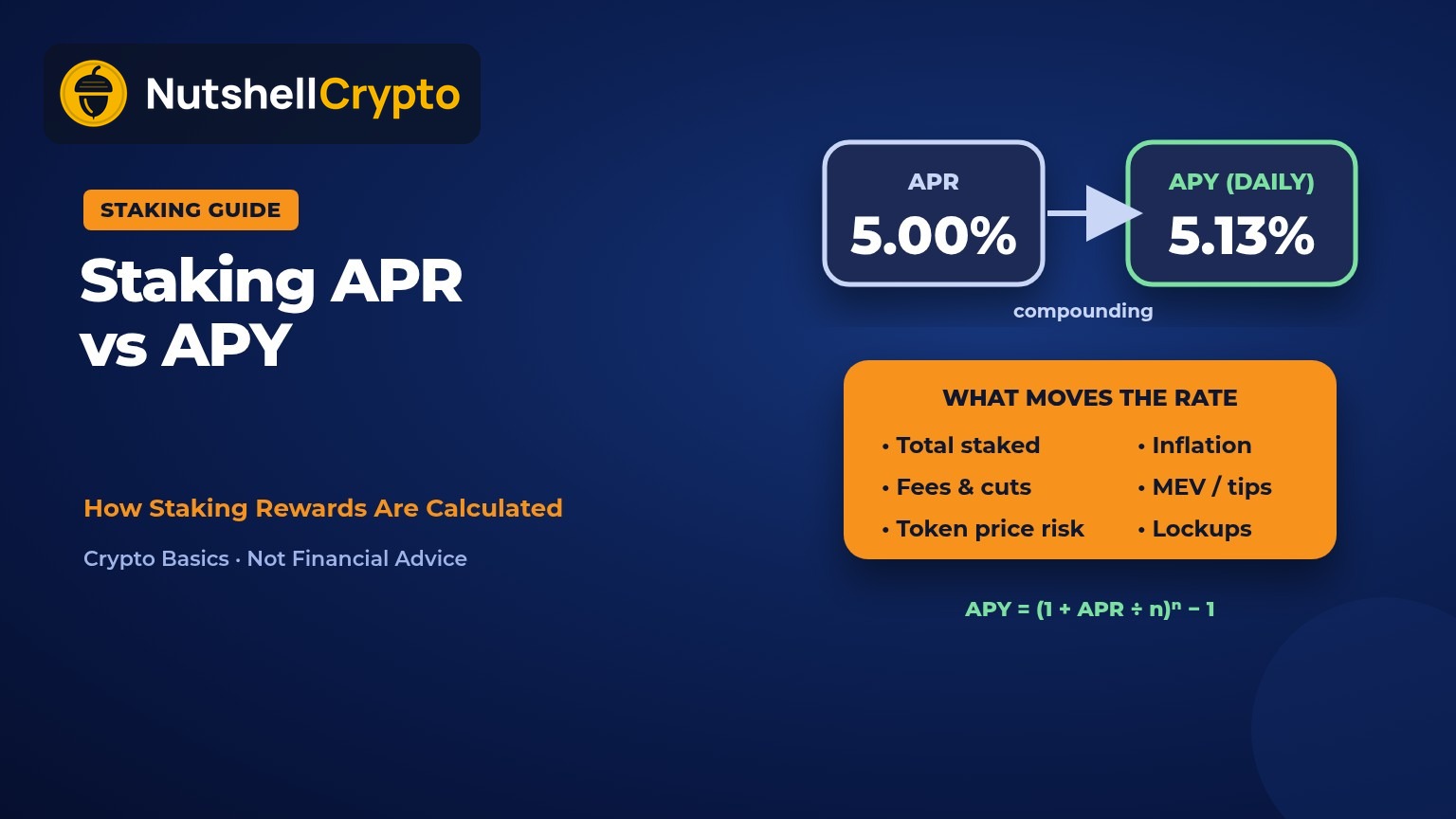
In a nutshell: Staking APR is the yearly reward rate on staked coins without compounding. APY is the same rate with compounding included, so it always looks a little higher. A 5% APR paid and restaked daily works out to about 5.13% APY. Neither number is fixed: staking rates move with how much of the coin is staked, network fees, validator commission and provider fees. Rewards are paid in the coin itself, so the token’s price matters far more than the rate. Educational only; not financial advice.
Last updated: October 28, 2026.
Every staking screen shows a percentage. Sometimes it says APR, sometimes APY, sometimes “up to.” Two platforms can show different numbers for the same coin, and the rate you see this week may not be the rate you get next month.
This guide explains what staking APR and APY mean, how to convert one into the other, where the rate actually comes from, and what it leaves out. The examples use real numbers we pulled on October 28, 2026.
Table of contents
What Is Staking APR?
APR stands for annual percentage rate. In staking, it is the share of your staked coins you would earn as rewards over one year if the current rate held and you never reinvested anything.
Stake 100 tokens at 5% APR and you would expect about 5 tokens in rewards after a year. The rewards are paid in the same token, not in dollars. If the token’s price changes, the dollar value of your stake and your rewards changes with it.
APR is the simpler and more honest way to show a raw rate, because it does not assume you will reinvest. Ethereum’s main staking page, for example, shows a “Current APR” (ethereum.org), and Lido’s API reports stETH rewards as an APR (Lido API).
APR vs APY: The Compounding Difference
APY stands for annual percentage yield. It takes the same rate and assumes every reward is added to your stake and starts earning too. That is compounding.
The conversion formula is:
APY = (1 + APR ÷ n)n − 1, where n is the number of times rewards are added per year.
The more often rewards compound, the bigger the gap. Here is what a 5% APR becomes at different payout schedules:
| How often rewards compound | n | APY from a 5% APR |
|---|---|---|
| Once a year | 1 | 5.00% |
| Monthly | 12 | 5.12% |
| Weekly | 52 | 5.12% |
| Daily | 365 | 5.13% |
At low rates, the difference is small. At high rates it grows. A 15% APR compounded daily is about 16.2% APY.
The catch: APY only applies if rewards really are restaked. Some systems do that for you. Lido says ETH rewards that are not needed for withdrawals are restaked daily (Lido Help Center). On other networks, or with your own validator, rewards may land in a separate balance and earn nothing until you stake them again. In that case, APR is the number to use.
Worked Examples
Example 1: Converting APR to APY
Lido’s API showed a 7-day average stETH APR of about 2.32% when we checked at 2:46 PM PKT on October 28, 2026 (Lido API). Since stETH rewards are added daily:
(1 + 0.0232 ÷ 365)365 − 1 ≈ 2.35% APY.
On 10 ETH, that is roughly 0.235 ETH of rewards in a year, if the rate stayed the same, which it will not. Our Lido staking guide covers how stETH works.
Example 2: Converting APY back to APR
Some platforms only show APY. To get APR back: APR = n × ((1 + APY)1/n − 1).
When we checked Kraken’s staking page at about 2:48 PM PKT on October 28, 2026, it listed Cosmos (ATOM) at 13.13% APY with weekly payouts (Kraken). With n = 52, that equals about 12.35% APR. Compare APR with APR and APY with APY. Mixing them makes one offer look better than it is.
Example 3: Simple vs compounded on $1,000
Say you stake $1,000 worth of a token at 8% APR and the price stays flat. Without restaking, you end the year with about $1,080. With daily compounding, you end with about $1,083. The $3 gap is real, but small next to the other things that move your result, covered below.
Why Staking APR Changes
A staking rate is not set by a bank. It mostly falls out of each network’s rules and how many people take part. Solana’s documentation puts it simply: returns depend on “the current inflation rate, total number of SOL staked on the network, and an individual validator’s uptime and commission (fee)” (Solana Docs).
1. New token issuance
Most proof-of-stake networks pay stakers with newly created tokens. The rate of new issuance sets the size of the reward pool.
- Solana: inflation started at 8% a year and falls by 15% each year toward a long-term 1.5% (Solana Docs). The network’s own
getInflationRatecall returned about 3.58% when we checked at 2:47 PM PKT on October 28, 2026 (Solana RPC). - Cosmos Hub: inflation floats between a minimum and maximum, rising when less than a target share of ATOM is staked and falling when more is (Cosmos SDK mint module). The Hub’s on-chain settings at 2:47 PM PKT showed a 7% minimum, 10% maximum and 67% target, with current inflation at the 10% cap (Cosmos Hub REST data).
2. How much is staked
The reward pool is shared by everyone who stakes. When more coins are staked, each one gets a smaller slice.
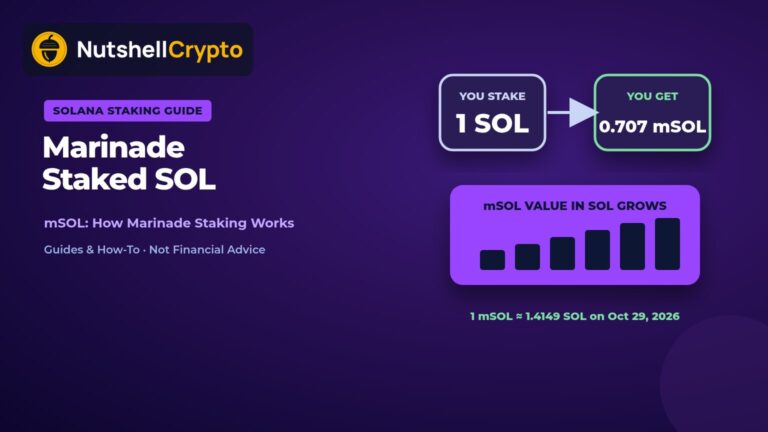
On Solana, about 437 million of roughly 637 million SOL was staked at 2:47 PM PKT on October 28, 2026, around 69%, based on the network’s getVoteAccounts and getSupply calls (Solana RPC). Divide 3.58% inflation by 69% staked and you get a rough gross rate of about 5.2% before validator commission. Liquid staking tokens landed nearby: DefiLlama showed JitoSOL at about 4.9% and mSOL at about 5.4% at 2:47 PM PKT (DefiLlama Yields).
On the Cosmos Hub, about 340 million of 539 million ATOM was bonded, or 63%. With 10% inflation and 2% going to the community pool, the rough gross rate is 10% × 0.98 ÷ 0.63 ≈ 15.5% before validator commission.
Ethereum works differently, but the idea is the same. Ethereum.org explains that total issuance grows with the square root of the number of validators, while each validator’s base reward shrinks by the same factor (ethereum.org). More ETH staked means a lower rate per ETH. When we checked on October 28, 2026, ethereum.org showed about 43.9 million ETH staked (35% of supply) and a 2.5% APR (ethereum.org). Validator Queue showed 44.1 million ETH and a 7-day staking APR of 2.45% at about 2:47 PM PKT (Validator Queue).
3. Transaction fees and MEV
On Ethereum, validators that propose blocks also collect priority tips and MEV (maximal extractable value), the extra value block builders pay for including and ordering transactions (ethereum.org: MEV). This part rises when the network is busy and falls when it is quiet, so it makes the rate bumpy. Lido’s daily APR readings moved between about 2.2% and 2.8% within a single week of October 2026 (Lido API).
4. Validator performance and commission
A validator that goes offline misses rewards. Validators also keep a commission. On the Cosmos Hub, the chain sets a 5% minimum commission (Cosmos Hub REST data), and many charge more. At 5%, the rough 15.5% ATOM rate becomes about 14.8%.
Nominal vs Real Yield
Here is the part most rate screens skip. If rewards come from new tokens, every holder’s share of the supply gets diluted. Stakers get the new tokens. Non-stakers do not.
So the headline rate is the nominal yield. The real yield is how much your share of the total supply actually grows:
Real yield ≈ (1 + staking rate) ÷ (1 + inflation) − 1
| Network (Oct 28, 2026, 2:47 PM PKT) | Inflation | Rough gross staking rate | Rough real yield |
|---|---|---|---|
| Solana | ~3.58% | ~5.2% | ~1.6% |
| Cosmos Hub | 10% | ~15.5% | ~5.0% |
The ATOM rate looks three times better than SOL’s, but most of it only offsets dilution. If you hold ATOM and do not stake, your share of the network shrinks by about 10% a year. Ethereum is a different case: it issues a small amount of new ETH but also burns part of every transaction fee, so its net supply change depends on network activity rather than a fixed schedule.
These rough numbers ignore commissions, fees and the fact that some tokens are locked or held by foundations. They are meant to show the idea, not to be exact.
How Providers Advertise Rates
Exchange and wallet rate screens tend to show the most flattering number. A few patterns to watch for:
- “Up to.” When we checked on October 28, 2026, Kraken’s staking page headline read “Earn staking rewards up to 21%” (Kraken). “Up to” is the top of a range, usually for one coin or one product. Most coins on the list paid far less.
- Before or after fees. The same Kraken page says its rates are “an estimate, before our commission.” The amount you actually receive is lower.
- APY instead of APR. APY is always the bigger number. Check which one you are reading.
- Past averages. Most rates are based on recent history, not a promise. Kraken describes its rates as based on average rewards “over the past period.”
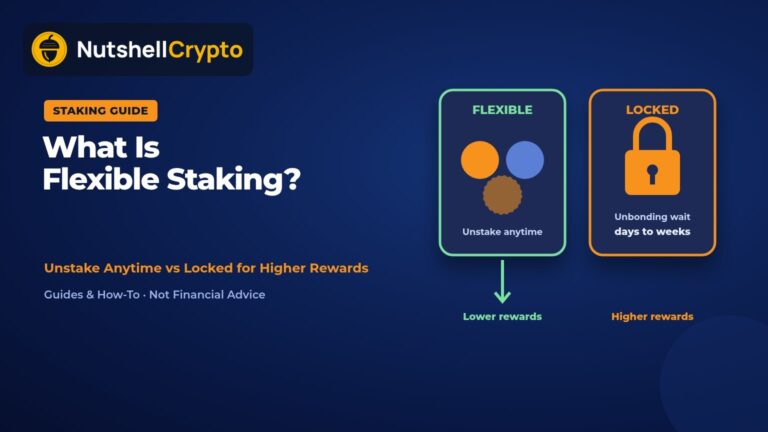
- Promotional or boosted rates. Higher rates for a limited time, a lockup or a minimum balance often go back down later. Our flexible vs locked staking guide shows how lockup options change the rate.
If a platform promises a fixed, high rate on a volatile coin, ask where the money comes from. Network rewards are never guaranteed.
Fees, Lockups and Timing
Provider fees
Fees are usually a percentage of your rewards, not of your stake. Lido keeps 10% of staking rewards (Lido Help Center). If the network pays 2.5%, a 10% fee leaves you about 2.25%. That is close to the 2.32% 7-day average Lido’s API showed, which also includes the ups and downs of fee and MEV income. Exchange fees vary by platform and coin, and they are often larger. Gas or network fees to stake and unstake come on top.
Waiting time to start earning
Rewards do not start the moment you click stake. On Ethereum, new validators join through an entry queue. At about 2:47 PM PKT on October 28, 2026, Validator Queue estimated the wait at about 22 days (Validator Queue). Pools like liquid staking protocols handle this for you, but the network delay still exists behind the scenes.
Unbonding
Getting out takes time too, and you usually earn nothing while you wait. The Cosmos Hub’s unbonding period is 21 days (Cosmos Hub REST data). Solana stake goes through a “cooldown” over epochs, and its docs say the exact duration “is difficult to predict” because it depends on other users (Solana Docs: Stake Accounts). If the price drops while you are waiting, you cannot sell.
Price Risk and Slashing
Price risk dwarfs the yield
Staking pays you more tokens, not more dollars. Stake $1,000 of a token at 5% APY. If the price falls 20% over the year, you end up with about $840, even after rewards. A 5% yield cannot cover a 20% drop. In crypto, a 20% move can happen in a week.
That is why a high APR on a small token is not automatically better than a low APR on a large one. The yield is the small number. The price is the big one.
Slashing
On networks with slashing, validators that break the rules lose part of their stake. Ethereum.org says provable misbehavior, such as signing two conflicting blocks, means “part of the validator’s stake is destroyed and the validator is forcibly removed from the network” (ethereum.org). If you delegate to that validator or use a pool that does, you can share the loss. Pick providers with long, clean records.
Platform risk
When an exchange stakes for you, you also rely on the exchange staying solvent. That risk is not in the APR at all.
Taxes on Staking Rewards
In the United States, the IRS says staking rewards are taxable income in the year you gain “dominion and control” over them, valued at their fair market value at that time (IRS Rev. Rul. 2023-14). That means daily or weekly rewards can each create a small taxable event, and selling them later can create a capital gain or loss.
In Canada, the CRA says income from staking may be business income or other income, depending on your situation (CRA).
Taxes cut your real return further. A 5% reward taxed as income is worth less than 5% to you. See our crypto staking taxes guide and ask a tax professional about your case.
Checklist Before You Trust a Staking Rate
- Is it APR or APY? If APY, how often does it compound, and is that automatic?
- Is it before or after the provider’s fee?
- Is it a current rate, a past average or an “up to” maximum?
- Where do the rewards come from: new tokens, fees, or something else?
- What is the coin’s inflation rate? What is the real yield after dilution?
- How long until rewards start, and how long to unstake?
- Is there slashing, and who covers it?
- How much could the token’s price fall while your coins are staked?
FAQ
What is a good staking APR?
There is no single good number. A rate only means something next to the coin’s inflation, fees and price risk. A 15% rate on a coin with 10% inflation can be worth less in real terms than it looks.
Is staking APR or APY higher?
APY, whenever rewards compound more than once a year. The same rate shown as APY will always be equal to or higher than APR.
Why does my staking APR keep changing?
Because it depends on how much of the coin is staked, network fees and MEV, validator performance and inflation settings. All of these move over time.
Is staking APR guaranteed?
No. Network staking rates are estimates. Rewards can drop, and your coins can lose value in dollars.
What does POS staking mean?
POS stands for proof of stake, the system in which validators lock up coins to help secure a network and earn rewards for it. Our guide to what staking is explains the basics.
Sources
- ethereum.org: Ethereum Staking
- ethereum.org: Proof-of-Stake Rewards and Penalties
- ethereum.org: Maximal Extractable Value (MEV)
- Validator Queue: Ethereum entry/exit queue and APR
- Lido API: stETH 7-day APR
- Lido Help Center: Do rewards compound?
- Lido Help Center: What fee is applied by Lido?
- Solana Docs: Staking and Inflation
- Solana RPC: getInflationRate
- Solana RPC: getVoteAccounts
- Solana Docs: Stake Accounts
- Cosmos SDK: Mint module
- Cosmos Hub REST: mint parameters
- Cosmos Hub REST: staking parameters
- DefiLlama Yields
- Kraken: Crypto Staking
- IRS: Revenue Ruling 2023-14
- CRA: Income from crypto mining and staking
This article is for education only and is not financial, tax or legal advice. Staking rates, fees and network rules change constantly; check current figures with the network or provider before staking.