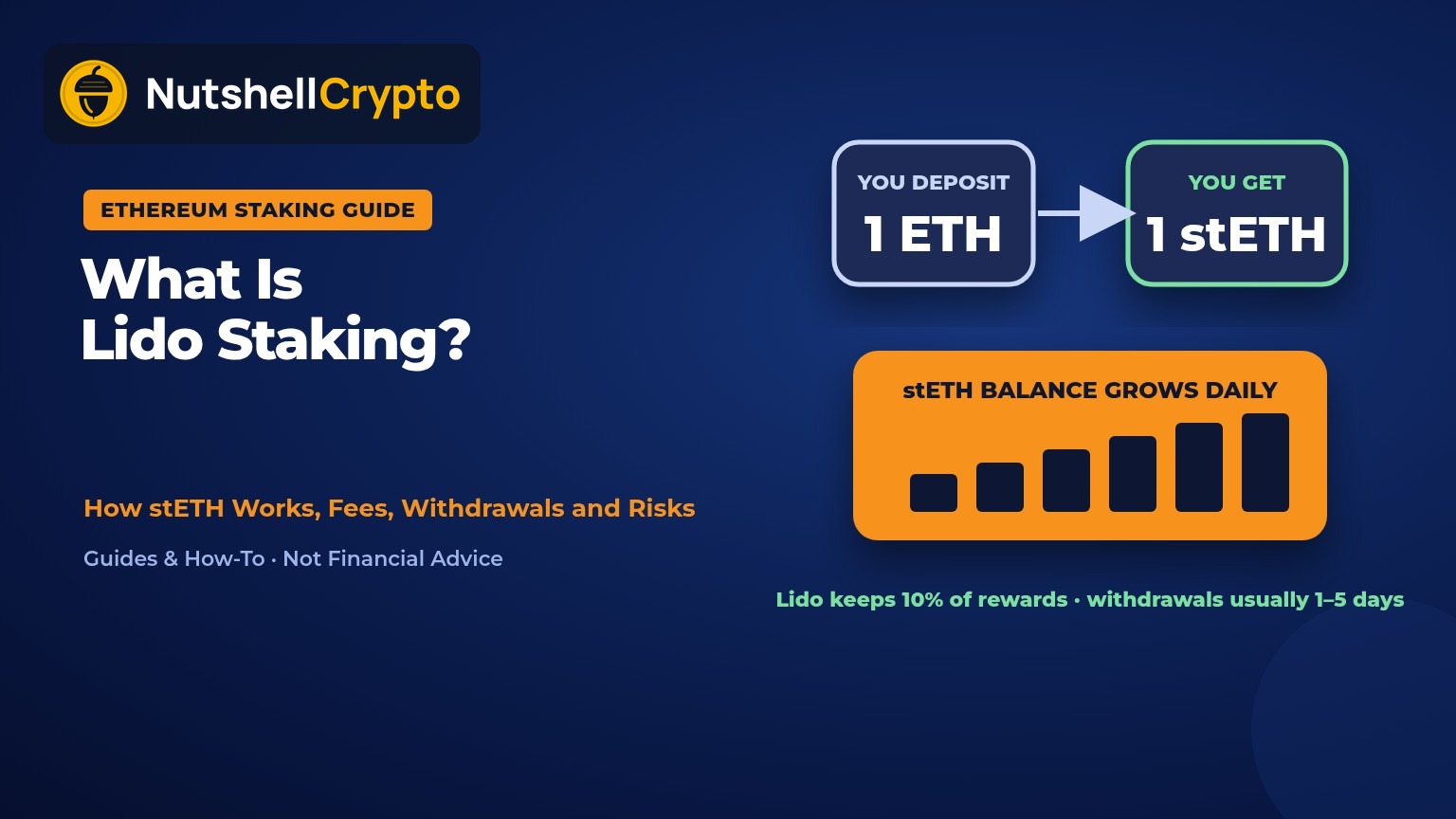
In a nutshell: Lido staking means depositing ETH into Lido, the largest Ethereum liquid staking protocol, and getting stETH back one-for-one. Your stETH balance grows every day as staking rewards are added, and you can hold, move or use it while your ETH stays staked. Lido keeps 10% of the rewards. To get ETH back you either request a withdrawal, which usually takes 1 to 5 days, or sell stETH on the market. Rewards are not guaranteed, and you take on smart contract, slashing and price risk. Educational only; not financial advice.
Last updated: October 28, 2026.
Running your own Ethereum validator takes 32 ETH and a machine that never goes offline. Most people who want staking rewards on a smaller amount end up choosing between an exchange and a liquid staking protocol, and Lido is the biggest protocol by far.
This guide walks through what Lido is, how stETH and wstETH work, how to stake and unstake, what Lido charges, and the risks that come with it.
Table of contents
What Is Lido Staking?
Lido is a set of smart contracts, run by a DAO, that stakes ETH on behalf of its users. Its help center says the protocol launched in December 2020 (Lido Help Center).
When you stake with Lido, your ETH is pooled with everyone else’s and sent to validators run by node operators. In return you receive stETH, a token that tracks your share of the pool. Lido’s docs list two main benefits: you can earn rewards on “as small a deposit as users want,” and the token stays usable in other apps instead of being locked (Lido Docs). That is the basic idea of liquid staking.
Lido is much larger than its rivals. When we checked DefiLlama at 11:05 AM PKT on October 28, 2026, Lido’s value locked on Ethereum was about $22.8 billion. The next-largest liquid staking entry, Binance staked ETH, was about $8.6 billion, and Rocket Pool was about $1.2 billion (DefiLlama).
How stETH Works
stETH is a “rebasing” token. Instead of each token gaining value, the number of tokens in your wallet goes up. Lido explains that “every day at 12PM UTC the amount of stETH in your address will increase with the current APR” (Lido Help Center: What is stETH?).
So if you stake 1 ETH, you start with about 1 stETH. At an APR of around 2.3%, a month later you would hold roughly 1.002 stETH, without doing anything. Lido says rewards compound automatically, because ETH that is not needed for withdrawals is restaked daily (Lido Help Center).
stETH is meant to track ETH, and most of the time it does. At 11:06 AM PKT on October 28, 2026, CoinGecko priced 1 stETH at about 1.0001 ETH, or roughly $2,349 (CoinGecko). That close link is not guaranteed, as the risks section below explains.
stETH vs wstETH
A balance that changes every day causes problems in some apps. Lido’s help center gives Uniswap as an example: its contracts are not built for rebasing tokens, so stETH placed there can miss out on rewards (Lido Help Center).
wstETH (“wrapped stETH”) fixes that. Your wstETH balance stays the same, and each wstETH becomes worth more stETH over time. Lido’s own example: wrap 100 stETH and you get 99.87 wstETH; unwrap later and you might receive 101 stETH (Lido Help Center: wstETH).
- Hold stETH if you just want to see your balance grow in your wallet.
- Use wstETH for DeFi apps, layer 2 networks and lending markets that expect a fixed balance.
Who Runs Lido’s Validators?
You never pick a validator yourself. Lido spreads deposits across several “staking modules,” each with its own rules for who can run validators. Lido’s Node Operator Portal lists a permissioned Curated module for professional operators, a Simple DVT module that uses distributed validator technology from Obol and SSV, and the Community Staking Module (CSM), which is open to anyone who posts a bond (Lido Node Operator Portal).
The DAO, which votes with the LDO token, approves the professional operators and sets the protocol’s parameters (Lido Docs). That makes Lido more curated than Rocket Pool, where any operator with a bond can join.
How to Stake ETH With Lido
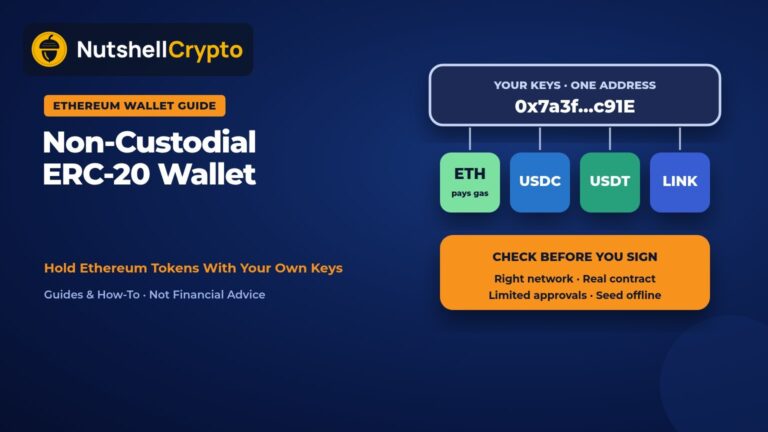
You need a self-custody wallet such as MetaMask or a hardware wallet. If you are new to that, start with our self-custody guide. The steps are short:
- Go to the official staking app at stake.lido.fi and connect your wallet.
- Enter the amount of ETH you want to stake and review the stETH you will receive.
- Confirm the transaction in your wallet and pay the Ethereum gas fee.
- Check that stETH arrives in your wallet. You may need to add the token so it shows up.
Lido notes that it may not be able to serve some countries “due to regulatory uncertainty.” In that case, its help center points to buying stETH on exchanges like Curve or 1inch instead (Lido Help Center). Buying on a decentralized exchange can come with slippage, so compare the rate first.
On small deposits, gas fees can eat a big part of a year’s rewards, so check the fee before you confirm. If you use a Ledger, our Ledger staking guide covers connecting a hardware wallet.
How Lido Withdrawals Work
There are two ways to turn stETH back into ETH.
1. Withdraw through Lido. This is a two-step process. You lock your stETH or wstETH in a withdrawal request, then claim your ETH once the request has been processed (Lido Help Center: Withdrawals). Lido says that “under normal circumstances” this takes 1 to 5 days, but it can take longer when the queue is long, when Ethereum’s validator exit queue is busy, or in a rare “Bunker mode” after mass slashing events (Lido Help Center: Withdrawal time). You stop earning rewards on the amount you withdraw.
2. Sell on the market. You can swap stETH for ETH on a DEX or aggregator straight away. That is faster, but the price can be slightly below 1 ETH, and much lower during a panic.
Lido Fees and Rewards
Lido’s main fee comes out of your rewards rather than your deposit, though you still pay Ethereum gas on each transaction. Lido’s help center says it “applies a 10% fee on staking rewards,” split between node operators and the DAO treasury, and that the DAO can change it by vote (Lido Help Center: Fees).
What you see is the rate after that fee. Lido’s own API showed a 7-day average stETH APR of about 2.32% when we checked at 11:05 AM PKT on October 28, 2026 (Lido API). The rate moves with network activity, and it is paid in ETH. If the price of ETH falls, your position can still lose value in dollars.
| Lido (stETH) | Rocket Pool (rETH) | Exchange staking | |
|---|---|---|---|
| Who holds the ETH | Smart contracts; you hold stETH | Smart contracts; you hold rETH | The exchange |
| How rewards show up | stETH balance grows daily | Each rETH is worth more ETH over time | Coins credited to your account |
| Fee on rewards | 10% | Up to 14% | Set by the exchange |
| Validator operators | Mostly DAO-approved, plus a permissionless module | Anyone with a bond | The exchange or its partners |
For other ways to stake, see our guide on how to stake Ethereum.
If you are weighing Lido against an exchange-run option, see how Coinbase’s cbETH handles rewards and fees.
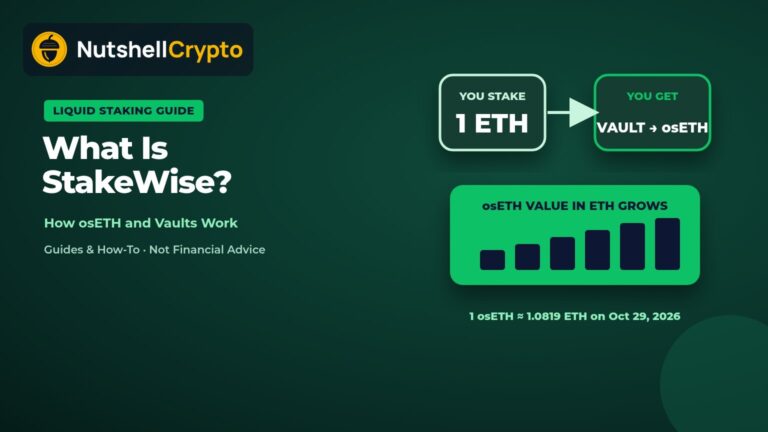
StakeWise takes a different approach, letting you choose a separate Vault with its own fee; see our guide to StakeWise and osETH.
Risks of Lido Staking
Lido’s own risk page lists smart contract risk, slashing risk and stETH price risk, among others (Lido Help Center: Risks). Here is what each means for you.
Smart contract risk
Your ETH sits in code. Lido says its code is open source, audited and covered by a bug bounty, but a bug or exploit could still cause losses.
Slashing risk
Validators that break Ethereum’s rules can be penalized. Lido’s risk page says “up to 100% of staked funds” are at risk if validators fail, and it spreads stake across many operators and keeps a reserve funded from fees to soften the impact.
stETH price risk
stETH can trade below ETH. This happened in June 2022, when CoinDesk reported stETH’s discount to ETH reached a record of about 8% as lenders like Celsius came under stress (CoinDesk). Withdrawals were not yet possible then; they are now, which helps, but a discount can still appear when many people rush to sell.
DeFi and leverage risk
Many people deposit stETH or wstETH into lending apps and borrow against it. If prices move, that can lead to liquidation, and each extra app adds its own smart contract risk.
Governance risk
The fee, the operator list and protocol upgrades are decided by LDO holders. Lido has also shut down products before: it ended staking on Polygon in December 2024 after a DAO vote (Lido Help Center).
Phishing
Fake Lido sites and “support” accounts are common. Type the address yourself, and never share your seed phrase with anyone.
US and Canada Notes
United States: In an August 5, 2025 staff statement, the SEC’s Division of Corporation Finance said that certain liquid staking arrangements, and the receipt tokens they issue, do not involve securities offerings, depending on the facts (SEC). It is a staff view, not a rule, and it does nothing to protect you from losses.
Canada: Lido is a DeFi protocol, not a registered Canadian crypto trading platform, so the investor protections that come with registration do not apply. Our guide to regulated crypto exchanges in Canada explains what registration covers.
Taxes on stETH
Two questions come up. First, swapping ETH for stETH, or stETH for ETH, may be treated as a disposal. Second, the daily stETH rebases are new tokens arriving in your wallet. The IRS says staking rewards count as income once you have control of them (IRS Rev. Rul. 2023-14), but it has not said exactly how that applies to liquid staking tokens. In Canada, the CRA says staking rewards may be business income or another type of income depending on your situation (CRA). Keep records of daily balances and every swap, and ask a tax professional. Our crypto staking taxes guide has the basics.
FAQ
Is Lido staking safe?
Lido is the largest and one of the longest-running Ethereum liquid staking protocols, but it is not risk-free. Smart contract bugs, slashing and stETH trading below ETH can all lead to losses.
Is there a minimum to stake with Lido?
Lido’s docs say you can earn rewards on “as small a deposit as users want.” In practice, gas fees make very small deposits hard to justify.
How long does it take to unstake from Lido?
Usually 1 to 5 days through Lido’s withdrawal queue, according to its help center, and sometimes longer. Selling stETH on the market is faster but may cost you a small discount.
What is the difference between stETH and wstETH?
stETH’s balance grows daily. wstETH keeps a fixed balance, and each token becomes worth more stETH over time. They represent the same staked ETH.
What is LDO?
LDO is Lido’s governance token, used to vote on DAO proposals. You do not need LDO to stake ETH, and staking does not pay you LDO.
Sources
- Lido Docs: Introduction
- Lido Help Center: What is stETH?
- Lido Help Center: What is wstETH?
- Lido Help Center: Why would I wrap my stETH?
- Lido Help Center: Do rewards compound?
- Lido Help Center: What fee is applied by Lido?
- Lido Help Center: How withdrawals work
- Lido Help Center: How long a withdrawal takes
- Lido Help Center: What are the risks of staking with Lido?
- Lido Help Center: Country availability
- Lido Help Center: Sunsetting Lido on Polygon
- Lido Node Operator Portal
- Lido API: stETH 7-day APR
- DefiLlama: Lido
- CoinGecko: Lido Staked Ether
- CoinDesk: Staked Ether becomes focus of crypto stress (June 14, 2022)
- SEC: Statement on Certain Liquid Staking Activities (Aug 5, 2025)
- IRS: Revenue Ruling 2023-14
- CRA: Income from crypto mining and staking
This article is for education only and is not financial, tax or legal advice. Rates, fees and protocol rules change; check Lido’s current documentation before staking.