

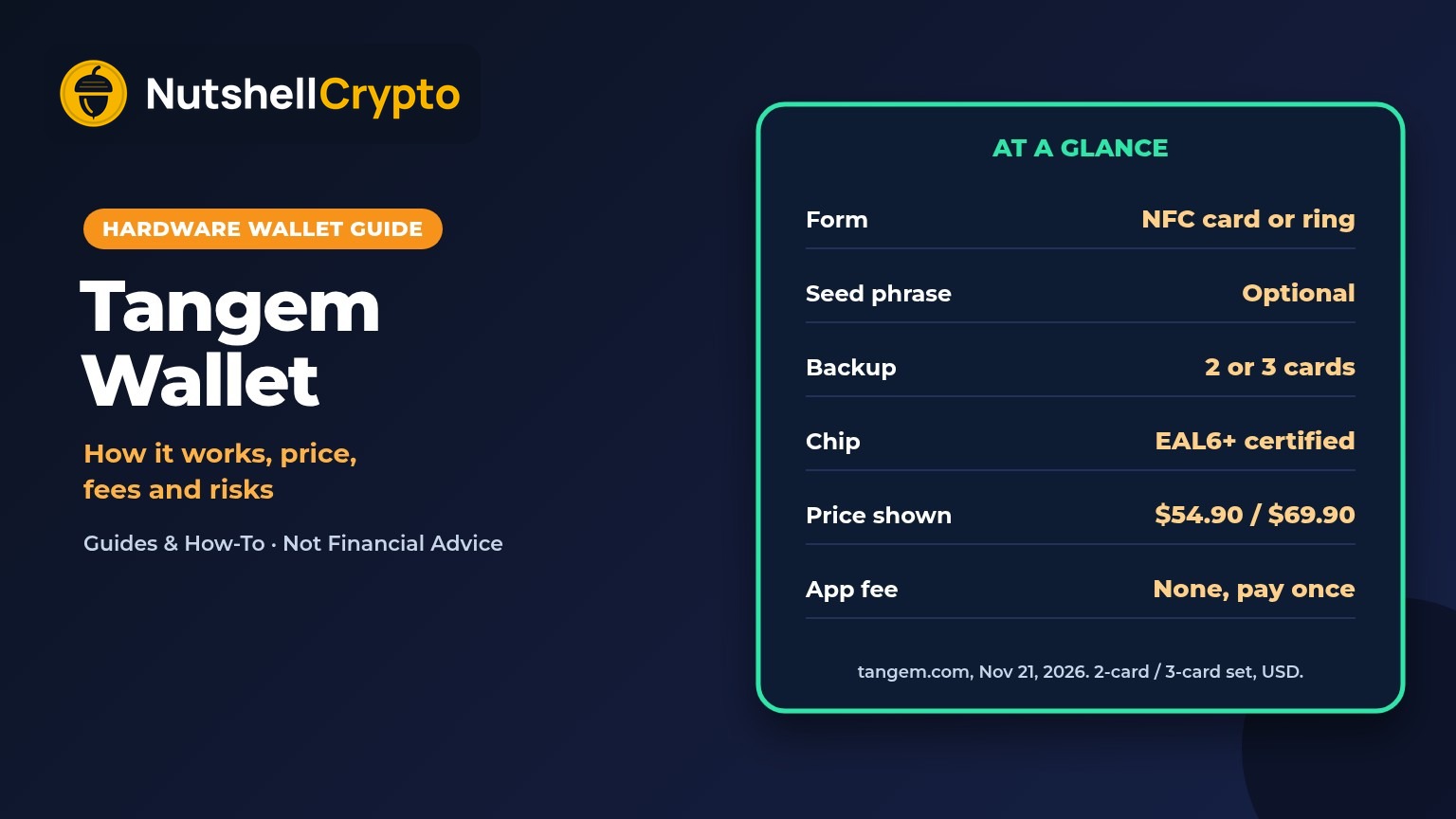
In a nutshell: Tangem Wallet is a hardware wallet in the shape of an NFC card (or a ring) that works with the free Tangem app on your phone. Your private key is created inside a certified chip, and two or three cards hold copies of the same wallet, so you don’t need a seed phrase unless you want one. A 2-card set was listed at $54.90 and a 3-card set at $69.90 on Tangem’s site when we checked, with no subscription. Educational only; not financial advice.
Tangem Wallet is a self-custody hardware wallet made of NFC cards or a ring that you tap on your phone to sign transactions in the Tangem app. There’s no battery, cable or screen on the device, and backup cards replace the usual 12 or 24-word recovery phrase, though a seed phrase is still an option.
This guide covers how Tangem works, what the packs cost (checked on November 21, 2026, at about 3:10 PM PKT on Tangem’s pricing page), what fees you’ll actually pay, which coins it supports, how to set it up and withdraw, the real risks, how it compares with Ledger, and short tax notes for the US, Canada and Australia.
Table of contents
What Is Tangem Wallet?
Tangem is a Swiss company, Tangem AG, based in Zug. Its main product is a hardware wallet the size of a bank card. Each card holds a secure chip and an NFC antenna, and it draws power from your phone’s NFC module when you tap it, so there is nothing to charge. Tangem says it has sold more than 6 million devices and that the app has more than 7 million downloads.
Like any cold wallet, Tangem is non-custodial: you hold the keys, not an exchange. If you’re new to that idea, our guide to self-custody in crypto explains what it means in practice, and hot wallet vs cold wallet shows where a card like Tangem fits.
There’s also the Tangem Ring, a zirconia ceramic ring with the same chip inside. Tangem says it works the same as the cards, it comes with two backup cards, and it can’t be bought on its own. Sizes run from 6 to 13 (US).
How Tangem Wallet Works
When you activate a Tangem set, the chip on the first card generates a random private key. The app then links your second and third cards, and the key is copied to them over an encrypted connection. Each card ends up holding the same wallet, and the key is meant to never leave the chips. You approve every transaction by tapping a card and entering your access code (or using your phone’s biometrics).
That’s why Tangem calls itself “seedless by design.” Tangem’s FAQ lists three ways to create a wallet:
- Let the chip’s hardware random number generator create the key, with no seed phrase anywhere (Tangem’s recommended option).
- Generate a seed phrase in the Tangem app and load it onto the cards.
- Import a seed phrase from another wallet.
The seedless route removes the risk of someone finding a written phrase, but it also means your cards are your only backup. A seed phrase gives you a way back if every card is lost, at the cost of having a phrase to protect. Our guide to what a seed phrase is and how to store it covers that trade-off, and if you like the no-phrase idea in app form, compare it with Zengo, the no-seed-phrase mobile wallet.
Block’s Bitkey wallet takes another seedless route, splitting bitcoin control across three keys instead of copying one key to cards.
One detail matters a lot: backups can only be created once. Tangem’s device loss help page says you can’t add new cards to an existing wallet later. If you lose a card, you buy a new set and move your funds to a new wallet.
Chip, Audits and Security Claims
Tangem says every wallet uses a microchip developed with Samsung Semiconductor and certified to Common Criteria EAL6+, the same level it compares to a biometric passport. Its security help page says the firmware was audited by Kudelski Security in 2018 and by Riscure in 2023, and that both found no backdoors and confirmed the firmware can’t be updated. The app checks that a card is genuine each time you tap it.
The homepage claims “zero out of 6,000,000 cards hacked since launch in 2017.” That’s Tangem’s own statement, not an independent finding, so treat it as a company claim.
The firmware is closed source. Tangem explains in a blog post on immutable firmware that it keeps the card code private but formally audited, and that it’s written to the chip at the factory with no update path. Tangem describes its app as open source, and the code is public on GitHub, but the license file in the iOS app repository says “this is not an open source license” and allows only personal, non-commercial use. You can read and build the code yourself, but it isn’t open source in the usual sense. Our page on open-source crypto wallets explains why some users care about this.
Tangem also says the device is rated IP69K for water and dust, works from -25 to 50°C, and comes with a 25-year limited hardware warranty.
Tangem Wallet Price and Packs
These are the US dollar prices shown on Tangem’s pricing page on November 21, 2026, at about 3:10 PM PKT. Prices change with promotions and can differ by country, so check the page before you buy.
| Pack | What’s in it | Price shown |
|---|---|---|
| 2-card set | Two cards, one wallet | $54.90 |
| 3-card set | Three cards, one wallet | $69.90 |
| Family Pack | Two sets, two separate wallets | $139.80 |
| Ring and 2 cards | Tangem Ring plus two backup cards | $160.00 |
| Pro Kit | Tangem’s all-in-one bundle | $180.00 |
Taxes and customs duties are not included. The page also offered “up to $20 in Bitcoin” credited to new wallets within 14 days of activation at the time of our check. Tangem’s own FAQ says the 3-card set is the safer choice: with two cards, losing one and forgetting your access code would leave you unable to reset or recover the wallet.
Buy only from Tangem’s site or an official reseller. A second-hand or already-activated card is a risk, since someone else may have set it up first.
Tangem Fees
There is no monthly fee. Tangem’s pricing FAQ says you pay for the wallet once, the app is free, and there are no subscription or maintenance fees. The costs you’ll see after that come from other parties:
- Network fees when you send or swap crypto. These go to the blockchain, not to Tangem.
- Swap provider fees. Tangem’s swap help page says in-app swaps run through third-party providers, and the fee is shown in the swap window before you confirm. Tangem’s own swap fees guide puts provider fees at typically 0.5% to 1.5%.
- Buy and sell fees charged by payment partners such as MoonPay. MoonPay’s sell page says fees range from 1% for bank transfers to 4.5% for Visa cards.
Supported Coins and App Features
Tangem says its wallet supports more than 20,000 tokens across more than 100 blockchains, including Bitcoin, Ethereum and common token standards.
Besides storing and sending, the app lets you buy, sell, swap and stake through integrated providers, and connect to dApps. There’s also Tangem Pay, an optional Visa card that spends USDC or USDT and works with Apple Pay and Google Pay. Tangem’s Tangem Pay announcement says it requires identity checks, uses a separate payment balance from your wallet, and is available in the US and select countries in Latin America, Asia-Pacific, the Middle East and Africa. Not all countries or US states are covered.
If you mainly hold stablecoins, our stablecoin wallet guide compares other options.
How to Set Up Tangem Wallet
Tangem’s setup guide walks through activation, which Tangem says takes a couple of minutes:
- Download the Tangem app from the App Store or Google Play. Your phone needs NFC.
- Tap Create wallet and choose a card or ring.
- Scan your first card by holding it against the back of your phone.
- Choose how to create the key: on the chip (no seed phrase) or with a seed phrase.
- Add and scan your backup cards, then finalize the backup. Backup cards must be new and empty.
- Set an access code of at least 4 characters and scan each card again to save it.
- Store the backup cards in different places, away from the card you carry.
Before moving a large amount, send a small test transaction. Our guide on how to transfer crypto to a cold wallet covers the steps, and how crypto wallet addresses work helps you avoid sending to the wrong network.
How to Withdraw from Tangem Wallet
Yes, you can withdraw at any time, in two main ways:
- Send to an exchange or another wallet. Open the coin in the app, tap Send, paste the address, check the network, and tap your card to sign. Then sell on the exchange and withdraw cash there.
- Sell in the app. Tangem’s selling help page says you can tap Transfer, then Sell, and cash out to a bank account or card through MoonPay. MoonPay will likely ask for ID, and the Sell button is disabled if MoonPay doesn’t support your token or country.
Tangem Wallet Risks
- Losing every card. Tangem’s help page is blunt: losing all your devices means losing your funds unless you created a seed phrase. Tangem can’t recover them.
- Forgetting the access code. You can reset it only with another card from the same wallet that has code recovery turned on, according to Tangem’s access code help page. Wrong guesses aren’t wiped; instead, Tangem adds a delay of up to 45 seconds per attempt, so a long access code matters if a card is stolen.
- No screen on the device. You check addresses and amounts on your phone, not on the card. That makes phone malware and fake apps a bigger worry than with a wallet that has its own display.
- App dependence. The cards work through the Tangem app. Tangem says no Tangem servers are involved in transactions, but you still rely on its app to use the device.
- Closed firmware. You trust the audits rather than reading the card code yourself.
These points come up often in community threads. In a r/Bitcoin discussion of the Tangem card, users praised the simple tap-to-sign design but raised the lack of on-device address checks, NFC reliability and reliance on the app.
Tangem vs Ledger
Ledger is the best-known hardware wallet brand. Its entry device, the Ledger Nano S Plus, has its own small screen, connects by USB-C, uses an EAL6+ secure element, supports 15,000+ coins and comes with recovery sheets for a seed phrase. Ledger’s shop listed it at $62 during a Black Friday sale when we checked on November 21, 2026.
| Tangem | Ledger Nano S Plus | |
|---|---|---|
| Form | NFC card or ring | USB-C device with screen |
| Backup | 2 or 3 cards; seed phrase optional | Seed phrase |
| Screen to verify transactions | No (uses phone) | Yes |
| Battery or charging | None | None (powered over USB) |
| Firmware updates | None (fixed at factory) | Yes |
Neither is fully open source; Tangem’s own Tangem vs Ledger comparison says the same about both. Tangem suits people who want a simple, phone-first wallet with no seed phrase to hide. Ledger suits people who want to confirm every address on a separate screen. If you go with Ledger, our Ledger staking guide shows how to earn on coins you hold there. For an offline approach with no wireless link at all, see how air-gapped hardware wallets work.
If you want to compare another card and screen option, our ELLIPAL Wallet guide covers the NFC X Card and the air-gapped Titan 2.0.
US, Canada and Australia Tax Notes
United States: The IRS treats crypto as property. Its digital assets page says moving crypto between wallets you own is not a taxable transaction, unless you pay the network fee in crypto, which counts as a digital asset transaction. Selling, swapping or spending crypto, including through a crypto card, can create a capital gain or loss you must report. Our guide to crypto taxes in the US has the details.
Canada: The CRA’s page on crypto-assets and your tax obligations lists selling, trading and paying for goods or services with crypto as dispositions you must value and report. Staking rewards are listed as an acquisition you must value too. See our guide to cryptocurrency tax in Canada, and whether transferring crypto is taxed for wallet-to-wallet moves.
Australia: The ATO says using crypto to load or top up a debit card is a CGT disposal, as explained on its crypto and debit cards page.
FAQ
Is Tangem a good wallet?
It’s a solid fit if you want an easy cold wallet with no seed phrase to manage. Its chip carries EAL6+ certification and its firmware has been audited twice, according to Tangem. The trade-offs are no screen on the device, closed firmware and full reliance on your backup cards.
Is Tangem better than Ledger?
Neither is better for everyone. Tangem is cheaper to start, needs no charging and can skip the seed phrase. Ledger has a screen for checking every transaction on the device and uses a standard seed phrase backup.
Is there a monthly fee for Tangem Wallet?
No. Tangem says you pay once for the cards, and the app has no subscription or maintenance fees. You still pay network fees and any swap, buy or sell provider fees.
Can you withdraw from Tangem Wallet?
Yes. You can send crypto to an exchange and cash out there, or use the in-app Sell option, which pays out to a bank account or card through MoonPay where supported. Expect an ID check and a provider fee.
Is Tangem safe from hackers?
The private key stays inside a certified chip, and every transaction needs the physical card plus your access code. Tangem says no card has been hacked since 2017, but that’s a company claim. The bigger real-world risks are phishing, fake apps and buying a card someone else has already set up.
How long will a Tangem wallet last?
Tangem says its cards are built to last at least 25 years and backs that with a 25-year limited hardware warranty. There’s no battery to wear out, but keep backup cards in safe, separate places in case one fails.
This article is for education only and isn’t financial or tax advice. Prices, fees and features change; check Tangem’s current pages before you buy.


