In a nutshell: Satoshi Nakamoto is the pseudonym used by the person, or possibly group, who wrote the Bitcoin whitepaper in 2008, launched the Bitcoin network in January 2009, and then stepped away in 2010–2011. Nobody has proven who Satoshi really is. Many people have been named, and in 2024 a UK court ruled that one claimant, Craig Wright, is not Satoshi. Educational only; not financial advice.
Last updated: October 7, 2026.
Bitcoin is worth hundreds of billions of dollars, yet nobody knows for sure who created it. So who is Satoshi Nakamoto? This guide covers everything that is actually documented: what Satoshi said about himself, the full timeline from the whitepaper to his last known emails, the ideas he built on, how many coins he may hold, and every major person who has been named as Satoshi, with what each one said in response. We quote Satoshi’s own emails and forum posts wherever possible. New to the coin itself? Start with our beginner’s guide to what Bitcoin is.
Table of contents
Who Is Satoshi Nakamoto?
Satoshi Nakamoto is the name signed on Bitcoin: A Peer-to-Peer Electronic Cash System, the nine-page whitepaper that introduced Bitcoin. The same name released the first Bitcoin software, mined the first block, and led development until late 2010. Then Satoshi handed the project to other developers and stopped communicating publicly.
Here is what is known for certain: Satoshi wrote the whitepaper and the original code, and left a long public record of emails and forum posts. Here is what is not known: Satoshi’s real name, nationality, age, or whether “Satoshi” was one person or a team. In this article we say “he” because Satoshi described himself as a man. That is his own claim, not a verified fact.
What Satoshi Said About Himself
The P2P Foundation profile
Satoshi said almost nothing personal. The main exception is his profile on the P2P Foundation website, where he announced Bitcoin in February 2009. An archived copy of that profile from 2012 lists him as “37, Male, Japan.” As CoinDesk explains, the age shown on the profile in later years points to a birth date of April 5, 1975.
Many people doubt that date is real. April 5, 1933 is the date of U.S. Executive Order 6102, which banned private ownership of gold, and the ban was lifted at the end of 1974. CoinDesk notes the theory that Satoshi picked the date as a nod to government control of money. Either way, treat the age, birthday and Japanese location as Satoshi’s claims, not facts.
Clues in his writing and posting times
Satoshi wrote fluent, native-sounding English. In a 2011 Wired feature, Benjamin Wallace pointed out that Satoshi’s forum posts and code comments used British spellings such as “optimise” and “colour.” He also noted that the genesis block quotes a headline from The Times of London (more on that below).
Wired also described an analysis by Swiss developer Stefan Thomas, who charted the timestamps of more than 500 of Satoshi’s forum posts. Almost no posts appeared between 5 a.m. and 11 a.m. GMT (midnight to 6 a.m. Eastern Time), even on weekends. That looks like someone sleeping on a North American schedule, not a Japanese one. A 2026 documentary cited a separate timing analysis that also pointed to the Americas (see Len Sassaman below). None of this proves anything. A careful person could fake spellings or post at odd hours.
One person or a group?
Satoshi always wrote as “I.” Still, some researchers and journalists think a small team could have been behind the name, partly because the design and code were so polished. The Wired feature quoted early developer Laszlo Hanyecz, who emailed with Satoshi: “Bitcoin seems awfully well designed for one person to crank out.” Security researcher Dan Kaminsky told Wired he suspected “a small team.” This question is still open.
Before Bitcoin: The Ideas Satoshi Built On
Bitcoin did not come out of nowhere. Since the 1990s, a community of privacy-minded programmers known as the cypherpunks had tried to build digital cash that did not depend on banks. Several earlier designs fed directly into Bitcoin:
| Idea | Creator | Year | What Bitcoin borrowed |
|---|---|---|---|
| Hashcash | Adam Back | 1997 (paper 2002) | Proof-of-work: computers must do costly calculations, the basis of Bitcoin mining |
| b-money | Wei Dai | 1998 | An anonymous, distributed electronic cash system created through computational work |
| RPOW (Reusable Proofs of Work) | Hal Finney | 2004 | Making proof-of-work tokens transferable from person to person |
| Bit gold | Nick Szabo | Idea from the late 1990s; blog post 2005 | Digital scarcity tied to costly computation, without a trusted third party |
The Bitcoin whitepaper directly cites two of these. Its first reference is Wei Dai’s b-money, and it says Bitcoin uses “a proof-of-work system similar to Adam Back’s Hashcash.” The Hashcash paper itself dates the original proposal to May 1997.
Satoshi’s main breakthrough was solving the double-spending problem without a central company. Earlier systems needed a trusted server to stop people from spending the same digital coin twice. Bitcoin uses a public chain of blocks secured by proof-of-work, so the whole network agrees on one history of transactions. Satoshi summed it up in his February 2009 P2P Foundation post: “The root problem with conventional currency is all the trust that’s required to make it work.”
Satoshi Nakamoto Timeline: From Whitepaper to Silence
Here are the key dates, all checked against primary sources (Satoshi’s archived emails and posts, the blockchain itself, and court records). Times are UTC unless noted.
| Date | Event |
|---|---|
| Aug 18, 2008 | Domain bitcoin.org registered |
| Aug 20–22, 2008 | Satoshi emails Adam Back, then Wei Dai, about a draft paper |
| Oct 31, 2008 | Whitepaper announced on the Cryptography mailing list |
| Jan 3, 2009 | Genesis block (block 0) created, with The Times headline |
| Jan 8, 2009 | Bitcoin v0.1 announced; the network starts running |
| Jan 12, 2009 | First bitcoin transaction: 10 BTC from Satoshi to Hal Finney (block 170) |
| Feb 11, 2009 | Satoshi announces Bitcoin on the P2P Foundation forum |
| Nov 22, 2009 | Satoshi opens the new Bitcoin forum (later BitcoinTalk) |
| Aug 15, 2010 | Value overflow bug; Satoshi releases a fix the same day |
| Dec 5, 2010 | Satoshi asks WikiLeaks not to use Bitcoin yet |
| Dec 12, 2010 | Satoshi’s last known public forum post |
| Dec 19, 2010 | Gavin Andresen takes over project management “with Satoshi’s blessing” |
| Apr 23 & 26, 2011 | Last known emails: “I’ve moved on to other things” |
| Mar 2014 | “I am not Dorian Nakamoto” appears on Satoshi’s old P2P Foundation account |
2008: The domain, the first emails and the whitepaper
Satoshi said he had been coding Bitcoin for a while before anyone saw it. In a November 17, 2008 email he wrote that he had worked through the details “over the last year and a half while coding it.”
The domain bitcoin.org was registered on August 18, 2008, according to public domain registration records (RDAP). Around the same time, Satoshi contacted Adam Back. Those emails became public in February 2024 when they were entered as evidence in a UK court case. As Bitcoin Magazine reported, they show Satoshi asking Back how to cite Hashcash, and Back pointing him to Wei Dai’s b-money. Satoshi then wrote to Dai.
On October 31, 2008, Satoshi posted to the Cryptography mailing list hosted at metzdowd.com. The original message begins: “I’ve been working on a new electronic cash system that’s fully peer-to-peer, with no trusted third party.” It linked to the whitepaper and listed the main features: double-spending prevented by a peer-to-peer network, no mint or trusted parties, and new coins made from “Hashcash style proof-of-work.” Many cryptographers on the list were skeptical. Hal Finney, one of the few enthusiastic readers, later recalled that Satoshi “got a skeptical reception at best.”
January 2009: The genesis block and Bitcoin v0.1
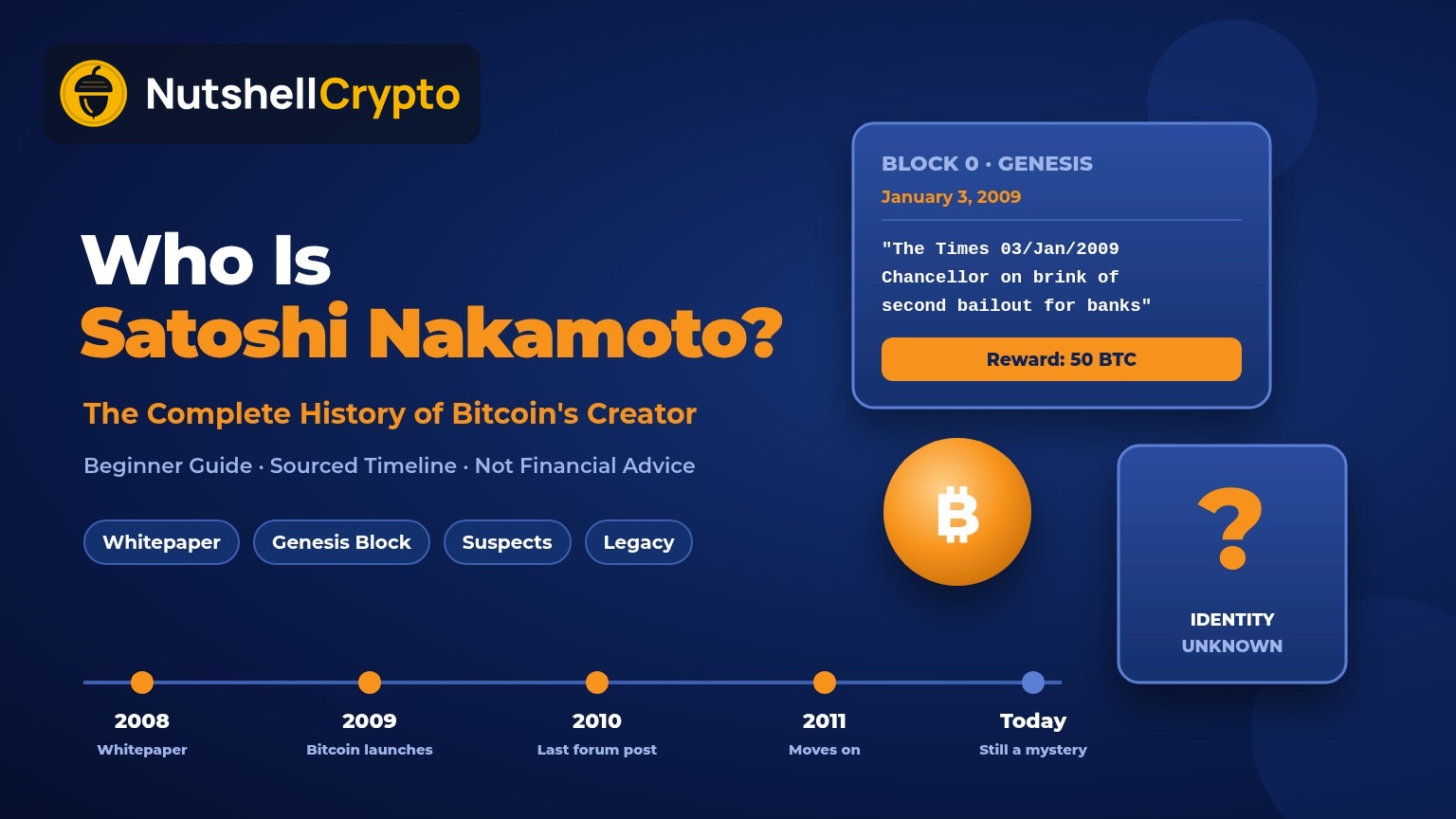
The first block in Bitcoin’s blockchain, called the genesis block or block 0, carries a timestamp of January 3, 2009, 18:15:05 UTC. Inside its first transaction, Satoshi embedded this text:
“The Times 03/Jan/2009 Chancellor on brink of second bailout for banks”
That was a real front-page headline from the British newspaper The Times that day. It proves the block could not have been made before that date. Many readers also see it as a comment on the bank bailouts of the 2008 financial crisis. The genesis block paid a 50 BTC reward that, because of how the code handles this one special block, can never be spent (see the Bitcoin Wiki).
On January 8, 2009, Satoshi announced Bitcoin v0.1 on the same mailing list. It was Windows-only, open source, and hosted on SourceForge. Some sources give January 9 because of time zones; the first block after the genesis block is timestamped January 9, 2009. The announcement already spelled out the famous supply cap: “Total circulation will be 21,000,000 coins,” with new issuance “cut in half every 4 years.” That schedule is what we now call the Bitcoin halving.
The first bitcoin transaction: Satoshi to Hal Finney
Hal Finney, a well-known cryptographer, downloaded the software right away. In his March 2013 BitcoinTalk post “Bitcoin and me,” he wrote: “I think I was the first person besides Satoshi to run bitcoin… I was the recipient of the first bitcoin transaction, when Satoshi sent ten coins to me as a test.” The blockchain confirms it. Transaction f4184fc5… in block 170, mined on January 12, 2009, sent 10 BTC to Finney, with the remaining 40 BTC going back as change.
2009–2010: Building the community
Through 2009 and 2010, Satoshi was the project’s lead developer and main public voice. On February 11, 2009, he posted about Bitcoin on the P2P Foundation forum. On November 22, 2009, he opened a dedicated forum with a post titled “Welcome to the new Bitcoin forum!” That forum became BitcoinTalk, which still exists. The Satoshi Nakamoto Institute’s archive lists his posts there, starting with that welcome message.
Other contributors joined, including Gavin Andresen, Laszlo Hanyecz and Jeff Garzik, all of whom appear in Wired’s 2011 feature, and Mike Hearn, whose emails with Satoshi are quoted below. Satoshi still made most of the code changes himself in this early period and answered questions about everything from mining to anonymity.
He also built a network alert system so developers could warn every Bitcoin user about urgent problems. Bitcoin.org’s alert retirement notice says it “was created by Satoshi Nakamoto” but was later seen as “a large source of centralization.” It was shut down with a final alert broadcast in January 2017.
The 2010 value overflow incident
On August 15, 2010, someone exploited a bug in block 74638 that created about 184 billion bitcoins out of thin air, according to the Bitcoin Wiki (tracked as CVE-2010-5139). Satoshi responded the same day. His forum post announced “Version 0.3.10 patches the block 74638 overflow bug.” Miners switched to the fixed software, the corrected chain overtook the bad one, and the fake coins disappeared from Bitcoin’s history. It remains one of the most serious bugs in Bitcoin’s history, and the quick fix showed how much the young network still depended on Satoshi.
December 2010: WikiLeaks and Satoshi’s last forum post
In late 2010, after payment companies cut off WikiLeaks, some forum members wanted it to accept bitcoin. Satoshi pushed back. On December 5, 2010, he wrote: “I make this appeal to WikiLeaks not to try to use Bitcoin. Bitcoin is a small beta community in its infancy… the heat you would bring would likely destroy us at this stage.”
On December 11, 2010, reacting to press coverage, he posted: “WikiLeaks has kicked the hornet’s nest, and the swarm is headed towards us.”
His final known public post came on December 12, 2010. It was a routine technical note about version 0.3.19 and denial-of-service protections. A week later, on December 19, Gavin Andresen wrote on the forum: “With Satoshi’s blessing, and with great reluctance, I’m going to start doing more active project management for bitcoin.”
2011: “I’ve moved on to other things”
Satoshi stayed in touch privately for a few more months. On April 23, 2011, Mike Hearn asked whether he planned to rejoin the community. Satoshi replied, in an email Hearn later published: “I’ve moved on to other things. It’s in good hands with Gavin and everyone.”
Around April 26, 2011, Satoshi sent Gavin Andresen the alert key with a final message. Andresen shared it with The Atlantic and others: “I wish you wouldn’t keep talking about me as a mysterious shadowy figure…” These are the last emails from Satoshi that are widely accepted as genuine.
After 2011: Silence, with one disputed exception
In March 2014, the day Newsweek named a California man as Satoshi (see below), a short message appeared on Satoshi’s old P2P Foundation account: “I am not Dorian Nakamoto.” TechCrunch noted it came from the account linked to the same email address used for the 2009 Bitcoin announcement. The message was not cryptographically signed, though. Later in 2014, Forbes reported that Satoshi’s old email address had been taken over by a hacker, so the account’s later activity can’t be trusted. No verified message from Satoshi has appeared since.
How Many Bitcoins Does Satoshi Own?
The most quoted figure is about 1.1 million BTC. That number is an estimate, not a confirmed balance.
It comes from researcher Sergio Demian Lerner. In 2013 he spotted a distinctive pattern, later nicknamed the “Patoshi” pattern, in how one early miner’s blocks were built. He first estimated about 1 million coins, then revised it to close to 1.1 million after building a more accurate tracking method. In a September 22, 2026 Cointelegraph Magazine feature, Lerner said the estimate “is accurate, with a disclaimer that the evidence is circumstantial.”
The same feature described a new reconstruction by blockchain data firm Bitquery. Applied strictly, the Patoshi fingerprint covers just under 900,000 BTC; read generously, about 1.17 million. Bitquery’s researcher broke the popular claim into three parts:
- The coins came from one mining machine. Strong evidence.
- That machine belonged to Satoshi. Circumstantial. Lerner points out that Satoshi’s early payments to people like Hal Finney and Mike Hearn came from Patoshi-pattern coins, which links the two.
- Satoshi still controls the keys. Can’t be proven, simply because the coins have never moved.
Those coins have never been spent. In September 2026, 600 BTC mined in March 2010 suddenly moved after 16 years, which sparked “Satoshi is back” rumors. Cointelegraph reported that Bitquery found 10 of the 12 source blocks did not match the Patoshi pattern, and the other two showed only weak matches. On-chain tracker Whale Alert also found no link to Satoshi’s stash.
What it means for supply: Bitcoin’s supply is capped at 21 million coins, so roughly 1.1 million BTC is about 5% of all bitcoin that will ever exist. The BBC uses the same 5% figure. If those coins are lost forever, Bitcoin is a bit scarcer than the headline cap suggests. If they ever moved, anyone could see it on the public blockchain. We don’t put a dollar value on the stash here because it changes every minute. For context on other big holders, see our guide to the biggest bitcoin investors, which explains why Satoshi isn’t ranked alongside companies that disclose their holdings.
Who Has Been Named as Satoshi?
Over the years, journalists, filmmakers and online sleuths have named many people as Satoshi. None of these claims has been proven. Everyone below who was alive when named has denied being Satoshi, except Craig Wright, whose claim a UK court rejected. We list only what is documented.
Hal Finney
Finney (1956–2014) created RPOW, received the first bitcoin transaction, and was one of Satoshi’s earliest collaborators. In 2014, Forbes journalist Andy Greenberg looked into him because Finney had lived a few blocks from Dorian Nakamoto in Temple City, California. After meeting Finney, seeing his emails with Satoshi, and hearing his denial, Greenberg concluded that Finney was telling the truth. Finney died of ALS on August 28, 2014, as the New York Times reported. His widow, Fran Finney, told the 2026 film Finding Satoshi that when she asked him, he laughed and said no, according to The Block (more on that film below).
Nick Szabo
Szabo designed bit gold, the closest earlier idea to Bitcoin. In 2015, Nathaniel Popper wrote in the New York Times that the most convincing evidence he found pointed to Szabo. Szabo has repeatedly denied being Satoshi. In a 2014 email to author Dominic Frisby, he wrote that Frisby had “got it wrong doxing me as Satoshi” (quoted on Wikipedia).
Dorian Nakamoto
In March 2014, Newsweek’s cover story named Dorian Prentice Satoshi Nakamoto, a Japanese-American engineer in California, as Bitcoin’s creator. A key piece of evidence was a brief quote from an in-person encounter, in which he said he was “no longer involved in that.” In an interview with the Associated Press, he denied any connection to Bitcoin and said he had misunderstood the reporter’s question. A statement from him, later appended to the Newsweek article, says: “I did not create, invent or otherwise work on Bitcoin. I unconditionally deny the Newsweek report.” The same day, the “I am not Dorian Nakamoto” message appeared on Satoshi’s old account. The story was widely criticized, and the claim is broadly considered debunked, as the BBC notes.
Craig Wright
In December 2015, Wired wrote that Australian computer scientist Craig Wright “either invented bitcoin or is a brilliant hoaxer.” Wright publicly claimed to be Satoshi from 2016 and later sued developers and others on that basis. Here is what the UK courts decided:
- March 14, 2024: At the end of a trial brought by the Crypto Open Patent Alliance (COPA), Mr Justice Mellor ruled that the evidence was “overwhelming” that Wright is not Satoshi (BBC).
- May 20, 2024: The written judgment, [2024] EWHC 1198 (Ch), declared that Wright is not the author of the whitepaper, did not operate as Satoshi from 2008 to 2011, did not create the Bitcoin system, and did not write the early software. The judge found that Wright had lied repeatedly and forged documents.
- Late 2024: The Court of Appeal refused Wright permission to appeal, calling the application “totally without merit,” as Cointelegraph reported.
- December 19, 2024: Wright received a 12-month prison sentence, suspended for two years, for contempt of court after filing a new claim against Bitcoin developers in breach of a court order (The Guardian).
- March 2025: He was ordered to pay £225,000 in costs after the Court of Appeal found he had “improperly used AI” in his appeal bid, and a judge granted a general civil restraint order limiting his ability to bring new claims (Law Gazette).
Adam Back
Back invented Hashcash, is cited in the whitepaper, and leads the Bitcoin company Blockstream. He has been named many times, and the 2024 HBO documentary Money Electric also examined him as a candidate. In April 2026, a New York Times investigation by John Carreyrou argued that Back is the most likely candidate. It relied on writing-style analysis and the timing of Back’s online activity. Back denied it. He told the BBC: “I’m not satoshi,” and called the evidence “a combination of coincidence and similar phrases from people with similar experience and interests.” According to Cointelegraph, Carreyrou himself acknowledged that only cryptographic evidence would be a true smoking gun. Back was also a witness against Craig Wright in the 2024 trial.
Len Sassaman
Sassaman was an American cryptographer and privacy researcher who worked at PGP with Hal Finney. He died on July 3, 2011, a few months after Satoshi went quiet. The 2026 documentary Finding Satoshi argued that Finney and Sassaman created Bitcoin together, as The Block reported. The Block also noted counterpoints: Sassaman publicly criticized Bitcoin in 2010–2011, and earlier research found moments when Satoshi was active while Finney was running a race. The filmmakers said there is no evidence that either man’s widow has access to Satoshi’s keys. The theory is unproven.
Peter Todd
The HBO documentary Money Electric: The Bitcoin Mystery, directed by Cullen Hoback, premiered in October 2024 and named Canadian Bitcoin developer Peter Todd as Satoshi. According to the BBC, its evidence included a forum post by Todd that looked like a continuation of one of Satoshi’s, plus a comment Todd once made about destroying bitcoins. Todd called the idea “ludicrous” and told the BBC: “I am not Satoshi.” He also said he had to leave home out of fear for his safety.
Other names
Others who have been suggested include Wei Dai, convicted criminal and programmer Paul Le Roux, and Elon Musk, who denied it in 2017 after a former SpaceX employee suggested it (BBC). In 2024, a British man named Stephen Mollah held a press conference claiming to be Satoshi, but, as the BBC put it, “his claim was largely ignored.” Wikipedia keeps a longer list of people who have been named.
How could anyone prove it? The usual answer is cryptographic proof, such as signing a message with a private key known to belong to Satoshi or moving coins from an early Satoshi-linked address. Even that would only prove someone controls the keys, not who wrote the whitepaper.
Why Satoshi’s Anonymity Matters for Bitcoin
Many Bitcoin users think it is a good thing that Satoshi is unknown and gone:
- No leader to pressure. There is no founder that governments, companies or criminals can target to change the rules. Changes need broad agreement from developers, miners, node operators and users.
- No “founder’s word.” If Satoshi returned, many argue he would not get control of Bitcoin, because the software is open source and runs on thousands of independent computers. CoinDesk’s George Kaloudis put it as “rules without rulers.”
- Satoshi wanted the focus on the project. His last email to Andresen asked him to stop presenting him as “a mysterious shadowy figure” and to give more credit to contributors.
Adam Back summed up a common view on X in 2026: he said he doesn’t know who Satoshi is, “I think it is good for bitcoin” (BBC). Today, bitcoin is held by individuals, companies, and funds such as spot bitcoin ETFs, and none of them depends on Satoshi to keep running.
Satoshi’s Legacy
- The satoshi unit. The smallest unit of bitcoin is named after him. Bitcoin.org’s vocabulary page explains that one bitcoin equals 100,000,000 satoshis, so one satoshi is 0.00000001 BTC.
- The whitepaper and code. The whitepaper is still hosted on bitcoin.org, and the software Satoshi started lives on as Bitcoin Core, developed in the open on GitHub.
- The blockchain idea. Bitcoin’s design inspired thousands of other cryptocurrencies, including Ethereum.
- A statue with no face. In September 2021, a bronze statue of Satoshi was unveiled in a technology park in Budapest, Hungary. Euronews reported that its face is polished like a mirror, so visitors see themselves. Its creators said it was the first statue honoring Satoshi.
- Self-custody. Satoshi wrote that with Bitcoin, “users hold the crypto keys to their own money.” That idea is behind every crypto wallet today.
If you’d like to own a small amount of bitcoin yourself, read our step-by-step guide on how to buy bitcoin first, and only invest what you can afford to lose.
FAQ
Is Satoshi Nakamoto alive?
Nobody knows. The last messages widely accepted as genuine are private emails from April 2011. A 2014 message on Satoshi’s old P2P Foundation account was never cryptographically verified.
How many bitcoins does Satoshi own?
An estimated 1.1 million BTC, based on Sergio Lerner’s “Patoshi” mining-pattern research. Depending on how strictly the pattern is applied, estimates range from just under 900,000 to about 1.17 million BTC. None of those coins has ever moved.
Is Satoshi Nakamoto Japanese?
Satoshi’s profile said he was a 37-year-old man living in Japan, but there is no proof. His fluent English, British spellings, posting times and the London newspaper headline in the genesis block lead many researchers to doubt it.
Was Craig Wright Satoshi?
No, according to the UK High Court. In 2024 it ruled that Wright is not Satoshi, did not write the whitepaper, and did not create Bitcoin. It also found he had forged documents. The Court of Appeal refused his bid to appeal.
Why did Satoshi disappear?
He never fully explained. He handed the project to Gavin Andresen and other developers in late 2010 and wrote in April 2011 that he had “moved on to other things.” His warnings about WikiLeaks attention in December 2010 suggest he was wary of the spotlight, but his reasons for leaving are unknown.
What is a satoshi?
A satoshi (“sat”) is the smallest unit of bitcoin: 0.00000001 BTC. One bitcoin equals 100 million satoshis, which is why you can buy a small fraction of a bitcoin.
Who sent the first bitcoin transaction?
Satoshi did. On January 12, 2009, he sent 10 BTC to Hal Finney in block 170, as a test.
Is Satoshi Nakamoto a real name?
It is almost certainly a pseudonym. Satoshi never proved his identity, and no one has proven a link between the name and a real person.
Sources
- Satoshi Nakamoto: Bitcoin: A Peer-to-Peer Electronic Cash System (whitepaper, 2008)
- Cryptography mailing list: “Bitcoin P2P e-cash paper” (Oct 31, 2008) and “Bitcoin v0.1 released” (Jan 8, 2009)
- Satoshi Nakamoto Institute: The Complete Satoshi (emails and forum posts)
- Satoshi Nakamoto Institute Library: b-money, Hashcash, bit gold, RPOW
- Internet Archive: Satoshi Nakamoto’s P2P Foundation profile (2012 copy)
- Hal Finney: “Bitcoin and me” (BitcoinTalk, 2013)
- Gavin Andresen: “Development process straw-man” (BitcoinTalk, Dec 19, 2010)
- Mike Hearn: published Satoshi email thread (April 2011)
- Bitcoin.org: Alert System Retirement and Vocabulary
- Bitcoin Wiki: Value overflow incident and Genesis block
- mempool.space: Block 170
- Wired: The Rise and Fall of Bitcoin (2011)
- CoinDesk: Happy 48th Birthday, Satoshi Nakamoto (2023)
- Bitcoin Magazine: Adam Back’s complete emails with Satoshi (2024)
- Sergio Demian Lerner (Bitslog): The Return of the Deniers and the Revenge of Patoshi (2019)
- Cointelegraph Magazine: Does Satoshi actually own 1.1 million Bitcoin? (Sept 22, 2026)
- Courts and Tribunals Judiciary: COPA v Wright [2024] EWHC 1198 (Ch)
- BBC: Judge rules computer scientist not Bitcoin inventor (Mar 14, 2024)
- The Guardian: Craig Wright sentenced for contempt (Dec 19, 2024)
- Law Gazette: Wright hit with costs bill over AI evidence (Mar 2025)
- Cointelegraph: Court of Appeal rejects Wright’s appeal bid (2024)
- Wired: Craig Wright report (Dec 2015)
- Newsweek: The Face Behind Bitcoin (Mar 2014) and AP: Man denies he’s bitcoin creator
- TechCrunch: “Real” Satoshi claims he is not Dorian Nakamoto (2014)
- Forbes: Satoshi’s email address compromised (Sept 2014)
- Forbes: Nakamoto’s neighbor, Hal Finney (Mar 2014)
- New York Times: Hal Finney dies at 58 (2014)
- New York Times: Decoding the Enigma of Satoshi Nakamoto (2015)
- New York Times: Who Is Satoshi Nakamoto? My Quest to Unmask Bitcoin’s Creator (Apr 8, 2026)
- BBC: Adam Back says he is not Satoshi (Apr 8, 2026)
- Cointelegraph: NYT revives Adam Back theory (Apr 2026)
- BBC: Peter Todd denies being Bitcoin’s inventor (Oct 2024) and HBO: Money Electric: The Bitcoin Mystery
- The Block: Finding Satoshi documentary (Apr 2026)
- The Atlantic: Andresen on his last exchange with Satoshi (2014)
- Euronews: Budapest Satoshi statue unveiled (Sept 2021)
- Wikipedia: Satoshi Nakamoto
Educational content only. This is not financial or investment advice. Crypto is volatile and you can lose money. Claims about Satoshi Nakamoto’s identity are reported as claims; nothing here asserts who Satoshi is. Do your own research before you act.