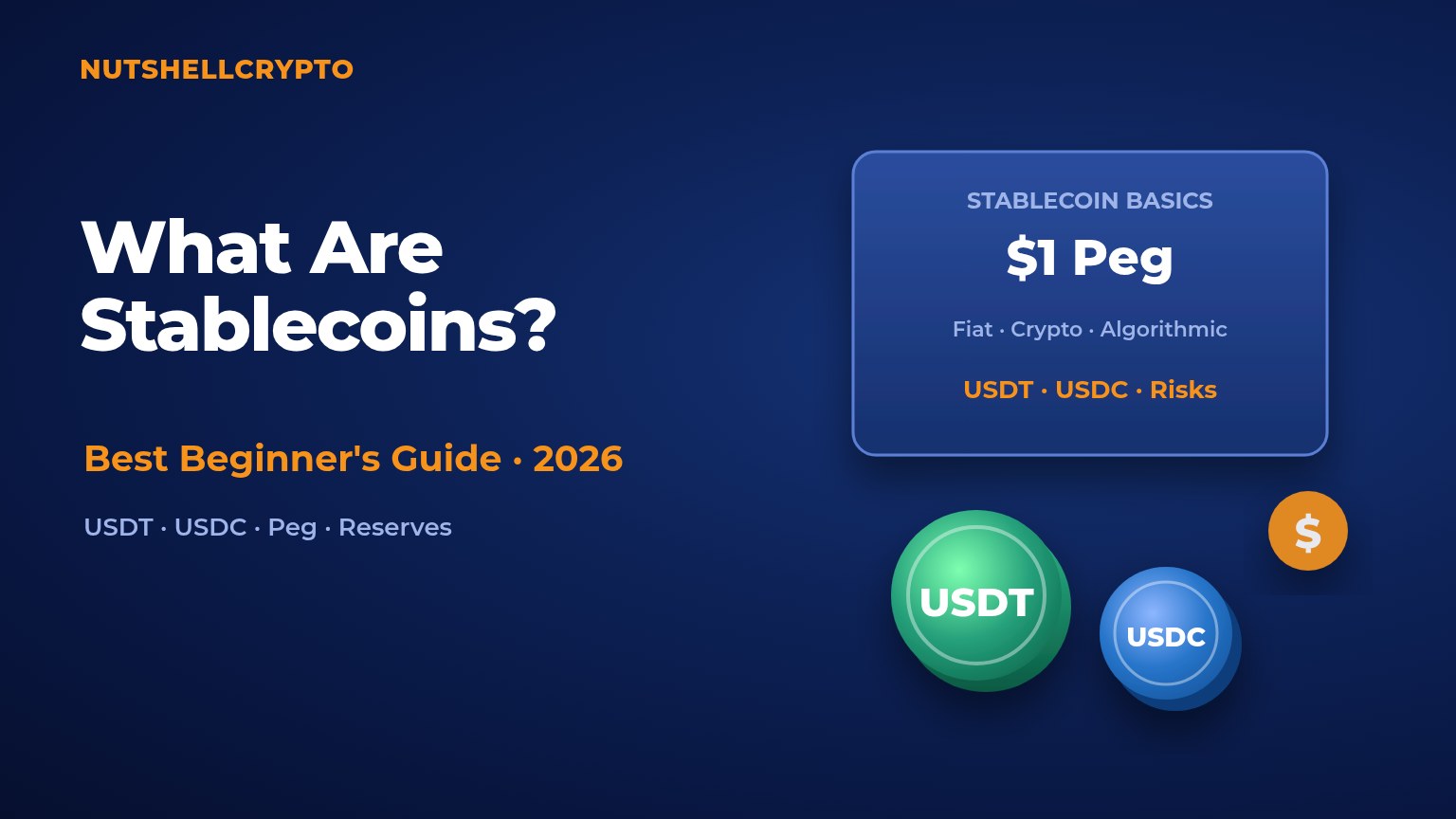
In a nutshell: What are stablecoins? They are cryptocurrencies designed to hold a steady value — usually $1 — by tracking a fiat currency such as the U.S. dollar. The two largest dollar coins, Tether (USDT) and USD Coin (USDC), dominate trading and transfers. This guide explains how pegs work, the main types (fiat-backed, crypto-backed, algorithmic), common uses, and the risks beginners should respect.
Last updated: November 3, 2026 (new: the current top 10 stablecoins by market cap, plus the US GENIUS Act). Issuers, reserves, networks, and rules can change; confirm details on official sources before you act.
If you have asked what are stablecoins, you are looking at the bridge between volatile crypto and everyday dollars. Bitcoin and Ethereum can swing several percent in a day. A well-designed dollar stablecoin aims to stay near $1 so people can trade, transfer, and park value on a blockchain without taking the same price risk. This beginner’s guide covers how that works, why USDT and USDC matter, what went wrong with TerraUSD (UST), and practical tips for first transfers. It is educational only — not personalized financial, tax, or investment advice. To see the biggest ones ranked, check our list of the largest stablecoins by market cap.
Table of contents
What Are Stablecoins?
What are stablecoins in one sentence? They are blockchain tokens built to track a reference asset — most often the U.S. dollar — so their market price stays close to a fixed target, usually $1.
Key ideas for beginners:
- Stable relative to crypto: Compared with Bitcoin or Ether, a dollar stablecoin is meant to move very little day to day. That does not mean zero risk (see depeg and issuer risks below).
- On-chain dollars: You can send them peer-to-peer on networks such as Ethereum, Tron, Solana, and others, often faster than a traditional bank wire.
- Issuer and reserves matter: For the largest coins, a company mints and redeems tokens and claims to hold matching reserves. Transparency and reserve quality differ by issuer.
- Not the same as a bank deposit: Holding a stablecoin is not the same as holding cash in an FDIC-insured bank account. Protections, redemption access, and legal status vary by product and jurisdiction.
According to CoinGecko’s stablecoin category, the sector as a whole sits in the hundreds of billions of dollars of market value, with Tether (USDT) and Circle’s USDC as the two largest dollar coins. DefiLlama’s stablecoin dashboard showed roughly $296 billion of stablecoins in circulation on November 3, 2026, and USDT plus USDC made up about 84% of that. Market-cap figures move daily — treat any number you see as approximate and check a live tracker.
If you are still building core crypto vocabulary, our guides on what Bitcoin is and what Ethereum is pair well with this overview.
Why People Use Stablecoins
People use stablecoins because they want crypto’s speed and global reach without holding a volatile asset every minute. Common motivations include:
- A parking spot between trades: Sell Bitcoin for USDT or USDC on an exchange, wait, then buy again later without converting fully back to bank dollars.
- Cross-border transfers: Send value internationally when traditional rails are slow or expensive (fees and compliance still apply).
- DeFi and on-chain apps: Provide liquidity, borrow, or settle smart-contract payments in a dollar unit.
- Dollar access where banking is hard: In some regions, dollar stablecoins are used as a practical way to hold USD-linked value — again with issuer and network risk.
None of those uses is risk-free. A stablecoin can trade below $1 in stress, an issuer can freeze certain addresses, and sending on the wrong network can lose funds.
How the Peg Works
A peg means the market price is engineered — and often defended — to stay near a target (for example, $1.00). For major fiat-backed coins, the core loop looks like this:
- Mint: Eligible customers (often institutions) deliver dollars to the issuer; the issuer creates new tokens.
- Redeem / burn: Eligible customers return tokens; the issuer destroys them and pays out dollars (subject to fees, minimums, and eligibility).
- Market trading: Most retail users buy and sell on exchanges. If the secondary market drifts away from $1, arbitrage and redemptions (where available) tend to pull the price back — when the system is working.
Circle describes USDC as fully backed by cash and cash-equivalent reserves and redeemable 1:1 for U.S. dollars for eligible parties. Tether similarly states that USD₮ tokens are pegged 1:1 and backed by reserves. Always read each issuer’s current transparency and terms pages; policies change.
Important nuance: buying USDT or USDC on a retail exchange usually means trading the exchange’s inventory, not minting with Circle or Tether. Direct redemption is often limited to large, verified customers and may carry minimums and fees.
3 Main Types of Stablecoins
When beginners ask what are stablecoins, the next question is usually “what backs them?” Three broad designs dominate the conversation.
1. Fiat-backed (most common)
The issuer holds dollars, short-term U.S. Treasuries, cash equivalents, or a similar reserve portfolio and issues tokens meant to match that value. USDT and USDC fall in this category. Reliability depends on reserve quality, custody, redemption access, and how honestly the issuer reports.
2. Crypto-backed (overcollateralized)
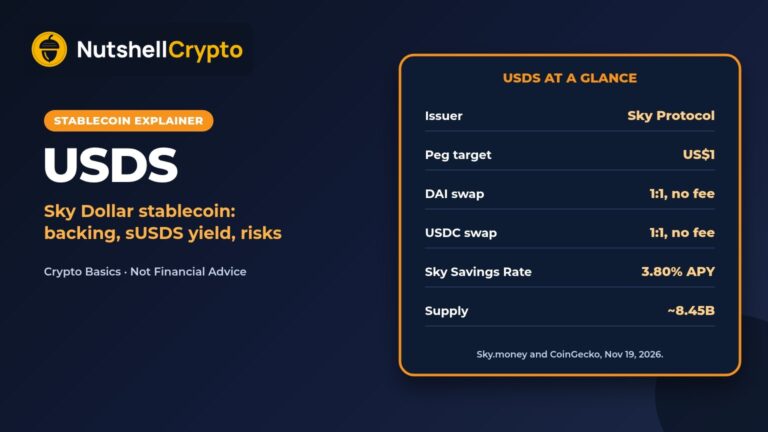
Smart contracts lock crypto collateral (for example Ether or other assets) and mint a stablecoin against it, usually requiring more collateral than the dollars issued. Designs vary. Users must understand liquidation risk: if collateral prices fall, positions can be closed automatically. Transparency is often on-chain, but volatility of the collateral is the central risk. A well-known example is USDS from Sky, the protocol formerly called MakerDAO; its SKY governance token can swing hard, as our news note on why is Sky dropping today shows.
3. Algorithmic (high caution)
Algorithmic designs try to keep a peg with mint/burn rules or companion tokens rather than full cash reserves. History shows this can fail violently. In May 2022, TerraUSD (UST) — an algorithmic stablecoin tied to the LUNA token — lost its dollar peg in a classic “death spiral.” As confidence cracked and redemptions surged, LUNA supply exploded and both assets collapsed. Contemporary explainers from outlets such as Bloomberg and analysis from the Richmond Fed document how the peg mechanism broke under stress.
Beginner takeaway: Prefer understanding fiat-backed majors first. Treat experimental or yield-heavy “stable” designs with extreme skepticism. High advertised yields are often a warning sign, not a free lunch.
Top Stablecoins by Market Cap (November 2026)
These are the ten largest stablecoins as of November 3, 2026, ranked by market cap on CoinGecko. All ten target $1. Figures are rounded and change daily as coins are minted and redeemed, and trackers can disagree (USDS in particular is counted differently from site to site). For the full ranking with chains, see our list of the largest stablecoins by market cap.
| Rank | Stablecoin | Issuer | Market cap (approx.) | How it holds the peg |
|---|---|---|---|---|
| 1 | Tether (USDT) | Tether | $178.9B | Fiat-backed |
| 2 | USD Coin (USDC) | Circle | $70.8B | Fiat-backed |
| 3 | Sky Dollar (USDS) | Sky (formerly MakerDAO) | $9.6B | Crypto-backed, plus real-world assets |
| 4 | Dai (DAI) | Sky (formerly MakerDAO) | $4.5B | Crypto-backed (overcollateralized) |
| 5 | Ethena USDe | Ethena Labs | $4.5B | Synthetic dollar (crypto collateral hedged with futures) |
| 6 | USD1 | World Liberty Financial | $3.8B | Fiat-backed |
| 7 | Global Dollar (USDG) | Paxos (Global Dollar Network) | $2.9B | Fiat-backed |
| 8 | PayPal USD (PYUSD) | Paxos, for PayPal | $2.7B | Fiat-backed |
| 9 | Ripple USD (RLUSD) | Ripple | $2.6B | Fiat-backed |
| 10 | Falcon USD (USDf) | Falcon Finance | $1.8B | Synthetic dollar (overcollateralized crypto) |
Three things stand out. First, USDT and USDC are still far ahead: no other coin is above $10 billion. Second, newer fiat-backed coins are growing from smaller bases. Our guides explain what PYUSD is and how PayPal’s stablecoin works and what RLUSD is and how Ripple USD works. Third, not every top-10 coin is cash-backed: Ethena’s USDe relies on hedged crypto positions, so its risks differ from a Treasury-backed coin. Our USDT vs USDC comparison covers the two leaders in detail. For the sixth-largest coin, see what USD1 is and how World Liberty’s stablecoin works.
US rule change: The GENIUS Act, a US federal law signed on July 18, 2025, sets a framework for “payment stablecoins” and requires them to be backed one-for-one by US dollars or other low-risk assets (Wikipedia summary; bill S. 1582 on Congress.gov). Coins with different designs, such as synthetic dollars, may be treated differently, so check an issuer’s own disclosures for how it says it complies.
USDT vs USDC: A Clear Comparison
USDT (Tether) and USDC (Circle) are the two names you will see most often. Both target $1. Both are centralized, fiat-referenced coins. Differences that matter for beginners:
| Topic | USDT (Tether) | USDC (Circle) |
|---|---|---|
| Issuer | Tether | Circle |
| Scale | Largest by market cap (about $179B on CoinGecko, Nov 3, 2026) | Second-largest dollar coin (about $71B on CoinGecko, Nov 3, 2026; Circle also publishes its own circulation figures) |
| Typical use | Deep liquidity on many global exchanges; common on Tron and Ethereum | Strong presence on regulated venues, DeFi, and multi-chain apps |
| Reserve style (high level) | Reports a diversified reserve mix (Treasuries and other assets); see Tether transparency | Emphasizes cash and short-term cash equivalents, including a BlackRock-managed government money market fund for much of the reserve |
| Reporting cadence | Regular transparency updates and attestations (check current schedule) | Monthly attestations highlighted by Circle; weekly/holdings disclosures often published |
There is no single “best” coin for everyone. Liquidity, supported networks, fees, and issuer transparency all matter. Market-cap figures drift daily — verify on CoinGecko or the issuer’s site. For a neutral category overview, see Wikipedia’s stablecoin article.
For a deeper side-by-side on reserves, audits, rules, depegs and supported chains, see our USDT vs USDC comparison.
Common Uses: Trading, Transfers, and DeFi
Trading pairs
Most crypto exchanges quote Bitcoin, Ether, and altcoins against USDT or USDC. Traders move in and out of those pairs without constantly wiring fiat. That is why stablecoin liquidity is so important to market structure.
Transfers and payments
Stablecoins can move 24/7 on public blockchains. Settlement speed depends on the network and fees. You still need the correct network, a compatible deposit address, and enough of the chain’s native gas token.
DeFi
DeFi apps often use dollar stablecoins for lending, liquidity pools, and settlement. Smart-contract bugs, oracle failures, and depegs can cause losses — start small and learn a protocol before committing meaningful funds.
If you are preparing to hold any crypto asset, review our crypto wallet beginner’s guide. If you are buying Bitcoin first and converting later, see how to buy Bitcoin.
Risks Beginners Should Know
Stablecoins reduce price volatility versus Bitcoin — they do not eliminate risk. Respect these categories:
- Depeg risk: The market price can trade below (or above) $1 during stress, liquidity gaps, or loss of confidence. Temporary wobbles of a fraction of a cent are common; larger breaks are rarer but historically real. Our guide to whether stablecoins are safe explains why depegs happen and how to judge a coin.
- Issuer and reserve risk: You depend on the issuer’s reserves, custody arrangements, and willingness/ability to redeem for eligible customers. Opaque or risky reserve assets raise the stakes.
- Freeze and compliance risk: Centralized issuers can blacklist or freeze addresses when required by law enforcement or their own policies. That is a feature of regulated compliance — and a custody trade-off versus purely decentralized assets.
- Smart-contract and protocol risk: On-chain apps that hold your stablecoins can be hacked or fail. Bridge hacks have also destroyed large amounts of value historically.
- Network / user-error risk: Sending USDT on Tron to an Ethereum-only address (or the reverse) is a classic way to lose funds. Always match network and token standard.
- Regulatory change: Rules for payment stablecoins, exchanges, and disclosures continue to evolve in the U.S. (see the GENIUS Act above), the EU, and elsewhere. Product availability can change by region.
Tax note for U.S. readers: converting crypto to crypto (including into a stablecoin) can be a taxable event depending on your situation. See our overview of crypto taxes in the US and confirm with a qualified tax professional. For how stablecoin swaps and interest are taxed, see our stablecoin taxes guide.
Practical Tips for Beginners
Lead with safety habits before chasing yield or exotic coins:
- Match the network: Confirm whether your exchange withdrawal and wallet deposit both use Ethereum (ERC-20), Tron (TRC-20), Solana, or another chain. Names like “USDT” exist on many networks; they are not interchangeable across chains without a bridge or conversion.
- Do a test send: Before moving a large amount, send a small amount and wait for confirmation.
- Keep a gas token: Ethereum needs ETH; Solana needs SOL; Tron typically needs TRX. Without gas, tokens can sit stuck.
- Prefer reputable venues: Use well-known exchanges and wallets, double-check URLs, and enable two-factor authentication.
- Read the label: “Stable” is marketing. Check whether the coin is fiat-backed, crypto-backed, or algorithmic — and who stands behind it.
- Avoid FOMO yield: Double-digit “risk-free” yields have preceded major failures (including UST). Understand where yield comes from.
- Recordkeeping: Save transaction IDs and dates for taxes and support.
FAQ
What are stablecoins used for most often?
Trading pairs on exchanges, moving dollar-linked value across borders or between wallets, and participating in DeFi apps that need a stable unit of account.
Are USDT and USDC the same?
Both target $1 and are widely used dollar stablecoins, but they have different issuers, reserve reporting styles, network footprints, and regulatory postures. For many retail trades they behave similarly; for large holdings, compare transparency and redemption access carefully.
Can a stablecoin go to zero?
Yes, in extreme cases — especially algorithmic designs without solid reserves, as TerraUSD (UST) showed in 2022. Major fiat-backed coins have also briefly depegged under stress. Past resilience is not a guarantee.
Is holding a stablecoin like holding cash in a bank?
No. Bank deposits (where insured) sit under a different legal and insurance framework. Stablecoins are crypto tokens with issuer, market, and operational risks.
Do I need Bitcoin knowledge first?
It helps. Understanding wallets, networks, and fees makes stablecoin transfers safer. Start with What Is Bitcoin? and What Is a Crypto Wallet? if those concepts are new.
Sources and Further Reading
- Tether official site — issuer overview for USD₮
- Circle USDC — issuer overview, reserves framing, and product FAQ
- CoinGecko — Stablecoins category — live market-cap rankings
- DefiLlama — Stablecoins — total stablecoin supply (Nov 3, 2026)
- Congress.gov — GENIUS Act (S. 1582) — US payment stablecoin law
- Wikipedia — GENIUS Act — summary and signing date
- Wikipedia — Stablecoin — category overview
- Bloomberg — Terra / UST explainer — algorithmic collapse context (2022)
- Richmond Fed — Why Stablecoins Fail: A Look at Terra
Not financial advice: This article is for general education about what are stablecoins and how popular dollar coins work. It is not a recommendation to buy, sell, hold, or use any token, protocol, or platform. Crypto assets can lose value, including stablecoins in stress events. Consider your own situation and consult qualified professionals for financial, tax, or legal advice.