In a nutshell: USDe is a dollar-pegged token from Ethena that its makers call a “synthetic dollar” rather than a classic stablecoin. Instead of holding cash in a bank, Ethena holds crypto and other assets and shorts an equal amount of futures, so price moves in the crypto are offset by the hedge. USDe itself pays nothing; you earn a variable reward only by staking it as sUSDe. Only approved, KYC-checked businesses can mint or redeem USDe directly, US users can’t mint at all, and the token briefly fell to $0.65 on Binance in October 2025. As of November 2, 2026, about 4.5 billion USDe are in circulation, according to CoinGecko.
Last updated: November 2, 2026.
USDe trades near $1 like USDT or USDC, but it is built in a very different way. There is no bank account full of dollars behind it. Its value comes from a hedged trading position that Ethena runs on crypto exchanges, which is why it can pay a yield and also why it carries risks that cash-backed stablecoins do not.
This guide covers how USDe holds its peg, what backs it today, how sUSDe rewards work, who can mint and redeem, how big it is, what happened during the October 2025 crash, and the main risks and tax points for readers in the US, Canada and Australia. New to the topic? Start with our explainer on what stablecoins are.
Table of contents
What Is USDe?
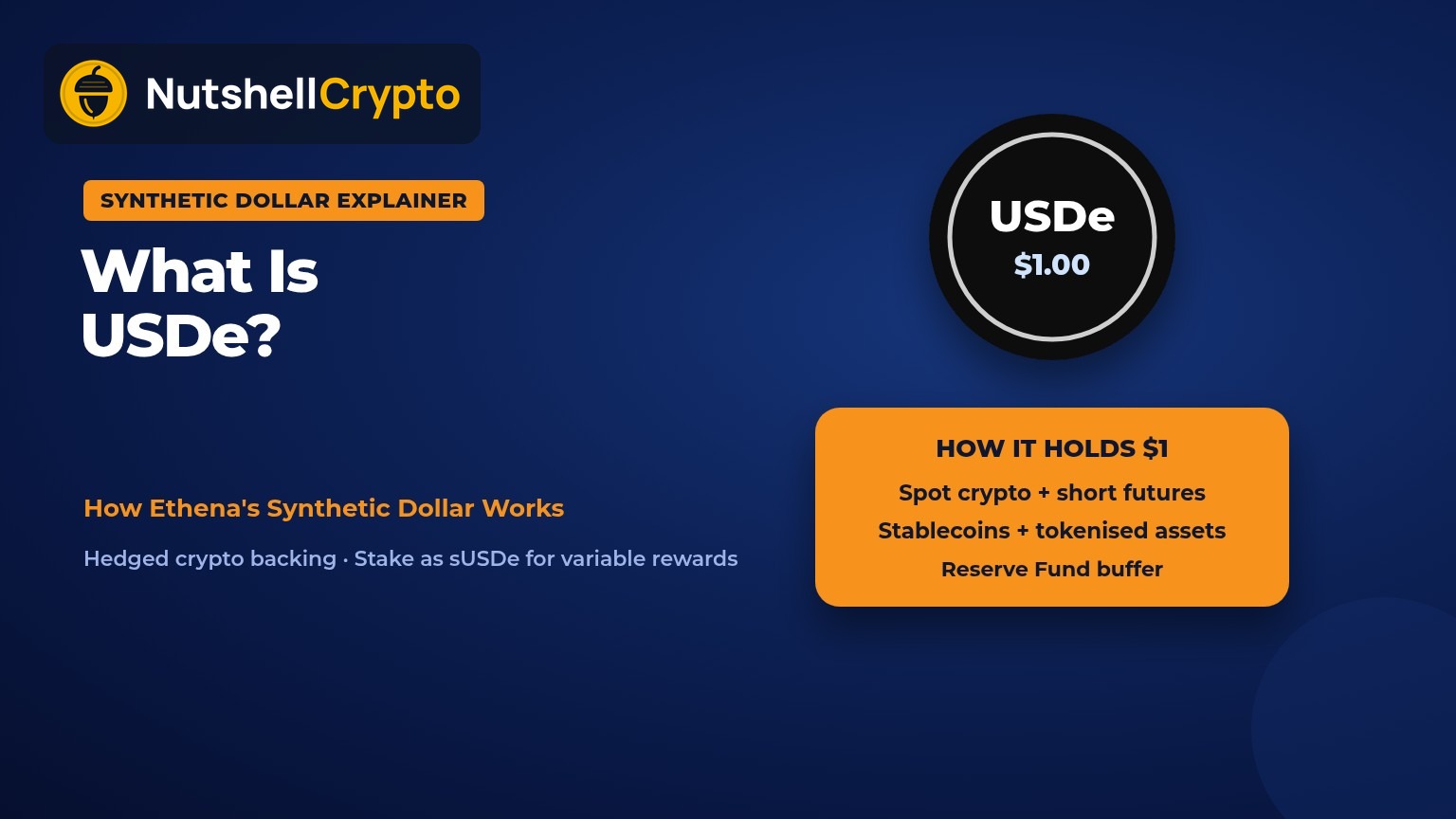
USDe is a token issued by Ethena that aims to stay worth about one US dollar. Ethena’s documentation describes it as “a crypto-native synthetic dollar utilizing spot assets as backing, onchain custody, and centralized liquidity venues” (Ethena docs). The legal counterparty for minting and redemption is Ethena (BVI) Limited, and its terms are governed by British Virgin Islands law (USDe terms).
Ethena was founded by Guy Young, and USDe opened to the public on February 19, 2024, after a closed beta (CoinDesk). In those first weeks the advertised reward on staked USDe was about 27% a year, which drew comparisons with Terra’s UST. Young’s answer at the time was that USDe’s yield comes from real, checkable sources (ETH staking and futures funding) rather than subsidies (Cointelegraph).
Ethena also has a separate governance token, ENA. ENA floats freely and is not pegged to anything, so don’t confuse it with USDe.
How USDe Keeps Its $1 Peg
The core idea is a “delta-neutral” position. When someone mints USDe with, say, $100 of USDT, Ethena puts the backing into its portfolio. Any volatile part of that portfolio, such as ETH or BTC, is paired with a short futures position of roughly the same size. If ETH falls 10%, the spot ETH loses value but the short futures position gains about the same amount, so the total stays close to $100 (Ethena docs).
Stable parts of the portfolio, like liquid stablecoins and short-term real-world assets, don’t need a hedge because they already hold a steady dollar value. Our guide to perpetual futures explains the contracts Ethena uses for the hedge.
The market price is held near $1 by arbitrage. Ethena’s docs give the example: if USDe trades at $0.95 on Curve, an approved minter can buy it there and redeem it with Ethena for $1 of USDT; if it trades above $1, they can mint new USDe and sell it. Ethena says about 0.50% of backing is usually kept as stablecoins inside the minting contract for instant redemptions, refilled from roughly 4% of backing held in stablecoins across custodians (Ethena docs).
What Backs USDe Today
For most of its life, USDe was backed mainly by spot crypto (including liquid staked ETH) hedged with short perpetual futures, plus a buffer of stablecoins. Ethena says it is now spreading the backing across more categories: basis trades on non-crypto markets such as commodities, DeFi lending, overcollateralised lending to institutions, tokenised real-world assets like short-term government debt, and liquid stablecoins. Its Risk Committee sets limits for each category, and the live mix is published on Ethena’s transparency dashboard (Ethena docs).
The backing assets are not left sitting on exchanges. Ethena uses “off-exchange settlement” custodians such as Copper and Ceffu, which hold the assets and lend the exchanges trading power without handing over custody. Copper settles profit and loss daily, and Ethena says that if an exchange failed, the funds are not expected to be stuck in its bankruptcy (Ethena docs; Ethena FAQ).
As of November 2, 2026, Ethena’s own transparency data showed about $4.58 billion of backing assets and a Reserve Fund of about $62.0 million (Ethena transparency). The Reserve Fund is meant to absorb periods when the hedge costs more than it earns. Ethena’s docs say the share of revenue sent to the Reserve Fund is currently 0%, so it is not growing from new revenue right now (Ethena docs).
What Is sUSDe and Where the Yield Comes From
Plain USDe earns nothing. To get rewards you stake it and receive sUSDe, a vault token whose value in USDe rises as Ethena deposits rewards. Ethena compares this to how Rocket Pool’s rETH works (Ethena docs; see our guide to Rocket Pool). You’ll get fewer sUSDe tokens than the USDe you put in, but each one is worth more USDe.
The money comes from the backing: staking rewards on staked ETH, the funding rate and futures basis earned by the short hedge, and interest on stablecoins and real-world assets (Ethena FAQ). When traders are heavily long, shorts get paid and rewards rise. When funding turns negative, Ethena says no rewards are paid and the Reserve Fund covers the cost, so sUSDe’s value should only rise or stay flat (Ethena docs).
Some current numbers, all as of November 2, 2026:
- 1 sUSDe was worth about 1.2562 USDe, read from the sUSDe contract on Ethereum (Etherscan).
- Ethena’s API showed a 30-day average sUSDe reward of about 4.82% and a 90-day average of about 4.68%, last updated October 28. Its average since launch was about 10.27% (Ethena app).
- About 915.7 million sUSDe were outstanding, holding roughly 1.15 billion USDe, so only about a quarter of USDe supply is staked.
- The unstaking cooldown in the contract was 86,400 seconds, or one day. You can also sell sUSDe on the open market if a buyer exists, but Ethena says it doesn’t guarantee such markets.
These rewards are variable and Ethena calls them “fully discretionary.” They are not interest and nobody promises them. Ethena also says sUSDe is not offered to people living in the EU or EEA (Ethena docs). For how rates like these are quoted, see our explainer on staking APR vs APY.
Who Can Mint and Redeem USDe
Minting and redeeming directly with Ethena is limited. Every address must be whitelisted after KYC and anti-money-laundering checks, and Ethena’s FAQ says US users can’t access the application (Ethena FAQ). The terms add that users in the United States are not eligible to become a Mint User, and that a holder who isn’t a Mint User has no right to redeem with Ethena (USDe terms).
Ethena BVI commits to redeem 1 USDe for its share of the reserves in supported digital assets, capped at $1 of value. That is a redemption into crypto assets such as stablecoins, not into dollars in a bank account. Ethena says it makes no profit on minting or redeeming, though slippage and execution costs are built into the price (Ethena docs).
Everyone else buys and sells USDe on the open market. Ethena’s docs name decentralised exchanges like Curve and Uniswap and centralised exchanges like Binance, OKX and Bybit (Ethena docs). Ethena can also block addresses it links to illegal activity, and blocked funds can be forfeited under its terms.
How Big Is USDe?
As of November 2, 2026, CoinGecko showed about 4.52 billion USDe in circulation, a market cap of about $4.51 billion and a price of $0.998, ranking it #23 among all crypto assets (CoinGecko). DefiLlama put circulation at about $4.53 billion, the fifth-largest stablecoin behind USDT, USDC, USDS and DAI (DefiLlama). See where it ranks in our list of the largest stablecoins.
USDe is much smaller than it was. DefiLlama’s history shows a peak of about $14.8 billion on October 4, 2025, and supply was about $4.89 billion a month ago. Most USDe is on Ethereum (about $2.5 billion), followed by Plasma, Base, Robinhood Chain and Solana, per DefiLlama.
The October 2025 Depeg on Binance
On October 10, 2025, during a crash in which more than $19 billion of crypto positions were liquidated in a day, USDe dropped to $0.65 on Binance before recovering (CoinDesk). Ethena said minting and redemption kept working the whole time.
The drop was mostly a Binance problem. Binance priced USDe collateral using only its own thin order book, and Ethena’s governance forum analysis says on-chain pools on Ethereum and Plasma stayed around $0.99 while USDe traded at $0.92 on Bybit and $0.65 on Binance. About $1.9 billion of USDe was redeemed over October 10 to 11, and the Reserve Fund wasn’t used (Ethena governance forum). Binance later compensated affected Futures, Margin and Loan users who held USDe, BNSOL or WBETH as collateral between 21:36 and 22:16 UTC (Binance).
The lesson is that a “$1” token can be worth much less on one venue for a short time, and that matters if you use it as collateral for leverage. Our guide to whether stablecoins are safe covers how depegs happen in general.
USDe vs USDT and USDC
| USDe | USDT / USDC | |
|---|---|---|
| What backs it | Crypto and other assets hedged with short futures, plus stablecoins and tokenised assets | Cash, Treasury bills and similar reserves |
| Yield to holders | Only if staked as sUSDe; variable | None paid by the issuer |
| Redeem directly | Whitelisted Mint Users, not US persons; paid in digital assets | Verified customers of Tether or Circle |
| Main extra risks | Negative funding, exchange and custodian failure, liquidation of the hedge | Bank and reserve-manager risk, issuer freezes |
For a deeper look at the two big cash-backed coins, read USDT vs USDC.
Regulation and Where USDe Is Available
European Union. In March 2025 Germany’s financial regulator BaFin ordered Ethena GmbH to stop offering USDe, citing serious shortcomings in its MiCA application. Ethena withdrew the application on April 3, 2025, and BaFin ordered the business wound down and fined it EUR 600,000. Holders could claim redemption from Ethena GmbH until August 6, 2025, after which claims go to Ethena (BVI) Limited (BaFin, April 2025; BaFin, June 2025).
United States. US users can’t mint or redeem with Ethena, as covered above. Holding or trading USDe through a third-party platform depends on that platform’s own rules.
Canada and Australia. Ethena’s docs don’t single out either country, but USDe is not issued by a Canadian- or Australian-regulated company, and availability depends on each exchange. In Australia, crypto exchanges must be registered with AUSTRAC before offering services, and since June 2026 you can check any provider on AUSTRAC’s public Virtual Asset Service Provider Register before you buy (AUSTRAC).
USDe Risks
- Negative funding. If shorts have to pay longs for a long time, the hedge loses money. The Reserve Fund (about $62 million as of November 2, 2026) is the first buffer, and it is small next to $4.5 billion of supply.
- Exchange and custodian risk. The hedge sits on centralised exchanges and the assets with off-exchange custodians. Ethena says this limits exchange failure risk, but it doesn’t remove it.
- Market price risk. As October 2025 showed, USDe can trade well below $1 on a single venue during a crash, which can trigger liquidations if you borrow against it.
- Redemption access. Most holders can’t redeem with Ethena and must sell on the market, which depends on liquidity.
- Regulatory risk. USDe has already been pushed out of the EU, and rules elsewhere can change.
- Smart contract risk. Ethena lists its audits in its docs, but audits don’t guarantee code is bug-free (Ethena audits).
USDe is not a bank deposit and has no FDIC, SIPC or similar protection, which Ethena’s terms say directly.
Is USDe Taxable?
Tax offices generally treat USDe like other crypto. In the US the IRS treats digital assets as property, so selling or swapping USDe can create a gain or loss (IRS). The CRA in Canada and the ATO in Australia take a similar approach to crypto assets (CRA; ATO). How the growing value of sUSDe is taxed isn’t spelled out in that guidance, so keep records and ask a tax professional. Our guide to stablecoin taxes covers the general rules for each country.
FAQ
Is USDe a stablecoin?
It’s designed to trade at $1, so it’s usually listed with stablecoins, but Ethena calls it a synthetic dollar because it is backed by a hedged crypto position rather than cash in a bank.
Is USDe the same as ENA?
No. ENA is Ethena’s governance token and its price moves freely. USDe aims to stay at $1.
Does USDe pay interest?
No. Only staked USDe (sUSDe) earns rewards, and those rewards are variable and discretionary.
Can I use USDe in the US?
US users can’t mint or redeem with Ethena and can’t use its app, according to Ethena’s FAQ and terms.
How long does it take to unstake sUSDe?
As of November 2, 2026, the sUSDe contract’s cooldown was one day.
Can USDe lose its peg?
Yes. It fell to $0.65 on Binance on October 10, 2025, though on-chain pools stayed close to $1 and it recovered the same day.
Sources
- Ethena docs: How USDe works
- Ethena docs: Backing assets overview
- Ethena docs: Reserve Fund
- Ethena docs: Rewards mechanism
- Ethena docs: Staking USDe
- Ethena docs: Minting USDe
- Ethena docs: Peg arbitrage mechanism
- Ethena docs: Backing asset custody
- Ethena docs: FAQ
- USDe Terms and Conditions (Aug 2025)
- Ethena docs: Audits
- Ethena transparency dashboard
- Etherscan: sUSDe contract
- CoinDesk: Ethena attracts $300M after public launch (Feb 20, 2024)
- Cointelegraph: Guy Young on USDe yield (Feb 2024)
- CoinDesk: USDe briefly loses peg (Oct 11, 2025)
- Ethena governance forum: USDe analysis, Oct 10-11 event
- Binance: Resolution of the USDE, BNSOL and WBETH price deviation
- BaFin: Winding-up of Ethena GmbH’s USDe business (Apr 2025)
- BaFin: Redemption process for USDe tokens (Jun 2025)
- CoinGecko: Ethena USDe
- DefiLlama: Ethena USDe
- AUSTRAC: Virtual asset service provider register goes public (Jun 30, 2026)
- IRS: Digital assets
- CRA: Guide for cryptocurrency users and tax professionals
- ATO: How to work out and report CGT on crypto
This article is for education only and is not financial, legal or tax advice. USDe’s backing, rewards and availability change often; check Ethena’s documentation and your platform’s terms for your country.