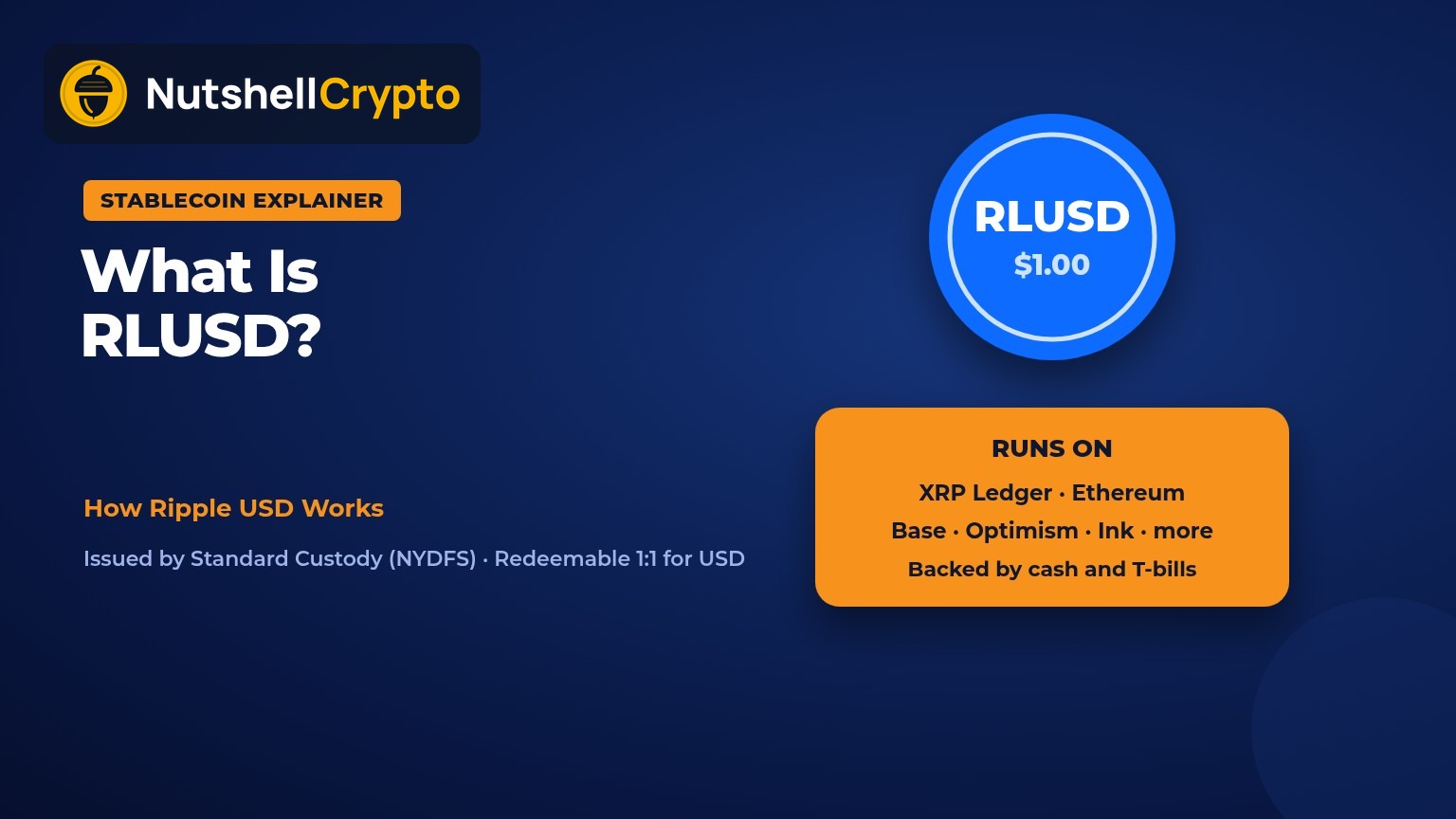
In a nutshell: RLUSD (Ripple USD) is a US dollar stablecoin from Ripple that launched in December 2024. It is issued by Standard Custody & Trust Company, a Ripple subsidiary chartered as a limited purpose trust company by the New York State Department of Financial Services (NYDFS). Each token is meant to be redeemable 1:1 for US dollars and is backed by cash, short-term US Treasuries and similar assets, with monthly attestations by an outside accounting firm. It runs natively on the XRP Ledger and Ethereum and has since spread to Ethereum Layer 2 networks. Direct minting and redemption are for approved businesses only; everyone else buys and sells RLUSD on exchanges. As of Oct 31, 2026, about 2.43 billion RLUSD are in circulation on CoinGecko.
Last updated: October 31, 2026.
Ripple is best known for XRP and its payments network, so its stablecoin often gets confused with XRP itself. RLUSD is something different: a digital dollar with a regulated issuer, a reserve held in US dollar assets, and a price that is supposed to stay at $1 rather than float with the market.
This guide covers who issues RLUSD and who supervises it, what backs it, which blockchains it runs on, how big it is today, how buying and redemption work, where you can get it (including Australia), and the main risks and tax points. New to the topic? Start with our explainer on what stablecoins are.
Table of contents
What Is RLUSD?
RLUSD is the ticker for Ripple USD. Ripple’s developer documentation describes it as a stablecoin “designed to maintain a constant value of one US dollar,” fully backed by a segregated reserve of cash and cash equivalents and redeemable 1:1 for US dollars (Ripple docs).
Ripple’s CEO Brad Garlinghouse announced final NYDFS approval on December 10, 2024 (CoinDesk), and the token went live on exchanges on December 17, 2024. The first listings were Uphold, Bitso, MoonPay, Archax and CoinMENA, with Bullish, Bitstamp, Mercado Bitcoin, Independent Reserve and Zero Hash named as coming next (Ripple press release).
Ripple pitches RLUSD mainly at institutions: payment companies, exchanges, market makers and treasury teams that want a regulated dollar token for cross-border payments, trading collateral and settlement (Ripple). Regular users can still hold it, but they usually get it through an exchange rather than from Ripple directly.
Who Issues RLUSD, and Who Regulates It
RLUSD is issued by Standard Custody & Trust Company, LLC (SCTC), a New York limited purpose trust company chartered by the NYDFS to engage in virtual currency business (Ripple transparency page). Ripple bought Standard Custody in 2024, before the launch (CoinDesk). Under that charter, Ripple says the stablecoin has to be backed 100% by highly liquid, short-term reserves, and SCTC must meet NYDFS rules on customer protection, reserves and redemption timelines. Ripple also says RLUSD has approval from the Dubai Financial Services Authority (DFSA) (Ripple FAQ).
A federal layer was added this month. On October 26, 2026, the US Office of the Comptroller of the Currency (OCC) gave final approval to charter Ripple National Trust Bank. Its approved activities include managing the segregated reserves behind RLUSD and acting as collateral trustee of those reserves for RLUSD holders. Ripple says RLUSD will continue to be issued by SCTC; the new bank adds OCC supervision on top of NYDFS oversight (Ripple press release; OCC Conditional Approval #1359). Compare that with PayPal’s coin, which is issued by an OCC-chartered Paxos bank; our PYUSD guide explains that setup.
What Backs RLUSD: Reserves and Attestations
According to Ripple’s documentation, the RLUSD reserve follows the NYDFS guidance on US dollar-backed stablecoins and is made up of (Ripple docs):
- US Treasury bills with three months or less left to maturity
- Government money market funds
- Overnight reverse repurchase agreements backed by Treasuries, with NYDFS-approved counterparties
- Cash deposits at US state or federally chartered banks
The reserves sit in segregated accounts, and Ripple says it picked BNY in July 2025 as the primary custodian of RLUSD reserves (Ripple FAQ).
Ripple publishes monthly attestation reports from an independent US-licensed CPA firm, which its docs name as Deloitte. They cover the amount of RLUSD in circulation and the make-up of the reserve, and are released no more than 30 days after month-end (Ripple transparency page). The same page showed $2,627.0 million of RLUSD in circulation against $2,758.6 million of reserve funds as of October 29, 2026, so reserves were above the tokens outstanding on that date. Keep in mind that an attestation checks balances at a point in time; it is not a full audit of the company.
Which Blockchains RLUSD Runs On
RLUSD started on two networks. On the XRP Ledger it is a native issued token, and on Ethereum it is an ERC-20 token (Ripple docs). In December 2025 Ripple began testing RLUSD on Optimism, Base, Ink and Unichain using Wormhole’s Native Token Transfers (NTT) standard, which lets Ripple keep native issuance and control of the token on each chain instead of relying on a wrapped version (Ripple). Wormhole announced the multichain rollout as live on June 4, 2026 (Wormhole).
As of Oct 31, 2026, Ripple’s developer docs list these networks for RLUSD (Ripple docs):
- XRP Ledger
- Ethereum
- Base
- Optimism
- Ink
- Unichain
- XRPL EVM sidechain
- Robinhood Chain
Ripple’s main product page still says “7 chains supported” and leaves Robinhood Chain out of its FAQ list, so the docs page appears to be the more recently updated of the two.
Two practical points. First, on the XRP Ledger your account needs a “trust line” to the RLUSD issuer before it can receive the token; Ripple’s docs say that takes at least 1.2 XRP held in reserve (1 XRP base reserve plus 0.2 XRP for the trust line) (Ripple docs). Second, the official issuer is rMxCKbEDwqr76QuheSUMdEGf4B9xJ8m5De on the XRP Ledger and the proxy contract is 0x8292Bb45bf1Ee4d140127049757C2E0fF06317eD on Ethereum (Ripple token addresses). Fake tokens can use the same name, so check the address before you accept or swap. Our stablecoin wallet guide covers picking a wallet that supports the right network.
How Big Is RLUSD?
As of Oct 31, 2026, about 9:55 PM PKT, CoinGecko showed about 2.43 billion RLUSD in circulation and a market cap of about $2.43 billion, with the price at $1.00 (CoinGecko). DefiLlama put circulating supply at about $2.42 billion, roughly flat from about $2.40 billion a month earlier, which made RLUSD the ninth-largest stablecoin on its list (DefiLlama).
Most of that supply is on Ethereum (about $1.71 billion on DefiLlama), with about $707 million on the XRP Ledger. The Layer 2 networks are still small: reading the token contract directly at the same time showed about 16 million RLUSD on Base and a few hundred tokens or fewer on each of the others. Ripple’s own transparency page showed a higher figure, $2.63 billion as of October 29, so expect small gaps between sources because of timing and what each one counts. For context, USDT and USDC were about $180 billion and $72 billion on DefiLlama. See the full ranking in our list of the largest stablecoins by market cap, or how the two leaders compare in USDT vs USDC.
How to Buy and Redeem RLUSD
There are two routes, and which one you use depends on who you are (Ripple docs):
- Institutions (direct): Ripple’s direct customers are limited to businesses that pass bank-level KYC and anti-money-laundering checks. They use the Ripple Mint platform to wire US dollars and have RLUSD minted to their wallet, or send RLUSD back and receive dollars (redemption burns the tokens). Ripple notes it has to wait for bank wires to clear before sending RLUSD.
- Everyone else (exchanges and on-ramps): retail users buy and sell RLUSD on exchanges and payment apps. Ripple’s availability page lists about 60 partners, including Kraken, Gemini, Binance, Bitstamp, Uphold, Revolut, MoonPay and Independent Reserve, and says the list is not an endorsement (Ripple availability).
Ripple’s user terms say each RLUSD can be redeemed by customers for one US dollar with Ripple, subject to the RLUSD Customer Agreement (RLUSD Stablecoin User Terms). In practice, if you are not a Ripple business customer, “redeeming” means selling RLUSD for dollars on an exchange, at whatever price and fee that platform offers.
Where RLUSD Is Available (US, Canada, Australia)
Ripple says availability depends on jurisdiction and lists partners by type rather than by country (Ripple availability). At launch, Ripple’s stablecoin lead said RLUSD would first reach the Americas, Asia-Pacific, the UK and the Middle East through partners (CoinDesk).
- United States: several US-facing platforms are on Ripple’s partner list, such as Kraken, Gemini and Uphold. Whether you can trade it still depends on the platform and, sometimes, your state.
- Canada: Ripple does not publish a Canada-specific list. Check whether the platform you use lists RLUSD for your province before sending funds.
- Australia: Independent Reserve, which is on Ripple’s partner list, offers RLUSD to Australian customers, with AUD deposits by bank transfer, PayPal or debit or credit card and trading on its order book (Independent Reserve). Because you buy with AUD, your cost in Australian dollars moves with the AUD/USD rate even though the token tracks the US dollar.
RLUSD vs XRP
They are separate assets. XRP is the native coin of the XRP Ledger and its price is set by the market; RLUSD is a dollar token issued against reserves and is meant to stay at $1 (Ripple FAQ). On the XRP Ledger, XRP is also what you pay network fees and account reserves in, so you need a little XRP to hold or move RLUSD there. Our guide to what XRP is covers the coin, and how the XRP Ledger works covers the network.
RLUSD Risks
- Issuer and reserve risk. RLUSD is only as good as SCTC’s reserves and its ability to honor redemptions. The reserves are attested monthly, but between reports you rely on the issuer and its regulators.
- Redemption access. Only approved business customers can redeem directly with Ripple. Retail holders depend on exchanges and their prices, which briefly ran well above $1 on some platforms right after launch (Fortune).
- Freezes and clawbacks. Ripple’s terms let it blacklist addresses and burn RLUSD when required by law or its compliance policies, and holders can lose the full balance (RLUSD User Terms). On the XRP Ledger, the issuer account has global freeze and trust line clawback enabled (Ripple GitHub).
- Cross-chain and smart contract risk. Moving RLUSD between networks relies on Wormhole’s messaging and Ripple’s contracts. Sending it on the wrong network, or to a wallet without an XRPL trust line, can fail or lose funds.
- Not a bank deposit. RLUSD is regulated as money transmission and is not designed to earn a return (RLUSD User Terms). Any yield you see offered on it comes from a third-party platform taking its own risk.
For a wider look at how stablecoins can fail, including past de-pegs, read are stablecoins safe?
Is RLUSD Taxable?
Buying and holding RLUSD is generally not a taxable event, but the US, Canada and Australia all treat stablecoins as crypto assets, not cash. Selling RLUSD, swapping it for another coin or spending it can be a disposal, and any rewards you earn on it are usually income. The IRS treats digital assets, stablecoins included, as property (IRS). The CRA says crypto dispositions can create income or capital gains (CRA). In Australia, the ATO treats crypto as a CGT asset, so converting AUD-bought RLUSD back to AUD can produce a small gain or loss when the exchange rate has moved (ATO). Our stablecoin taxes guide goes through these cases in more detail.
FAQ
Is RLUSD the same as XRP?
No. XRP is a floating-price coin; RLUSD is a dollar stablecoin issued by Ripple’s NYDFS-chartered trust company and backed by reserves.
Who backs RLUSD?
Standard Custody & Trust Company issues it and holds a segregated reserve of cash, short-term Treasuries, government money market funds and overnight repos, with BNY as primary custodian and monthly attestations.
Can I redeem RLUSD for dollars with Ripple?
Only if you are an approved business customer. Individuals usually sell RLUSD on an exchange instead.
Can I buy RLUSD in Australia?
Yes, Independent Reserve lists RLUSD for Australian customers with AUD funding. Check each platform’s terms before you buy.
Can RLUSD be frozen?
Yes. Ripple’s terms allow it to freeze addresses and burn RLUSD when the law or its compliance policies require it.
Sources
- Ripple: Ripple USD (RLUSD) and FAQ
- Ripple: RLUSD transparency reports
- Ripple: Where to find RLUSD
- Ripple: RLUSD Stablecoin User Terms
- Ripple docs: What is RLUSD?
- Ripple docs: RLUSD chains and networks
- Ripple docs: RLUSD token addresses
- Ripple docs: RLUSD on the XRP Ledger
- Ripple GitHub: RLUSD XRP Ledger settings
- Ripple: Ripple USD launches globally (Dec 16, 2024)
- Ripple: RLUSD expands to L2s with Wormhole NTT (Dec 16, 2025)
- Ripple: OCC grants final approval for Ripple National Trust Bank (Oct 26, 2026)
- OCC: Conditional Approval #1359 (Ripple National Trust Bank)
- Wormhole: RLUSD is now multichain (Jun 4, 2026)
- CoinDesk: RLUSD gets NYDFS approval (Dec 10, 2024)
- CoinDesk: Ripple to roll out RLUSD on Dec. 17
- Fortune: RLUSD launches on global exchanges
- Independent Reserve: Buy RLUSD in Australia
- CoinGecko: Ripple USD
- DefiLlama: Ripple USD
- IRS: Digital assets
- CRA: Guide for cryptocurrency users and tax professionals
- ATO: How to work out and report CGT on crypto
This article is for education only and is not financial, legal or tax advice. Stablecoin availability and rules change; check Ripple and your platform for the latest terms in your country.