In a nutshell: PYUSD (PayPal USD) is a US dollar stablecoin that PayPal launched in August 2023. It is issued by Paxos Trust Company, N.A., a national trust bank supervised by the US Office of the Comptroller of the Currency, and each token is meant to be redeemable 1:1 for US dollars, backed by dollar deposits, US Treasuries and similar cash equivalents. In the US you can buy, sell, send and hold PYUSD in PayPal and Venmo with no PayPal fee, and move it to outside wallets on networks such as Ethereum, Solana and Arbitrum. As of Oct 30, 2026, about 2.9 billion PYUSD are in circulation. PayPal does not list Canada or Australia among its PYUSD markets.
Last updated: October 30, 2026.
PayPal USD is the stablecoin of one of the world’s best-known payment companies, which is why it gets a lot of attention from people who have never touched crypto before. But PYUSD works like other fiat-backed stablecoins: a regulated company holds dollars and short-term US government debt, and issues tokens on public blockchains that are supposed to stay worth $1.
This guide explains who issues PYUSD and who regulates it, what backs it, which blockchains it runs on, how to buy and send it in PayPal and Venmo, where it is available (including what that means for Canada and Australia), how the PYUSD rewards program works, and the risks to know about. If stablecoins are new to you, start with our guide to what stablecoins are.
Table of contents
- What is PYUSD?
- Who issues PYUSD, and who regulates it
- What backs PYUSD: reserves and monthly reports
- Which blockchains PYUSD runs on
- How big is PYUSD?
- How to buy, sell and send PYUSD in PayPal and Venmo
- Where PYUSD is available (US, Canada, Australia)
- How PYUSD rewards work
- PYUSD and the US GENIUS Act
- PYUSD risks
- Is PYUSD taxable?
- FAQ
What Is PYUSD?
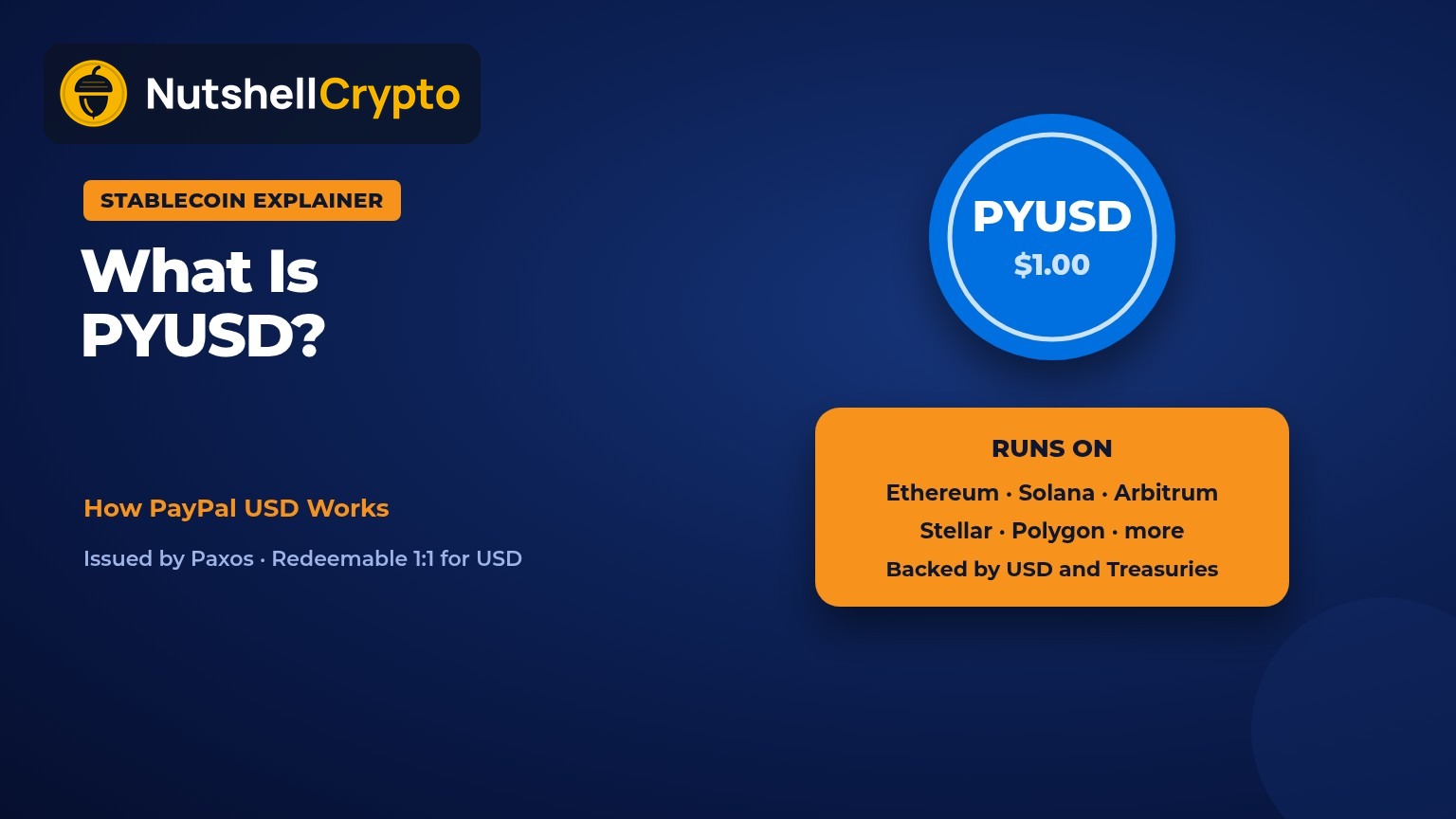
PYUSD is the ticker for PayPal USD, a stablecoin designed to keep a steady value of one US dollar. PayPal describes it as redeemable 1:1 for US dollars and backed by US dollar deposits, US Treasuries and similar cash equivalents (PayPal). In the PayPal app you can buy and sell 1 PYUSD for 1 USD.
PayPal announced PYUSD on August 7, 2023, presenting it as a stablecoin built for payments that eligible US customers could send, use at checkout and move to compatible external wallets (PayPal Newsroom). Although it carries PayPal’s name, PayPal does not issue the token. That job belongs to Paxos.
The key difference from coins like bitcoin or ether is that PYUSD is not meant to rise or fall in price. It is a digital dollar that moves on blockchains, so you can send it at any time of day, hold it in a self-custody wallet, or use it in crypto apps, while the issuer keeps matching dollar assets in reserve.
Who Issues PYUSD, and Who Regulates It
PYUSD is issued by Paxos Trust Company, N.A., and PayPal’s own disclosures say issuance and custody of PayPal USD are performed by Paxos (PayPal). Paxos also issues other stablecoins, including Global Dollar (USDG) and Pax Dollar (USDP).
Paxos used to be a New York limited-purpose trust company supervised by the New York State Department of Financial Services. The OCC conditionally approved its application to convert to a national trust bank, and Paxos completed the conversion on December 12, 2025 (OCC Conditional Approval #1358; Paxos licenses). Paxos now says the issuance of PYUSD and its reserves are subject to oversight by the OCC (Paxos).
PayPal’s role is distribution: it offers PYUSD to its users, runs the PayPal and Venmo wallets, and pays the rewards program. PayPal is clear that it is not a bank, that your crypto hub is not a deposit account, and that PYUSD is not a deposit and is not legal tender (PayPal). Crypto held in PayPal or Venmo is not eligible for FDIC insurance (Paxos).
What Backs PYUSD: Reserves and Monthly Reports
Paxos says PYUSD reserves are held 100% in US dollar deposits, US Treasuries and cash equivalents, so customer funds are available for 1:1 redemption with Paxos. It also says customer assets sit in segregated, bankruptcy-remote accounts, so they would not be used to pay Paxos’s debts if Paxos became insolvent (Paxos).
Paxos publishes two kinds of documents every month on its PYUSD transparency page:
- Paxos reserve reports: a self-reported breakdown of the reserve portfolio, released 5 business days after month-end. Paxos notes these are not independently reviewed.
- Attestation reports: examinations by an outside accounting firm. Reports from February 28, 2025 onward are issued by KPMG LLP; earlier ones were issued by WithumSmith+Brown.
An attestation is not the same as a full financial audit. It checks that reserves matched the tokens outstanding at a point in time. It is still one of the main tools you have to check what backs a stablecoin, and PayPal points users to these reports as well.
Which Blockchains PYUSD Runs On
PYUSD started on Ethereum as an ERC-20 token. PayPal added Solana on May 29, 2024, pitching it as a faster, cheaper option (PayPal Newsroom). Today Paxos lists seven blockchain networks for PYUSD (Paxos):
- Ethereum
- Solana
- Arbitrum
- Stellar
- Polygon
- X Layer
- Stable
Not every network is available everywhere you hold PYUSD. PayPal’s transfer help page says PYUSD can be sent to most Ethereum and Arbitrum addresses in wallets that support ERC-20 tokens and to most Solana addresses that support SPL tokens, and that you choose the network in a selector when you send or receive (PayPal Help). Venmo adds that some networks need extra information, such as a memo on Stellar, and that some networks may not be available in every region (Venmo Help).
The golden rule: the sender and receiver must use the same network. PYUSD sent over a network the receiving wallet doesn’t support can be lost for good. If you plan to move it out of PayPal, our stablecoin wallet guide covers how to pick a wallet that supports the right network.
How Big Is PYUSD?
As of Oct 30, 2026, CoinGecko shows about 2.90 billion PYUSD in circulation and a market cap of about $2.91 billion, with the price at $1.00 (CoinGecko). DefiLlama puts circulating supply at about $2.87 billion, up from about $2.72 billion a month earlier, which makes PYUSD the eighth-largest stablecoin on its list (DefiLlama).
By DefiLlama’s chain breakdown on the same day, most PYUSD sits on Ethereum (about $1.82 billion), followed by Solana (about $684 million) and Arbitrum (about $281 million), with smaller amounts on other networks. For comparison, USDT and USDC are far larger, at roughly $180 billion and $72 billion on DefiLlama. See our list of the largest stablecoins by market cap for the full ranking, or USDT vs USDC for how the two leaders differ.
How to Buy, Sell and Send PYUSD in PayPal and Venmo
In the US, PayPal’s steps are simple: sign in or create a PayPal account, complete identity verification, and opt in to crypto. You can then buy PYUSD in your PayPal wallet, send it to friends on or off PayPal, spend it where PayPal is accepted, or hold it (PayPal).
Key points from PayPal and Venmo’s own pages:
- Fees: PayPal charges no fees to buy, sell, hold or transfer PYUSD between eligible PayPal users. Venmo says there are no fees to buy, sell or hold PYUSD, or to send it to other Venmo and PayPal users (Venmo Help).
- Outside wallets: sending PYUSD to an external wallet costs a blockchain network fee, and crypto transfers cannot be cancelled or reversed (Venmo Help). PayPal also lists minimum transfer amounts by network, such as 10 PYUSD on Ethereum and 1 PYUSD on Solana or Arbitrum (PayPal Help).
- Limits: PayPal’s US crypto FAQ sets a maximum of $100,000 in crypto purchases per week and a weekly transfer limit of $25,000, with no annual purchase limit (PayPal Help).
- Venmo: crypto works only on personal Venmo profiles, and you need to verify your identity, including an SSN or ITIN (Venmo Help).
- Hawaii: buying, selling, transferring and holding crypto with PayPal and Venmo is not available in Hawaii (Paxos).
Outside PayPal, PYUSD is also listed on crypto exchanges and used in DeFi apps. Paxos itself offers minting and redemption for business customers. If you buy on an exchange, the price can drift a fraction of a cent from $1, while PayPal sells and buys at exactly 1 USD.
Where PYUSD Is Available (US, Canada, Australia)
For most of its life PYUSD was mainly a US product. On March 17, 2026, PayPal announced it was bringing PYUSD to PayPal accounts in 70 markets, starting with places such as Colombia, Costa Rica, the Dominican Republic, Peru, Singapore (business accounts only), the United Kingdom and the United States (PayPal Newsroom).
PayPal’s “Where is PYUSD available?” page lists what each market can do. The US gets the full set: buy, sell, send, receive, crypto transfers and rewards. The UK is listed as buy and sell only, Singapore as buy, sell, send and receive, and dozens of smaller markets in Latin America, Africa, Asia-Pacific and Europe have either full access or buy, send, receive and rewards without selling (PayPal Help).
Canada and Australia: neither country appears in PayPal’s PYUSD availability table as of Oct 30, 2026. PayPal tells users to check their PayPal app to see whether PYUSD is offered in their country. Until it shows up there, Canadians and Australians who want a dollar stablecoin usually use other coins on locally registered exchanges, which our stablecoins explainer covers. PYUSD is a public token, so it can still be sent to a self-custody wallet anywhere, but PayPal’s PYUSD features, including rewards, depend on your country.
How PYUSD Rewards Work
PayPal runs a loyalty program that pays rewards on PYUSD held in a PayPal account. As of Oct 30, 2026, PayPal’s PYUSD page advertises a 4% annual reward rate, and it stresses that the rate is variable and subject to change (PayPal). How it works, according to PayPal:
- Rewards are calculated on your average daily PYUSD balance and paid monthly in PYUSD.
- You must be signed up for crypto, opt in to rewards, and hold at least 1 PYUSD.
- You can opt out at any time; rewards already earned are paid on the next payment date.
- Rewards are not available in every market; PayPal’s March 2026 release said they were not offered to users in Singapore or the UK.
PayPal says it does not intend the program to be a securities offering, and that taking part is not an investment. The rewards are paid by PayPal, not generated by lending your coins out, which is different from the DeFi yields described in our stablecoin staking guide. Rewards are generally taxable income, which we cover below.
PYUSD and the US GENIUS Act
The GENIUS Act, signed into law in July 2025, creates a federal framework for payment stablecoins in the US (Congress.gov). On October 21, 2026, the OCC announced its final rule implementing the Act for issuers under its supervision, covering areas such as reserve backing, redemption and risk management. The OCC says the final rule and the GENIUS Act take effect on January 18, 2027 (OCC).
From that date, a company generally must be approved as a permitted payment stablecoin issuer to issue a payment stablecoin in the US. The OCC expects existing issuers to request waivers, which it can grant for up to 12 months to issuers with a substantially complete application pending (OCC Bulletin 2026-51). Because Paxos is already an OCC-chartered trust bank, PYUSD sits under the regulator that wrote these rules, but neither Paxos nor PayPal has published anything we could find about PYUSD’s specific approval status under the new regime.
PYUSD Risks
A regulated issuer and monthly attestations lower some risks, but they don’t remove them. Our guide to whether stablecoins are safe goes deeper; here are the points specific to PYUSD.
- Depeg risk. PYUSD’s $1 value depends on Paxos holding enough liquid reserves and honoring redemptions. On exchanges, the market price can move slightly above or below $1, especially in thin markets or during stress.
- Issuer and operational risk. On October 15, 2025, Paxos mistakenly minted $300 trillion of PYUSD on Ethereum during an internal transfer and burned the excess about 20 minutes later. Paxos said it was an internal technical error, not a security breach, and that customer funds were safe (CNBC; Decrypt). No one lost money, but it showed how much depends on the issuer’s internal controls.
- Freezes and seizures. Paxos’s terms say it may freeze use of PYUSD, temporarily or permanently, when required by law, such as a court order or a formal directive from a regulator or law enforcement, and that this applies to every holder, not just Paxos customers (Paxos terms). PYUSD is not censorship-resistant the way bitcoin is.
- Platform risk. PYUSD held in PayPal or Venmo is not a bank deposit and is not FDIC-insured. Access also depends on your account standing and on PayPal’s country rules.
- Transfer mistakes. Sending PYUSD on the wrong network, or to a wallet that doesn’t support it, can mean the funds are lost.
- Rewards can change. PayPal sets the reward rate at its discretion; the current 4% is not guaranteed.
Is PYUSD Taxable?
Holding PYUSD is not a taxable event by itself, but the tax authorities in the US, Canada and Australia all treat stablecoins as crypto assets rather than cash. That means selling PYUSD, swapping it for another coin or spending it can be a disposal, and PYUSD rewards are usually income. In Australia, the ATO treats crypto as a CGT asset (ATO); the IRS treats digital assets, including stablecoins, as property (IRS). Our stablecoin taxes guide walks through the details, including small peg gains and exchange-rate effects.
FAQ
Is PYUSD the same as having dollars in PayPal?
No. A PayPal USD balance is a crypto asset issued by Paxos and held in your PayPal crypto hub. PayPal says it is not a deposit and is not FDIC-insured, though you can sell it for US dollars 1:1 in PayPal.
Who backs PYUSD?
Paxos Trust Company, N.A. issues PYUSD and holds the reserves, which Paxos says are 100% in US dollar deposits, US Treasuries and cash equivalents, with monthly reserve reports and KPMG attestations.
Can I use PYUSD in Canada or Australia?
PayPal’s PYUSD availability list does not include Canada or Australia as of Oct 30, 2026. The token can be held in a self-custody wallet, but PayPal’s buying, selling and rewards features depend on your country.
Which network is cheapest for sending PYUSD?
PayPal pitched Solana as the faster, lower-cost option when it added it in 2024. Network fees change all the time, so check the fee shown before you confirm, and make sure the receiver uses the same network.
Can PYUSD be frozen?
Yes. Paxos’s terms allow it to freeze PYUSD when required by law, for example after a court order or a formal directive from a regulator or law enforcement.
Sources
- PayPal: PayPal USD (PYUSD)
- PayPal Help: Where is PYUSD available?
- PayPal Help: How do I transfer my crypto?
- PayPal Help: Crypto buying FAQs
- PayPal Newsroom: PayPal Launches U.S. Dollar Stablecoin (Aug 7, 2023)
- PayPal Newsroom: PYUSD on Solana (May 29, 2024)
- PayPal Newsroom: PayPal Brings PayPal USD to Users Across 70 Markets (Mar 17, 2026)
- Venmo Help: Understanding PayPal USD
- Venmo Help: Crypto Transfers
- Venmo Help: Cryptocurrency FAQ
- Paxos: PayPal USD
- Paxos: PayPal USD attestations and reserve reports
- Paxos: Licenses
- Paxos: Illegal Activity terms
- OCC: Conditional Approval #1358 (Paxos)
- OCC: Final rule to implement the GENIUS Act (Oct 21, 2026)
- OCC Bulletin 2026-51: GENIUS Act waivers and applications
- Congress.gov: S.1582, GENIUS Act
- CoinGecko: PayPal USD
- DefiLlama: PayPal USD
- CNBC: PayPal’s crypto partner mints 300 trillion stablecoins in “technical error”
- Decrypt: Paxos mints, then burns $300 trillion in PayPal stablecoins
- IRS: Digital assets
- ATO: How to work out and report CGT on crypto
This article is for education only and is not financial, legal or tax advice. Stablecoin availability, rewards and rules change; check PayPal, Venmo or Paxos for the latest terms in your country.